Most coaches and course creators try Meta ads the same way, and fail the same way. They build a webinar or a video sales letter, point cold Facebook traffic straight at it, and wait for enrolments that never come. The leads are expensive, the show-up rate is dismal, and almost nobody buys.
The ads are not the problem. The sequence is. Asking a stranger who has known you for eight seconds to give up an hour for your webinar — or worse, to buy a £2,000 program from a VSL — is, as the sharpest operators in this space put it, proposing on the first date. It is the single most common and most expensive mistake in this entire category.
This guide builds the funnel that actually fills programs: the warm-up principle that turns strangers into buyers, how to choose between a lead magnet, webinar, challenge, or VSL funnel based on your offer, the multi-funnel system that removes the single point of failure, the funnel-stage metrics that show you exactly where you are leaking money, and how to qualify high-ticket buyers before they ever reach a call — all within the complete Meta Ads framework.
The Warm-Up Principle: Why Cold Traffic to a VSL Fails
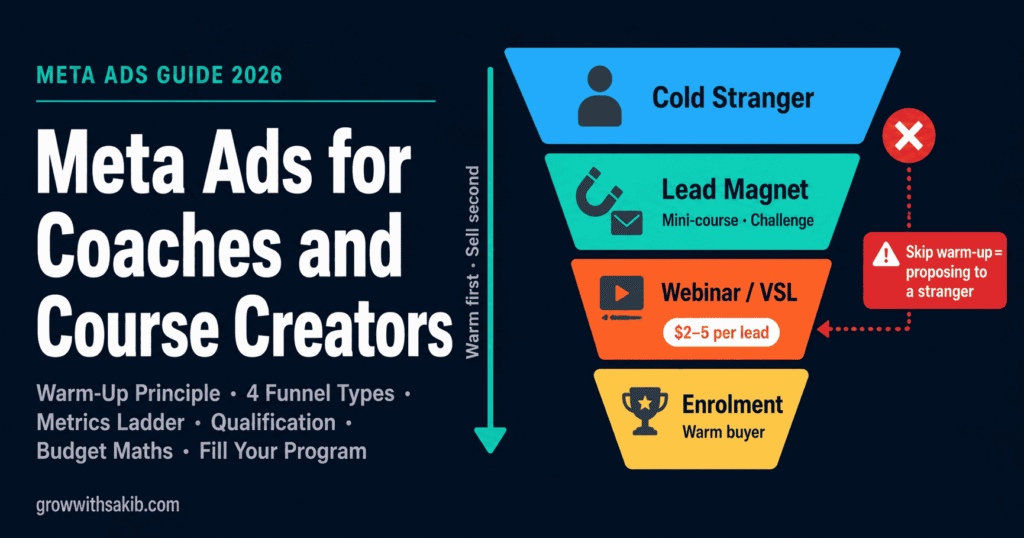
The foundational concept in coaching and course advertising is this: a Meta ad reaches a cold stranger, and strangers do not buy high-ticket programs or even give up an hour for a webinar on first contact. The funnel’s entire job is to warm that stranger into someone who knows, likes, and trusts you before you ask for anything significant.
The ‘proposing to a stranger’ problem
As Radical Marketing’s coach blueprint frames it memorably, sending Meta cold traffic straight to a VSL is the ‘proposing to a stranger’ approach — awkward, expensive, and it almost never works. A video sales letter asks for a buying decision; a cold viewer has no reason yet to trust the person making the pitch. The mismatch between the ask and the relationship is why these funnels burn money.
The fix is to insert a warm-up step. As Radical Marketing documents, a real 5-7 day mini email course as the lead magnet — not a static PDF — builds trust before the prospect ever sees a sales message, pulling in leads at $2-5 instead of $15-20, and by the time they reach the webinar they already know, like, and trust you.
Why warming up lowers cost AND raises conversion
This is the rare lever that improves both sides of the equation. A low-friction free offer (a guide, a mini-course, a challenge) converts cold traffic to leads far more cheaply than a high-friction webinar registration or VSL. And because those leads then experience your teaching before the pitch, a much higher percentage convert when the sales message finally comes. You pay less per lead and close more of them.
Choosing Your Funnel: Lead Magnet, Webinar, Challenge, or VSL
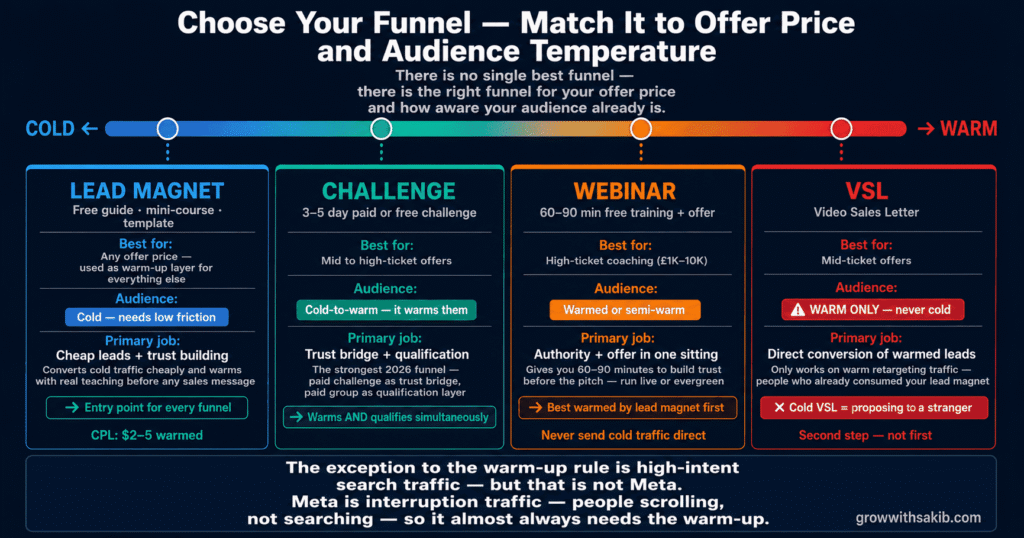
There is no single best funnel — there is the right funnel for your offer price and how aware your audience is. Matching the funnel to the offer is the second decision after committing to the warm-up principle.
The four core funnels
- Lead magnet funnel: a free guide, mini-course, or template captures leads cheaply, then an email sequence nurtures toward an offer. Best for lower-priced courses and list-building, and as the warm-up layer for everything else.
- Webinar funnel: a free 60-90 minute training teaches, builds authority, and makes an offer. As ClickFunnels notes, webinars work for high-ticket coaching because they give you 60-90 minutes to build authority and make an offer — run live or evergreen.
- Challenge funnel: a paid or free multi-day challenge (e.g. a 3-5 day mini-challenge) acts as a trust bridge. As Communipass documents, the strongest 2026 coaching funnels use a paid challenge as the trust bridge and a paid group as the qualification layer for the high-ticket sale.
- VSL funnel: a video sales letter sells directly — but, critically, to warm retargeting traffic only, never cold. Best as the second step for people who consumed your lead magnet but did not buy.
| Funnel | Best For Offer Price | Audience Temperature | Primary Job |
| Lead magnet | Any (warm-up layer) | Cold | Cheap leads + trust building |
| Webinar | High-ticket (£1K-10K) | Warmed or semi-warm | Authority + offer in one sitting |
| Challenge | Mid to high-ticket | Cold-to-warm (it warms them) | Trust bridge + qualification |
| VSL | Mid-ticket | Warm retargeting ONLY | Direct conversion of warmed leads |
The Multi-Funnel System: Removing the Single Point of Failure
Most coaches run one funnel, and when the webinar does not convert, they assume the whole approach is broken. Usually it is not the webinar — it is the fragility of relying on a single path. The strongest operators run several funnels that reinforce each other.
As Radical Marketing describes it, relying on one funnel is like having one friend group — if it falls apart, your social life is over. Their best clients run multiple funnels simultaneously: a mini-course as a lead magnet that warms cold traffic, a VSL funnel for warm retargeting of people who went through the mini-course but did not book a call, and monthly webinars for fence-sitters who need a live event to commit.
How the funnels reinforce each other
- Lead magnet / mini-course (cold entry). Converts cold Meta traffic cheaply and warms them with real teaching. Everyone enters here.
- VSL retargeting (warm conversion). People who consumed the mini-course but did not buy get retargeted with a VSL — another conversion attempt at zero extra cold-traffic spend, via a Meta retargeting campaign targeting video viewers and email lead custom audiences.
- Webinar for fence-sitters (live push). A recurring monthly webinar gives the not-yet-convinced a live, higher-trust event to finally commit.
- Application / call (high-ticket close). For high-ticket offers, warmed prospects apply and book a call — qualified before they ever speak to you.
The key efficiency: only the lead magnet spends on cold traffic. Every other funnel runs on warm audiences you already paid to acquire once — the same compounding logic that makes retargeting the most efficient spend in any account. One cold acquisition, multiple conversion attempts.
The Funnel-Stage Metrics That Show Where You’re Leaking
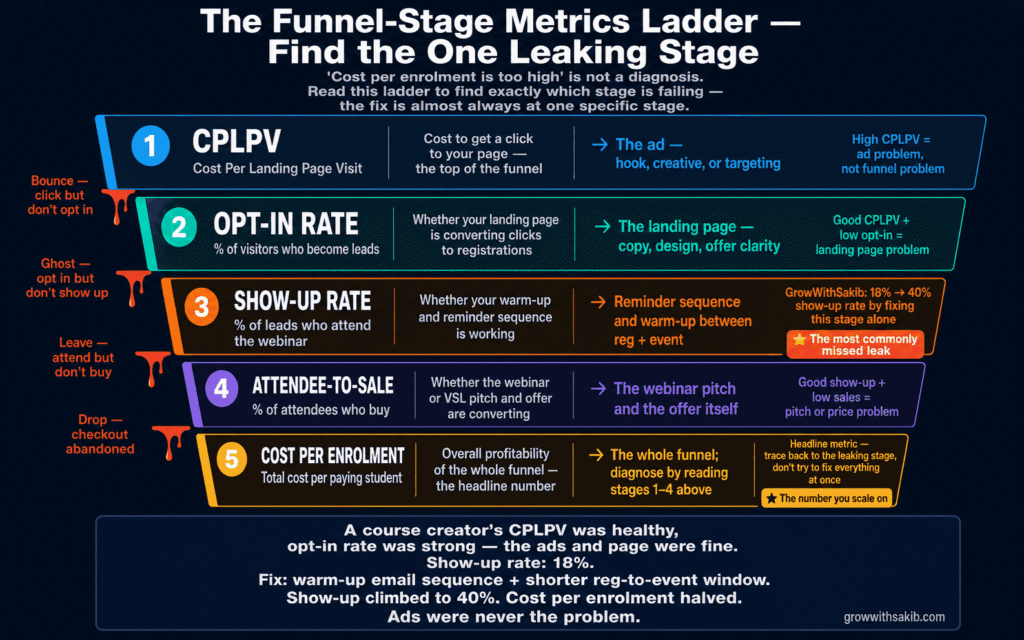
When a coaching funnel underperforms, ‘cost per lead is too high’ is rarely a useful diagnosis. The funnel has stages, each with its own metric, and the leak is almost always at one specific stage. Reading the full ladder tells you exactly what to fix.
The metrics ladder
As Percoyo’s coaching-funnel breakdown lays out, you track the journey stage by stage: cost per landing page visit (CPLPV), opt-in rate (visitors who became leads), show-up rate (leads who attended the webinar), and conversion rate (attendees who became customers). Each metric isolates a different possible failure.
| Stage Metric | What It Measures | If It’s Bad, Fix… |
| CPLPV (cost per LP visit) | Cost to get a click to your page | The ad — creative, hook, or targeting |
| Opt-in rate | % of visitors who become leads | The landing page — copy, design, offer clarity |
| Show-up rate | % of leads who attend the webinar | The reminder sequence and the warm-up |
| Attendee-to-sale | % of attendees who buy | The webinar/VSL pitch and the offer itself |
| Cost per enrolment | Total cost per paying student | The whole funnel; the headline profitability number |
Optimise for enrolment, not opt-ins, once you have volume
Early on, you optimise campaigns for leads because that is the only signal with enough volume. As AdStellar advises, set up three conversion events — lead capture, initiate checkout, and purchase — so that once you have enough purchase volume, you can optimise for enrolments rather than opt-ins. This tells Meta to find buyers, not just form-fillers, the same shift from quantity to quality that defines mature
Targeting and Creative for Coaches: You Are the Ad
Coaching and course advertising has a distinctive truth: the person is the product. People buy a transformation from someone they believe can deliver it, which makes the creator’s presence and story the single most important creative element.
Targeting: broad plus creative-as-qualifier
Like the rest of the 2026 platform, coaching targeting works best broad, with the creative doing the qualifying. Build lookalike audiences from your buyer list and warm custom audiences from engagers and video viewers, but let the ad itself call out the right person — ‘For service-based founders stuck under £10k months’ filters better than any interest stack. This is the same creative-as-targeting reality that governs the whole cluster.
Story ads and the founder’s face
The highest-performing coaching creative is the creator talking directly to camera, telling a story — their own transformation, a student’s result, or the core insight behind their method. As with authentic UGC creative, a real person speaking honestly outperforms polished production because trust is the thing being sold. The founder’s face and voice are not optional in this niche; they are the asset.
Lead with transformation, prove with specifics
Coaching ad copy should lead with the transformation the student wants and prove it with specifics — a concrete result, a named timeframe, a real student story. Vague promises (‘change your life’) convert worse than specific ones (‘book 5 discovery calls in 30 days’). Use video formats — short vertical for the hook, longer for the story — and test relentlessly, since creative is the biggest lever you have.
Qualification: Filling a Program With the Right People
For high-ticket coaching especially, filling your program is not about maximising leads — it is about filling it with people who can afford it, are ready for it, and will succeed in it. Qualification is a deliberate funnel layer, not an afterthought.
Qualify before the call, not on it
The most common high-ticket time-sink is sales calls with unqualified prospects. As ClickFunnels advises, qualification saves more time than any other part of the system — use an application, not just a calendar link, and let your email sequence set expectations about price and commitment so the wrong people filter themselves out before booking. If you only work with clients ready to invest a certain amount, say so early.
The qualification layers
- The offer itself: a higher price point and a clear commitment requirement naturally filter for serious buyers.
- The email sequence: setting expectations about investment and commitment lets the wrong people opt out before they cost you a call.
- The application: a short form before the calendar — budget, timeline, fit questions — surfaces who is genuinely ready. The same logic as qualifying questions on a lead form.
- The paid challenge or group: as Communipass documents, a paid challenge or group acts as the highest-qualification layer — someone who has paid even a small amount to join is dramatically more likely to be a serious buyer for the high-ticket offer that follows.
Tracking and Budget: Knowing Your Numbers Before You Scale
Coaches and course creators often scale on feel and get burned. Because the funnel has several steps between ad and sale, you need clean tracking and a budget grounded in your real economics before you spend aggressively.
The three-event tracking setup
As AdStellar documents, set up three critical conversion events: lead capture (fires on opt-in), initiate checkout (fires when someone starts enrolling), and purchase (fires on completed enrolment). Verify each with the Meta Pixel Helper, and run Conversions API alongside the pixel — without server-side tracking you lose a quarter or more of your conversion data, which for a multi-step funnel is fatal to optimisation.
Budgeting from your real economics
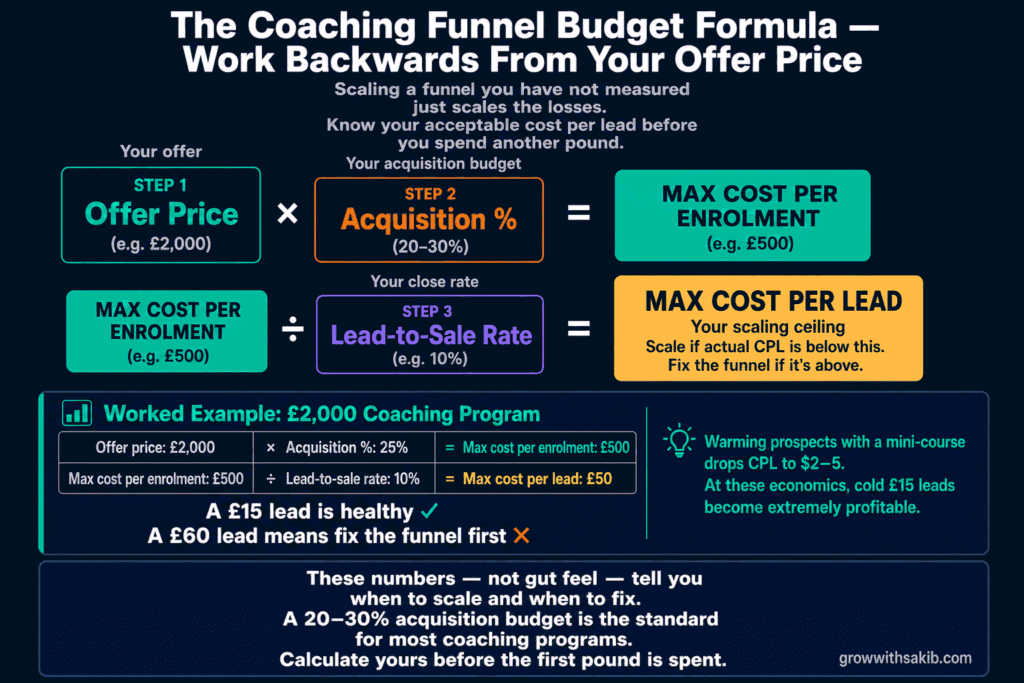
As The Digital Exchange’s budget framework lays out, most course creators and coaches can profitably allow 20-30% of their offer price for acquisition. Work backwards: if your course sells for £500 and you allow 25%, your acceptable cost per enrolment is £125. If 1 in 10 leads buys, your acceptable cost per lead is £12.50. Knowing this number before you scale is what separates profitable scaling from burning money chasing volume — the same principle covered in the Meta Ads Guide budget framework.
6 Coaching & Course Ad Mistakes That Drain Budget
Mistake 1: Sending cold traffic to a VSL or webinar
The cardinal error — proposing to a stranger. Cold Meta traffic has no reason to trust you yet, so a direct sales asset converts terribly and expensively. Insert a warm-up step (lead magnet, mini-course, or challenge) before any sales message. Warm first, sell second.
Mistake 2: Running one funnel with a single point of failure
Relying on one webinar or one VSL means one broken link sinks everything. Run a multi-funnel system — lead magnet for cold entry, VSL retargeting for warm conversion, webinars for fence-sitters — so no single failure stops enrolments.
Mistake 3: Diagnosing ‘high CPL’ instead of the leaking stage
A high cost per enrolment is a symptom, not a diagnosis. Read the metrics ladder — CPLPV, opt-in rate, show-up rate, attendee-to-sale — to find the one stage that is leaking. The fix is usually at a single stage, not everywhere.
Mistake 4: Optimising for cheap leads, not enrolments
A flood of £3 opt-ins that never buy is worse than fewer qualified leads that enrol. Once you have volume, optimise for purchase events, not opt-ins, and qualify high-ticket buyers with applications. Measure cost per enrolment, not cost per lead.
Mistake 5: Hiding the creator behind polished branding
In coaching, the person is the product, and people buy trust in a human. Faceless, over-produced brand ads underperform the creator talking honestly to camera. Put your face, voice, and story in the ad creative — test different hooks and delivery styles rather than different brand treatments.
Mistake 6: Scaling before knowing the funnel maths
Scaling a funnel you have not measured just scales the losses. Know your acceptable cost per lead and per enrolment from your real economics first. Then scale what the numbers prove works, using the same disciplined cadence as any campaign.
Frequently Asked Questions
Do Meta ads work for coaches and course creators?
Yes — they are one of the most effective channels for filling coaching programs and courses, but only when used to feed a warm-up funnel rather than sell directly. As Radical Marketing documents, sending cold Meta traffic straight to a VSL or webinar is ‘proposing to a stranger.’ Warm prospects first with a lead magnet, mini-course, or challenge, then sell to the warmed audience — this drops cost per lead and raises conversion.
What funnel should a course creator use?
Match the funnel to your offer price. A lead magnet funnel suits lower-priced courses and warms cold traffic for everything else. A webinar funnel fits high-ticket coaching. A challenge funnel acts as a trust bridge and qualifier. A VSL works only on warm retargeting traffic. As Communipass notes, the strongest 2026 funnels use a paid challenge as the trust bridge and a paid group as the qualification layer for high-ticket sales.
Should I send cold traffic to a webinar?
Generally no — not without a warm-up. Cold traffic to a webinar registration produces expensive leads and poor show-up rates. As Radical Marketing advises, warm prospects first with a free mini-course or challenge so that by the time they reach the webinar they already know and trust you. The exception is high-intent search traffic (Google), which is problem-aware — but Meta is interruption traffic and needs warming.
What is a good cost per lead for coaching ads?
It depends entirely on your offer economics, not a universal benchmark. As The Digital Exchange explains, allow 20-30% of your offer price for acquisition, then work backwards through your lead-to-sale rate. A £2,000 program at 25% acquisition and a 10% lead-to-sale rate supports about £50 per lead. Warming traffic with a mini-course can bring CPL down to £2-5 versus £15-20 cold.
Why don’t my coaching leads convert?
Usually one of three reasons: you sent cold traffic to a sales asset without warming it, your leads are cheap but unqualified, or a specific funnel stage is leaking. Read the metrics ladder — opt-in rate, show-up rate, attendee-to-sale — to find the leak. Often the ads are fine and the problem is the show-up sequence or an unwarmed cold ask.
How do I fill a high-ticket coaching program with Meta ads?
Warm cold traffic with a lead magnet or challenge, nurture toward a webinar or application, and qualify before the call. As ClickFunnels advises, use an application rather than just a calendar link, and let your email sequence set price and commitment expectations so the wrong people self-filter. Measure cost per qualified application and per enrolment, not raw cost per lead.
What creative works best for coaching ads?
The creator talking directly to camera, telling a story — their own transformation, a student result, or the insight behind their method. As with authentic UGC, a real person speaking honestly outperforms polished production because trust is what is being sold. Lead with a specific transformation and prove it with a concrete result, avoiding hyperbolic income guarantees that risk account restriction.
Key Takeaways
- Warm before you sell. Cold Meta traffic to a webinar or VSL is ‘proposing to a stranger.’ A free lead magnet, mini-course, or challenge warms prospects first — dropping cost per lead from $15-20 to $2-5 and raising conversion.
- Match the funnel to the offer. Lead magnets for low-ticket and warm-up, webinars for high-ticket authority, challenges as trust bridges, and VSLs for warm retargeting only — never cold.
- Run a multi-funnel system. One funnel is a single point of failure. Lead magnet for cold entry, VSL retargeting for warm conversion, and webinars for fence-sitters reinforce each other — only the lead magnet pays for cold traffic.
- Diagnose the leaking stage, not ‘high CPL.’ Read the metrics ladder — CPLPV, opt-in rate, show-up rate, attendee-to-sale — to find the one stage that is failing. The fix is usually at a single stage.
- Optimise for enrolments once you have volume. Set up lead, initiate-checkout, and purchase events so you can tell Meta to find buyers, not just form-fillers.
- Qualify high-ticket buyers in the funnel. Use applications over calendar links and let the email sequence set price expectations so the wrong people self-filter. Match qualification intensity to your price.
- You are the ad. In coaching, the person is the product. The creator talking honestly to camera outperforms polished branding, because trust is what is being sold.
- Know your funnel maths before scaling. Offer price × acquisition % = max cost per enrolment; ÷ lead-to-sale rate = max cost per lead. Scale on the numbers, not on feel.