‘Is my ROAS good?’ is one of the most-asked questions in Meta advertising, and almost every answer you’ll find gives you the wrong thing: an industry average. The problem is that an average ROAS tells you almost nothing about whether your specific campaigns are making money.
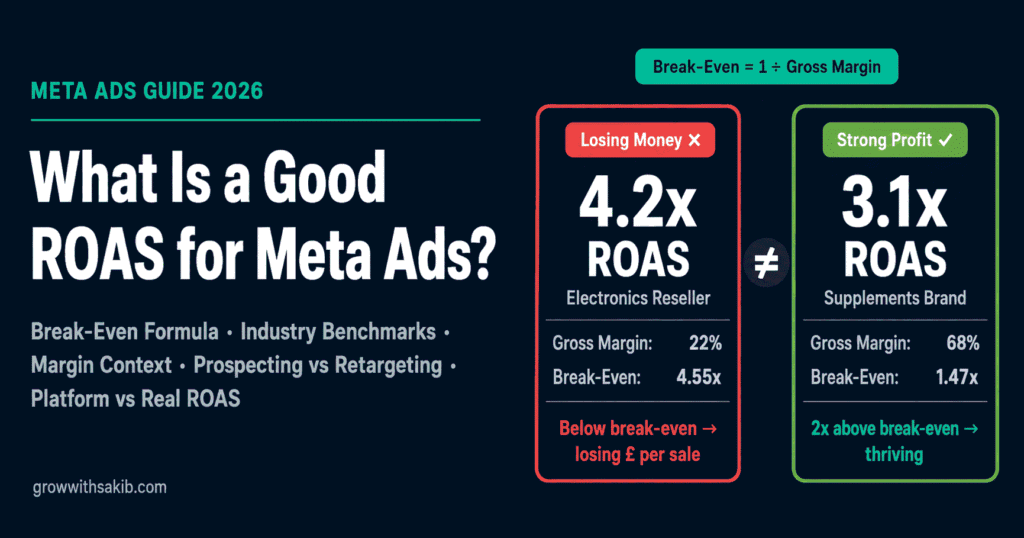
Here’s the uncomfortable truth. A 4x ROAS can be bleeding you dry, and a 2x ROAS can be highly profitable. It depends entirely on your margins — and that’s the part the benchmark articles skip. Chasing someone else’s ‘good’ number is how profitable accounts get killed and unprofitable ones get scaled.
This guide gives you the real 2026 benchmarks by industry, because you genuinely want them — all within the complete Meta Ads framework that puts ROAS in its proper strategic context. But it frames them as what they are — a directional read — and then teaches you the one calculation that actually answers the question for your business: your break-even ROAS, and the target you should set above it.
ROAS, Quickly: What the Number Actually Means
ROAS — return on ad spend — is the revenue generated for every unit of currency spent on advertising. It’s the most widely used efficiency metric in paid media, and the formula is simple: ad revenue divided by ad spend.
That simplicity is exactly the trap. ROAS measures revenue, not profit. It says nothing about what it cost you to make and ship the product, which is why two businesses with an identical ROAS can have completely opposite financial outcomes. To know whether a ROAS is good, you have to bring margin into the picture — which is what the rest of this guide does.
The 2026 Meta Ads ROAS Benchmarks by Industry
Here are the current benchmarks advertisers are searching for. Treat them as a directional read — a way to sense whether you’re roughly in the right range — not as a target to chase. The real target comes later, from your own margins.
The headline averages
As WebFX reports, Facebook ads average a ROAS of about 2.79x in 2026, with 3-5x considered healthy for most industries and below 2x suggesting campaigns may not be profitable after ad costs. AdAmigo’s 2026 data puts the average range at 2.79x to 3.61x, varying significantly by industry — see the Meta Ads cost guide for how CPM and CPA benchmarks by industry connect to these ROAS figures. And Visible Factors notes a median ROAS across industries of 1.93x — a reminder that the median advertiser sits below the often-quoted averages.
By industry and niche
| Category | Typical 2026 ROAS | Note |
|---|---|---|
| E-commerce (average) | 2.79x – 2.87x | The broad ecommerce midpoint; varies hugely by niche |
| Beauty & Personal Care | ~1.57x | Lower average despite popularity — high competition |
| Baby Products | ~4.39x+ | Among the standout high performers |
| High-margin (art, jewellery, supplements) | Higher end (4x–6x) | High margins support and show strong ROAS |
| Low-margin (electronics, commodities) | Higher reported, lower real profit | High break-even eats the headline number |
| Retail / Travel / Tech (lead-style) | Lower | Audiences less likely to convert via lead forms |
As the Ad Profit Calculator’s analysis summarises, typical reported ecommerce ROAS in 2026 falls between 3x and 6x, with high-margin products (supplements, beauty, fashion) toward the higher end and low-margin products (electronics, commodities) showing higher reported ROAS but lower real profit because their break-even is also higher. That last point is the whole game — and the next section explains it.
The Only Benchmark That Matters: Your Break-Even ROAS
Forget the industry averages for a moment. The single most important number for your business is your break-even ROAS — the point at which an ad-driven sale neither makes nor loses money. It’s specific to your margins, and it beats any benchmark on the internet.
The formula
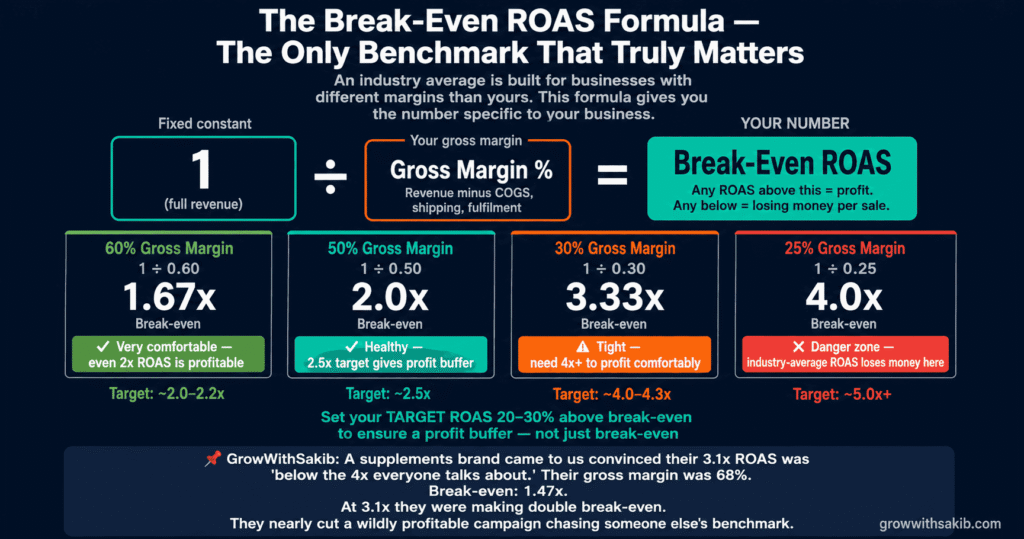
As AdAmigo sets out, break-even ROAS = 1 ÷ gross margin percentage. Your gross margin is what’s left of revenue after cost of goods, shipping, and fulfilment. The lower your margin, the higher the ROAS you need just to stand still.
As Hawky explains, if your gross margin is 50%, you need at least 2:1 ROAS to cover ad spend — anything above is profit from paid acquisition, anything below means you lose money on every ad-driven sale. This single number is more useful than any industry average, because it’s specific to your business, not someone else’s.
Set your target above break-even
Break-even keeps the lights on; it doesn’t grow the business. As Hawky advises, calculate your break-even first, then set your target ROAS with a profit buffer — typically 20-30% above break-even. So a 50% margin business (2.0x break-even) might target around 2.5x; a 30% margin business (3.33x break-even) might target 4x or more — and the Meta Ads learning phase is where accounts need sufficient budget to generate the 50 weekly conversions that let the algorithm optimise toward those targets. That buffer is your actual profit margin on ad-driven revenue.
Why a High ROAS Can Lose Money (and a Low One Can Profit)
This is the core misunderstanding that the break-even formula resolves, and it’s worth stating plainly because it overturns how most people read their dashboard. ROAS without margin context is not just incomplete — it can point you in exactly the wrong direction.
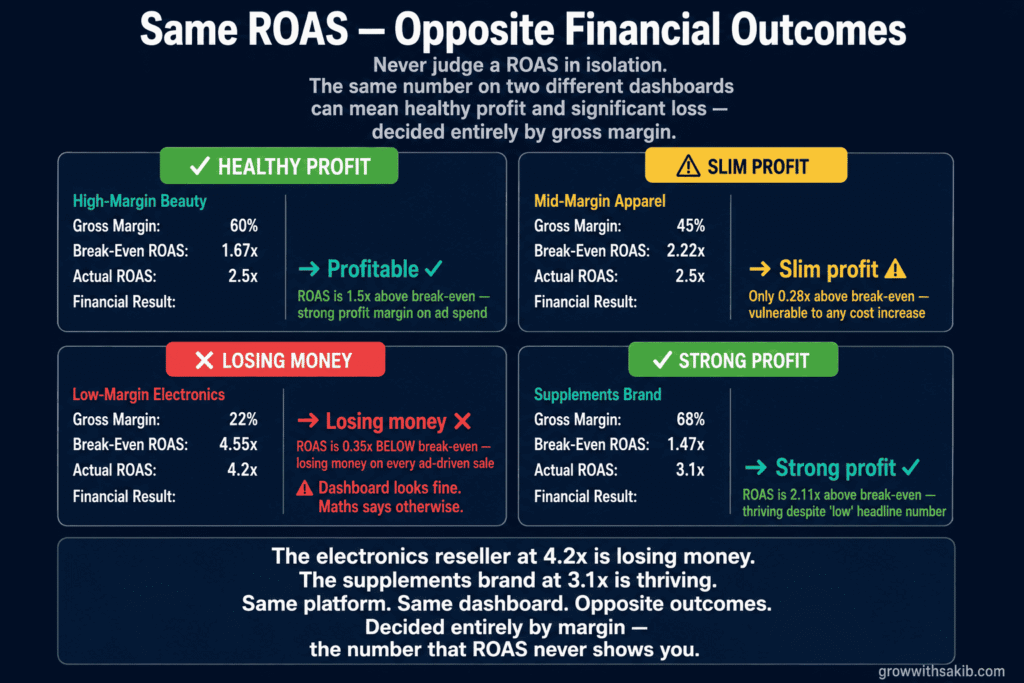
As Hawky puts it, the same ‘average’ ROAS of 2.87x is great for a high-margin beauty brand and dangerous for a low-margin electronics reseller. The number on your screen is identical; the financial reality is opposite. A high ROAS on thin margins can still lose money once you subtract the real cost of goods, while a modest ROAS on fat margins prints profit.
| Scenario | Margin | Break-Even | ROAS | Result |
|---|---|---|---|---|
| High-margin beauty | 60% | 1.67x | 2.5x | Healthy profit |
| Mid-margin apparel | 45% | 2.22x | 2.5x | Slim profit |
| Low-margin electronics | 22% | 4.55x | 4.2x | Losing money |
| Supplements | 68% | 1.47x | 3.1x | Strong profit |
Platform ROAS vs Real ROAS: Which Number to Trust
Even once you know your target, there’s a second problem: the ROAS Meta reports is not the same as the ROAS your bank account experiences. Knowing the gap between them is what separates advertisers who scale confidently from those who scale into losses.
Why platform ROAS overstates
Meta’s reported ROAS tends to overstate your true return, for the reasons covered in our attribution guide: it claims credit for conversions that organic, email, or direct would have driven anyway, and iOS privacy changes have made attribution noisier. As AdAmigo notes, privacy changes have impacted attribution accuracy, though tools like the Conversions API can recover 20-40% of lost data. The number in Ads Manager is a directional signal, not gospel.
The three-number cross-check
As the Ad Profit Calculator recommends, cross-reference quarterly: compare Meta-reported revenue to GA4 Meta-attributed revenue to actual store revenue from Meta sources. The ratio between these three numbers tells you how much to trust your Ads Manager ROAS as an absolute benchmark versus a directional signal.
- Meta-reported ROAS: the most generous; what Ads Manager claims.
- GA4 (analytics) attributed: usually lower; a more conservative, last-click-leaning view.
- Actual store revenue from Meta: the truth, cross-checked against real orders and self-reported ‘how did you hear about us.’
If Meta claims a 4x ROAS but your blended store maths says ad-driven revenue is closer to a 2.5x return, that gap is your reality check — run a full Meta ads account audit to identify whether the gap is tracking, attribution, or structural. Set your scaling decisions on the conservative, cross-checked figure — not the platform’s optimistic one.
Prospecting vs Retargeting: Don’t Blend the Two
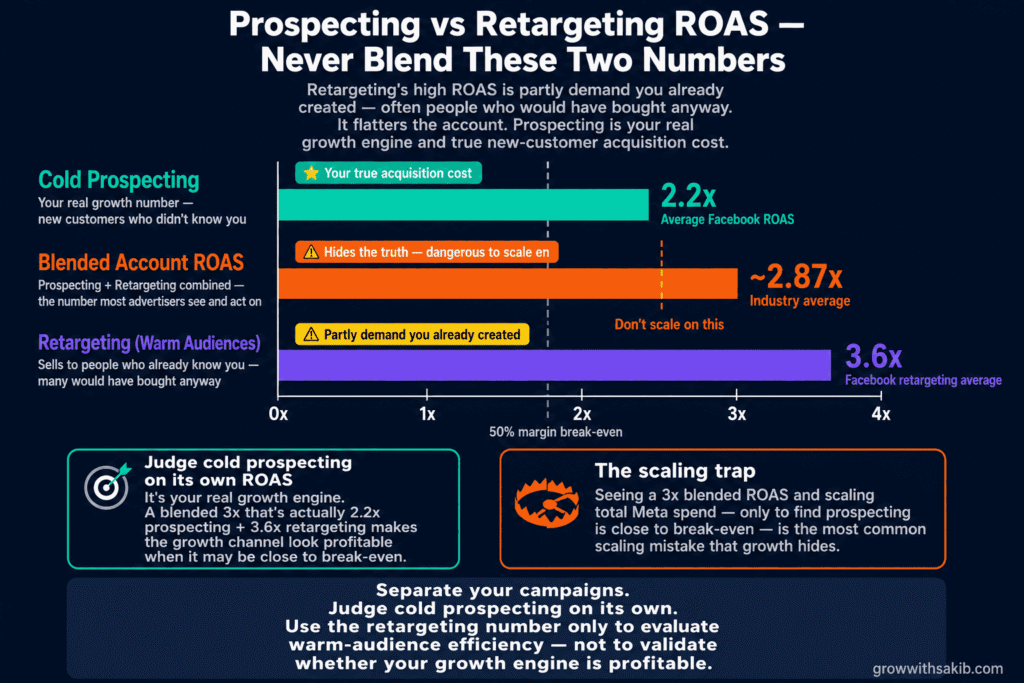
One blended account ROAS hides a crucial split. Retargeting almost always shows a far higher ROAS than prospecting — and treating the blended number as your performance can badly mislead your scaling decisions.
As Hawky’s ecommerce data shows, the average Facebook ROAS runs around 2.2:1 for prospecting campaigns and 3.6:1 for retargeting. Retargeting looks better because it sells to people who already know you — many of whom would have bought anyway. That flattering number is partly demand you already created, not new growth.
The implication: judge cold prospecting on its own ROAS, because that’s your real growth engine and your true cost of acquiring a new customer. A blended 3x that’s really 2.2x prospecting plus 3.6x retargeting can tempt you to scale, when the prospecting that actually drives growth is much closer to break-even than the headline suggests. Separate them, and weigh the incrementality the way our retargeting guide describes.
When to Graduate From ROAS to Blended MER
As your account matures, ROAS alone — even break-even-adjusted, cross-checked ROAS — stops being enough. The metric serious operators graduate to is blended MER, and knowing when to make the switch matters.
Blended MER (Marketing Efficiency Ratio) is total revenue divided by total ad spend across everything — every channel, every campaign, including SEO for small business organic investment that does not appear in Ads Manager but contributes to total revenue. It sidesteps the attribution wars entirely by measuring whether your whole marketing engine is profitable, not whether Meta can claim a given sale. As covered in our attribution guide and scaling guide, MER is the anchor metric mature accounts scale on.
Use ROAS when… use MER when…
| Use Campaign ROAS When | Use Blended MER When |
|---|---|
| Optimising individual campaigns | Judging overall profitability |
| Comparing creative or audiences | Making scaling decisions |
| Early-stage, single-channel | Multi-channel or mature account |
| Diagnosing a specific ad set | Reporting to stakeholders on profit |
The progression is natural: start by getting individual campaigns above their break-even ROAS, then, as you add channels and scale, shift your headline judgement to blended MER while still using ROAS to optimise at the campaign level. ROAS becomes a tactical metric; MER becomes the strategic one.
6 ROAS Mistakes That Cost Advertisers Money
Mistake 1: Chasing an industry benchmark instead of your break-even
The most expensive mistake. An industry average is built for businesses with different margins than yours. Calculate your break-even ROAS (1 ÷ gross margin) and target above it — that number, not a benchmark, tells you if you’re profitable.
Mistake 2: Judging ROAS without margin context
A 4x ROAS can lose money on thin margins; a 2x can profit on fat ones. Never read a ROAS in isolation. The same dashboard number means opposite things for a 22% reseller and a 60% beauty brand.
Mistake 3: Trusting platform ROAS as absolute truth
Meta overstates ROAS by over-claiming credit and is noisier post-iOS. Cross-check Meta-reported against GA4 and actual store revenue, and make scaling decisions on the conservative figure, not Ads Manager’s optimistic one — the same structured period-over-period approach used when tracking SEO results monthly.
Mistake 4: Blending prospecting and retargeting ROAS
Retargeting’s high ROAS (3.6x) flatters a blended number and hides that your prospecting (2.2x) — your real growth engine — is closer to break-even. Judge cold prospecting on its own ROAS.
Mistake 5: Comparing mismatched attribution windows
A 7-day-click ROAS isn’t comparable to a 1-day-click ROAS — the wider window claims more conversions. Match attribution settings before comparing to benchmarks or your own history, or you’ll misread a window difference as performance.
Mistake 6: Never graduating to MER
At scale, campaign ROAS can’t tell you if the whole business is profitable — the Meta Ads Guide covers how mature accounts structure campaigns and measurement together. Mature, multi-channel accounts judge on blended.
Frequently Asked Questions
What is a good ROAS for Meta ads?
Generally 3x to 5x for most businesses, with the 2026 cross-industry average around 2.79x, per WebFX. But the only benchmark that truly matters is your break-even ROAS (1 ÷ gross margin). A high-margin brand profits at 2x; a low-margin reseller may lose money at 4x. Calculate your break-even first, then target 20-30% above it for profit.
What is the average ROAS for Facebook ads in 2026?
Around 2.79x across industries, per WebFX, with AdAmigo citing a 2.79x-3.61x range and Visible Factors a median of 1.93x — meaning many advertisers sit below the quoted averages. E-commerce averages roughly 2.87x. These vary dramatically by niche, margin, and business stage, so use them as a directional read, not a target.
How do I calculate my break-even ROAS?
Divide 1 by your gross margin percentage. As AdAmigo explains, a 60% margin gives a 1.67x break-even; a 30% margin gives 3.33x. Gross margin is revenue minus cost of goods, shipping, and fulfilment. Any ROAS above your break-even is profit from paid acquisition; anything below means you lose money on each ad-driven sale. Then target 20-30% above break-even.
Is a 2x ROAS good?
It depends entirely on your margin. A 2x ROAS is the break-even point for a 50% margin business — so it’s exactly break-even, no profit. For a 60%+ margin business it’s profitable; for a 30% margin business (3.33x break-even) it’s a significant loss. There’s no universal answer: 2x is good, bad, or break-even depending on your gross margin.
Why is my ROAS high but I’m still losing money?
Because ROAS measures revenue, not profit, and ignores your margin. As Hawky explains, a low-margin business can show a high ROAS and still lose money once cost of goods is subtracted. If your break-even ROAS (1 ÷ margin) is higher than your actual ROAS, you lose on every sale. A 22%-margin reseller needs 4.55x just to break even, so even 4.2x loses money.
Should I trust the ROAS Meta reports?
Treat it as directional, not absolute. As the Ad Profit Calculator advises, Meta over-claims credit and attribution is noisier post-iOS, so cross-reference Meta-reported revenue against GA4 and your actual store revenue from Meta sources quarterly. The Conversions API recovers some lost accuracy. Make scaling decisions on the conservative, cross-checked figure rather than Ads Manager’s optimistic number.
What’s a good ROAS for retargeting vs prospecting?
They differ a lot. As Hawky’s data shows, prospecting averages around 2.2x and retargeting around 3.6x, because retargeting sells to warm audiences who often would have bought anyway. Judge cold prospecting on its own ROAS — it’s your real growth engine — and don’t let retargeting’s flattering number inflate a blended figure you then scale on; the full split methodology is in the Meta Ads A/B testing guide.
Key Takeaways
- A ‘good’ ROAS is 3-5x for most businesses, with the 2026 average around 2.79x — but treat any industry benchmark as a directional read, never a target.
- Your break-even ROAS beats any benchmark. Calculate it as 1 ÷ gross margin: a 30% margin needs 3.33x to break even, a 60% margin only 1.67x. Then target 20-30% above it.
- A high ROAS can lose money; a low one can profit. Margin decides. A 4.2x ROAS loses money at a 22% margin; a 3.1x ROAS thrives at a 68% margin. Never judge ROAS without margin context.
- Platform ROAS overstates reality. Meta over-claims credit and is noisier post-iOS. Cross-check Meta-reported against GA4 and actual store revenue, and scale on the conservative figure.
- Separate prospecting from retargeting. Retargeting (~3.6x) flatters the account; prospecting (~2.2x) is your real growth number and true new-customer acquisition cost.
- Match attribution windows before benchmarking. A 7-day-click ROAS isn’t comparable to a 1-day-click ROAS — compare like with like or you’ll misread a window difference as performance.
- Advantage+ Shopping lifts ROAS ~15-25%. If you lag benchmarks and run fully manual, switching to ASC is often the highest-leverage fix — mind the existing-customer cap.
- Graduate from ROAS to blended MER at scale. Campaign ROAS optimises ads; blended MER tells you if the whole business is profitable. Use ROAS tactically, MER strategically.