Scaling is where most profitable Meta campaigns go to die. You find a campaign that works — good ROAS, stable CPA, consistent conversions — and the obvious move is to pour more budget into it. So you double the daily spend. Within 48 hours, your CPA has doubled too, your ROAS has collapsed, and the campaign that was printing money is now losing it.
This happens because scaling is not simply ‘spending more on what works.’ More spend changes the auction dynamics, exhausts your most responsive audience, and — if done too fast — resets the algorithm’s hard-won learning. Scaling is a discipline with its own rules, and breaking them is expensive.
This guide gives you the complete framework: how to know when a campaign is ready, how to choose between vertical and horizontal scaling, the exact cadence that protects performance, how to recognise the scaling ceiling before you waste budget on it, and the marginal-CPA thinking that separates advertisers who scale profitably from those who scale themselves into losses — all within the complete Meta Ads framework.
Is Your Campaign Ready to Scale? The Readiness Checklist
Scaling a campaign that is not ready does not magnify success — it magnifies instability. Before you increase a single pound of budget, the campaign must meet specific conditions. Scaling at the wrong time is one of the most common and expensive scaling mistakes.
The five readiness conditions
- Exited the learning phase. The ad set has accumulated approximately 50 optimisation events in a 7-day window and shows ‘Active’ rather than ‘Learning’ status. As documented in Meta’s learning phase guidance, scaling before the algorithm has stabilised its delivery model magnifies the volatility rather than the performance. See our full guide to the Meta ads learning phase for how to exit it cleanly.
- Stable performance for 5-7 consecutive days. As Crunchy Digital’s 2026 scaling guide notes, early strong CPAs can be misleading — a couple of good days do not mean the data is stable enough to support a budget increase. Wait for consistency, not a lucky run.
- Profitable at current spend. Scaling a campaign that is break-even or marginally profitable will not make it profitable — it will accelerate the losses once marginal CPA rises. Confirm genuine profitability before scaling, ideally on blended metrics, not just platform-reported ROAS.
- Tracking verified and firing. Your Meta Pixel and Conversions API must be configured and firing reliably. Scaling amplifies the consequences of bad data — if your tracking is incomplete, the algorithm optimises toward the wrong signal at a larger budget.
- Account Spending Limit headroom. Per OptiFOX’s 2026 best practices, Meta’s Account Spending Limit (ASL) caps total spend across your entire account. If your ASL is too low, scaling campaigns will suddenly stop spending. Raise it proactively before you scale, not after delivery stalls.
Vertical vs Horizontal Scaling: Which to Use and When
There are two fundamental ways to scale a Meta campaign, and choosing the wrong one for your situation can destroy performance. Understanding the difference — and when each applies — is the foundation of every scaling decision.
Vertical scaling: more budget on what works
Vertical scaling means increasing the budget on your existing winning ad sets without changing targeting, creative, or structure. As AdStellar’s scaling guide explains, vertical scaling works best when you have large audiences with room to grow and stable performance. If your ad set targets a 5% lookalike of 10 million people and you are only reaching 100,000 of them, you have substantial vertical scaling room — Meta can find more buyers within that large pool.
Horizontal scaling: expand what works to new places
Horizontal scaling means creating new ad sets or campaigns with different audiences or creatives. As AdStellar documents, horizontal scaling works better when you have limited audience sizes or want to test new targeting without risking existing performance. Instead of pushing more budget through one audience, you duplicate the winning ad set with a new audience — your original keeps performing while the new one expands your reach, using the Meta retargeting strategy to ensure warm audiences are captured during horizontal expansion.
| Factor | Vertical Scaling | Horizontal Scaling |
|---|---|---|
| What changes | Budget on existing ad sets | New ad sets / audiences / creatives added |
| Best when | Large audience, stable performance, room to grow within the pool | Limited audience size, or you want to expand reach without risking the winner |
| Main risk | Audience saturation; rising frequency; learning reset if too fast | Spreading budget thin; new ad sets re-entering learning phase |
| Speed | Slower — bound by the 20% cadence | Faster — can launch multiple new ad sets in parallel |
| Protects the winner? | No — you are changing the winning ad set | Yes — the original ad set is left untouched |
| Use for | Squeezing more from a proven audience with headroom | Breaking through a saturation ceiling; diversifying risk |
The 20% Rule: Why It Exists and How to Apply It
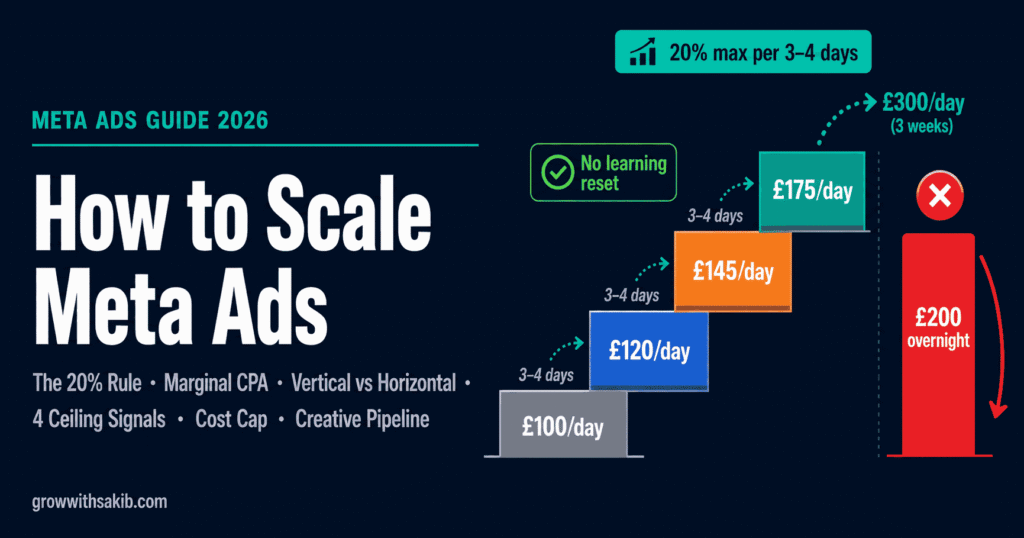
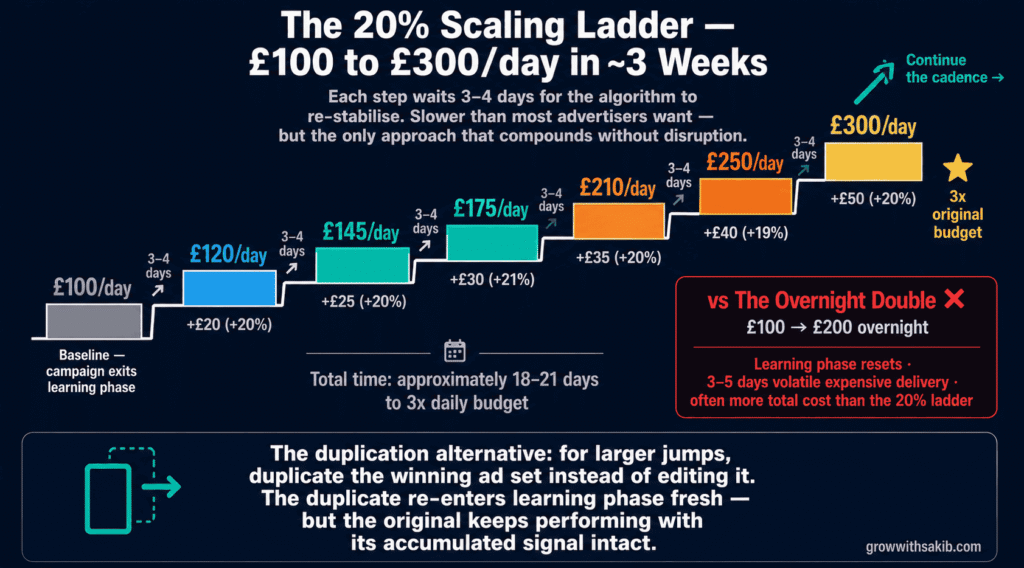
The single most reliable scaling mechanism is also the simplest: increase budgets by no more than 20% every 3-4 days. Understanding why this works tells you when you can bend it and when you cannot.
The mechanism behind the rule
Meta’s algorithm treats budget increases of 20% or less as minor adjustments that do not reset the learning phase. As the Modern Marketing Institute’s scaling analysis explains, every major edit — budget changes above roughly 20%, audience changes, optimisation event changes, creative swaps, bid strategy changes — resets the learning phase counter. When that happens, the signal the algorithm has accumulated is effectively discarded, and it starts over from a cold state.
This is why doubling your budget overnight is so destructive. You are not just spending more — you are telling the algorithm to throw away everything it has learned about who converts and start again, at a higher budget, with no accumulated signal. The result is a 3-5 day period of volatile, expensive delivery while it re-learns.
The scaling ladder
As OptiFOX’s 2026 guide lays it out, the practical application is a scaling ladder — a sequence of 20% increases with 3-4 days between each step:
The duplication alternative that sidesteps the rule
There is a way to add budget faster than the 20% cadence allows: duplication. Instead of increasing a winning ad set’s budget, you duplicate it and run the copy alongside the original. As the Modern Marketing Institute recommends, introducing new budget through duplication rather than editing preserves the original ad set’s learning history while giving the new budget a fresh start. The tradeoff: the duplicate re-enters its own learning phase, and the two can compete in the same auction. Use duplication for larger jumps; use the 20% rule for steady compounding on a proven winner.
The Metric That Governs Scaling: Marginal CPA
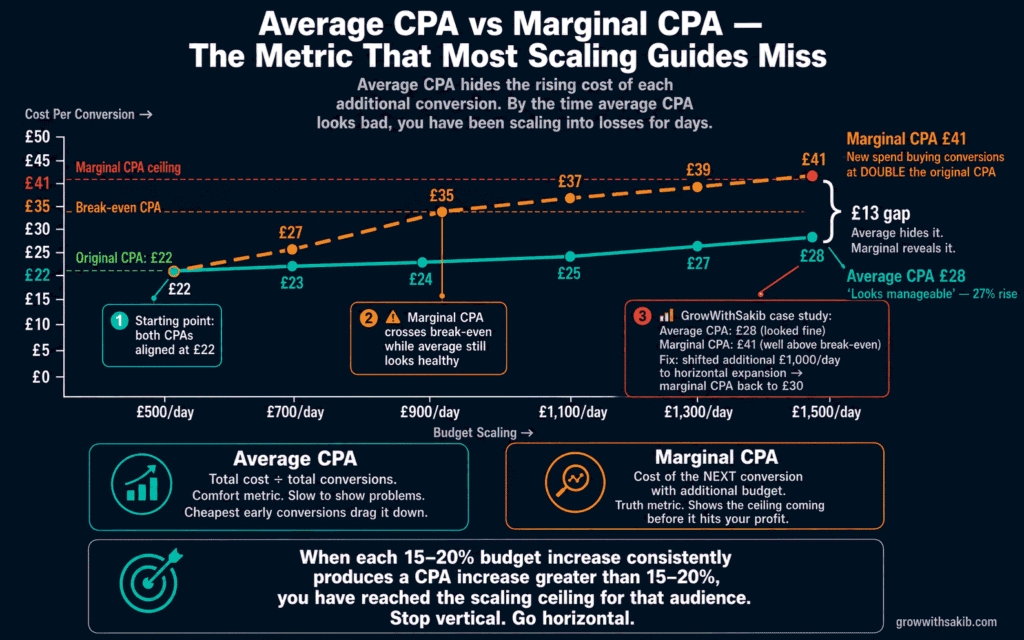
Here is the concept most scaling guides miss entirely, and it is the one that explains why scaling fails. When you scale, your average CPA can look fine while your campaign quietly becomes unprofitable. The reason is the gap between average CPA and marginal CPA.
Average CPA vs marginal CPA
Average CPA is the total cost divided by total conversions across the whole campaign. Marginal CPA is the cost of the next conversion — the one you buy with the additional budget you just added.
When you scale, Meta first spends your budget on the cheapest, most responsive conversions available. As you add budget, it has to reach further into less responsive segments of your audience, and each additional conversion costs more than the last. Your marginal CPA rises long before your average CPA shows a problem — because the cheap early conversions keep the average down while the expensive marginal ones quietly erode your profit.
How to estimate marginal CPA
You can approximate marginal CPA by comparing two stable periods. Take your spend and conversions before a budget increase and after it has stabilised. The additional spend divided by the additional conversions is your marginal CPA for that increment — the same structured period-over-period measurement approach used when tracking SEO results monthly. If that number is at or below your target CPA, the increase was healthy. If it is well above, you have started scaling into diminishing returns and should switch tactics — typically from vertical to horizontal scaling.
The Scaling Ceiling: Four Signals You Have Hit It
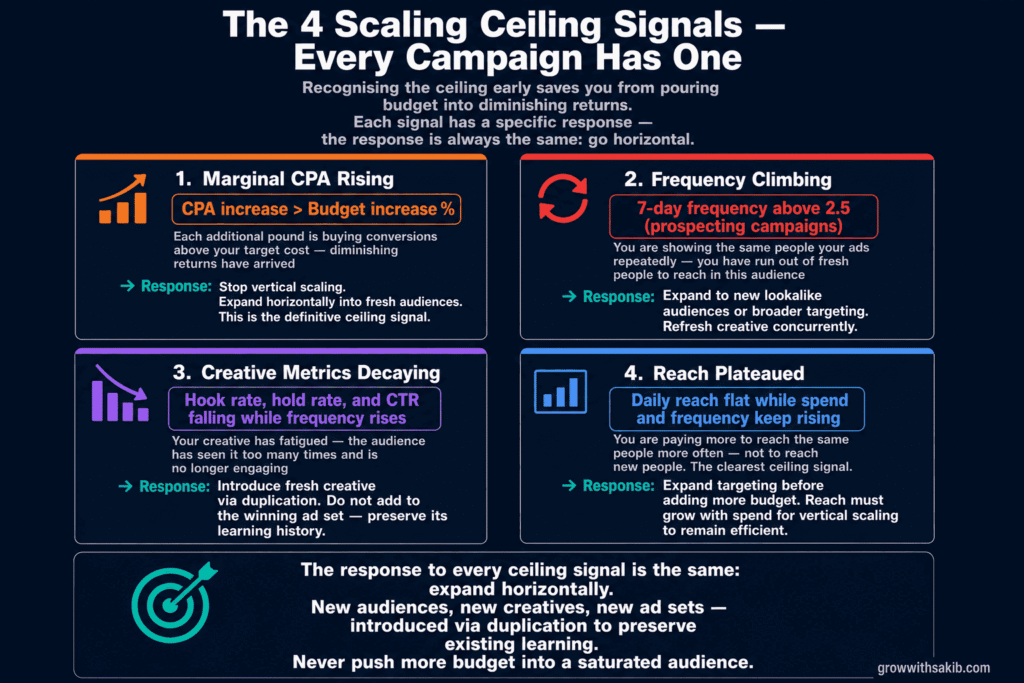
Every campaign has a scaling ceiling — a point where adding budget stops producing proportional returns because you have exhausted the most responsive portion of your audience. Recognising the ceiling early saves you from pouring budget into diminishing returns. There are four reliable signals.
Signal 1: Marginal CPA exceeds target
Covered in the previous section, this is the definitive signal. When each budget increase produces a more-than-proportional CPA increase, you are buying conversions above your target cost. This is the ceiling expressing itself in the metric that matters most.
Signal 2: Frequency above 2.5 on prospecting audiences
As RocketShip HQ documents, a 7-day frequency climbing above 2.5 on prospecting audiences indicates audience saturation — you are showing the same people your ads repeatedly because you have run out of fresh people to reach. Rising frequency with rising costs is the classic saturation signature. The fix is horizontal expansion, not more budget into the saturated audience.
Signal 3: Creative metrics decaying
When hook rate, hold rate, and CTR decline while frequency rises, your creative has fatigued — the audience has seen it too many times. As RocketShip HQ notes, checking creative metrics is the third ceiling diagnostic. The fix here is fresh UGC and creative, introduced through duplication so you do not reset the winning ad set’s learning.
Signal 4: Reach plateaued while spend climbs
As AdStellar’s 6-step scaling guide describes it, when your daily reach has plateaued while frequency keeps climbing, you have saturated your current audience. You are spending more to reach the same people more often, not to reach new people. This is the ceiling in its clearest form — and the unambiguous signal to expand targeting before scaling budget further.
| Ceiling Signal | Threshold | Response |
| Marginal CPA rising | CPA increase > budget increase % | Stop vertical scaling; expand horizontally |
| Frequency climbing | 7-day frequency above 2.5 (prospecting) | Expand to new audiences; refresh creative |
| Creative metrics decaying | Hook rate, hold rate, CTR falling as frequency rises | Introduce fresh creative via duplication |
| Reach plateaued | Reach flat while spend and frequency rise | Expand targeting before adding more budget |
Bidding Strategy While Scaling: Cost Cap and the Overnight Trap
Your bidding strategy determines whether scaling inflates your CPA or protects it. As you scale, the right bid strategy keeps the algorithm acquiring conversions at a cost you can live with — but switching strategies carelessly can crater your delivery overnight.
Cost Cap for controlled scaling
Cost Cap bidding tells Meta to get you as many conversions as possible while keeping your average cost around a target you set. As Benly’s scaling guide documents, Cost Cap protects against CPA inflation during scaling — set it 15-25% above your target CPA to give the algorithm enough flexibility to find conversions while capping the damage. This is the bidding strategy most suited to disciplined scaling, because it directly addresses the marginal-CPA problem: it stops the algorithm from buying conversions above your ceiling.
Timing matters. As TheOptimizer’s 2026 bidding guide advises, do not start a new campaign on Cost Cap — complete the learning phase with Highest Volume, gather at least 50 conversions, confirm your baseline CPA, then activate Cost Cap. The exception is a mature pixel with strong historical data, where Meta’s prediction models are not starting from zero.
The overnight-switch trap
Switching a high-spend campaign to Cost Cap overnight is a classic scaling mistake. As RocketShip HQ’s data shows, flipping a £10,000/day Highest Volume campaign to Cost Cap overnight reduces spend by 25-40% on day one before the algorithm adjusts — a sudden delivery collapse that looks like the strategy failing when it is really just re-calibrating.
The fix is the duplicate-and-phase-down method: duplicate the campaign with Cost Cap at a lower budget, scale the duplicate up gradually, and phase down the original Highest Volume campaign over 5-7 days. You transition spend smoothly rather than shocking the account with an overnight switch.
CBO vs ABO while scaling
Campaign Budget Optimisation (CBO, now Advantage Campaign Budget) lets Meta distribute budget across ad sets automatically, favouring top performers. As Meta’s CBO documentation describes, this can accelerate scaling by shifting spend to what is working. The caveat: CBO can starve new test ad sets of budget if the algorithm heavily favours an existing winner. For scaling proven audiences, CBO is efficient; for testing new horizontal expansion with Advantage+ Shopping Campaigns, ad set budgets (ABO) guarantee each new audience gets enough spend to generate meaningful data before CBO decides its fate.
Why Creative Is the Real Scaling Constraint
Most advertisers think of scaling as a budget problem. At scale, it is a creative problem. Creative fatigue is what kills scaled campaigns before budget mechanics do — because the more you spend, the faster your audience sees your ads, and the faster they fatigue — the full creative format strategy for avoiding this is in the Meta ad formats guide.
As you increase budget, frequency rises faster. The same creative that performed beautifully at £200/day burns out in days at £2,000/day because it is reaching the same people far more often. This is why the 2026 scaling consensus is that vertical scaling alone hits a ceiling quickly — the constraint is not the budget, it is how fast the creative fatigues at higher spend.
The creative velocity requirement for scaling
- Maintain a creative pipeline before you scale, not after. Scaling demands fresh creative continuously. If your creative production cannot keep pace with the faster fatigue that scaling causes, your scaled campaign will decay no matter how well you manage the budget mechanics.
- Introduce new creative through duplication. Adding creative to a winning ad set can reset its learning. Instead, duplicate the ad set and introduce fresh creative in the copy, preserving the original’s learning history.
- Lead with UGC. As covered in our guide to UGC ads on Meta, authentic creator content fatigues more slowly and produces the volume of variations that scaling requires. A standing UGC pipeline is effectively a prerequisite for sustained scaling.
- Test hooks continuously. Use structured A/B testing to keep a queue of proven new hooks ready to rotate in the moment creative metrics start to decay.
6 Scaling Mistakes That Kill Profitable Campaigns
Mistake 1: Doubling the budget overnight
The fastest way to destroy a profitable campaign is a sudden, large budget increase. It resets the learning phase, discards accumulated signal, and triggers 3-5 days of volatile, expensive delivery. Stick to 20% increases every 3-4 days, or use duplication for larger jumps — the full campaign structure and budget allocation framework is in the Meta Ads Guide.
Mistake 2: Scaling before the campaign is ready
Two good days is not stability. Scaling a campaign still in or barely out of the learning phase magnifies volatility, not performance. Confirm all five readiness conditions — exited learning, 5-7 days stable, genuinely profitable, tracking verified, ASL headroom — before increasing budget.
Mistake 3: Watching average CPA instead of marginal CPA
Average CPA hides the rising cost of each additional conversion. By the time average CPA looks bad, you have been scaling into losses for days. Track marginal CPA — the cost of the conversions bought with the new budget — to see the ceiling coming before it hits your profit.
Mistake 4: Relying purely on vertical scaling
Pushing all your budget into one winning ad set saturates that audience, drives up frequency, and fatigues the creative fast. Vertical scaling has a ceiling. Pair it with horizontal expansion into new audiences to keep growing past the point where a single audience runs out of room.
Mistake 5: Switching bid strategy overnight at high spend
Flipping a high-spend campaign to Cost Cap overnight can drop delivery 25-40% on day one. Use the duplicate-and-phase-down method instead — build up a Cost Cap duplicate while phasing out the original over 5-7 days for a smooth transition.
Mistake 6: Treating scaling as a budget problem, not a creative problem
At scale, creative fatigue is the binding constraint. The same creatives burn out far faster at high spend. No budget tactic fixes a creative pipeline that cannot keep pace. Build the pipeline before you scale, and introduce fresh creative through duplication continuously — and consider investing in SEO for small business as the organic channel that generates first-party customer data without the creative velocity requirement of scaled paid campaigns.
Frequently Asked Questions
How do I scale Meta ads without killing performance?
Scale gradually using the 20% rule — increase budgets by no more than 20% every 3-4 days to avoid resetting the learning phase — and combine vertical scaling (more budget on winning ad sets) with horizontal scaling (new audiences and creatives). As Meta’s learning phase documentation explains, large sudden changes reset the algorithm’s optimisation. Watch marginal CPA, not just average CPA, to catch diminishing returns before they erode profit.
What is the 20% rule in Meta ads scaling?
The 20% rule states that you should increase a campaign or ad set budget by no more than 20% every 3-4 days. As the Modern Marketing Institute documents, Meta’s algorithm treats increases of 20% or less as minor adjustments that do not reset the learning phase, while larger increases discard accumulated signal and trigger a costly 3-5 day re-learning period. The 3-4 day wait lets the algorithm re-stabilise before the next increase.
Should I scale vertically or horizontally?
Use vertical scaling (more budget on existing ad sets) when you have a large audience with room to grow and stable performance. Use horizontal scaling (new audiences and creatives) when your audience is saturated or you want to expand without risking the winner. As AdStellar’s scaling guide notes, most successful accounts use a hybrid: vertical first to extract headroom, then horizontal when frequency rises and marginal CPA climbs.
Why does my CPA go up when I increase my budget?
Two reasons. First, a large increase may have reset your learning phase, causing temporary volatility. Second — and more fundamentally — as you spend more, Meta exhausts your cheapest, most responsive conversions and reaches into less responsive segments, so each additional conversion costs more. This is rising marginal CPA. If frequency is climbing above 2.5 and reach has plateaued, you have hit your audience’s scaling ceiling and need to expand horizontally.
What is a scaling ceiling and how do I know I’ve hit it?
A scaling ceiling is the point where adding budget stops producing proportional returns because you have exhausted the most responsive part of your audience. As RocketShip HQ documents, four signals indicate it: marginal CPA rising faster than your budget increases, 7-day frequency above 2.5 on prospecting, decaying creative metrics (hook rate, CTR), and reach plateauing while spend climbs. The response is horizontal expansion, not more vertical budget.
Should I use Cost Cap when scaling Meta ads?
Cost Cap is well-suited to disciplined scaling because it caps the cost of additional conversions. As Benly’s guide recommends, set it 15-25% above your target CPA. But do not switch a high-spend campaign to Cost Cap overnight — RocketShip HQ’s data shows this drops day-one spend by 25-40%. Instead, duplicate the campaign with Cost Cap at a lower budget, scale it up, and phase down the original over 5-7 days.
How fast can I realistically scale a Meta campaign?
Using the 20% rule, expect to roughly double daily budget over 10-14 days and triple it over 2-3 weeks, assuming performance holds at each step. Faster scaling is possible through duplication (running parallel copies) but introduces new ad sets into their own learning phases. The realistic constraint is rarely the budget mechanics — it is how fast your creative pipeline can produce fresh assets to counter the faster fatigue that higher spend causes.
Key Takeaways
- Confirm all five readiness conditions before scaling: exited learning phase, 5-7 days stable performance, genuine profitability, verified tracking, and Account Spending Limit headroom.
- Follow the 20% rule: increase budgets by no more than 20% every 3-4 days to avoid resetting the learning phase. For larger jumps, use duplication to preserve the original’s learning history.
- Watch marginal CPA, not average CPA. Average CPA hides the rising cost of each additional conversion. Marginal CPA — the cost of conversions bought with new budget — is the metric that reveals diminishing returns.
- Combine vertical and horizontal scaling. Vertical to extract headroom from a proven audience; horizontal to expand reach when frequency climbs and the audience saturates. Pure vertical scaling hits a ceiling fast.
- Know the four scaling-ceiling signals: marginal CPA exceeding target, frequency above 2.5, decaying creative metrics, and plateaued reach. Each one says: expand horizontally, stop adding vertical budget.
- Use Cost Cap to protect CPA while scaling, set 15-25% above target — but never switch a high-spend campaign to Cost Cap overnight. Duplicate and phase down over 5-7 days instead.
- Scaling is a creative problem disguised as a budget problem. Creative fatigues far faster at high spend. A standing creative pipeline is a prerequisite for sustained scaling, not an afterthought.
- Introduce new budget, audiences, and creative through duplication, not by editing winning ad sets — this preserves accumulated learning while giving the new element a fresh start.