Money goes out. Some leads come in. But the link between them stays foggy – is your content actually paying off, or just keeping you busy? Most content-ROI guides answer that with enterprise dashboards, CRMs, and data teams you don’t have. You don’t need any of that. With free tools and one formula, a solo owner can measure content ROI properly.
This is the measurement guide for the content strategy for small business guide on GrowWithSakib, whose goal table shows what to measure for each goal but not how. Here’s the how – the money math – built for a business without an analytics team.
Why Content ROI Feels Hard (But Isn’t)
Content ROI has a reputation for being impossible to measure, for three real reasons: content compounds (a post written today may generate its first lead in four months and keep working for years), the buyer journey is non-linear (people read several pieces across weeks before buying), and standard last-click tracking gives all the credit to the final step, hiding content’s true contribution.
None of that makes it unmeasurable – it just means you measure it differently from paid ads. And the payoff is worth it. In Demand Metric’s widely-cited study, content marketing generated around three times more leads at a fraction of the cost per lead of paid advertising. Treat that as a directional industry benchmark, not a promise – the point of this guide is to measure your own number, which is the only one that matters.
The Content ROI Formula
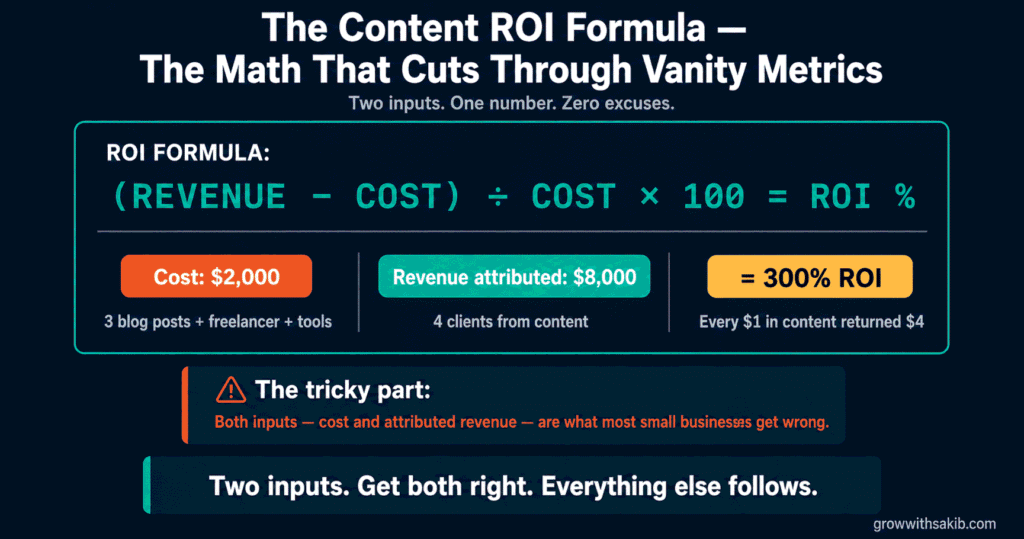
At its core, ROI is one simple calculation:
Simple as it looks, the two inputs are where people go wrong: they undercount the cost (forgetting their own time) and mis-attribute the revenue (using last-click). Get those two right and the formula does the rest. Let’s take them step by step.
Step 1: Count All Your Costs (Not Just Tools)
Most owners wildly undercount content costs by tracking only obvious expenses. Add up everything:
- Your time (the big one) – hours spent writing, editing, and publishing x a realistic hourly rate. This is usually the largest cost and the one most people ignore.
- Any outsourced work – writers, designers, editors you pay.
- Tools – SEO tools, email platform, design apps, hosting attributable to content.
- Promotion – any spend boosting or distributing the content.
If you skip your own time, your ROI looks artificially spectacular and you can’t compare it honestly to paid ads. Count it. One efficient way to lower this cost – and lift ROI – is to get more from each piece with the content repurposing approach on GrowWithSakib.
Step 2: Track Organic Traffic Growth
Organic traffic is content’s leading indicator – it moves first, months before revenue. Use Google Search Console (free) to track clicks, impressions, and which pages and queries bring people in, and Google Analytics to see the organic channel’s sessions over time. Watch the trend, not any single week.
Rising organic traffic tells you content is working at the top of the funnel even before leads appear. It’s the same tracking setup covered in the guide to tracking results on GrowWithSakib and the guide to Google Search Console on GrowWithSakib. But traffic alone isn’t ROI – you need conversions.
Step 3: Set Up Conversion Tracking in GA4
This is the step that turns traffic into measurable value, and GA4 does it for free. You need to tell GA4 what counts as a conversion (a “key event”) for your business:
- Mark your key events – in GA4, set your real goals as key events: contact-form submissions, phone-call clicks, quote requests, bookings, lead-magnet downloads, and newsletter signups.
- Tag your links with UTMs – add UTM parameters (source, medium, campaign) to links you share, so GA4 attributes leads to the right content and channel.
- Check the landing page – GA4’s reports show which page a converting visitor first arrived on, so you can see which articles drive leads.
Once key events are set, GA4 shows conversions by landing page and channel – so you can see exactly which content pieces generate leads, not just clicks. If you don’t have a form, even a “how did you hear about us?” question at checkout or enquiry captures lead source for free.
Step 4: Attribute Leads to Content (Honestly)
Here’s the trap that makes content look worse than it is: last-click attribution. It gives 100% of the credit to the final step before conversion – often a branded search or a direct visit – and zero to the blog post that first brought the person in months earlier. Judge content by last-click and you’ll wrongly conclude it “doesn’t convert.”
Attribute more fairly with free options:
- Look at content-assisted conversions – GA4’s attribution and conversion-path reports show every touchpoint in a conversion, not just the last. Any conversion where content appeared in the path is content-influenced.
- Use first-touch for discovery – to see which content brings new people in, look at the landing page of a converter’s first visit.
- Just ask – “how did you hear about us?” on your form or first call is the simplest attribution tool there is, and it catches what analytics miss.
The honest rule: content is usually an early or middle touch, not the final click. Credit it for the journeys it starts and assists, not just the ones it closes – and remember that the funnel stage each piece serves comes from your content mapping on GrowWithSakib.
Step 5: Compare Cost Per Lead – Content vs Paid Ads
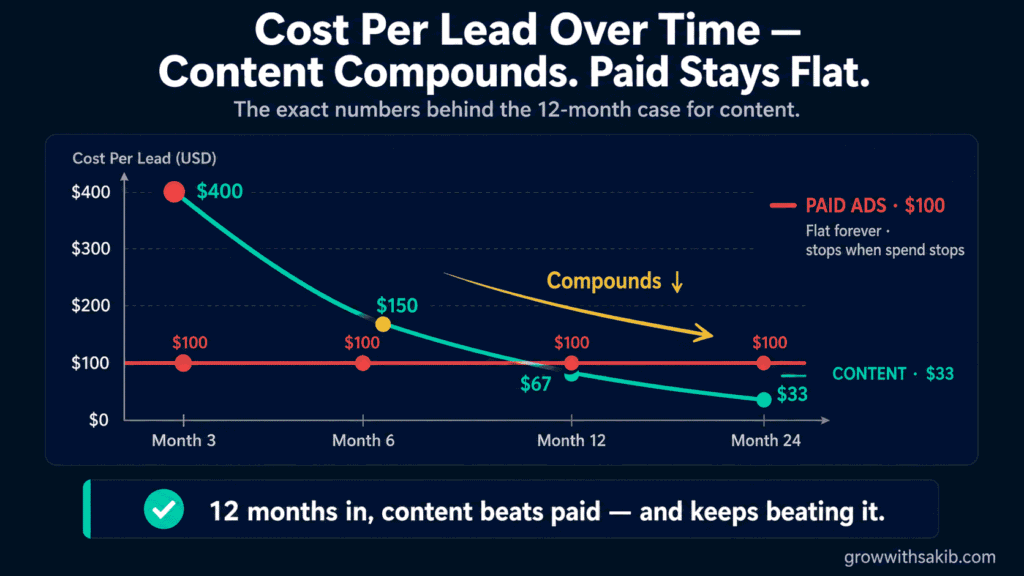
This is the comparison every owner really wants. Cost per lead (CPL) = total cost / number of leads. Calculate it for both channels on the same timeframe and the difference becomes clear – especially over time.
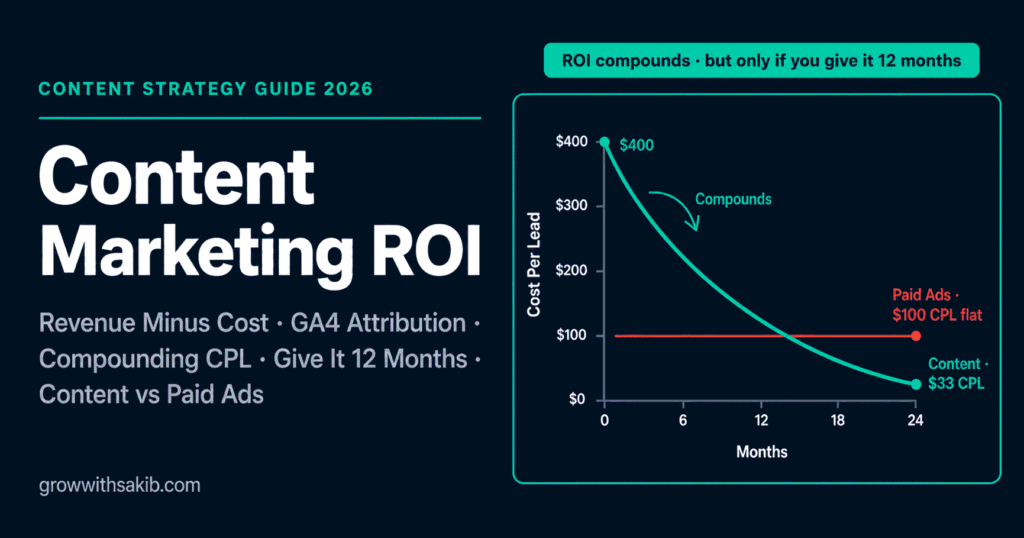
Here’s a realistic small-business example, showing the same content investment early versus mature:
| Channel / Timeframe | Monthly Cost | Leads | Cost Per Lead |
|---|---|---|---|
| Paid ads (any month) | $2,000 ad spend | 20 | $100 |
| Content – month 3 (ramping) | $2,000 (your time + tools) | 5 | $400 |
| Content – month 12 (compounding) | $2,000 | 30 | $67 |
| Content – month 24 (mature) | $1,500 (mostly maintenance) | 45 | $33 |
Notice the story the numbers tell. Early on, content’s CPL is worse than paid – it’s still ramping. But content compounds: the same articles keep working and keep earning leads, so cost per lead falls month after month, while paid ads’ CPL stays flat (stop paying and the leads stop instantly). This is why judging young content on paid’s timeline is a mistake – and why, at maturity, content is dramatically cheaper per lead. That’s the real meaning behind the “3x more leads per dollar” benchmark.
The Honest Timeline
- 3-6 months to show meaningful results – content needs time to rank and build trust. Expect little in the first quarter; that’s normal, not failure.
- 12-18 months to hit its stride – this is when compounding really shows and CPL drops well below paid.
- It keeps paying after you stop – unlike ads, a ranking article earns leads for years at near-zero marginal cost. That durability is the whole ROI case.
- Refreshing beats replacing – updating existing posts is often the highest-ROI content activity, as covered in the content audit guide on GrowWithSakib.
Your Simple Monthly ROI Dashboard
You don’t need fancy software – a one-tab spreadsheet updated monthly does the job. Track these:
| Metric | Where to Get It | Why It Matters |
|---|---|---|
| Organic traffic | Search Console / GA4 | Leading indicator (moves first) |
| Leads from content | GA4 key events + ‘how did you hear’ | The conversions that count |
| Total content cost | Your own tally (time + tools) | The investment side of ROI |
| Cost per lead | Cost / leads | The comparison vs paid ads |
| Content ROI | (Revenue – cost) / cost x 100 | The bottom line |
Review it monthly for trends and quarterly for the big ROI picture. Tie each number back to the goal it serves using your content marketing goals on GrowWithSakib, and you’ll always know whether content is earning its keep.
Common Content ROI Mistakes
| Mistake | Why It Hurts | Do This Instead |
|---|---|---|
| Ignoring your own time as a cost | ROI looks fake; comparison is unfair | Count your hours at a real rate |
| Judging content by last-click | Hides content’s true contribution | Look at assisted conversions + ask leads |
| Comparing young content to mature ads | Content loses on the wrong timeline | Compare over 12 months; expect a ramp |
| Mixing up ROAS and ROI | Flatters ads unfairly | Use full costs for both channels |
| Tracking only traffic | Traffic isn’t revenue | Set up conversion key events in GA4 |
| Quitting content at month 3-4 | Abandons it before it compounds | Give it 12-18 months to hit stride |
| Chasing an industry average | Benchmarks aren’t your business | Measure your own numbers |
Frequently Asked Questions
1. How do I measure content marketing ROI for a small business?
Use the formula ROI = (revenue from content – cost of content) / cost of content x 100, with free tools. Track organic traffic in Google Search Console, set up conversion events in GA4 (form fills, calls, downloads), attribute leads to content while watching out for last-click undercounting, and calculate your cost per lead to compare against paid ads. Count all costs – including your own time – and measure the trend over months, since content compounds rather than converting instantly.
2. What is the content marketing ROI formula?
The formula is: ROI = (Revenue from content – Cost of content) / Cost of content x 100. For example, if your content costs $2,000 a month and is attributed to $8,000 in revenue, your ROI is (8,000 – 2,000) / 2,000 x 100 = 300%. The two tricky inputs are cost (include your own time, tools, and promotion, not just obvious expenses) and revenue (attribute fairly rather than giving all credit to the last click before purchase).
3. How do I track content conversions in GA4?
In GA4, mark your real goals as ‘key events’ – contact-form submissions, phone-call clicks, quote requests, bookings, and lead-magnet downloads. Add UTM parameters (source, medium, campaign) to links you share so GA4 attributes leads correctly, and use GA4’s landing-page reports to see which articles drive conversions. GA4 is free and event-based, so it fits content tracking well. If you don’t have a form, a simple ‘how did you hear about us?’ question captures lead source at no cost.
4. Is content marketing cheaper than paid ads?
Over time, usually yes – but not at first. Demand Metric’s widely-cited study found content generates roughly three times more leads at a far lower cost per lead than paid advertising. The catch is timing: early on, content’s cost per lead is higher while it ramps, but because content compounds, the same articles keep earning leads and the cost per lead falls over months, while paid ads’ cost per lead stays flat and stops the moment you stop paying. Measure your own numbers over a year.
5. How do I compare content and paid ads cost per lead?
Calculate cost per lead (CPL) for each: total cost divided by number of leads, on the same timeframe. For paid ads, that’s ad spend plus management divided by leads. For content, it’s your time plus tools plus promotion divided by content-attributed leads. Compare fairly by using full costs for both (don’t compare content’s true ROI to the ads’ flattering ROAS), and compare over 12 months rather than a single month, since content’s CPL drops as it compounds while paid stays flat.
6. Why does content marketing look like it doesn’t convert?
Because of last-click attribution. Standard analytics give 100% of the credit to the final step before a sale – often a branded search or direct visit – and zero to the blog post that first brought the person in months earlier. Since content is usually an early or middle touchpoint, last-click systematically hides its contribution, making it look like content ‘doesn’t convert’ when it’s actually starting and assisting the journeys other channels finish. Look at assisted conversions and ask leads how they found you.
7. How long before content marketing shows ROI?
Expect 3 to 6 months for meaningful results and 12 to 18 months for content to hit its stride, because it needs time to rank and build trust. The first quarter often shows little, which is normal rather than failure. The payoff is durability: unlike paid ads, a ranking article keeps generating leads for years at almost no additional cost, so its ROI compounds long after publication. Judging content on paid advertising’s instant timeline is the most common measurement mistake.
8. Do I need expensive tools to measure content ROI?
No. Google Search Console (traffic and rankings), GA4 (conversion tracking and attribution), and a simple spreadsheet cover everything a small business needs – all free. You don’t need an enterprise analytics stack, a CRM pipeline, or a data analyst. The most valuable ‘tool’ is often a ‘how did you hear about us?’ question that captures lead source directly. Start with these free tools and a monthly review; add paid software only when a free tool genuinely limits you.
Key Takeaways
- Measure content ROI with free tools – Google Search Console, GA4, and a spreadsheet – no CRM, enterprise stack, or data team required.
- The formula is ROI = (revenue from content – cost of content) / cost of content x 100; the two tricky inputs are counting all costs and attributing revenue fairly.
- Count all costs, especially your own time – skip it and your ROI looks fake and can’t be compared honestly to paid ads.
- Set up key events in GA4 (form fills, calls, downloads) and use UTMs so you can see which content drives leads, not just clicks.
- Beware last-click attribution – it undercounts content, which is usually an early or middle touch; look at assisted conversions and ask leads how they found you.
- Compare cost per lead (cost / leads) for content vs paid ads on the same timeframe, using full costs for both – not the ads’ flattering ROAS.
- Content compounds: its cost per lead is high early but falls over time as articles keep earning leads, while paid CPL stays flat and stops when you stop paying.
- Give content 3-6 months for results and 12-18 to hit stride; the Demand Metric ‘3x more leads’ benchmark is directional – measure your own numbers.