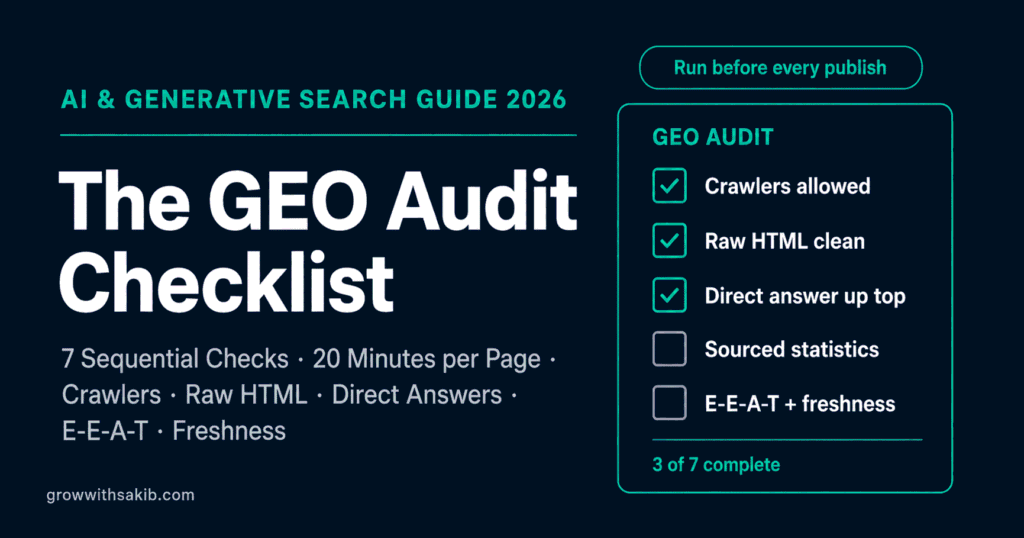
You can write a brilliant page that ranks on Google and is still completely invisible to ChatGPT, Perplexity, and Google’s AI answers. The reason is usually simple and fixable – but you have to know what to look for. That’s what this checklist is for.
Run this GEO audit checklist on any page before you publish and you’ll catch the issues that quietly keep you out of AI answers. It’s the practical companion to the complete guide to generative engine optimization on GrowWithSakib, and it pulls together the specifics from across that cluster into one repeatable check. Bookmark it – you’ll use it on every page.
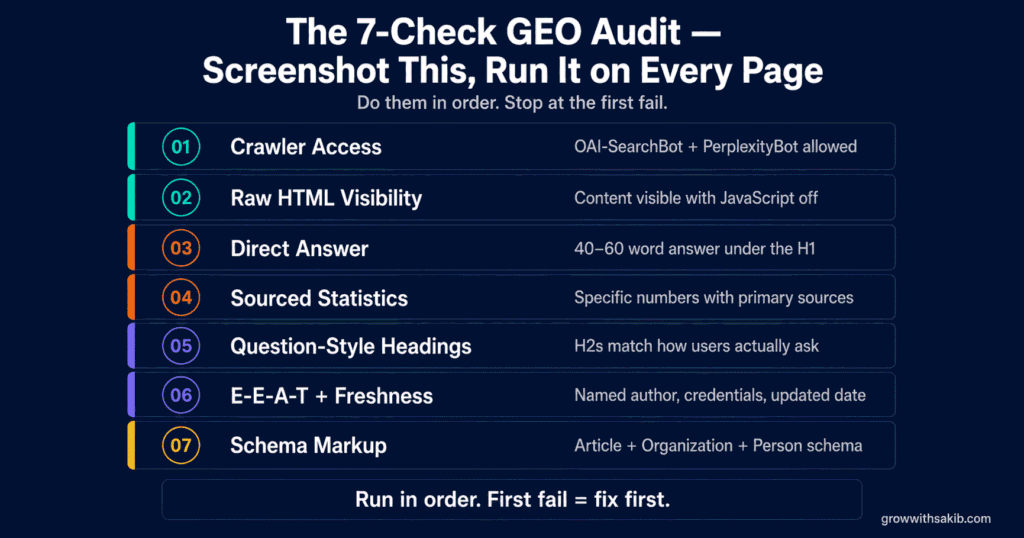
A quick note on how to use it: work top to bottom. The order matters, because the early checks are gatekeepers – if AI can’t access or read your page, nothing else counts. Each item gives you what to check, why it matters, and exactly how to fix it.
Check 1: Can AI Crawlers Access the Page?
What to check: Confirm your robots.txt doesn’t block the AI search crawlers – especially OAI-SearchBot (ChatGPT) and PerplexityBot (Perplexity).
Why it matters: This is the gatekeeper. If AI crawlers can’t reach your page, no amount of great content or schema helps – you’re simply not in the pool. A surprising number of sites block these crawlers by accident, often after over-reacting to “AI scraping” headlines and blanket-blocking every AI bot they can find.
How to fix it: Open yoursite.com/robots.txt and make sure these user agents aren’t disallowed. A safe starting point:
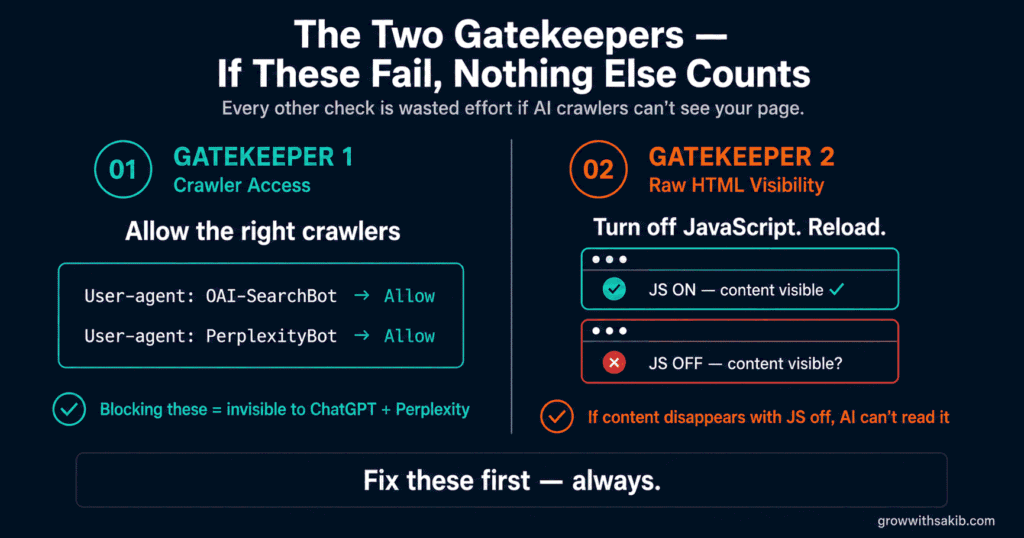
| User-agent: OAI-SearchBot Allow: / User-agent: PerplexityBot Allow: / # GPTBot (below) is OpenAI’s TRAINING crawler. # Blocking it does NOT remove you from ChatGPT search. |
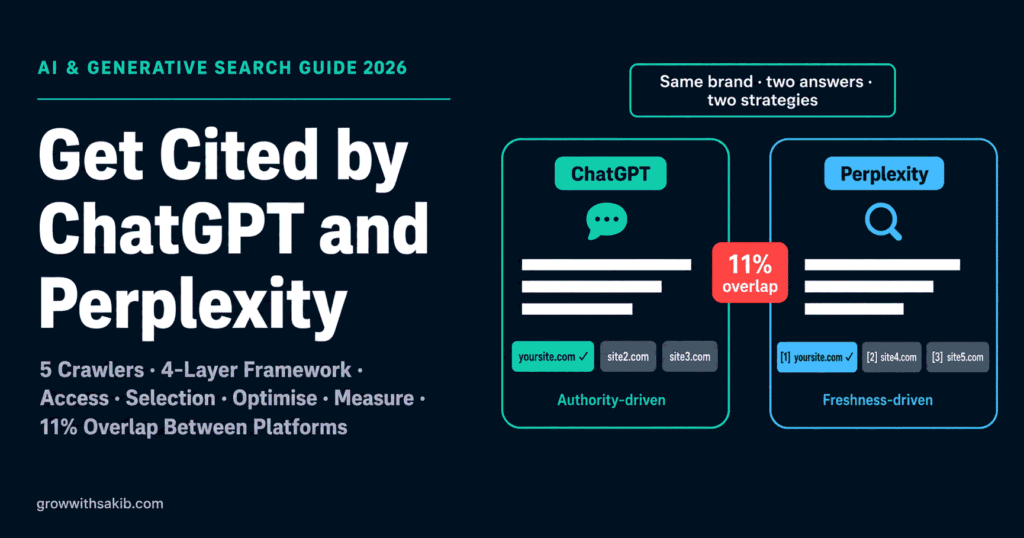
The common trap: blocking GPTBot only opts you out of model training – ChatGPT search citations come from OAI-SearchBot. The full crawler breakdown is in the guide to getting cited by ChatGPT and Perplexity on GrowWithSakib.
Check 2: Is Your Content Visible in Raw HTML?
What to check: Make sure your main content appears in the page’s raw HTML, not only after JavaScript runs.
Why it matters: This is the trap almost no beginner hears about. Most AI crawlers don’t run JavaScript – GPTBot, OAI-SearchBot, ClaudeBot, and PerplexityBot fetch the raw HTML and stop, according to large-scale AI crawler analysis reported by ToTheWeb. Google’s Gemini is the exception, because it runs on Googlebot’s infrastructure. So a page can rank fine in Google and appear in AI Overviews, yet look completely blank to ChatGPT, Claude, and Perplexity.
How to fix it: Do the 30-second test – view the page with JavaScript turned off (or use “View Page Source” rather than “Inspect”). If your main content vanishes, AI crawlers see blank too. The fix is to serve your important content in the initial HTML via server-side rendering or static generation. This is a technical-SEO job; see the technical SEO guide on GrowWithSakib.
Check 3: Does Each Section Lead With a Direct Answer?
What to check: Confirm each section opens by answering its implied question directly, before any build-up.
Why it matters: AI systems extract the most relevant passage from your page to build their answer. If your key point sits four paragraphs down after a long warm-up, it gets skipped. AI reads the opening lines first to decide what a section is about – the opposite of the old SEO habit of building to a conclusion.
How to fix it: For each heading, put a clear 40-60 word answer in the first sentence or two, then expand. A quick self-test: read only the first sentence under each heading – do they still answer the questions? If not, rewrite the openings. The full method is in the answer engine optimisation guide on GrowWithSakib.
Check 4: Can Each Passage Stand on Its Own?
What to check: Make sure individual sections make sense when read in isolation, without relying on earlier context.
Why it matters: AI lifts single passages out of your page and drops them into an answer. If a paragraph says “as mentioned above” or leans on a definition from three sections back, it breaks when extracted alone. Self-contained passages get cited; context-dependent ones don’t.
How to fix it: Read each key paragraph on its own. If it doesn’t stand up, add the small bit of context it needs – restate the subject instead of saying “it,” and define terms near where you use them. You don’t need to break content into artificial chunks: in June 2026 Google confirmed its systems can understand multiple topics on a page and surface the relevant part themselves, so organise for human readability first and the extractable structure follows.
Check 5: Are Your Claims Backed by Specific Facts?
What to check: Look for vague, unverifiable claims and confirm the important ones are backed by specific, checkable facts.
Why it matters: AI favours content it can verify and cite. The foundational Princeton GEO study presented at ACM KDD 2024 found that adding statistics, citations, and quotations improved visibility in generative answers by up to around 40%, while keyword stuffing did little and sometimes hurt. Vague hype like “best-in-class” gives AI nothing to quote.
How to fix it: Run each claim through one test – could a sceptical stranger verify it? Replace “trusted by many” with a real number, and add a sourced statistic where you can. The details are in statistics-rich content on GrowWithSakib, and the fix for salesy language is in the guide to entity optimisation for GEO which covers neutral, authoritative framing that AI systems favour.
Check 6: Are the Author and Brand Clearly Identified?
What to check: Confirm the page has a named author with credentials, and that your brand is described consistently as a clear entity.
Why it matters: AI weighs trust signals when deciding whom to cite. Pages with a named, credentialed author are cited more readily than anonymous “admin” or “editorial team” content, and AI needs to recognise your brand as a consistent entity to cite it by name. Weak or conflicting identity signals get you skipped in favour of a source the AI can confidently identify.
How to fix it: Add a real author byline with a short bio and credentials, and keep your brand name, description, and key facts consistent across your site and profiles. Linking your author and organisation to verified external profiles (the schema sameAs property) gives AI a verification pathway. The full method is in the guide to entity optimisation for GEO on GrowWithSakib.
Check 7: Is the Content Current?
What to check: Make sure the page shows a visible, recent last-updated date and contains up-to-date information.
Why it matters: Freshness is a trust signal, and some AI tools lean on it heavily. Perplexity in particular runs real-time searches and favours current content, so a page updated this quarter can out-compete an older, higher-authority one. Stale dates and outdated facts quietly lower your citation odds.
How to fix it: Add a visible “last updated” date, refresh key facts and examples to the current year, and make sure updated pages get recrawled. Build a simple schedule to revisit high-value pages – freshness isn’t a one-time fix, it’s maintenance. Pair this with the GEO performance measurement guide to confirm freshness updates are translating into more AI citations.
The GEO Audit Checklist at a Glance
Here’s the whole checklist in one scannable table – screenshot it, bookmark it, run it on every page before you publish.
| # / Check | Pass Condition |
| 1. Crawler access | robots.txt allows OAI-SearchBot and PerplexityBot |
| 2. Raw-HTML visible | Main content shows with JavaScript off |
| 3. Answer-first | Each section opens with a direct answer |
| 4. Self-contained | Passages make sense read in isolation |
| 5. Specific facts | Claims are verifiable; a sourced stat included |
| 6. Author + entity | Named author with credentials; consistent brand |
| 7. Freshness | Visible recent date; current information |
Two Honest Points Before You Rely on This
First, ranking still matters underneath all of this. AI answers draw heavily from pages that already rank – Botify’s research found that about 75% of domains cited in AI Overviews also appeared in the top organic results. This checklist makes a page extractable and citable, but it works best on a page that already has a solid SEO foundation, covered in the small business SEO guide on GrowWithSakib.
Second, be sceptical of dramatic GEO statistics. You’ll see claims that AI traffic converts several times better than organic, or exact percentage lifts from single tactics. The direction is well-supported – extractable, specific, well-structured pages get cited more – but many precise numbers are vendor-stated and vary wildly. Use this checklist because the fundamentals are sound, then measure your own results with the method in the guide to measuring GEO performance on GrowWithSakib.
What About Schema? (The Honest 2026 Version)
Schema markup earns its own honest note, because advice here is often out of date. Structured data still helps machines understand your page and can match you to recognised entities – it’s worth adding correctly. But two things are true in 2026 that many checklists miss.
- There’s no special “AI schema” requirement – Google has been explicit that no special structured data is needed to appear in its AI features. Add schema for its genuine benefits, not as a mandatory AI hack.
- The FAQ rich result is gone – Google retired it on 7 May 2026, so FAQPage markup no longer wins that dropdown. It can still help AI parse your Q&A content, so treat it as an extraction signal, not a Google rich-result play.
The rule that never fails: make schema match your visible content. Mismatched or misleading markup hurts trust. If you add structured data, validate it and keep it honest – the deeper implementation lives in the Technical SEO Strategies guide.
Common GEO Audit Mistakes
| Mistake | Why It Hurts | Do This Instead |
| Auditing content but never crawler access | A blocked page can’t be cited at all | Check robots.txt first, every time |
| Ignoring JavaScript rendering | AI crawlers see a blank page | Test with JavaScript off; use raw HTML |
| Burying the answer | AI can’t extract a buried point | Lead each section with a direct answer |
| Chasing the retired FAQ rich result | That result no longer exists | Keep useful Q&A; skip the schema chase |
| Anonymous content | Weak author trust signals | Add named authors with credentials |
| Publish-and-forget | Freshness fades; citations drop | Re-run this checklist on updates |
| Trusting inflated GEO stats | Many are shaky vendor numbers | Follow the direction; measure your own |
Frequently Asked Questions
1. What is a GEO audit checklist?
A GEO audit checklist is a short set of checks that tells you whether AI search engines can find, read, and cite a page. It typically verifies that AI crawlers can access the page, the content is visible in raw HTML, sections lead with direct answers, passages are self-contained, claims are specific and verifiable, the author and brand are clearly identified, and the content is current. It’s how you make a page AI-ready before publishing.
2. How do I check if AI can read my page?
Do two quick checks. First, open your robots.txt and confirm you don’t block OAI-SearchBot or PerplexityBot. Second, view the page with JavaScript turned off (or use “View Page Source”) – if your main content disappears, AI crawlers see blank too, because most don’t run JavaScript. If content stays visible and crawlers are allowed, AI can read the page. Then focus on structure and trust signals.
3. Why is my page not showing up in AI answers?
The most common reasons, in order: AI crawlers are blocked in robots.txt; your content is rendered by JavaScript so crawlers see a blank page; your answer is buried instead of leading each section; or your claims are too vague to cite. Work through this checklist top to bottom – the early, technical checks are usually the culprit, and they’re the ones beginners overlook most.
4. Do AI crawlers read JavaScript?
Mostly no. Major AI crawlers like GPTBot, OAI-SearchBot, ClaudeBot, and PerplexityBot fetch the raw HTML and don’t run JavaScript. Google’s Gemini is the exception, since it uses Googlebot’s rendering infrastructure. This means a page can rank in Google and appear in AI Overviews yet be invisible to ChatGPT, Claude, and Perplexity. Serve your important content in the initial HTML to be safe.
5. How often should I run a GEO audit?
Run the full checklist on every page before you publish, and re-run it whenever you significantly update a page. Beyond that, revisit high-value pages on a schedule – quarterly is a sensible rhythm – because freshness fades and AI platforms change. Pair the page-level checklist with monthly visibility monitoring so you can see whether your fixes are translating into more citations over time.
6. Does schema markup help with GEO?
It helps, but it’s not a magic switch. Schema helps machines understand your content and match you to recognised entities, so it’s worth adding correctly and keeping consistent with visible text. But Google requires no special “AI schema,” and it retired the FAQ rich result on 7 May 2026. Treat schema as helpful reinforcement and an extraction aid – not a mandatory AI hack.
7. Do I need a paid tool to run a GEO audit?
No. Every check in this list is free and manual: read your robots.txt, test with JavaScript off, and review your own page’s structure, facts, author, and dates. Paid AI-visibility tools become useful later – for tracking citations across many prompts and competitors at scale – but you don’t need one to audit a single page. Start free and add tools only when manual tracking gets unwieldy.
8. Does ranking still matter for AI visibility?
Yes, a lot. AI answers draw heavily from pages that already rank well – Botify found about 75% of AI Overview citations also appeared in top organic results. This checklist makes a page extractable and citable, but it performs best on a page with a solid SEO foundation. GEO extends your SEO work rather than replacing it, so keep ranking fundamentals in place underneath.
Key Takeaways
- A GEO audit checklist tells you whether AI search engines can find, read, and cite a page – run it on every page before you publish.
- Check crawler access first: make sure robots.txt allows OAI-SearchBot and PerplexityBot, and remember blocking GPTBot only opts you out of training, not ChatGPT search.
- The biggest hidden trap is JavaScript rendering – most AI crawlers don’t run JS, so test with JavaScript off and serve key content in raw HTML.
- Lead every section with a direct answer and keep passages self-contained, so AI can extract and cite them independently.
- Back claims with specific, verifiable facts – the Princeton study found statistics and citations lift AI visibility, while vague hype gives AI nothing to quote.
- Add named authors with credentials and keep your brand a consistent entity, and keep content fresh with a visible recent date.
- Schema helps but isn’t a magic switch: there’s no special AI schema, the FAQ rich result was retired in May 2026, and markup must match visible content.
- Ranking still matters underneath GEO (about 75% of AI Overview citations come from top organic results), and dramatic GEO conversion stats should be treated with caution — the complete GEO guide covers the full evidence-based methodology for improving AI visibility across all nine optimisation methods.