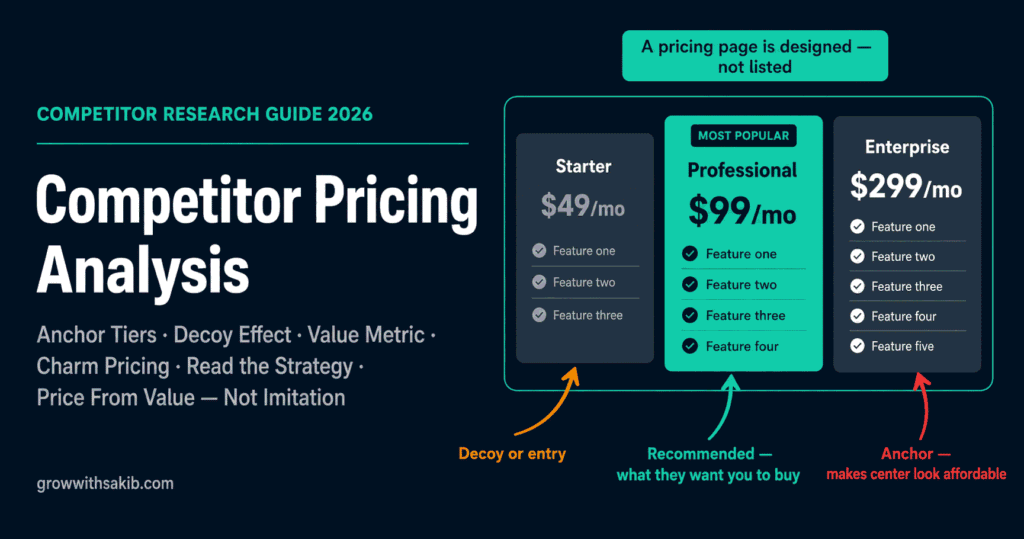
Most businesses do competitor pricing analysis like this: open three rivals’ pricing pages, note the numbers, set their own price somewhere in the middle. Then they wonder why their margins are thin and their pricing feels arbitrary.
Real competitor pricing analysis reads what’s behind the numbers. A competitor’s pricing page isn’t a price list — it’s a psychological structure engineered to push you toward a specific choice. Learn to read it, and you learn their entire value strategy.
This expands the pricing themes in our complete guide to competitor research. Pricing is where competitor research gets genuinely strategic — and where copying a rival can quietly destroy your margins.
Why Copying Competitor Prices Is a Trap
The instinct to match or undercut a competitor’s price feels safe. It isn’t. When you copy a price, you import assumptions you can’t see — their costs, their margins, their funding, their strategy — none of which are yours.
Pricing also carries enormous weight in whether a business survives. CB Insights lists pricing and cost issues among the common reasons startups fail, and a price set by imitation rather than value is exactly how that happens. Undercut a rival who has deeper pockets and you simply lose the margin war.
How to Read a Competitor’s Pricing Page
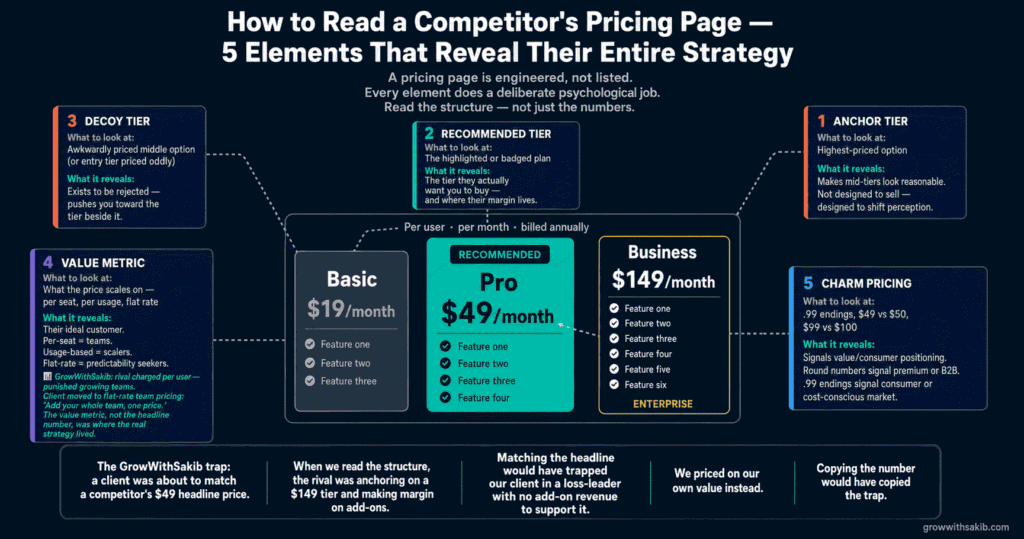
A pricing page is designed, not listed. Here’s what to look for and what each element reveals.
| Element | What to look at | What it reveals |
|---|---|---|
| Anchor tier | The highest-priced option | Makes mid-tiers look reasonable by comparison |
| The ‘recommended’ tier | The one they highlight | The tier they actually want you to buy |
| Decoy tier | An awkwardly-priced middle option | Exists to push you to the tier beside it |
| Value metric | What price scales on (seats, usage) | How they define and charge for value |
| Charm pricing | $49 vs $50, .99 endings | Signals a value/consumer positioning |
Anchoring: the highest price isn’t for selling
That expensive top tier often isn’t meant to sell much. It’s an anchor — it makes everything below it look affordable by comparison. Confirm which tier actually sells most by checking their organic keyword rankings for terms like “pricing” and “[brand] plans” — high-volume landing pages reveal where real conversion happens. When you see a competitor with a premium tier far above the others, they’re shaping perception, not just offering an option. The mid-tier suddenly feels like the sensible choice.
The decoy effect: the tier that exists to be rejected
Sometimes a middle tier is priced so close to the top one that it makes the top look like obvious value. That awkward tier is often a deliberate decoy — it exists to make the tier next to it irresistible. When a competitor’s tiers don’t seem to make rational sense, look again: the “illogical” one is usually doing a psychological job.
The value metric: what they actually charge for
The most strategic thing to identify is the value metric — the unit a competitor’s price scales on — and competitor keyword analysis can reveal how they talk about that metric in their paid and organic content. Per seat? Per usage? Flat? This reveals how they think about value and which customers they’re built for. A per-seat model targets teams; usage-based targets scalers; flat-rate targets predictability-seekers. The metric tells you their ideal customer more clearly than the number does.
Build a Competitor Pricing Map
Pull every competitor’s pricing into one view so you can see the shape of the market, not just individual numbers. For each, capture the tiers, the value metric, the highlighted plan, and any add-ons or hidden fees — using the tools covered in the competitor analysis framework to structure the map systematically.
Patterns jump out fast. If every competitor clusters at one price point, that’s the market’s comfort zone — and a gap above or below may be open. This is exactly the kind of price-and-model gap covered in our guide on how to identify market gaps, and it pairs naturally with a competitor SWOT analysis where pricing becomes a strength or weakness entry.
Price From Value, Not Imitation
The point of all this reading is not to copy better — it’s to price from your own value. Once you understand a competitor’s structure and target customer, you can position deliberately: above them if your value justifies it, below if you have a genuine cost advantage, or differently structured if their model leaves customers underserved — the shadow competitors often expose the biggest underserved gaps, including the “free workaround” that beats everyone on price.
Where a competitor’s reviews reveal customers frustrated by pricing — surprise fees, punishing per-seat costs — that’s a signal you can turn into an advantage. Mining competitor reviews often surfaces pricing complaints that point straight at a positioning move.
Common Mistakes to Avoid
- Copying the headline number. You import assumptions — costs, margins, strategy — that aren’t yours.
- Reading prices without structure. The tiers and value metric matter more than the numbers.
- Racing to undercut. A price war favours whoever has the deepest pockets, not you.
- Ignoring the value metric. It reveals a competitor’s ideal customer more than the price does.
- Treating pricing as fixed. Competitor pricing shifts — re-map it periodically using the complete competitor research framework to keep pricing analysis connected to the rest of your competitive intelligence.
An Honest Note on Pricing Analysis
Reading a competitor’s pricing tells you their structure and likely intent — it does not tell you their actual margins, costs, or whether their pricing even works for them. A confident-looking pricing page can sit on top of a struggling business. Don’t assume a rival’s pricing is optimal just because it’s polished.
Pricing psychology also varies by market and culture. Charm pricing that works for consumer products can cheapen a premium B2B service; anchoring that works in SaaS may feel manipulative in a trust-sensitive field. And pricing is one of the highest-stakes decisions a business makes — use competitor analysis to inform it, but test changes carefully rather than overhauling your pricing on a single read of a rival’s page. Set up competitor monitoring so you catch pricing changes early rather than reacting to them late.
Frequently Asked Questions
What is competitor pricing analysis?
Competitor pricing analysis is studying not just what rivals charge, but how and why they structure their pricing. It decodes the psychology behind tiers, anchors, and decoys to reveal a competitor’s value strategy and target customer. The goal is to price from your own value, informed by what rivals do, rather than blindly copying their numbers.
Should you match competitor prices?
Usually not. Copying a competitor’s price imports assumptions you can’t see — their costs, margins, funding, and strategy — none of which are yours. Matching or undercutting a rival with deeper pockets often just erodes your margin. Use competitor pricing to understand the market, then set your own price based on the value you deliver.
What is price anchoring?
Price anchoring is presenting a high-priced option to make other options look more reasonable by comparison. When a competitor shows an expensive top tier, it often isn’t meant to sell much — it exists to make the mid-tier feel like the sensible, affordable choice. Recognising the anchor tells you which plan the competitor actually wants you to buy.
What is the decoy effect in pricing?
The decoy effect is when a deliberately awkward middle tier is priced close to a higher one, making that higher tier look like obvious value. The decoy exists to be rejected — its job is to push buyers toward the option beside it. When a competitor’s tiers seem illogical, the odd one is usually doing this psychological work.
How do you read a competitor’s pricing page?
Look beyond the numbers at the structure: the anchor tier, the highlighted “recommended” plan, any decoy tier, the value metric the price scales on, and charm pricing like .99 endings. Each element reveals strategy — which plan they want you to buy, how they define value, and who their ideal customer is. The design is deliberate, not incidental.
What is a value metric in pricing?
A value metric is the unit a competitor’s price scales on — per seat, per usage, per project, or flat. It’s the most strategic thing to identify, because it reveals how a competitor defines value and which customers they’re built for. Per-seat targets teams, usage-based targets scalers, and flat-rate targets buyers who want predictability.
Is it worth undercutting competitors on price?
Rarely as a core strategy. A price war rewards whoever can absorb thinner margins longest — usually the better-funded competitor, not you. Undercutting also signals lower value and attracts price-sensitive customers who churn easily. It’s smarter to differentiate on value, experience, or a pricing model rivals don’t offer than to compete purely on a lower number.
Key Takeaways
- Competitor pricing analysis reads the strategy behind the numbers, not just the numbers.
- Copying a rival’s price imports their hidden costs, margins, and assumptions — a trap.
- A pricing page is engineered: anchors, decoys, and highlighted tiers all do a job.
- The highest tier is often an anchor, not a seller — it makes mid-tiers look reasonable.
- The value metric (per seat, usage, flat) reveals a competitor’s ideal customer.
- Map all competitors’ pricing together to see the market’s shape and open gaps.
- Price from your own value — above, below, or differently structured — not by imitation.
- A polished pricing page can hide a struggling business; don’t assume it’s optimal.