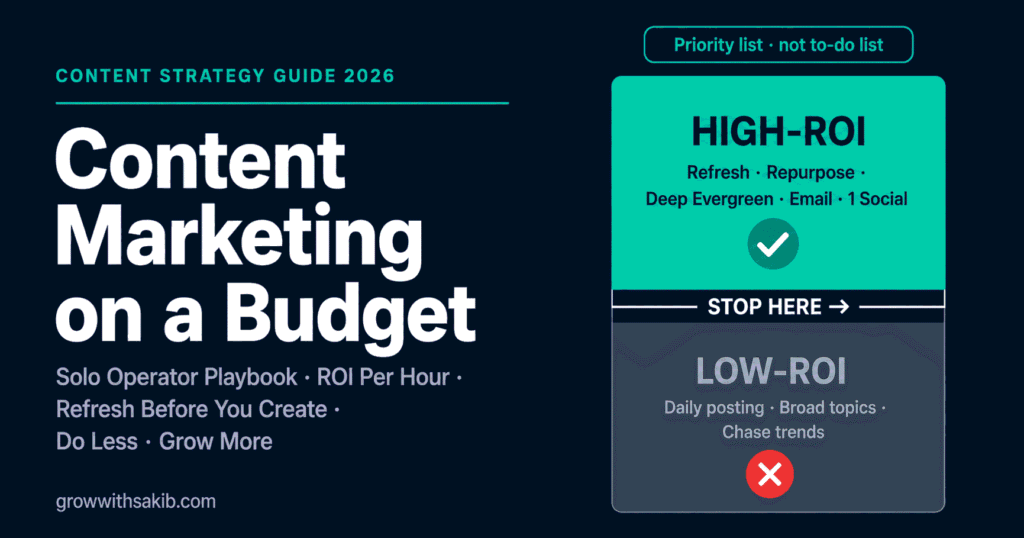
Everything you’ve read about content strategy sounds great – until you remember you’re running the whole business yourself, with a few spare hours a week and almost no budget. “This is wonderful, but I don’t have the time or the money” is the most honest response there is. So let’s answer it directly: you can’t do everything, and you don’t need to. You need to do the right few things, in the right order.
This is the practical, resource-light companion to the content strategy for small business guide on GrowWithSakib. It won’t add to your to-do list – it’ll help you cut it down to what actually matters when time and money are tight.
The Core Principle: Do Fewer Things That Compound
When resources are scarce, the winning move isn’t to do more with less – it’s to do less, better. A handful of strong, compounding assets beats a flood of forgettable ones. Big brands can afford to spray content everywhere; you can’t, and you shouldn’t try. Your advantage is focus.
“Compounding” is the key word. A paid ad stops the moment you stop paying. A well-written evergreen blog post keeps earning traffic and leads for years at almost no extra cost – the ROI logic covered on GrowWithSakib. So the whole game on a budget is to spend your scarce hours on things that keep paying you back. The Content Marketing Institute consistently finds that businesses with a focused, documented approach report more success than those spreading themselves thin.
The ROI-Per-Hour Priority Order
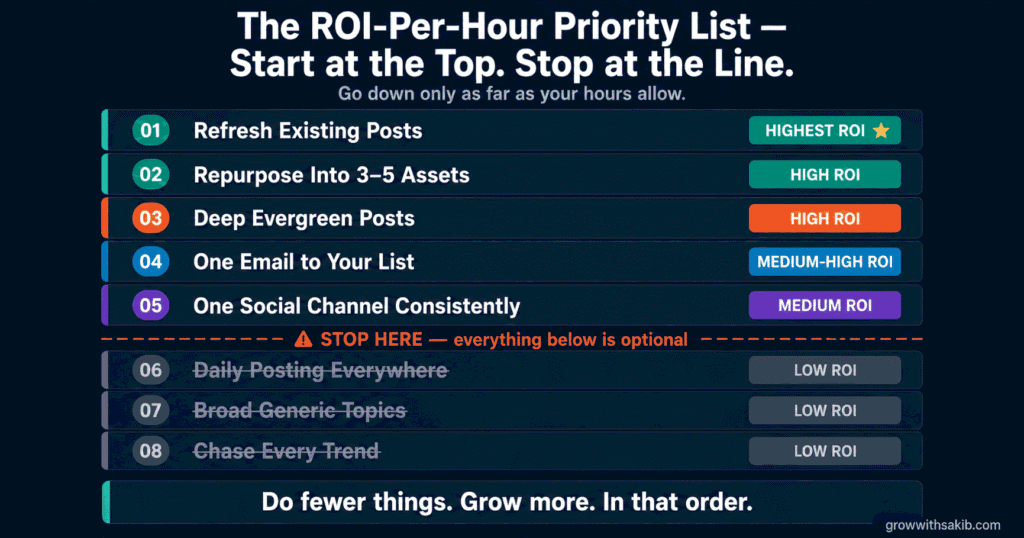
Here’s the framework that changes everything: judge every content activity by its return per hour, then work down the list until you run out of time. This is roughly how the activities rank for a typical small business:
| Priority / Activity | Why It’s High ROI per Hour |
|---|---|
| 01. Refresh existing content that’s decaying | Fastest wins – already ranks, small effort to recover |
| 02. Repurpose one strong asset into many | One piece becomes a week of content |
| 03. One deep evergreen post on a narrow, high-intent topic | Compounds for years; you can actually win it |
| 04. Email to your owned audience | Direct, free, high-converting, you own the list |
| 05. Consistent presence on ONE social channel | Focus beats spreading thin |
| 06. (Lower ROI per hour below this line) | Do these only if time remains |
| 07. Daily posting from scratch on every platform | Huge time, low return, unsustainable solo |
| 08. Broad, generic topics big brands own | You’ll lose; wasted hours |
| 09. Chasing every new platform and trend | Spreads you too thin to compound |
The discipline is simple: start at the top and go down only as far as your hours allow. Most time-poor owners get more from refreshing and repurposing – the top of the list – than from frantically creating new content, which usually sits lower than people assume.
Which Content Types Deliver the Most ROI Per Hour
Three formats do the heaviest lifting on a budget, and it’s worth knowing why:
- Evergreen SEO blog posts – the compounding engine. One deep post on a topic people search for keeps earning traffic for years. This is where your limited creation time should mostly go.
- Email to your list – the highest-converting channel you fully own. Unlike social, no algorithm sits between you and your audience. A simple monthly email to past and potential customers punches far above its time cost.
- Repurposed social – not created from scratch, but sliced from your blog posts, so the marginal time cost is tiny. Leverage, not new work.
Using AI to Accelerate – Responsibly
AI is the biggest gift the budget content marketer has ever been handed – used correctly. It accelerates the slow parts, letting one person produce far more. But used lazily, it produces exactly the generic content that gets ignored. The line matters.
| Let AI Do This | But You Must Do This |
|---|---|
| Draft outlines and first drafts | Direct the angle; heavily edit and rewrite |
| Suggest topics and headlines | Choose what fits your audience and expertise |
| Repurpose a post into social drafts | Add your voice; fact-check every claim |
| Fix grammar and tighten copy | Add real examples, data, and experience |
The rule: AI drafts, you direct and finish. Never publish raw AI output. The thing AI cannot supply is the one thing that makes small-business content win – your real experience, your specific examples, your honest judgement. Tools like ChatGPT, Canva, and Grammarly cut your production time; your expertise is what makes the result worth reading. Layer in what only you know, every time.
When to Repurpose vs Create New
This decision alone can double your output. The default answer, on a budget, is repurpose first – it’s far cheaper than creating from scratch. Use this simple rule:
- Repurpose when you already have a strong asset that isn’t fully leveraged – a good blog post that never became social content, a webinar not turned into articles, an FAQ not made into posts. Most owners are sitting on far more unleveraged content than they realise.
- Create new when there’s a genuine gap – a high-intent topic you haven’t covered, or a stage of the buyer journey with no content. Create to fill a real hole, not out of habit.
In practice, one strong new piece a week or two, fully repurposed, keeps you visible everywhere without the cost of constant creation. The full method is in the content repurposing strategy on GrowWithSakib – one post becoming a week of content is the budget marketer’s core skill. And before creating anything new, check whether refreshing an existing post on GrowWithSakib would get you further for less effort.
How One Person Maintains a Schedule
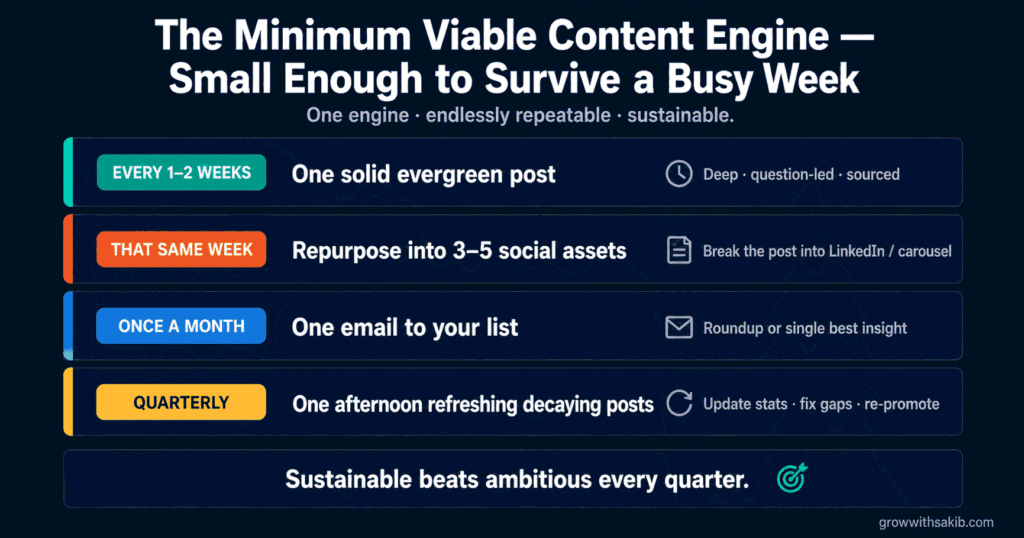
The secret to consistency as a solo operator isn’t discipline – it’s a small enough system that survives a busy week. Here’s a minimum viable content engine that runs on a few hours:
Two habits make it stick: batch (write two or three posts in one focused session so a busy week doesn’t break your streak) and plan lightly ahead with a simple content calendar on GrowWithSakib. A modest schedule you actually keep beats an ambitious one you abandon in a fortnight – every single time.
What to Skip (Saying No Is a Strategy)
On a budget, what you refuse to do matters as much as what you do. Give yourself permission to skip:
- Being on every platform – pick one or two where your audience actually is; ignore the rest.
- Daily posting – consistency at a sustainable cadence beats daily output you can’t maintain.
- Broad, competitive topics – leave the generic head terms to the big brands; own your narrow niche.
- Vanity metrics – likes and impressions don’t pay bills; track traffic, leads, and revenue instead.
- Expensive tools you don’t need yet – free tools cover the essentials until you genuinely outgrow them.
Every hour you don’t spend on a low-ROI activity is an hour you can spend on a compounding one. Ruthless focus isn’t a limitation of the budget business – it’s its competitive advantage.
Common Budget Content Marketing Mistakes
| Mistake | Why It Hurts | Do This Instead |
|---|---|---|
| Trying to do everything | Spreads you too thin to compound | Do fewer things by ROI per hour |
| Creating new before repurposing | Wastes your scarcest resource – time | Repurpose and refresh first |
| Publishing raw AI content | Generic, hollow, ignored | AI drafts; you add experience and edit |
| Chasing broad, competitive topics | You lose to big brands | Win narrow, high-intent niches |
| Being on every platform | Unsustainable solo | Pick one or two channels |
| Over-ambitious schedule | Abandoned in two weeks | Build a minimum viable engine |
| Tracking vanity metrics | Feels productive, isn’t | Track traffic, leads, revenue |
Frequently Asked Questions
1. How do I do content marketing on a small budget?
Prioritise by ROI per hour. Refresh existing content and repurpose what you already have before creating anything new. Spend your limited creation time on fewer, deeper evergreen posts targeting narrow, high-intent topics where you have real experience. Use AI to accelerate drafting but add your own expertise and edit heavily. Run a small, sustainable schedule – one solid post every week or two, repurposed into one social channel, plus a monthly email. Consistency beats volume when resources are tight.
2. Which content gives the most ROI per hour?
For most small businesses, the highest-ROI-per-hour activities are, in order: refreshing existing content that’s decaying (fastest wins), repurposing one strong asset into many pieces, writing one deep evergreen post on a narrow high-intent topic (it compounds for years), and emailing your owned audience. Lower down are daily posting from scratch, broad competitive topics, and chasing every platform – high effort, low return. Start at the top of that list and work down only as far as your hours allow.
3. Should I use AI to create content on a budget?
Yes, to accelerate – not to replace you. AI is excellent for drafting outlines and first drafts, suggesting topics, repurposing posts into social drafts, and tightening copy, which lets one person produce far more. But never publish raw AI output: it’s generic and gets ignored. Direct the angle, edit heavily, fact-check every claim, and layer in your real experience, specific examples, and honest opinions. AI makes content faster; your expertise makes it worth reading. That combination is the budget marketer’s edge.
4. Should I repurpose content or create new content?
On a budget, default to repurposing – it’s far cheaper than creating from scratch. Repurpose when you have a strong asset that isn’t fully leveraged, like a good blog post that never became social content or an FAQ you haven’t turned into posts. Create new only when there’s a genuine gap: a high-intent topic you haven’t covered or a buyer-journey stage with no content. Most owners are sitting on far more unleveraged content than they realise, so repurposing usually wins on cost per result.
5. How can one person keep up with content marketing?
Build a system small enough to survive a busy week rather than relying on willpower. A workable minimum: one evergreen post every one to two weeks (AI-drafted, you rewrite), repurposed into three to five posts on one main social channel, plus one monthly email, and a quarterly afternoon refreshing your top decaying posts. Batch your writing – do two or three posts in one focused session – and plan lightly ahead with a simple calendar. A modest schedule you keep beats an ambitious one you abandon.
6. What content should a small business focus on first?
Start with what compounds and what you already have. First, refresh existing posts that are decaying – the fastest, cheapest wins. Second, repurpose your best existing content across channels. Third, invest your creation time in one deep evergreen post on a narrow, high-intent topic where you have genuine experience. Support it with a simple monthly email to your owned list. Skip broad competitive topics, daily posting, and being on every platform until you’ve mastered these compounding basics.
7. Can content marketing work without any budget?
Yes – content marketing is uniquely suited to near-zero budgets because the main investment is time and thought, not ad spend. Free tools (Google Search Console, Google Analytics, Canva’s free tier, and AI assistants) cover the essentials, and a single evergreen blog post can generate leads for years at no ongoing cost. The trade-off is time and patience: content takes months to compound. But for a business with more time than money, it’s often the single most cost-effective growth channel available.
8. How do I compete with big brands on a small budget?
Don’t fight them where they’re strong – fight where they’re weak. Big brands own broad, generic keywords, and AI already answers basic questions, so competing there is a losing battle. Instead, win on narrow, specific, high-intent topics tied to your real experience and niche – the questions your exact customers ask that big brands are too broad to answer well. Your agility, authenticity, and lived expertise are advantages no large competitor or AI can replicate. Focus beats budget.
Key Takeaways
- On a budget, do fewer things that compound – a handful of strong, lasting assets beats a flood of forgettable ones.
- Prioritise by ROI per hour: refresh existing content and repurpose first, then write deep evergreen posts, then email your list – and work down only as far as your hours allow.
- The highest-ROI content types are evergreen SEO posts (compound for years), email (owned, high-converting), and repurposed social (tiny marginal cost).
- Win on narrow, high-intent topics tied to your real experience – not broad terms big brands and AI already own.
- Use AI to accelerate drafting and repurposing, but direct it, edit heavily, and add your own experience – never publish raw AI output.
- Default to repurposing over creating new; create new only to fill a genuine content or funnel gap.
- Sustain a schedule with a minimum viable engine: one post every 1-2 weeks, repurposed into one channel, plus a monthly email – small enough to survive a busy week.
- Saying no is a strategy: skip every-platform posting, daily output, broad topics, and vanity metrics to protect time for compounding work.