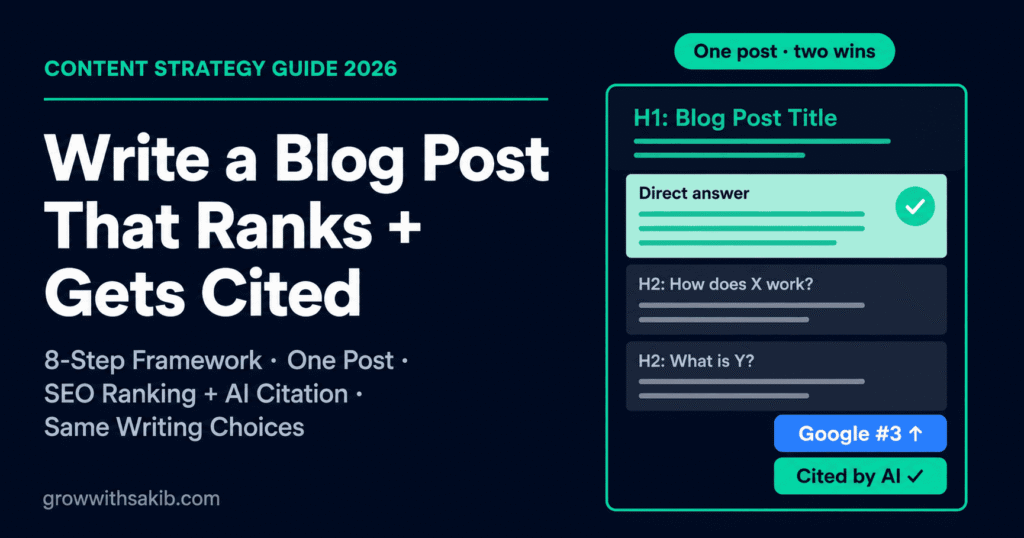
For years, writing a blog post meant writing for Google. Now it means writing for Google and for the AI engines – ChatGPT, Perplexity, and Google’s own AI Overviews – that increasingly answer your customers’ questions directly. The good news: the changes are specific, not radical, and the same good structure serves both.
This is the practical, beginner-friendly framework for how to write a blog post that ranks and earns AI citations – long-form blog posts being the foundation of both SEO and GEO. It’s the writing how-to for the content strategy for small business guide on GrowWithSakib. Follow it top to bottom, and see the difference it makes in the before/after at the end.
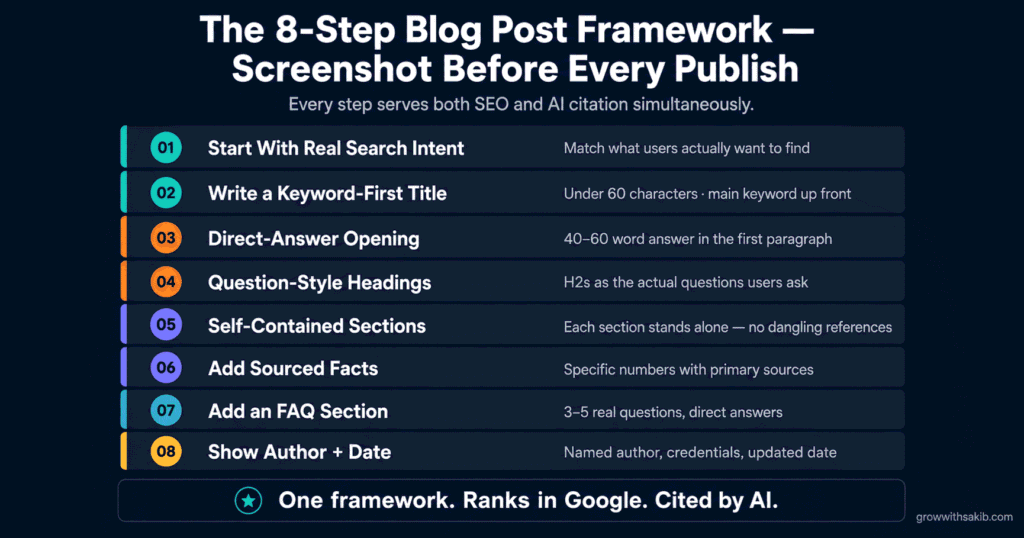
The Blog Post Framework: 8 Steps
Here’s the full process, in order. Each step notes what it does for SEO and for AI (GEO).
Step 1: Match Search Intent and Map the Questions
Before writing a word, Google your target keyword and study the top results. What format wins – a how-to, a list, a definition? Match it. Then build a question map: collect the real questions people ask from Google’s People Also Ask, autocomplete, and by typing your topic into ChatGPT. These questions become your headings. Find them the way the content audience profile guide on GrowWithSakib describes.
SEO: matching intent is the single biggest ranking factor. AI: covering the real questions means you answer the sub-queries AI breaks a topic into.
Step 2: Write the Title Tag and H1
Put your primary keyword near the front of your title, and keep the title tag under about 60 characters so it doesn’t get cut off. Your H1 (the on-page headline) should include the keyword too and clearly state what the post delivers. Write it for a human to click, not just for a crawler.
SEO: the title tag is a core ranking and click signal. AI: it’s often the first thing an AI uses to categorise what your page is about.
Step 3: Open With a Direct Answer
This is the highest-impact GEO change, and most posts get it wrong. In your first one to three sentences, answer the main question directly – before any story, background, or warm-up. Put it in a short, plain-language summary at the very top (a highlighted box works well). Then expand below for readers who want depth.
SEO: it satisfies searchers instantly and can win a featured snippet. AI: engines extract answers from the top of the page – a buried answer gets skipped for a competitor who led with theirs.
Step 4: Use Real Questions as Your H2 Headings
Turn your question map into headings. Phrase H2s as the actual questions people ask (“How much does X cost?”) rather than vague labels (“Costs”). Keep a clean hierarchy: one H1, then H2s, then H3s for sub-points, in order. Map primary questions to H2s and follow-up questions to H3s.
SEO: question headings match how people search and target PAA boxes. AI: they map directly to the sub-questions AI is trying to answer, and clean heading order helps it parse your page.
Step 5: Lead Each Section With Its Answer
Under every heading, answer the question in the first sentence, then add context, examples, and detail. Each section should make sense on its own, so a reader – or an AI – can lift it out and still understand it. This is the answer-first habit applied section by section.
SEO: skimmable sections lower bounce and keep readers engaged. AI: self-contained, answer-first passages are exactly what engines extract and cite.
Step 6: Back Claims With Specific, Sourced Statistics
Replace vague claims with specific, verifiable facts, and link each statistic to its original source – the actual study or report, not a roundup. The Princeton GEO study found that adding statistics and citations meaningfully increases how often generative engines cite a page. “Many businesses struggle” is worthless; “a 2026 survey found 40% of businesses struggle with X (linked)” is citable.
SEO: sourced data builds E-E-A-T and trust. AI: specific, attributed numbers are citation magnets – and get the free statistics right using the statistics-rich content guide on GrowWithSakib.
Step 7: Place Keywords and Internal Links Naturally
Use your primary keyword in the title, H1, and within the first 100 words, then naturally through the body and a couple of H2s – never stuffed. Add internal links with descriptive anchor text to your related posts, so you build a connected cluster rather than isolated articles. This is how you build topical authority on GrowWithSakib.
SEO: natural keyword placement and internal links signal relevance and structure. AI: linked clusters help engines see you as an authority on the whole topic, not one page.
Step 8: Add an FAQ Section
Finish with an FAQ of three to seven real questions your body didn’t fully cover – phrased exactly as users ask them, each answered in a direct sentence of roughly under 60 words. FAQs are one of the most reliable citation magnets there is, because the question-and-answer format matches how AI retrieves information. This also feeds answer engine optimisation on GrowWithSakib.
SEO: FAQs capture featured snippets and PAA placements. AI: clean Q&A pairs are among the most-cited content in AI answers.
The Framework at a Glance
Here’s the whole framework in one checklist – run it on every post before you publish.
| Step / Do This | Serves |
|---|---|
| 01. Match search intent + map real questions | SEO + AI |
| 02. Keyword near front of title tag (<60 chars) and H1 | SEO + AI |
| 03. Open with a direct answer in the first 1-3 sentences | SEO + AI |
| 04. Use real questions as H2s; clean H1-H2-H3 order | SEO + AI |
| 05. Lead each section with its answer | SEO + AI |
| 06. Back claims with specific, source-linked stats | SEO + AI |
| 07. Keyword in first 100 words; internal links | SEO + AI |
| 08. Add an FAQ of real questions, ~60-word answers | SEO + AI |
| 09. Named author bio + visible last-updated date | SEO + AI |
That last row matters too: a named author with a short bio and a visible last-updated date both signal trust and freshness, which Semrush’s research on AI Overviews found favours expert-led, well-sourced, current content. They’re small additions with real weight.
Before and After: The Same Post, Two Ways
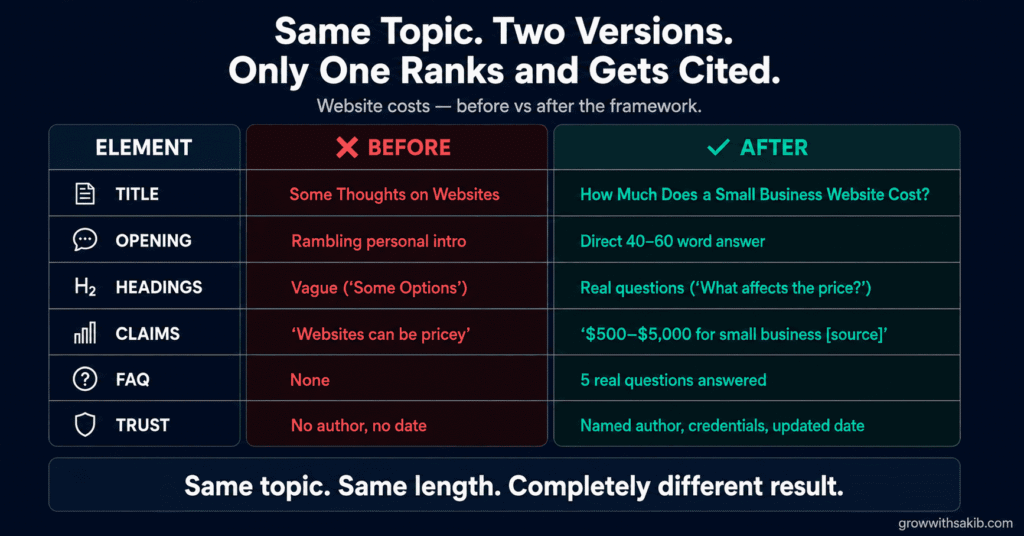
Here’s the framework in action. Below is the same short blog post – answering “how much does a small business website cost?” – written first without the framework, then with it. Watch what changes.
Before: Written Without the Framework
The problems: the title has no keyword, the opening answers nothing, the headings are vague labels, the claim is unverifiable mush, and there’s nothing for AI to extract or trust. Google struggles to rank it; AI has nothing to cite.
After: Written With the Framework
The difference: the keyword leads the title, the answer arrives immediately, the headings match real searches, the claim is specific and sourced, and the FAQ gives AI clean Q&A pairs to cite. (Use a real, sourced figure in that stat line – the bracket is a placeholder, not a number to invent.) Same topic, same length – completely different result on both Google and AI.
| Element | Before | After |
|---|---|---|
| Title | Vague, no keyword | Keyword-first, clear, under 60 chars |
| Opening | Fluffy warm-up | Direct answer in the first sentences |
| Headings | “Introduction,” “Things to Consider” | Real questions people ask |
| Claims | Vague and unverifiable | Specific, with a linked source |
| FAQ | None | 5 real questions, ~60-word answers |
| Trust signals | No author or date | Named author + last-updated date |
An Honest Word on What This Does and Doesn’t Do
Keep expectations grounded:
- Structure amplifies quality; it doesn’t replace it – the framework makes genuinely helpful content findable and citable. It won’t rescue thin content that says nothing new.
- Ranking still underpins citations – AI answers lean heavily on pages that already rank, so the SEO half of this matters as much as the GEO half. They’re partners, not rivals.
- Be sceptical of precise citation stats – you’ll see confident claims that this or that tactic lifts citations by an exact percentage. The direction is well-supported; the specific numbers are often vendor-stated, so measure your own.
- It compounds over time – one framework-built post is good; a connected cluster of them is what builds lasting authority. Track results with the guide to measuring GEO performance on GrowWithSakib.
Common Blog-Writing Mistakes
| Mistake | Why It Hurts | Do This Instead |
|---|---|---|
| Burying the answer in a warm-up | Google and AI skip it | Lead with a direct answer up top |
| Vague label headings | Miss searches and sub-questions | Use real questions as H2s |
| Unverifiable claims | Nothing for AI to cite | Add specific, source-linked stats |
| Keyword stuffing | Reads badly; can hurt ranking | Place keywords naturally in key spots |
| Skipping the FAQ | Misses the easiest citation win | Add real-question FAQ answers |
| Isolated posts | No topical authority | Internally link into a cluster |
| No author or date | Weak trust and freshness signals | Add a named author and last-updated date |
Frequently Asked Questions
1. How do I write a blog post that ranks on Google and gets cited by AI?
Fuse SEO structure with GEO signals in one process: match search intent, put your keyword near the front of the title tag and H1, open with a direct answer, use real questions as H2 headings, lead each section with its answer, back claims with specific sourced statistics, add internal links, and finish with an FAQ. The same structure that helps Google rank you also helps AI extract and cite you, so you write one post for both.
2. What is the most important part of a blog post for AI citations?
Opening each section – and the whole post – with a direct answer. AI engines extract answers from the top of a page and skip content that buries the point under a long warm-up. Put a clear, plain-language answer in your first one to three sentences, then expand. Combined with a strong FAQ section, this answer-first structure is the single biggest driver of whether AI cites your post.
3. Where should I put my keyword in a blog post?
Put your primary keyword near the front of the title tag (under about 60 characters), in your H1, and within the first 100 words of the post. Then use it naturally through the body and in a couple of H2 headings. Don’t stuff it – modern search rewards natural, helpful writing and can penalise obvious keyword stuffing. Natural placement in those key spots is enough to signal relevance.
4. Should blog headings be questions?
Yes, where natural. Phrasing H2 headings as the real questions people ask (“How much does X cost?”) rather than vague labels (“Costs”) matches how people search and how AI breaks a topic into sub-questions. Build a question map from People Also Ask, autocomplete, and ChatGPT, then map primary questions to H2s and follow-ups to H3s. Keep a clean H1-H2-H3 order so both Google and AI can parse your structure.
5. Does an FAQ section help with SEO and AI?
Yes – it’s one of the highest-return additions you can make. An FAQ of real user questions, each answered directly in about 60 words, captures featured snippets and People Also Ask placements for SEO, and gives AI engines clean question-and-answer pairs that are among the most-cited content in AI answers. Add three to seven questions your main sections don’t fully cover, phrased exactly as users would ask them.
6. How long should a blog post be to rank and get cited?
Long enough to fully answer the question and its follow-ups – not a fixed word count. For competitive informational topics, that often means comprehensive, long-form coverage, because depth signals authority to Google and gives AI more to work with. But padding hurts: every section must earn its place. Aim to cover the topic more completely than the current top results, then stop – quality and completeness matter more than hitting a length target.
7. Do I still need traditional SEO if I’m optimising for AI?
Yes – more than ever. AI answers draw heavily from pages that already rank well in traditional search, so SEO is the foundation GEO builds on, not a replacement for it. The encouraging part is that they reward the same things: clear structure, direct answers, specific facts, and genuine expertise. Writing one well-structured post with this framework serves both channels at once, which is why they’re partners rather than competing priorities.
8. Why isn’t my well-written blog post getting cited by AI?
Usually because of structure, not quality. If your answer is buried under a long introduction, your headings are vague labels, your claims are unverifiable, or you have no FAQ, AI has nothing clean to extract – even from an expert post. Rewrite it to lead with direct answers, use question headings, add specific sourced statistics, and include an FAQ. Also confirm the page is crawlable and actually ranks, since citations lean on ranking.
Key Takeaways
- Write one post for two audiences – Google and AI engines reward the same things, so the same structure serves both; you don’t write two versions.
- Match search intent first, then map real questions from People Also Ask and ChatGPT to use as your headings.
- Put your keyword near the front of the title tag (under 60 characters), in the H1, and within the first 100 words.
- Open the post and every section with a direct answer – this is the single biggest driver of AI citations, since engines extract from the top.
- Use real questions as H2 headings, keep a clean H1-H2-H3 order, and back claims with specific statistics linked to their original source.
- Add internal links to related posts to build a cluster, and finish with an FAQ of real questions answered in about 60 words – a top citation magnet.
- Include a named author bio and a visible last-updated date for trust and freshness, which AI Overviews research shows are favoured.
- Ranking still underpins citations and structure amplifies (not replaces) quality – so keep SEO strong and make every section genuinely useful.