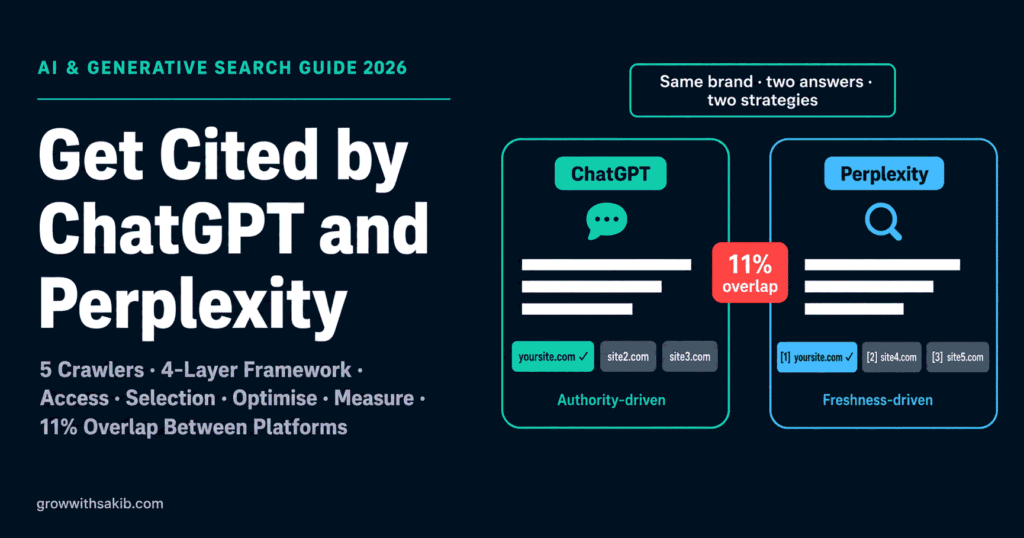
ChatGPT and Perplexity are the two biggest standalone AI answer tools, and getting cited in them works differently from Google. There’s a technical layer (letting the right crawlers in) and a strategy layer (matching how each platform chooses sources) – and most guides only cover one.
This is a practical, platform-specific playbook for getting cited by ChatGPT and Perplexity. It expands the measurement and tactics sections of the complete guide to generative engine optimization on GrowWithSakib. For Google’s platform specifically, see the companion guide on getting cited in Google AI Overviews.
Layer 1: Access – Which Crawlers Must You Allow?
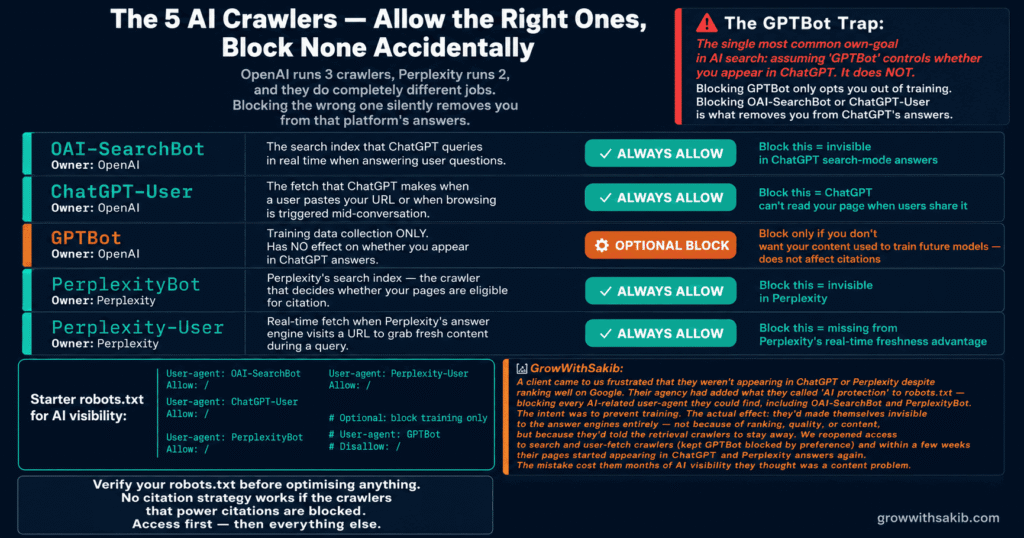
Before either platform can cite you, its crawler has to be able to read your site. If you block the wrong bot in robots.txt, you make yourself invisible – and this is the single most common own-goal in AI search.
OpenAI’s Crawlers (for ChatGPT)
OpenAI runs three separate crawlers, and the distinction is critical. Per OpenAI’s crawler documentation:
- OAI-SearchBot – powers ChatGPT’s search and citations. This is the one that gets you into ChatGPT search results. Allow it.
- ChatGPT-User – fetches a page on demand when a user asks ChatGPT to read a specific URL. Allow it.
- GPTBot – crawls content for model training. Blocking this only opts you out of training; it does NOT remove you from ChatGPT search.
Perplexity’s Crawlers
Perplexity runs two crawlers, per Perplexity’s official crawler documentation:
- PerplexityBot – builds and refreshes the index behind cited answers. Block this and you disappear from Perplexity. Allow it.
- Perplexity-User – fetches pages in real time when a user asks a live question. Because it’s user-triggered, it may not follow robots.txt.
A copy-ready starter robots.txt for AI search visibility:
| # Allow AI search crawlers (get cited) User-agent: OAI-SearchBot Allow: / User-agent: ChatGPT-User Allow: / User-agent: PerplexityBot Allow: / User-agent: Perplexity-User Allow: / # Optional: opt out of model training only User-agent: GPTBot Disallow: / |
Two practical notes. Changes can take up to 24 hours to register on each platform. And both vendors publish IP-range files (like OpenAI’s searchbot.json and Perplexity’s perplexitybot.json) so you can verify a crawler is genuine in your server logs. This access layer sits on top of solid technical SEO on GrowWithSakib – crawlable pages, content in HTML, no accidental blocks.
Layer 2: Selection – How Does Each Platform Choose Sources?
ChatGPT and Perplexity pick sources in genuinely different ways, so the same page can be cited by one and ignored by the other. In fact, cross-platform analysis by Leapd found only about 11% of domains overlap between the two. They are not one channel.
How ChatGPT Chooses Sources
ChatGPT searches selectively. For many queries it answers from training data and doesn’t search the web at all; it searches when the question seems to need fresh or specific information. When it does cite, it tends to pull fewer sources but absorb them deeply – the cited page’s framing shapes the whole answer.
The practical implication: for ChatGPT, authority and clear structure win. Being a recognised, well-structured source on a topic raises your odds of being the one it leans on. A single ChatGPT citation carries a lot of weight because it shapes what the user reads.
How Perplexity Chooses Sources
Perplexity is retrieval-first: it runs a real-time web search on nearly every query, reads candidate pages, and synthesises an answer with dense, inline numbered citations. It cites more sources per answer than ChatGPT and has no knowledge cutoff – fresh content can be cited within hours of being crawled.
The practical implication: for Perplexity, freshness and specificity win. Recently published or updated content with specific data competes well, even from smaller sites, because Perplexity actively crawls rather than leaning on training data. Its real-time model creates more openings for newcomers.
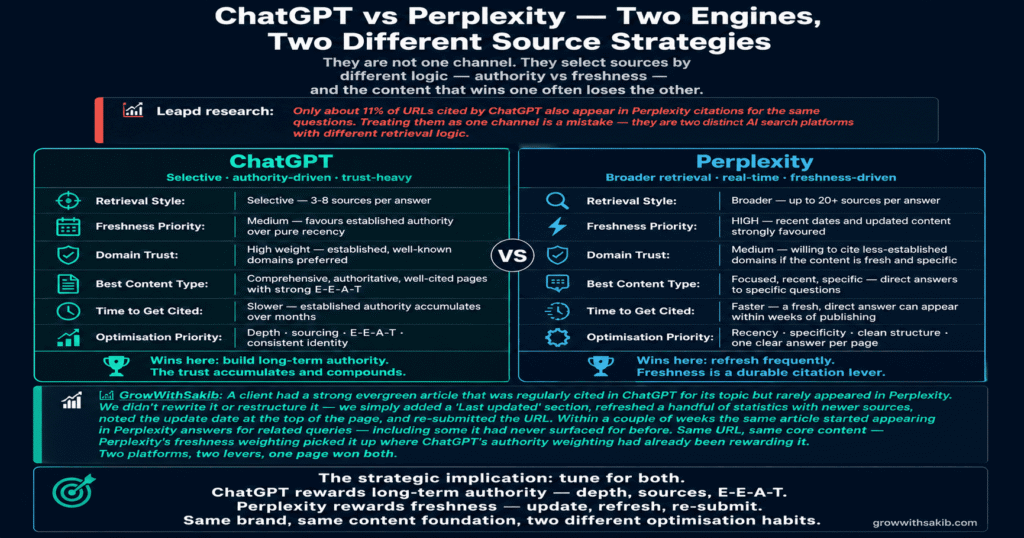
ChatGPT vs Perplexity: The Source-Selection Comparison
| Factor | ChatGPT (with search) | Perplexity |
| Search behaviour | Selective – searches when needed | Real-time – searches nearly every query |
| Citation density | Fewer sources, absorbed deeply | Many sources, inline numbered |
| Knowledge cutoff | Falls back to training data | No cutoff – continuous crawl |
| Rewards most | Authority + clear structure | Freshness + specificity |
| Opportunity for | Recognised, structured sources | Fresh content, smaller sites |
| Search crawler | OAI-SearchBot | PerplexityBot |
Layer 3: Optimise – What to Do Differently for Each
Most optimisation helps both platforms, but a few moves are platform-specific. Start with the shared foundation, then tune.
The Shared Foundation (Helps Both)
- Lead with direct answers – both extract cleaner passages when the answer comes first. This is the core skill in structuring content for AI summaries.
- Structure clearly – question headings, short paragraphs, lists, and tables help both parse your meaning.
- Add specific, sourced facts – verifiable data is citable on both platforms; vague claims are not.
- Build entity recognition – both favour sources they can identify as a known, consistent brand.
Tune for ChatGPT: Authority
Because ChatGPT leans on recognised sources, invest in authority signals: genuine credentials and author bios, being mentioned across reputable third-party sites, and consistent entity signals. Strengthen the work in the guide to entity optimisation on GrowWithSakib, since ChatGPT is more likely to trust and absorb a clearly-established source.
Tune for Perplexity: Freshness
Because Perplexity rewards recency, keep content current: update key pages regularly with fresh data, publish on time-sensitive topics, and make sure updated pages get recrawled. A genuinely current, specific page can beat an older, higher-authority one on Perplexity – a real opening if you publish consistently.
Layer 4: Measure – How to Test If You’re Cited
Neither platform gives you a clean “citations” dashboard, so you test manually. The process is simple and costs nothing – and doing it regularly builds real intuition about what each platform likes.
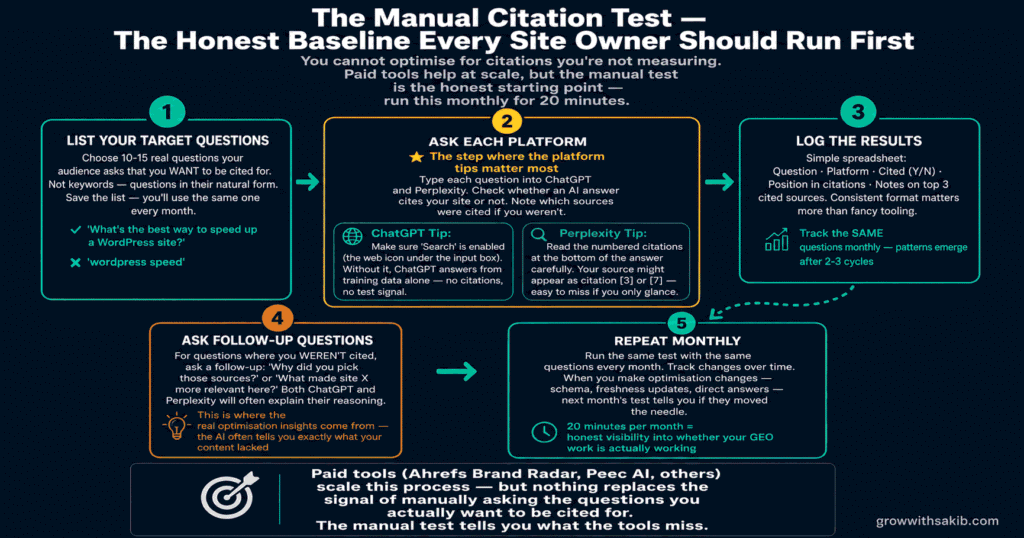
The Manual Citation Test (Both Platforms)
- List your target questions – the real queries where you’d want to be cited, in natural language.
- Ask each platform directly – run each question in ChatGPT (with search on) and in Perplexity, and note who gets cited.
- Log the results – record whether you appear, which competitors do, and which page of yours (if any) is cited.
- Ask follow-ups – probe with “what are the best sources on this?” to see the wider citation set each platform trusts.
- Repeat on a schedule – citations shift as models and indexes update, so re-test monthly and watch the trend.
Two platform-specific tips:
- ChatGPT – make sure search is actually active (look for the searching indicator and source links); if it answered from training data, your query may not have triggered a search.
- Perplexity – citations are inline and numbered, so it’s easy to see exactly which sources were used and where you rank in the list.
Track these AI citations alongside your normal traffic using the approach in the guide to tracking SEO results on GrowWithSakib. Specialist AI-visibility tools can automate this at scale, but the manual test is the honest baseline every site owner should run first.
An Honest Word on the Data and Limits
Treat cross-platform citation statistics with caution. You’ll see confident figures for exact source breakdowns, conversion multiples, and citation rates, but many are vendor-stated, drawn from small samples, or fast-changing. The directional patterns here – ChatGPT selective and authority-driven, Perplexity real-time and freshness-driven – are well-supported across sources; the precise percentages often aren’t.
Two honest limits. User-triggered fetchers like Perplexity-User may ignore robots.txt, so your control isn’t absolute. And nothing guarantees a citation – allowing crawlers and optimising well raises your probability, but both platforms change constantly. Build durable quality, test often, and don’t chase any single number.
Common Mistakes Getting Cited by ChatGPT and Perplexity
| Mistake | Why It Hurts | Do This Instead |
|---|---|---|
| Blocking GPTBot to stop ‘AI theft’ | Doesn’t affect ChatGPT search; false comfort | Block GPTBot but allow OAI-SearchBot |
| Blanket-blocking all AI bots | Erases you from AI search entirely | Allow OAI-SearchBot and PerplexityBot |
| Treating both platforms the same | They pick sources differently | Tune authority for ChatGPT, freshness for Perplexity |
| Letting content go stale | Perplexity favours fresh pages | Update key pages and get them recrawled |
| Weak authority signals | ChatGPT leans on recognised sources | Build credentials and entity recognition |
| Never testing citations | You’re optimising blind | Run the manual test monthly per platform |
| Trusting exact vendor stats | Many are shaky or fast-changing | Follow the directional patterns instead |
Frequently Asked Questions
1. How do I get cited by ChatGPT and Perplexity?
First allow their search crawlers in robots.txt – OAI-SearchBot for ChatGPT and PerplexityBot for Perplexity – so they can read your site. Then optimise for how each picks sources: ChatGPT rewards authority and clear structure, Perplexity rewards freshness and specificity. Structure content for clean extraction, back claims with specific facts, keep it current, and test each platform manually to confirm you’re cited.
2. Which crawlers do I need to allow for AI search?
Allow OAI-SearchBot (powers ChatGPT search citations) and PerplexityBot (builds Perplexity’s index), plus the user-triggered ChatGPT-User and Perplexity-User. Per OpenAI’s and Perplexity’s official crawler documentation, these are the agents behind citations. Blocking them removes you from AI search answers, so make sure your robots.txt doesn’t accidentally disallow them.
3. Does blocking GPTBot remove me from ChatGPT search?
No. GPTBot only controls whether your content is used for model training. ChatGPT search citations come from a different crawler, OAI-SearchBot. So you can block GPTBot to opt out of training while still allowing OAI-SearchBot to keep appearing in ChatGPT search. Blocking GPTBot alone does not affect your ChatGPT search visibility.
4. How is getting cited by ChatGPT different from Perplexity?
ChatGPT searches selectively and cites fewer sources but absorbs them deeply, so authority and clear structure matter most. Perplexity searches in real time on nearly every query, cites many sources inline, and has no knowledge cutoff, so freshness and specificity matter most. Cross-platform analysis found only about 11% domain overlap, so they genuinely reward different things.
5. Why does Perplexity cite fresh content so quickly?
Because Perplexity runs a real-time web search on nearly every query with no knowledge cutoff, so newly published or updated content can be cited within hours of being crawled. This differs from ChatGPT, which often answers from training data and searches only selectively. Perplexity’s real-time model rewards recency, giving fresh, specific content – even from smaller sites – a genuine chance to be cited.
6. Will blocking AI crawlers protect my content?
Blocking training crawlers like GPTBot opts you out of model training, which is a valid choice. But blocking the search crawlers (OAI-SearchBot, PerplexityBot) removes you from AI search answers entirely – a steep cost. Note that user-triggered fetchers like Perplexity-User may ignore robots.txt anyway. Decide training and search separately rather than blanket-blocking everything.
7. How do I check if I’m cited in ChatGPT or Perplexity?
Test manually. List your target questions, ask each one in ChatGPT (with search enabled) and in Perplexity, and note who gets cited. In ChatGPT, confirm search actually activated by looking for source links; in Perplexity, the inline numbered citations make your position obvious. Log the results and repeat monthly, since citations shift as the platforms update their models and indexes.
8. Do I need different content for ChatGPT and Perplexity?
Not different content – a shared foundation with different emphasis. Both reward direct answers, clear structure, specific facts, and entity recognition. Beyond that, lean into authority for ChatGPT (credentials, third-party mentions, consistent brand signals) and freshness for Perplexity (regular updates, current data, timely topics). One well-structured page, tuned on these two dimensions, can perform on both.
Key Takeaways
- Getting cited works in four layers: allow the right crawlers (access), match how each picks sources (selection), optimise per platform, and test (measure).
- Allow OAI-SearchBot for ChatGPT and PerplexityBot for Perplexity – these crawlers power citations, and blocking them makes you invisible in AI search.
- The GPTBot trap: blocking GPTBot only opts you out of training – it does NOT remove you from ChatGPT search, which uses OAI-SearchBot.
- ChatGPT searches selectively and cites fewer sources deeply, rewarding authority and clear structure; a single ChatGPT citation shapes the whole answer.
- Perplexity searches in real time on nearly every query with no knowledge cutoff, citing many sources and rewarding freshness and specificity.
- Only about 11% of cited domains overlap between the two, so tune authority for ChatGPT and freshness for Perplexity on a shared, well-structured foundation.
- Test citations manually: ask your target questions in each platform, log who’s cited, and repeat monthly since results shift as models update.
- Treat exact cross-platform stats with caution – the directional patterns are reliable, the precise percentages often aren’t, and no citation is guaranteed.