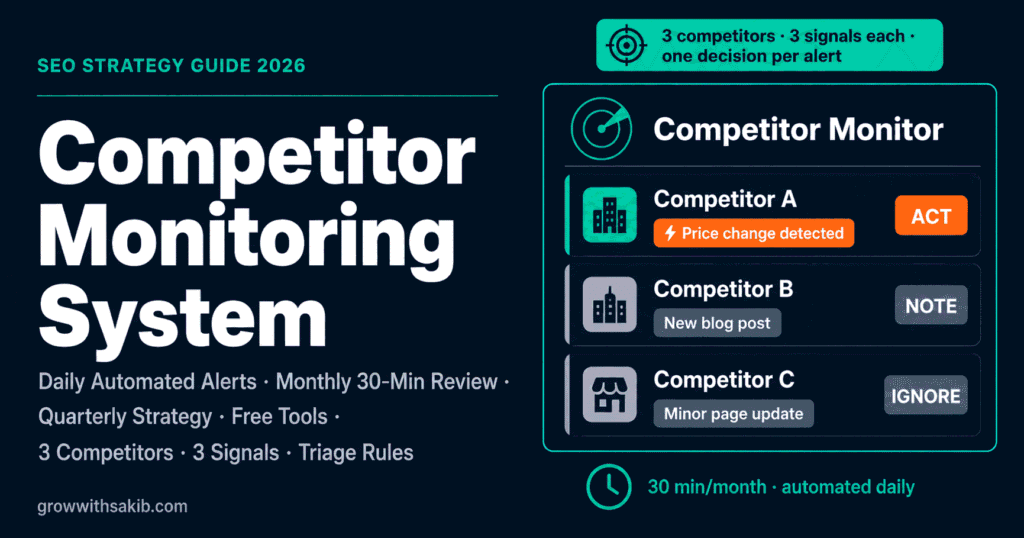
Most competitor research dies the day the project ends. The slide deck gets filed, everyone moves on, and six months later a rival has changed their pricing, launched a feature, and shifted their whole message — and nobody noticed.
A competitor monitoring system fixes that. It’s the difference between researching competitors once and actually keeping up with them — a lightweight, repeating rhythm that flags real moves without eating your week.
This expands Step 8 of our complete guide to competitor research. If the competitor analysis framework is the deep dive you run periodically, monitoring is what keeps it alive between cycles.
Why You Need a System, Not Just Occasional Checks
Markets move faster than annual reviews can track. In Crayon’s State of Competitive Intelligence research, 59% of practitioners said their markets had grown much more competitive over two years. One-off research ages out before you act on it — the same reason SEO for small business requires ongoing measurement rather than a one-time setup.
But the answer isn’t to obsess daily — that way lies burnout and noise. The answer is a system with a rhythm: automate the urgent, schedule the rest, and protect your attention. Done right, it takes well under an hour a month for most small businesses.
The Tiered Monitoring Cadence
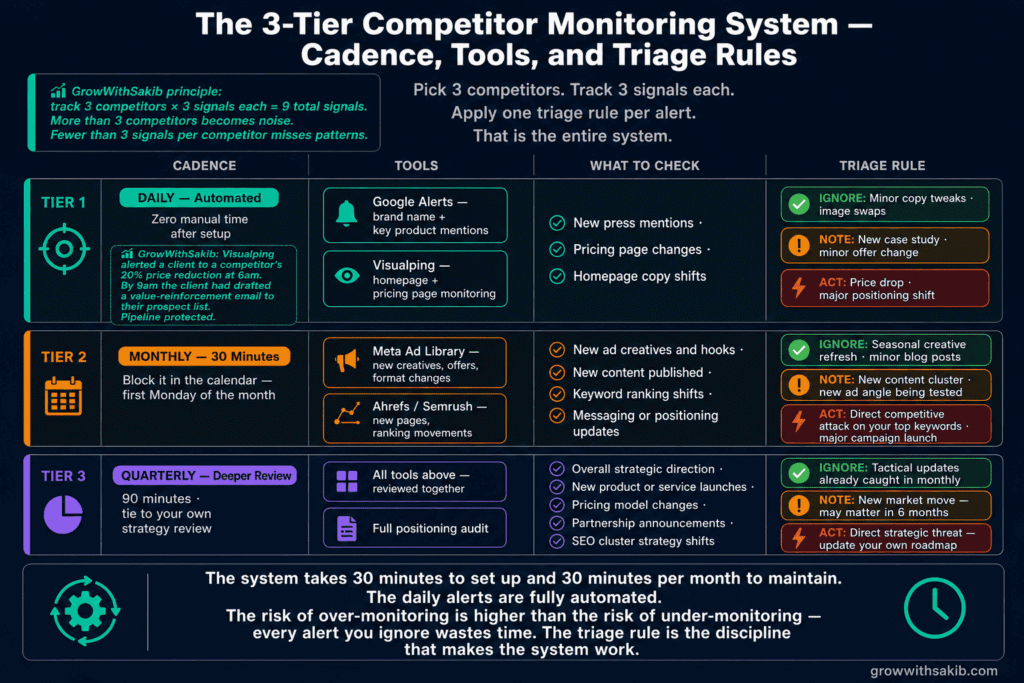
The core idea: match the checking frequency to how fast each signal changes. Not everything deserves a daily look.
| Cadence | What to track | Why this frequency |
|---|---|---|
| Daily (automated) | Big news, brand mentions, major launches | Time-sensitive — but automated, so zero effort |
| Monthly (30 min) | Pricing, new content, active ads, messaging | Changes often enough to matter, rarely daily |
| Quarterly (deeper) | Strategy, positioning, full re-analysis | Slow-moving; needs reflection, not alerts |
Automate the daily tier so it costs you nothing but a glance. Put the monthly and quarterly tiers on your calendar as recurring blocks — if it’s not scheduled, it won’t happen.
What to check monthly (the 30-minute routine)
- Pricing pages: any change in price, tiers, or packaging?
- New content: what did they publish? Any new topic cluster forming?
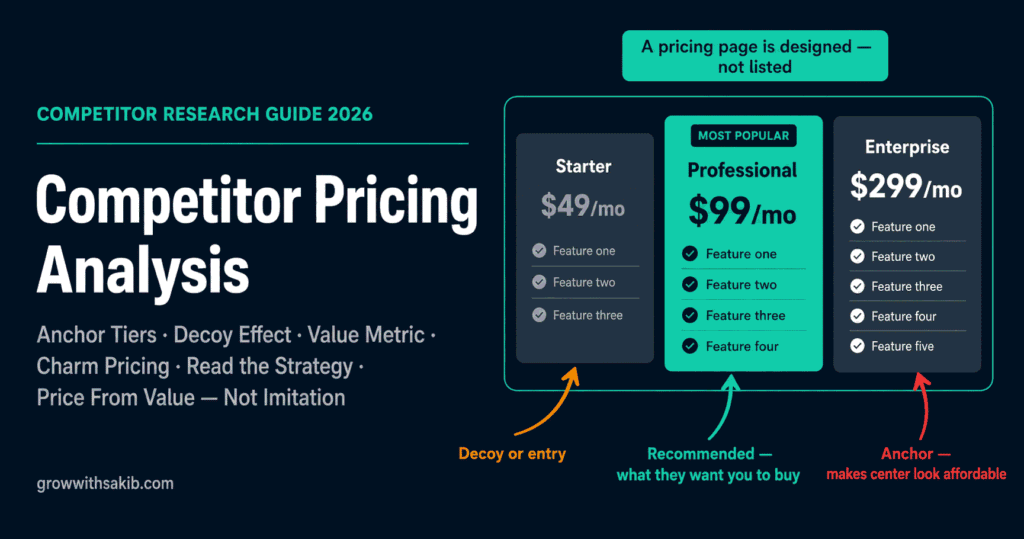
- Active ads: a quick Meta Ad Library scan for new campaigns or angles — and competitor pricing analysis for any changes to tiers or packaging that the pricing page watcher flagged.
- Homepage messaging: did their main promise or positioning shift?
What to review quarterly (the deeper look)
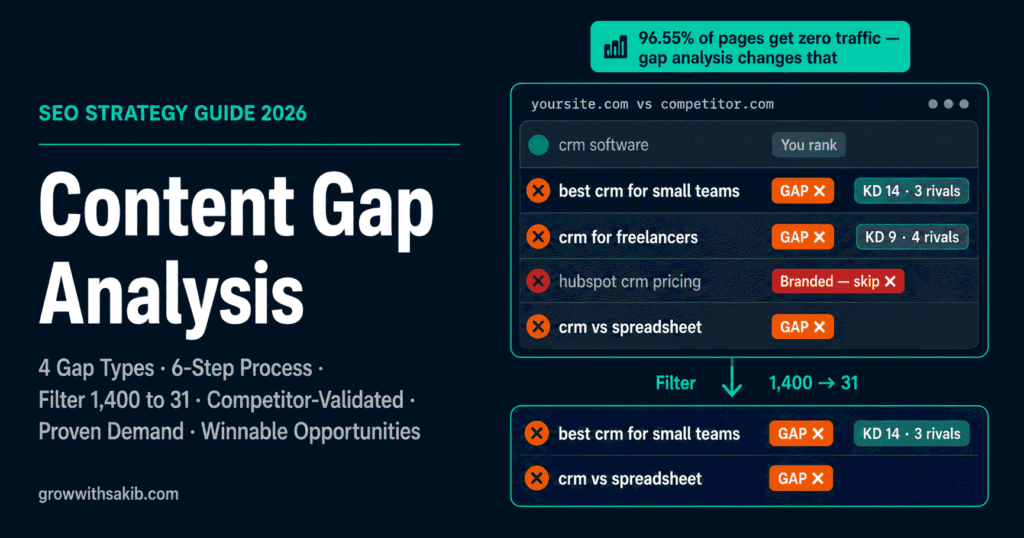
Once a quarter, go beyond surface changes. Re-run a light content gap analysis, revisit your competitor SWOT analysis, and ask the bigger question: has anyone’s strategy actually shifted? Quarterly is also when you check whether new competitors have appeared — including shadow competitors like AI Overviews or Reddit threads that are now ranking for your keywords.
Build Your Free Monitoring Stack
You don’t need an enterprise platform to start. These free tools cover the essentials:
| Tool | What it monitors | Tier |
|---|---|---|
| Google Alerts | Brand mentions, news, launches | Daily (automated) |
| Visualping / change detection | Pricing & key page changes | Daily (automated) |
| Meta Ad Library | Competitor ads & creative | Monthly |
| Ahrefs / Semrush alerts | New keywords, ranking moves | Monthly |
| Manual calendar block | Messaging, strategy review | Monthly / quarterly |
Set up Google Alerts for each competitor’s brand name, and a page-change watcher on their pricing and homepage. Those two automations alone catch most time-sensitive moves while you sleep. The Meta Ad Library handles your monthly ad scan for free.
The Alert Triage Rule: Ignore, Note, or Act
Monitoring creates a new problem: alerts pile up and become noise. The fix is a triage rule. Every alert gets sorted into one of three buckets the moment you see it.
| Bucket | When | What you do |
|---|---|---|
| Ignore | Cosmetic or trivial change | Nothing — close it and move on |
| Note | Interesting but not urgent | Log it; watch for a pattern over time, especially in competitor keyword movements that may signal a content strategy shift |
| Act | Material move (price, launch, pivot) | Take it to a decision this week |
Most alerts are Ignore. A few are Note. The rare Act alert is the entire reason the system exists — and it should flow straight into a decision, ideally through your competitor analysis framework so the response is deliberate, not reactive.
Common Mistakes to Avoid
- Tracking everything. Start with three competitors and a few signals, or you’ll quit.
- All manual, no automation. Automate the daily tier; reserve human time for judgement.
- No triage. Without an ignore/note/act rule, alerts become noise you tune out.
- Monitoring without acting. Watching a competitor change and doing nothing is just anxiety — use the competitor analysis framework to turn the signal into a deliberate response.
- No calendar block. Unscheduled monitoring quietly stops within a month.
An Honest Note on Competitor Monitoring
Monitoring has a dark side: done obsessively, it makes you reactive. Chasing every competitor move can pull you off your own strategy and into a copycat spiral. The goal is awareness, not imitation — you monitor to make better decisions, not to mirror rivals. Plenty of strong moves come from ignoring what competitors do, not following it.
The right intensity also varies. A fast-moving startup market may justify weekly checks; a stable niche may need only quarterly ones. And a solo founder should keep the system far lighter than a funded team would. Scale the cadence to your market’s speed and your own capacity — a sustainable small system always beats an ambitious one you abandon, and this one tool is most powerful when it sits inside your complete competitor research process.
Frequently Asked Questions
How do you monitor competitors?
Build a tiered system: automate daily alerts for big news and page changes, run a 30-minute monthly check on pricing, content, ads, and messaging, and do a deeper strategic review each quarter. Use a triage rule — ignore, note, or act — on every alert so monitoring drives decisions instead of becoming noise you tune out.
What tools do I need for competitor monitoring?
Start free: Google Alerts for brand mentions and news, a change-detection tool like Visualping for pricing and key pages, the Meta Ad Library for competitor ads, and alerts in Ahrefs or Semrush for ranking moves. Add a recurring calendar block for manual messaging and strategy checks. This free stack covers the essentials for most small businesses.
How often should I check on competitors?
Match frequency to how fast each signal changes. Automate daily monitoring for time-sensitive news and major changes, do a short monthly review of pricing, content, and ads, and run a deeper strategic review quarterly. Daily manual checking causes burnout and noise; quarterly-only checking lets fast-moving changes slip past. The tiered cadence balances both.
What should I monitor about competitors?
Track pricing and packaging changes, new content and topics, active ad campaigns, homepage and positioning messaging, product launches, and — quarterly — any strategic shifts and new competitors entering. Don’t track everything; pick the handful of signals that would actually change your decisions, and ignore cosmetic changes that look like activity but mean nothing.
Can I monitor competitors for free?
Yes. Google Alerts, a free change-detection tool, the Meta Ad Library, and a recurring calendar block cover most needs at no cost. Paid platforms add convenience and aggregation, but a free stack is enough to catch the moves that matter — pricing changes, new ads, fresh content — for most small and mid-sized businesses.
How do I avoid alert overload?
Use a triage rule. The moment an alert arrives, sort it into ignore (cosmetic), note (interesting, watch for a pattern), or act (material move worth a decision this week). Most alerts are ignore. This three-bucket habit stops monitoring from becoming background noise you eventually stop reading altogether.
What’s the difference between competitor research and monitoring?
Competitor research is the periodic deep dive — analysing rivals thoroughly to inform a decision. Monitoring is the ongoing, lightweight tracking that keeps that research current between cycles. Research tells you where competitors stand today; monitoring flags when something changes. You need both: the deep analysis on a cadence, plus continuous alerts in between.
Key Takeaways
- Competitor research dies without monitoring — a system keeps it alive between deep dives.
- Match cadence to signal speed: automate daily, check monthly, review deeply quarterly.
- Start embarrassingly small — three competitors, a few signals, one calendar block.
- Automate the daily tier with Google Alerts and a page-change watcher; it costs nothing.
- Build a free stack before paying for an enterprise monitoring platform.
- Triage every alert: ignore, note, or act — most are ignore.
- Monitoring without acting is just anxiety; route ‘act’ alerts into a real decision.
- Don’t over-monitor — awareness, not imitation; scale the cadence to your market’s speed.