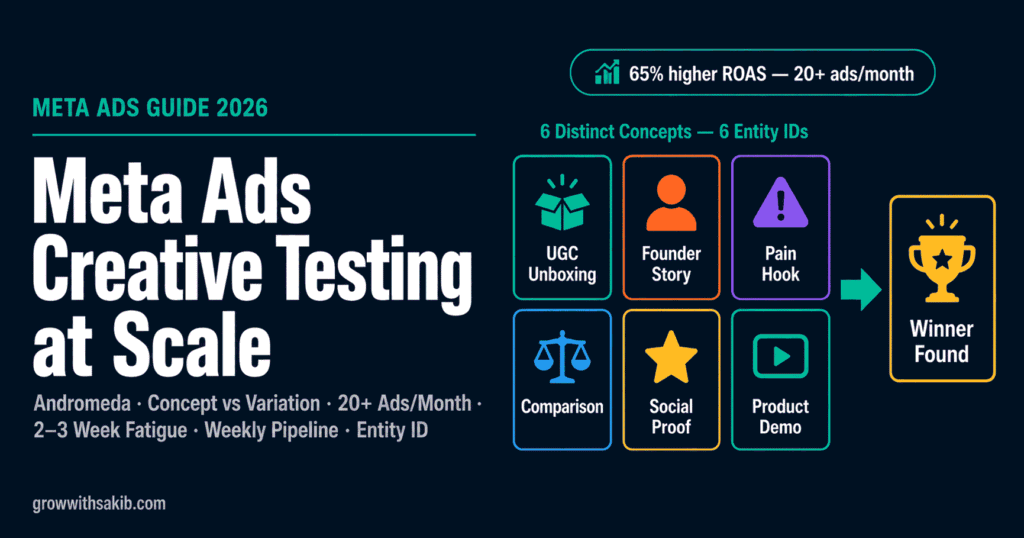
For years, creative testing on Meta followed a comfortable ritual. You built a separate testing campaign, gave it a small budget, tested one variable at a time, waited a week or two, then promoted the winner to your main campaign. It was slow, but it was orderly.
That ritual is now actively hurting you. Meta’s Andromeda update changed the mechanics of how ads get selected and how the algorithm learns, and the old testing model fights against the new system instead of working with it. In 2026, the advertisers who win are not the ones who test most carefully — they are the ones who test most, with the most diverse creative, in the structure the algorithm actually rewards.
This guide is about creative testing at scale: how Andromeda changed what testing means, the concept-versus-variation framework that organises a modern testing system, why the separate test campaign is dead, how much creative you actually need, and how to build a production pipeline that keeps pace with the faster fatigue of the Advantage+ era — all grounded in the complete Meta Ads framework. For the statistical mechanics of declaring a winner, this pairs with our dedicated guide to Meta Ads A/B testing.
Why Andromeda Changed What Creative Testing Means
You cannot run a modern testing system without understanding the engine it feeds. Meta’s Andromeda update did not just tweak delivery — it changed the unit that competes for impressions, and that changes everything about how you test.
Andromeda is a retrieval engine
As Atria’s Andromeda guide explains, Andromeda is Meta’s AI-powered ad retrieval engine, launched in late 2024. Every time someone opens their feed, it scans tens of millions of eligible ads and narrows them to roughly 1,000 candidates per impression — in under 300 milliseconds — before those candidates even enter the ranking auction. Meta built it to handle the explosion of ad variations created by Advantage+ automation and AI creative tools.
The implication is direct: if your ad does not make it through retrieval, it never competes. Your creative is no longer just persuasion — it is the thing that determines whether you enter the auction at all. As AdMove’s creative testing analysis puts it, in a retrieval-first system your creative determines which ads the algorithm selects for the auction.
Ads compete on Entity ID, not ad ID
Here is the shift most advertisers have not absorbed. As Affect Group’s 2026 creative testing guide documents, when you upload an ad, Andromeda does not see it as a file with a unique ID. It breaks the ad down into meaningful elements — what is in the frame, the colours, who is speaking, the text, the tone of the audio — and builds a digital fingerprint called an Entity ID. It is the Entity ID, not your ad ID, that competes for impressions.
This is why minor variations no longer count as real tests. If you upload the same video with a slightly different caption, Andromeda may read it as essentially the same Entity — competing for the same impressions rather than opening new ones. Genuine creative diversity — different hooks, formats, people, messages — creates distinct Entity IDs that reach distinct pockets of your audience. Sameness collapses into one entity; diversity expands your reach.
The Concept-vs-Variation Framework
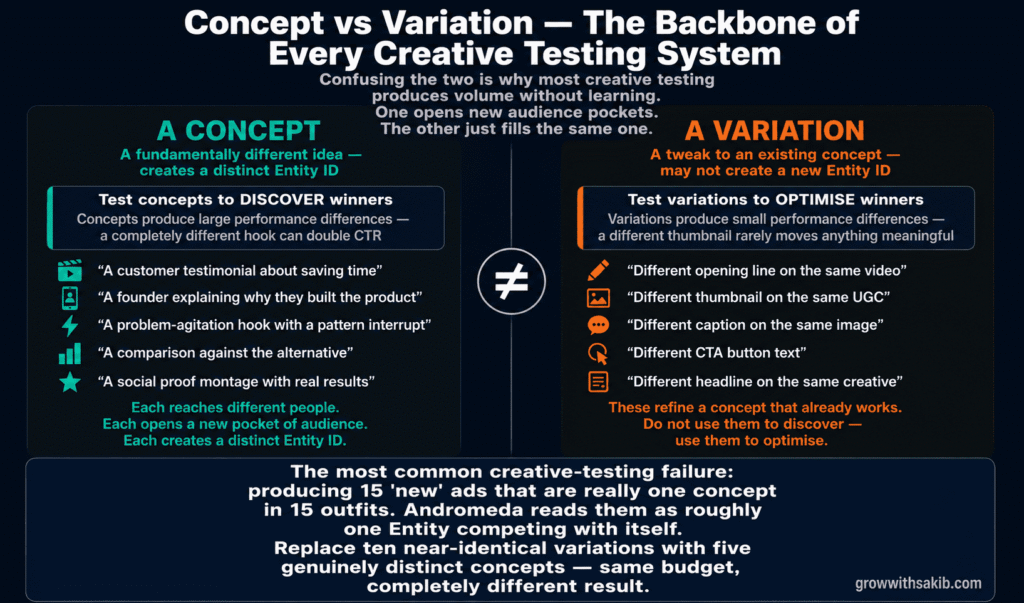
The backbone of a modern creative testing system is one distinction: the difference between a concept and a variation. Confusing the two is why most creative testing produces volume without learning.
What is a concept vs a variation?
- A concept is a fundamentally different idea — a different hook, a different emotional angle, a different format, a different problem framing. ‘A customer testimonial about saving time’ and ‘a founder explaining why they built the product’ are two concepts. They create distinct Entity IDs and reach different people.
- A variation is a tweak to an existing concept — a different opening line on the same video, a different thumbnail, a different caption, a different CTA button. Variations refine a concept that already works.
The strategic rule follows directly: test concepts to discover winners; test variations to optimise them. As Segwise’s creative playbook recommends, the modern standard is 8-12 conceptually distinct concepts per campaign with 2-3 variations each, refreshed on a 2-3 week cycle. The concepts find the winning idea; the variations squeeze more performance out of it once found.
Why concept testing comes first
Concepts produce large performance differences; variations produce small ones. A completely different hook can double your CTR; a different shade of button rarely moves anything meaningfully. So you spend your testing energy discovering winning concepts, and only once a concept proves itself do you invest in variations to extend and optimise it.
This is also where this guide hands off to the statistical side. Deciding whether one variation truly beat another — at a confidence level you can trust — is the job of structured A/B testing. Creative testing at scale finds the concepts worth testing; A/B testing confirms the winners with statistical rigour. You need both, for different jobs.
Why the Separate Test Campaign Is Dead
The biggest structural change in 2026 creative testing is one many advertisers have not made: abandoning the isolated testing campaign. The old 70/30 split — 70% of budget on a proven-winners campaign, 30% on a separate testing campaign — now works against you.
The mechanism that broke the old model
As Affect Group explains, Advantage+ and simplified account structures changed how impressions get allocated. The algorithm now decides how to split impressions between creatives inside a single ad set, based on which Entity IDs actually hook users. If you keep carving out a separate testing campaign with 30% of the budget out of habit, you are cutting your test creatives off from the very audience they need to learn on. Fewer signals mean slower learning, and conclusions arrive late.
In other words: isolating your tests starves them. The algorithm learns fastest when new and proven creatives live side by side in the same ad set, because it can allocate impressions across all of them in real time based on early signals — instead of you manually comparing a budget-starved test campaign against a well-fed main one a week later.
The consolidated structure that works
As Affect Group recommends, the modern default is one main ad set where old and new creatives live side by side. It is faster, and the algorithm gets more data to allocate properly. You introduce new concepts directly into your primary ad set — typically via duplication to avoid resetting learning — and let Andromeda distribute impressions toward the Entity IDs that hook users.
How Much Creative You Actually Need in 2026
Creative volume stopped being a nice-to-have and became a primary performance driver. The numbers are specific, and they are higher than most advertisers are comfortable with.
The volume targets
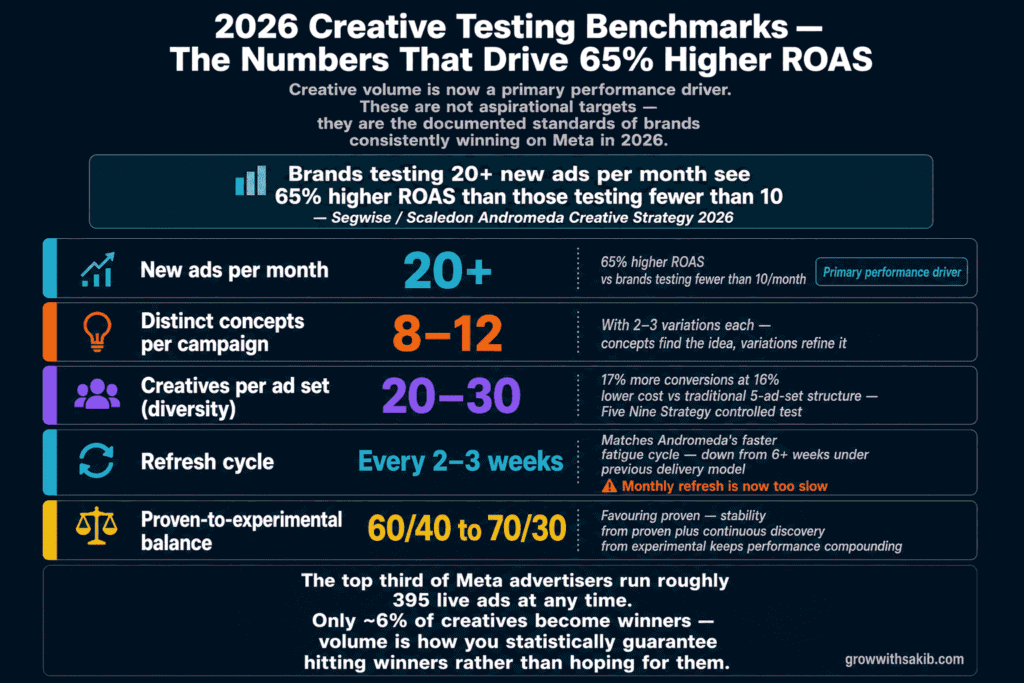
As Segwise’s data documents, brands testing 20+ new ads per month see 65% higher ROAS than brands testing fewer than 10, and the top third of advertisers run roughly 395 live ads at any time. The Jetfuel Agency analysis reinforces it: brands testing 20+ new ads monthly see 65% higher ROAS than those testing fewer than 10. This is not about carpet-bombing the feed — it is about giving Andromeda enough distinct Entity IDs to find the winners that statistically exist in a minority of your creative.
Why volume works: the hit-rate reality
Only a small fraction of creatives become winners. As covered in our work on UGC and creative, Motion’s analysis of over 550,000 ads found roughly 6% of ads drive the majority of spend. If only ~6% of your creative wins, then producing 10 ads a month yields a fraction of a winner, while producing 25-30 yields one or two reliable winners — and the Meta Pixel data quality feeding each creative directly affects which ones the algorithm identifies as winners. Volume is how you statistically guarantee hitting winners rather than hoping for them.
The fatigue cadence
Volume is not only about discovery — it is about replacement. As Segwise notes, Andromeda brings faster fatigue: 2-3 weeks versus the 6+ weeks advertisers were used to. The same creative reaches its audience faster at scale and wears out sooner. The recommended cadence is a refresh every 2-3 weeks, with new concepts continuously entering the rotation before the current winners fade.
1. New ads per month
- Testing Element: New ads per month
- 2026 Target: 20+
- Source-backed Benchmark: 65% higher ROAS vs <10/month
2. Distinct concepts per campaign
- Testing Element: Distinct concepts per campaign
- 2026 Target: 8-12
- Source-backed Benchmark: With 2-3 variations each
3. Creatives per ad set (diversity)
- Testing Element: Creatives per ad set (diversity)
- 2026 Target: 20-30 genuinely different
- Source-backed Benchmark: 17% more conversions at 16% lower cost (vs 5-ad-set)
4. Refresh cycle
- Testing Element: Refresh cycle
- 2026 Target: Every 2-3 weeks
- Source-backed Benchmark: Matches the faster Andromeda fatigue cycle
5. Proven-to-experimental balance
- Testing Element: Proven-to-experimental balance
- 2026 Target: 60/40 to 70/30 favouring proven
- Source-backed Benchmark: Stability plus continuous risk-taking
What to Test: Building Genuinely Diverse Concepts
If diversity is what wins retrieval, the practical question is how to generate genuinely distinct concepts rather than dressed-up duplicates. The answer is to vary the elements that change the Entity ID meaningfully.
The concept dimensions worth varying
- Hook: the first 3 seconds. Problem call-out, result tease, pattern interrupt, contrarian statement. The single highest-leverage element — covered in depth in our UGC and creative guide.
- Format: UGC, studio, testimonial, founder-to-camera, product demo, catalogue/dynamic, static, carousel. As Confect documents, mixing formats is a core Andromeda lever because each format creates distinct entities reaching distinct users — and Facebook vs Instagram performance differs significantly by format type.
- Messaging angle: problem/solution, emotional, social proof, comparison, contextual use-case, objection-handling. Same product, fundamentally different framing.
- Emotion and tone: aspirational vs humorous vs urgent vs reassuring. Tone is part of the Entity fingerprint and reaches different psychographic pockets.
- Talent and setting: different presenters, demographics, and environments genuinely diversify the entity and the audience it resonates with.
Mine your winners for the next concepts
As The Digital Exchange’s Andromeda guide advises, let your results guide your creative — when you find an angle or format that performs, create more ads like it. The discipline: when a concept wins, do not just clone it (that creates near-duplicate entities). Instead, extract the winning element — the hook, the angle, the format — and build new, distinct concepts that share that element while varying others. You compound on what works without collapsing into sameness.
Reading the Results: Which Metrics Tell You What Won
Testing at volume only pays off if you can read which concepts won — fast, and before you have burned budget. The leading-indicator metrics let you diagnose creative health before conversion data matures.
The diagnostic metric stack
- Hook rate (3-second view rate): the percentage of impressions that watch the first 3 seconds. Diagnoses whether the hook stops the scroll. Low hook rate means the concept fails at the gate — kill or fix the hook.
- Hold rate (video plays to 50-75%): the percentage who keep watching. Diagnoses whether the body holds attention after the hook lands. Good hook, poor hold means the concept opens well but loses people.
- CTR (link): diagnoses whether the creative drives action. Good hold but poor CTR points to a weak payoff or offer.
- CPA / ROAS: the final arbiter, but the slowest. Use the leading indicators above to make early read decisions while conversion data accumulates.
The tagging requirement
Volume creates a measurement problem: with 20-30 creatives running, you cannot tell what won without structure. As Segwise notes, without creative tagging, identifying which concepts actually win is mostly guesswork — which is why mapping tags to performance has become standard practice. Tag every creative by its concept dimensions — hook type, format, angle — so that when winners emerge, you learn which elements drove the win, not just which file did — and tie winner data back to your Meta Ads cost metrics to confirm CPA improvement at scale.
This is the difference between testing that compounds and testing that just spends. A tagged testing programme tells you ‘problem-call-out hooks in UGC format consistently win for us’ — a reusable insight. An untagged one tells you ‘ad #47 won’ — useless once that ad fatigues. For the statistical side of confirming winners, see our A/B testing guide, and feed both into your account audit routine.
Advantage+ Creative and DCO: Let the Machine Test the Variations
Once you understand concepts versus variations, Meta’s automated creative tools find their proper place. They are excellent at testing variations and poor substitutes for testing concepts — and knowing the difference keeps you in control.
What Advantage+ Creative and DCO do
Dynamic Creative Optimisation (DCO) and Advantage+ Creative take your assets and automatically generate and test combinations — different images, headlines, primary text, and automated enhancements — serving each user the combination most likely to resonate. As Meta’s internal testing reports (cited by Segwise), Advantage+ Creative drives roughly a 22% ROAS lift over manual setups.
The right division of labour
Use Advantage+ Creative and DCO to test variations within a concept — let the machine find the best headline-image-copy combination for a concept you have already decided to run, using the retargeting audience segments from your Meta Custom Audiences to test how variations perform differently across funnel stages. Do not rely on them to discover concepts; that is a human creative-strategy job, because a fundamentally new angle or format is not something the combination engine can invent from your existing assets.
There is also a control consideration. As covered in our A/B testing guide, Advantage+ Creative’s automated enhancements change the creative in ways you do not fully control, which can muddy a clean concept test. When you need a clean read on which concept won, run the test with enhancements off; when you are optimising a proven concept for maximum performance, turn them on and let the machine extract the last increment.
Building a Creative Testing Pipeline That Keeps Pace
Everything above fails without a production system. Faster fatigue plus higher volume targets mean creative testing is no longer a periodic project — it is a continuous pipeline. The brands that win build the loop, not just the campaign.
The weekly testing loop
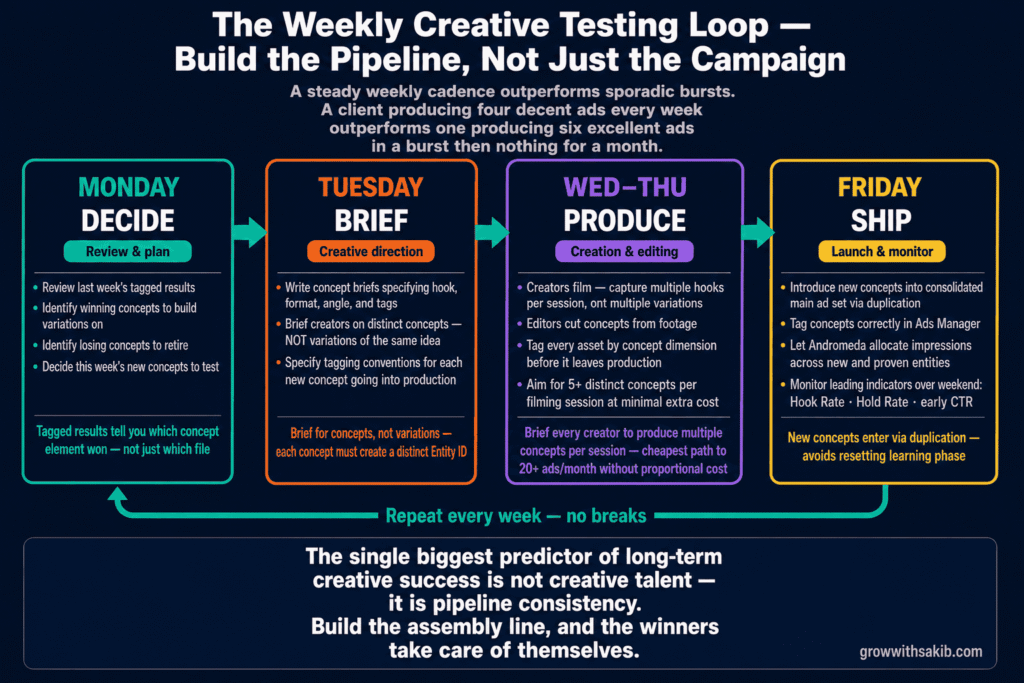
As AdMove describes it, the modern system runs a weekly loop: decide what to test, generate the brief, produce the creative pack, and ship the ad set. The discipline is in the rhythm — a repeatable weekly cadence rather than sporadic bursts of production followed by stale stretches. As Jetfuel Agency stresses, you need a repeatable process for producing new creative, not a one-time sprint; build the pipeline, not just the campaign.
- Monday — Decide. Review last week’s tagged results. Identify winning concepts to build variations on and losing concepts to retire. Decide this week’s new concepts to test.
- Tuesday — Brief. Write concept briefs specifying hook, format, angle, and tags. Brief creators or your production team on distinct concepts, not variations.
- Wednesday-Thursday — Produce. Creators film; editors cut. Capture multiple concepts per session for efficiency.
- Friday — Ship. Introduce new concepts into the consolidated ad set via duplication, tagged correctly. Let Andromeda allocate. Monitor leading indicators over the weekend — and review campaign structure against the Meta Ads Guide to confirm your setup is optimised for the allocation to work correctly.
The proven-experimental balance
As Affect Group advises, every batch should be part variations on what already works and part new concepts that take real risk — roughly 60/40 or 70/30 favouring proven, depending on stage. If you only re-shoot winners, your ceiling keeps dropping as they fatigue. If you only ship experiments, the campaign is unstable. The balance keeps performance steady while continuously searching for the next winner.
6 Creative Testing Mistakes That Slow You Down
Mistake 1: Testing variations and calling them concepts
Producing 15 near-identical versions of one idea feels productive but teaches the algorithm almost nothing — Andromeda reads them as one Entity competing with itself. Test genuinely distinct concepts (different hooks, formats, angles) to open new audience pockets; save variations for refining proven winners.
Mistake 2: Keeping a separate, budget-starved test campaign
Isolating tests in a small-budget campaign cuts them off from the data they need to learn. In 2026, introduce new concepts into your consolidated main ad set so the algorithm can allocate impressions in real time. Reserve isolated testing only for entirely new format categories, as Affect Group notes.
Mistake 3: Testing too little volume
With only ~6% of creatives becoming winners, testing fewer than 10 ads a month means you rarely hit a winner. The brands seeing 65% higher ROAS test 20+ new ads monthly. Low volume is not careful — it is slow, and it leaves winners undiscovered — especially for Meta Ads for local business campaigns where smaller audience pools accelerate fatigue.
Mistake 4: Not tagging creative
Running 20-30 creatives without tagging means you learn ‘ad #47 won’ instead of ‘problem-call-out UGC hooks win for us.’ Tag every creative by concept dimension so wins become reusable insights, not one-off lucky files.
Mistake 5: Refreshing on the old fatigue timeline
Andromeda fatigue runs 2-3 weeks, not 6+. Advertisers refreshing monthly or quarterly let winners decay before replacements arrive, causing performance to sawtooth. Match your refresh cadence to the faster fatigue cycle with a continuous pipeline.
Mistake 6: Using Advantage+ Creative to find concepts
Automated tools test variations brilliantly but cannot invent fundamentally new concepts from your existing assets. Relying on them for concept discovery leaves your hardest creative work undone. Humans generate concepts; let the machine optimise variations within them, as covered alongside structured A/B testing.
Frequently Asked Questions
What is creative testing at scale on Meta?
Creative testing at scale means systematically producing and testing a high volume of genuinely diverse ad concepts — rather than one ad at a time — so Meta’s algorithm can find winners fast. As Confect documents, the old approach of finding one winning ad and scaling it has been replaced by building a system that continuously feeds Andromeda diverse, fresh creative. The goal is enough distinct concepts for the algorithm to surface the ~6% that become winners.
How many creatives should I test per month?
Aim for 20+ new ads per month. As Segwise’s data shows, brands testing 20+ new ads monthly see 65% higher ROAS than those testing fewer than 10, and the top third of advertisers run roughly 395 live ads at any time. Most experts recommend 8-12 conceptually distinct concepts per campaign with 2-3 variations each, refreshed every 2-3 weeks to match Andromeda’s faster fatigue cycle.
What is the difference between a concept and a variation?
A concept is a fundamentally different idea — a different hook, format, angle, or emotion — that creates a distinct Entity ID and reaches different people. A variation is a tweak to an existing concept, like a new caption or thumbnail. Test concepts to discover winners (they produce large performance differences) and variations to optimise proven winners (they produce small ones). Confusing the two is why most creative testing produces volume without learning.
Should I use a separate testing campaign?
Generally no, not anymore. As Affect Group explains, Advantage+ allocates impressions between creatives inside a single ad set, so an isolated test campaign starves your tests of the data they need to learn. Introduce new concepts into your consolidated main ad set instead. The exception: a standalone test still helps when introducing a fundamentally new format, like your first UGC or long-form video, where you want a clean read.
How often does creative fatigue in 2026?
Faster than before. As Segwise documents, Andromeda has shortened the fatigue cycle to 2-3 weeks, down from 6+ weeks. The same creative reaches its audience faster at scale and wears out sooner. Watch for rising frequency with falling CTR and hook rate as the fatigue signature, and refresh with new concepts on a 2-3 week cadence through a continuous production pipeline rather than periodic bursts.
How do I know which creative won?
Tag every creative by concept dimension — hook type, format, angle — and read the leading indicators first: hook rate (3-second views) diagnoses the opening, hold rate diagnoses the body, and CTR diagnoses the payoff, before slower CPA data matures. As Segwise notes, without tagging, identifying winners is guesswork. For statistically confident winner declarations, pair this with structured A/B testing.
Does Advantage+ Creative replace creative testing?
No — it complements it. Advantage+ Creative and DCO excel at testing variations within a concept (headline, image, and copy combinations) and drive roughly a 22% ROAS lift per Meta’s testing. But they cannot invent fundamentally new concepts from your existing assets. The 2026 division of labour: humans generate diverse concepts; machines optimise variations within them. Turn enhancements off when you need a clean concept read.
Key Takeaways
- Andromeda competes ads on Entity ID — the creative’s content fingerprint — not the file. Genuine creative diversity opens new audience pockets; minor variations collapse into one entity competing with itself.
- Test concepts to discover winners; test variations to optimise them. Concepts produce large performance differences and deserve your creative energy; variations produce small ones and can be automated.
- The separate test campaign is mostly dead. Isolated tests starve creatives of learning data. Introduce new concepts into your consolidated main ad set; isolate only for entirely new formats.
- Volume is now a primary performance driver. Brands testing 20+ new ads monthly see 65% higher ROAS than those testing under 10. With only ~6% of creatives winning, volume is how you reliably hit winners.
- Fatigue is faster — 2-3 weeks, not 6+. Refresh continuously through a pipeline, not in periodic bursts, so fresh concepts always enter rotation before winners fade.
- Tag every creative by concept dimension. Tagging turns ‘ad #47 won’ into ‘problem-call-out UGC hooks win for us’ — a reusable insight instead of a one-off lucky file.
- Humans test concepts; machines test variations. Put your creative energy into diverse concepts and let Advantage+ Creative and DCO optimise combinations within them.
- Creative testing at scale is a manufacturing problem. Pipeline consistency beats creative bursts. A steady weekly loop of decide, brief, produce, ship compounds where sporadic production sawtooths.