Cold advertising is expensive. You are paying to convince complete strangers to stop scrolling, pay attention, trust you, and act — all in three seconds. The conversion rate reflects exactly how hard that is.
Warm advertising is a different game entirely. The person you are reaching already visited your site, watched most of your video, opened your lead form, or bought from you six months ago. You are not introducing yourself. You are following up. The trust is partially established. The interest has been demonstrated.
Meta Custom Audiences are how that follow-up happens at scale. They are the most reliable, privacy-resilient targeting tool on the platform in 2026 — and most advertisers are using them at roughly a third of their potential.
Why Custom Audiences Matter More in 2026, Not Less
The conventional wisdom after iOS 14 was that privacy changes would make retargeting harder and less effective. That was partly right — but the conclusion many advertisers drew was wrong.
What iOS 14 did was reduce the accuracy of browser-based tracking and third-party interest signals. On-platform engagement data — video views, Page interactions, Instagram profile visits, lead form openings — was completely unaffected because it never crosses a browser boundary. Customer list audiences sourced from your CRM are equally immune. As noted by Adlibrary’s 2026 Custom Audience analysis, the custom audience remains the most reliable Meta audience type to build precisely because every signal that builds it is owned first-party data.
In 2026, Meta’s Advantage+ has taken over for cold prospecting. Custom Audiences remain the essential tool for the middle and bottom of the funnel — where you know who you are talking to and what they need to hear next, as part of the complete Meta Ads strategy.
All 8 Meta Custom Audience Source Types: Complete Reference
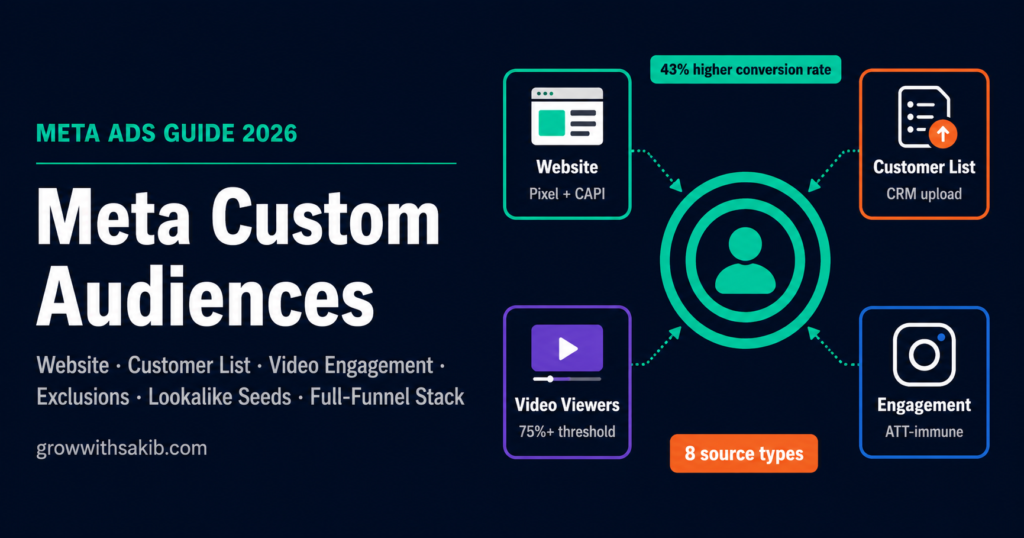
Meta currently offers eight distinct custom audience source types, all accessed through your Meta Business Manager account. The official Meta documentation covers the definitions, but most competitor guides only address three to six. Here is the complete picture — what each type requires to build, how long it retains users, whether iOS privacy restrictions affect it, and where it belongs in a retargeting strategy.
| Source Type | Max Retention | iOS ATT Impact | Signal Strength | Primary Use Case |
| Website (Pixel + CAPI) | 180 days (Purchase: 2 years) | Reduced for opted-out iOS users; CAPI recovers 15–30% | High for purchase events; Medium for page visits | Retargeting cart abandoners, product viewers, purchasers |
| Customer List (CRM upload) | Persistent until removed | None — offline first-party data | Very High when fresh and complete | Retention, upsell, acquisition suppression, lookalike seeds |
| App Activity | 180 days | Moderate — ATT applies to iOS apps | High for in-app conversion actions | App user retargeting, upgrade campaigns |
| Offline Activity / CAPI Events | 180 days | None — server-side data, no browser | Very High — real transaction data | In-store buyers, CRM stage completions, phone orders |
| Video Engagement | 365 days | None — entirely on-platform | High at 75%+ threshold; Low at 3–10s | Warm awareness retargeting; free to build from organic or paid video |
| Instagram Account Engagement | 365 days | None — on-platform data | High for profile visitors and story reactors | Brand retargeting; bridge to conversion offer |
| Facebook Page Engagement | 365 days | None — on-platform data | Medium to High depending on depth | Community retargeting, local business brand reinforcement |
| Lead Form Engagement | 90 days | None — on-platform data | Very High — especially form openers | Nurturing incomplete leads; suppressing converted leads |
Website Custom Audiences: Breaking the ‘180-Day All Visitors’ Trap
The most commonly built website custom audience is ‘all website visitors, last 180 days.’ It is also the weakest segmentation choice available to you.
Your 180-day visitor pool contains the person who clicked your ad by accident and bounced in three seconds, the competitor researching your pricing, the journalist covering your industry category, and the genuinely interested buyer who visited five times. All of them sit in the same audience. Meta’s algorithm cannot distinguish between them. You are paying to reach all of them equally.
The Intent x Recency Framework
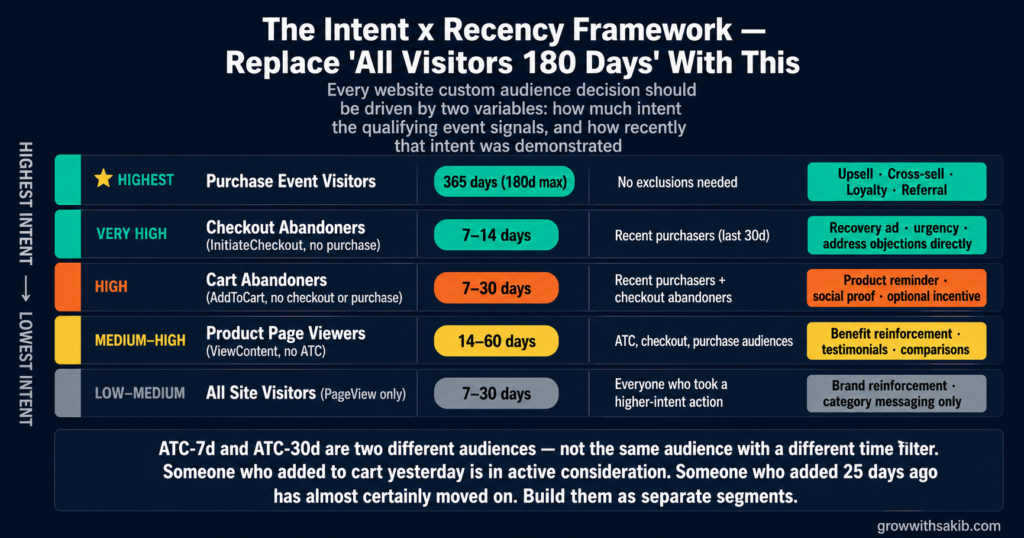
Every website custom audience decision should be driven by two variables: how much intent the qualifying event signals, and how recently that intent was demonstrated. Research from Bravery Technology’s 2026 Custom Audiences guide confirms that a 7-day website visitor audience converts at significantly higher rates than a 60-day audience — but the pool is smaller. Higher intent combined with shorter recency produces a higher-value segment that justifies more spend and a more direct offer.
| Audience Segment | Intent Level | Recommended Window | Exclude These | Creative Approach |
| Purchase event visitors | Highest — converted | 365 days (or 180-day max) | No exclusions needed | Upsell, cross-sell, loyalty, referral program |
| Checkout abandoners (InitiateCheckout, no purchase) | Very High | 7–14 days | Recent purchasers (last 30 days) | Recovery ad; urgency; address objections directly |
| Cart abandoners (AddToCart, no checkout or purchase) | High | 7–30 days | Recent purchasers + checkout abandoners | Product reminder; social proof; optional incentive |
| Product page viewers (ViewContent, no ATC) | Medium–High | 14–60 days | ATC, checkout, purchase audiences | Benefit reinforcement; testimonials; comparisons |
| Multi-page visitors (2+ page visits) | Higher than single-visit | 14–60 days | Anyone who progressed further in funnel | Direct offer; stronger CTA than first-visit messaging |
| All site visitors (PageView only) | Low to Medium | 7–30 days | Everyone who took a higher-intent action | Brand reinforcement; category-level messaging only |
Matching Window Size to Your Traffic Volume
- 500+ daily visitors: 7-day windows produce highly intent-rich, manageable audiences. Use them.
- 100–500 daily visitors: 14–30 day windows hit the sweet spot — enough volume for Meta’s algorithm to optimise delivery, enough recency to maintain signal quality.
- Under 100 daily visitors: 30–60 day windows are necessary to build audiences above the 1,000-user threshold needed for effective delivery. Use ViewContent or Landing Page View as the qualifying event, since lower-funnel actions will not generate sufficient volume.
For this to work reliably in 2026, you need your Meta Pixel and Conversions API (CAPI) correctly configured and verified. Pixel-only tracking misses 15–30% of iOS conversion events — which means your website audiences are smaller and noisier than they should be.
Customer List Audiences: The Highest-Quality Signal Available
Customer list custom audiences — built by uploading CRM data directly to Meta — are the most reliable audience type in 2026. iOS restrictions cannot touch them. Browser privacy features are irrelevant. Ad blockers have no effect. The matching happens server-side using hashed identifiers against Meta’s user database, as described in the Meta Business Help Center’s custom audience best practices.
How to Maximise Your Match Rate
When you upload a customer list, Meta hashes each identifier with SHA-256 and compares the results against its own hashed user database. The percentage of records that successfully link to a Meta user profile is your match rate — and it directly determines the effective size and quality of your audience.
| Identifier | Match Impact | Required Format | Notes |
| Email address | Highest | Lowercase, no spaces, SHA-256 hashed | Most users created their Facebook account with email — highest single-identifier impact |
| Phone number | High | E.164 format (+447911123456), SHA-256 hashed | Significant uplift when combined with email |
| First name + Last name | Medium | Separate columns, lowercase, SHA-256 hashed | Helps disambiguate common emails; meaningful combined uplift |
| City + State + Postcode | Medium | String fields; postcode with leading zeros, SHA-256 hashed | Geographic disambiguation for names that appear frequently |
| Date of birth | Lower | YYYYMMDD format, SHA-256 hashed | Useful for disambiguation; lower individual contribution |
| External ID (CRM ID) | Medium | Any consistent string, SHA-256 hashed | Valuable for returning customer identification across sessions |
The CRM Decay Problem
B2C customer lists decay at approximately 2–4% per month. People change email addresses, create new accounts, and delete old ones. A customer list uploaded a year ago without refreshing is operating at roughly 65% of its original match rate — even if the list itself has not changed.
- B2C businesses: refresh customer list uploads every 30–60 days. Weekly for high-velocity campaigns — the same systematic measurement discipline applies when tracking SEO results and organic performance alongside your paid campaigns.
- B2B businesses: refresh every 60–90 days. B2B email turnover is lower but still significant.
- Automation: connect your CRM directly to Meta via HubSpot, Salesforce, LeadsBridge, or Zapier to remove the manual refresh step entirely.
Segment Your Customer List — Never Upload It as One Audience
- By recency: purchased last 90 days = upsell and loyalty audience. Purchased 90–365 days ago = reactivation audience. Same list, completely different messages.
- By value: your top 10–20% customers by lifetime value deserve different treatment — and produce better lookalike seeds.
- By product: customers who bought Product A are natural prospects for Product B if there is logical adjacency.
- As a suppression audience: upload your full customer list as an exclusion on every prospecting and acquisition campaign. Showing acquisition creative to existing customers wastes budget and damages brand trust simultaneously.
Engagement Custom Audiences: The ATT-Immune Retargeting Layer
Engagement custom audiences are built entirely from interactions on Meta’s own platforms. Video views, Page interactions, Instagram profile visits, lead form openings — all captured on Meta’s servers without any browser involvement. iOS App Tracking Transparency cannot touch them. Browser ad blockers are irrelevant. Safari’s Intelligent Tracking Prevention does not apply.
As Adlibrary’s 2026 analysis notes, these audiences are 100% measurable, 100% durable, and do not require a single line of CAPI code. For any account where pixel signal is degraded, engagement audiences are the essential backstop.
Video Engagement: The Cheapest Warm Audience You Can Build
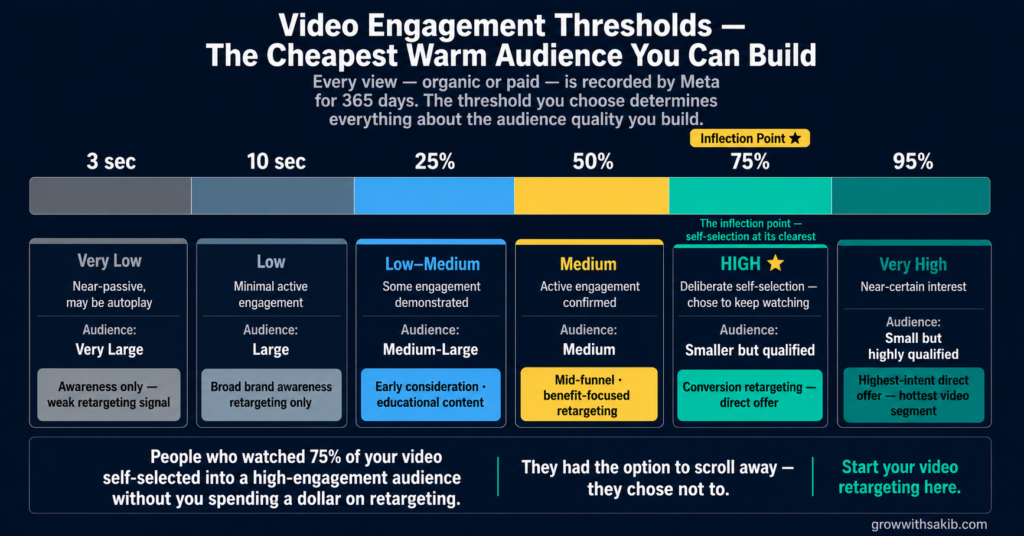
Every video view — organic or paid — on Facebook or Instagram is recorded by Meta. You can build retargeting audiences from people who watched a specific threshold of any of your videos in the past 365 days. The threshold you choose completely determines the quality of the audience you build.
| View Threshold | Intent Signal | Audience Size | Best Use |
| 3 seconds | Very Low — near-passive, may be autoplay | Very Large | Awareness reach extension only; weak retargeting signal |
| 10 seconds | Low — minimal active engagement | Large | Broad brand awareness retargeting; low conversion potential |
| 25% watched | Low-Medium | Medium-Large | Early consideration; educational content retargeting |
| 50% watched | Medium — active engagement confirmed | Medium | Mid-funnel; benefit-focused content retargeting |
| 75% watched | High — deliberate self-selection | Smaller but qualified | Conversion-focused retargeting; this is the inflection point |
| 95% watched | Very High — near-certain interest | Small but highly qualified | Direct offer retargeting; highest-intent video segment |
The 75% threshold is the inflection point. Someone who watched 75% of a 30-second product video chose to keep watching when they could have scrolled away. As Adlibrary’s custom audience deep-dive puts it: people who hit this threshold self-selected into a high-engagement audience without you spending a dollar on retargeting.
Instagram Engagement Audiences
- All who interacted with your account: widest net — profile visits, post likes, comments, saves, DMs. Use as a broad brand retargeting layer.
- Profile visitors: someone navigating to your profile is demonstrating active curiosity, not passive feed-scroll engagement.
- Post and ad engagers: liked, commented, shared, or saved your content. Higher intent than a profile visit alone.
- People who sent a message: the highest-intent Instagram engagement signal. Someone who messaged your account raised their hand and deserves the most direct follow-up offer — and understanding Facebook vs Instagram ad performance helps you decide which platform to prioritise for your retargeting campaigns.
Lead Form Engagement
- Form openers who did not submit: demonstrated enough interest to open the form — something prevented completion. Retarget with a lower-friction offer or a landing page alternative.
- Form submitters: use primarily as a suppression audience on lead generation campaigns to prevent the same person filling the same form twice.
The Exclusion Strategy That Prevents 20–40% Budget Waste
Exclusions are the half of retargeting strategy that almost no guide covers in depth. According to MHI Growth Engine’s 2026 exclusion audit data, brands implementing comprehensive exclusion strategies reduce wasted prospecting spend by 20–40% — simply by stopping ads from reaching audiences that cannot or will not convert.
The Most Expensive Missing Exclusion
Build an AddToCart audience (people who added to cart in the last 30 days) and run a recovery campaign. Did you exclude recent Purchasers? Some of those AddToCart users completed a purchase after adding to cart — they are still in your audience because the AddToCart event fired first, and the Purchase event came separately and later. Your ads are now showing ‘You left something behind’ messages to people who already bought. Depending on traffic volume and purchase rate, this can account for 20–40% of retargeting spend.
| Campaign Type | Target Audience | Required Exclusion | Why |
| Cart abandonment recovery | AddToCart last 14–30 days | Purchases last 30 days | Excludes people who bought after adding to cart |
| Checkout recovery | InitiateCheckout last 7–14 days | Purchases last 30 days | Prevents post-purchase recovery messaging to buyers |
| Product view retargeting | ViewContent last 14–60 days | AddToCart + checkout + purchase last 30 days | Excludes higher-intent audiences who already progressed |
| Lead generation (new leads) | Broad or lookalike audience | Lead form submitters + existing CRM customers | Prevents existing contacts seeing cold-acquisition messaging |
| New customer acquisition | Lookalike or broad audience | All current customers (CRM list) | Suppresses existing customers from acquisition spend |
| Win-back campaign | CRM: purchased 90–365 days ago | CRM: purchased in last 90 days | Keeps active customers out of reactivation campaigns |
| Upsell (Product B to A buyers) | CRM: Product A purchasers | CRM: Product B purchasers (if applicable) | Avoids selling what customers already own |
The March 2025 Change That Made Custom Audience Exclusions Non-Negotiable
On March 31, 2025, Meta permanently removed interest-based exclusions from Ads Manager. Advertisers can no longer exclude audiences based on interest categories or behaviours. As of June 2025, the same removal applied to boosted posts.
The only remaining exclusion mechanism is custom audience exclusions — placing a specific custom audience in the Exclude field under Audience Controls, a critical step when running Meta Ads for local business campaigns where existing customers often overlap with prospecting audiences in small geographic areas. As confirmed by Conversios’s 2026 targeting guide, if you are not actively building and maintaining custom suppression audiences, you now have zero exclusion capability.
Controls vs Suggestions: The 2026 Shift That Changes Everything
Meta now divides all targeting inputs into two categories. The official Advantage+ Audience documentation explains this distinction — and understanding it is essential for knowing what Meta will actually honour versus what it treats as guidance only.
| Input Type | Category | Meta’s Behaviour | Examples |
| Location | Control — hard constraint | Will not show ads outside this geography | Country, city, radius — always respected |
| Minimum age | Control | Will not show ads to users below this age | Hard age floor — always respected |
| Custom audience EXCLUSIONS (under Controls) | Control | Will not show ads to users in this audience | Customer suppression — respected as a hard rule |
| Custom audience INCLUSIONS | Suggestion | Guides the algorithm; may expand beyond it | Retargeting audience — algorithm may reach outside it for better performance |
| Lookalike audiences | Suggestion | Starting signal; not a hard boundary | Used as a seed, not a fence around delivery |
| Age range above minimum | Suggestion | Preference, not constraint — may expand to adjacent ages | 25–45 targeting may reach 22 or 48-year-olds |
| Detailed targeting (interests) | Suggestion | Soft guide; Meta expands when performance suggests it | Interest audiences — algorithm may reach people without stated interest |
GDPR, CCPA, and Compliance: What You Cannot Skip
Customer list custom audiences carry legal obligations that cannot be treated as optional. Meta’s terms of service for Custom Audiences and international privacy regulations — particularly GDPR and CCPA — impose requirements that apply whether or not you have read them.
Before Uploading Any Customer List
- Accept Meta’s Custom Audience Terms. In Ads Manager, go to Audiences > Create Audience > Customer List. Accepting the Custom Audience Terms of Service is mandatory before Meta will process any uploaded data.
- Use only permission-based data. GDPR and Meta’s data policy require that data subjects gave explicit consent for use in advertising. Data from purchased lists, scraping, or collection without clear opt-in cannot be legally uploaded.
- Remove opted-out users before upload. The ICO’s GDPR guidance on direct marketing confirms that the right to erasure extends to third-party processors. Users who unsubscribed, requested deletion, or withdrew marketing consent must be removed from any list before uploading.
- Document your lawful basis. Under GDPR, you must have a documented legal basis for processing personal data in advertising. Consent is the strongest and most defensible. Full guidance is available from the UK Information Commissioner’s Office.
- Update your privacy policy. Explicitly state that you use customer data for targeted advertising on Meta’s platforms, what data is processed, and how users can opt out.
The September 2025 Naming Restriction
From September 2025, Meta began proactively restricting custom audiences and custom conversions whose names suggest sensitive personal information — health conditions, financial status, political or religious affiliation. The Meta GDPR compliance guidance provides the full list of restricted attribute categories.
- What gets flagged: audience names like ‘Diabetes medication visitors’ or ‘High income buyers’. These audiences are prevented from use in new campaigns.
- What is safe: neutral business segment names: ‘High-value customers Q3 2026’, ‘Newsletter subscribers — active’, ‘Website visitors — product page’.
- Action required: audit your existing audience and conversion names now. Rename anything that could be interpreted as revealing a sensitive personal attribute.
What SHA-256 Hashing Does — and Does Not Do
Meta requires all personal identifiers to be SHA-256 hashed before upload. Hashing is one-way — Meta receives only hashes and never stores your original data. However, as the ICO makes clear, hashing does not create a lawful basis for processing. If you do not have consent to use someone’s data for advertising purposes, hashing it before sending it to Meta does not change that legal position.
Using Custom Audiences as Lookalike Seeds: Why Quality Dominates Size
Every lookalike audience starts from a custom audience seed. The algorithm analyses the seed, identifies patterns, and finds similar users across Meta’s wider population. As documented in the Meta Lookalike Audiences help article, the quality of the lookalike is determined entirely by the quality and specificity of the seed you provide.
| Seed Source | Lookalike Quality | Why | Minimum Records |
| Top-decile LTV customers (CRM segment) | Excellent | Signals exactly who your most valuable customers are | 500–1,000 records |
| All purchasers (Pixel + CAPI, rolling 180d) | Very Good | Direct purchase signal; strongest behaviour pattern for modelling | 1,000+ events |
| High-LTV customer list upload | Very Good | Quality depends on how precisely ‘high LTV’ is defined | 500–1,000 records |
| 75%+ video viewers (365d) | Good | High engagement self-selection; useful without a large customer base | 2,000+ users |
| Lead form submitters (90d) | Good | High-intent on-platform action | 1,000+ records |
| All email subscribers | Moderate | Large volume but wide quality variance | 5,000+ for adequate signal quality |
| All website visitors (PageView) | Moderate | Too broad; includes accidental visitors and competitors | 10,000+ for adequate signal |
| Contest entrants or freebie opt-ins | Poor | Incentivised actions attract audiences different from buyers | Avoid — signal quality too low for effective lookalike creation |
The concrete comparison: a lookalike seeded from 500 paying customers consistently outperforms a lookalike seeded from 5,000 newsletter subscribers. Purchase behaviour is a far more specific signal than passive email subscription, and lookalike modelling amplifies whatever signal quality you provide as the seed.
The Full-Funnel Audience Stack
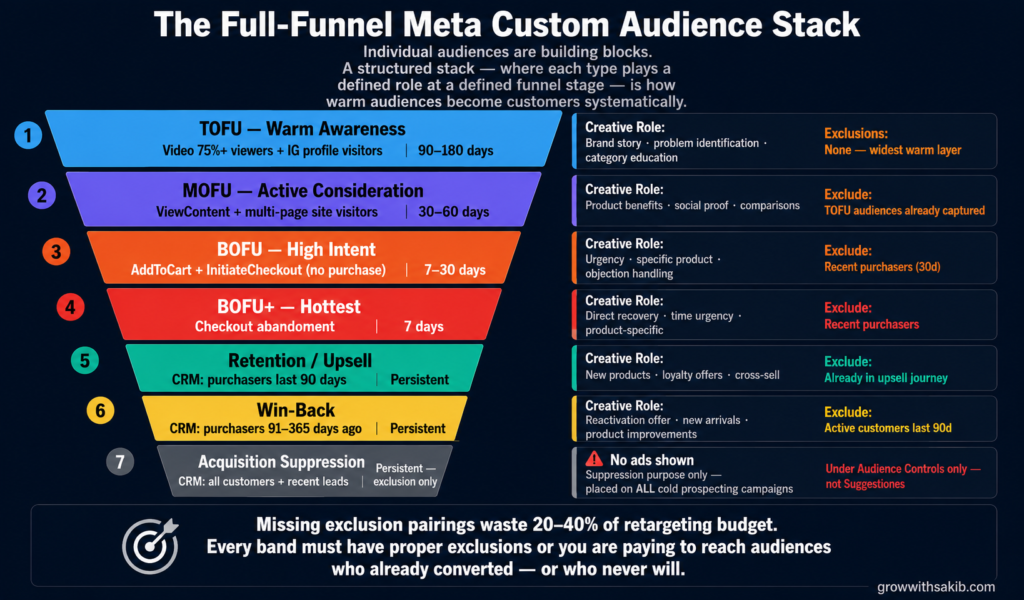
Individual custom audiences are building blocks. A structured audience stack — where each type plays a defined role at a defined funnel stage with the right creative and proper exclusions — is how high-performing Meta accounts convert warm audiences into customers systematically. This connects directly to the campaign structure principles covered in the Meta Ads Guide and the ad format decisions that should match each stage.
| Funnel Stage | Audience Source | Window | Creative Role | Exclusions |
| TOFU — Warm Awareness | Video 75%+ viewers + IG profile visitors | 90–180 days | Brand story; problem identification; category education | None — widest warm layer |
| MOFU — Active Consideration | ViewContent + multi-page site visitors | 30–60 days | Product benefits; social proof; comparisons | TOFU audiences already captured |
| BOFU — High Intent | AddToCart + InitiateCheckout (no purchase) | 7–30 days | Urgency; specific product; objection handling | Recent purchasers (last 30 days) |
| BOFU+ — Hottest | Checkout abandonment (last 7 days) | 7 days | Direct recovery; product-specific; time urgency | Recent purchasers |
| Retention / Upsell | CRM: purchasers last 90 days | Persistent | New products; loyalty offers; cross-sell | Already in upsell journey |
| Win-back | CRM: purchasers 91–365 days ago | Persistent | Reactivation offer; new arrivals; product improvements | Active customers last 90 days |
| Acquisition Suppression | CRM: all customers + recent leads | Persistent — exclusion only | No ads shown — suppression purpose only | Applied on all cold campaigns |
Note: understanding how the Meta ads learning phase interacts with audience size is important here — audiences below 1,000 users can prevent ad sets from exiting learning, directly increasing your cost per result.
Frequently Asked Questions
What is the minimum size for a Meta Custom Audience?
Meta requires a minimum of 100 people in a custom audience before it can be used for ad delivery. In practice, performance falls off significantly below 1,000 users — the algorithm needs sufficient scale to optimise delivery. For customer list uploads, upload at least 300–500 raw contacts to account for match rate losses. Full minimum size requirements are documented in the Meta Business Help Center.
How long does a Meta Custom Audience last?
Retention windows vary by source type. Website custom audiences: up to 180 days (up to 2 years for Purchase events). Facebook Page and Instagram engagement: up to 365 days. Lead form engagement: up to 90 days. Customer list audiences persist until you manually remove them. The complete retention window reference is available in the Meta audience targeting documentation.
Why is my Meta Custom Audience match rate low?
Low match rates almost always trace to four causes: (1) Insufficient identifiers — email alone produces 40–60% match rates; adding phone + name pushes this to 60–75%+. (2) Formatting errors — phone numbers missing country codes, emails with trailing spaces. (3) Stale data — lists decay 2–4% per month. (4) Audience composition — B2B lists often contain work emails that users did not use for their Facebook accounts. Full identifier formatting requirements are in the Meta Business Help Center best practices guide.
What happened to interest-based exclusions in Meta Ads?
Meta permanently removed interest-based exclusions from Ads Manager on March 31, 2025 and from boosted posts in June 2025. It is no longer possible to exclude audiences based on interest categories. The only remaining exclusion mechanism is custom audience exclusions placed under Audience Controls. Full confirmation is available in the Conversios 2026 targeting guide.
Can I use custom audiences in Advantage+ Shopping Campaigns?
Yes, with an important distinction. In Advantage+ Shopping Campaigns, custom audience inclusions work as signals — suggestions that guide the algorithm toward certain users, not hard constraints. Meta may deliver beyond your defined audience when it predicts better performance elsewhere. Custom audience exclusions placed under Audience Controls are treated as hard constraints and will be respected. See the Meta Advantage+ Audience documentation for full details.
Are Meta Custom Audiences GDPR compliant?
Customer list custom audiences can be built in a GDPR-compliant way, but compliance depends entirely on your implementation. You must accept Meta’s Custom Audience Terms of Service, use only data from users who gave explicit marketing consent, remove opted-out users before upload, and document your lawful basis for processing. The ICO’s GDPR and direct marketing guide provides authoritative guidance on lawful basis requirements.
What are the new At Least and In the Past engagement filters?
Meta introduced these two engagement audience filters in March 2026. The At Least filter requires a minimum number of qualifying engagements before a user is included — filtering out one-time accidental exposures. The In the Past filter sets a precise recency window. Combined, they create segments like ‘engaged with my Instagram posts at least 3 times in the past 14 days’ — meaningfully higher quality than ‘anyone who engaged in the last 30 days.’ Full breakdown is available in Digital Applied’s March 2026 engagement filter guide.
Key Takeaways
- Meta Custom Audiences have 8 source types. Most advertisers use 2–3. On-platform engagement audiences are entirely ATT-immune and systematically underused.
- The ‘all visitors, 180 days’ audience is the most common and least effective website custom audience. Segment by intent level and recency using the Intent x Recency framework instead.
- Customer list match rates average 40–60% for email-only uploads. Adding phone + name pushes this to 60–75%+. Lists decay 2–4% monthly and must be refreshed regularly.
- The 75% video view threshold is the inflection point for engagement audiences — it builds free, durable warm audiences with genuine intent signals and 365-day retention.
- Missing exclusion pairings waste 20–40% of retargeting budget. AddToCart campaigns must exclude recent Purchasers. Acquisition campaigns must exclude all existing customers.
- Interest-based exclusions were permanently removed on March 31, 2025. Only custom audience exclusions placed under Audience Controls now work as hard suppression rules.
- Custom audience inclusions are now suggestions, not constraints. Meta may deliver outside your defined audience. Only exclusions under Controls are honoured as hard rules.
- Lookalike seed quality dominates seed size. 500 paying customers outperform 5,000 newsletter subscribers as a seed in every meaningful test.