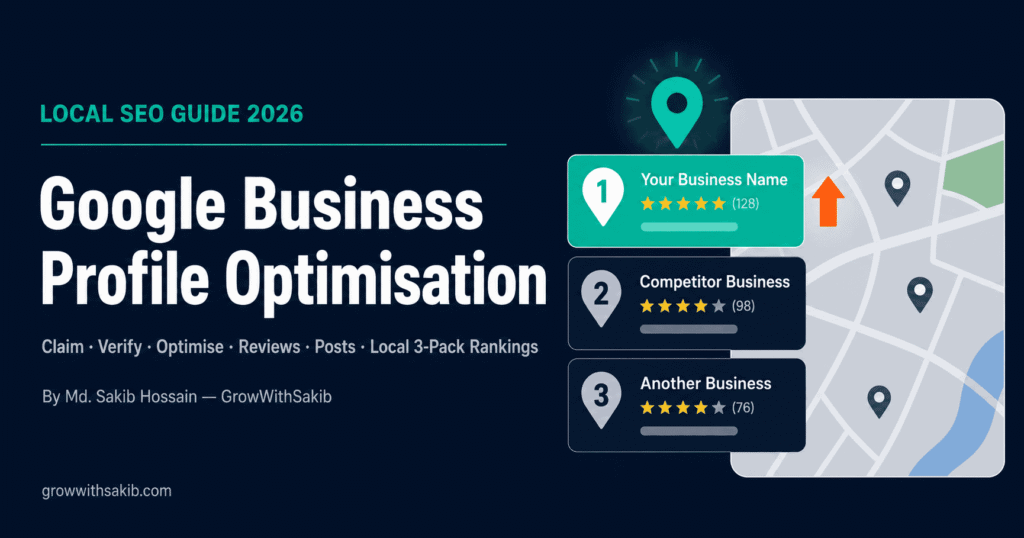
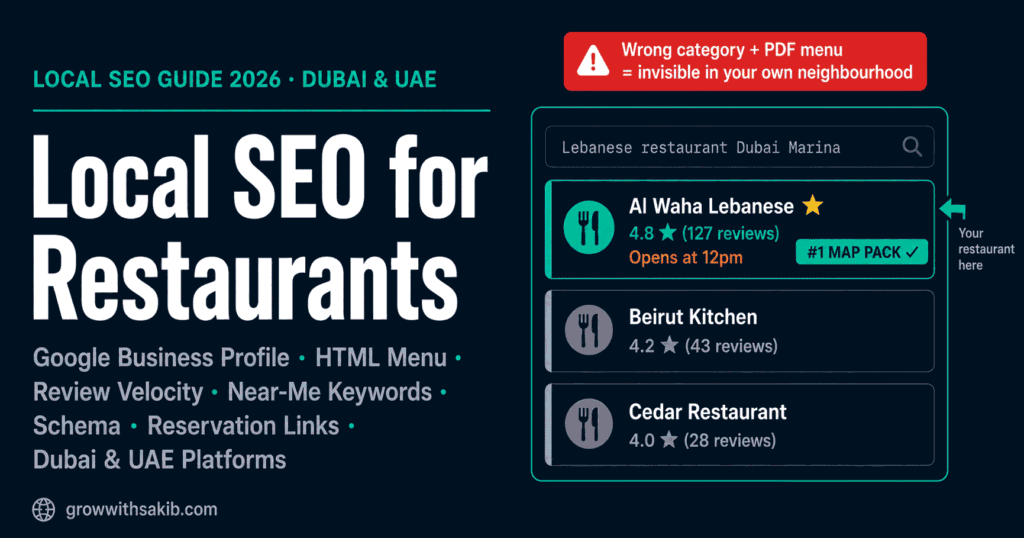
A diner deciding where to eat tonight doesn’t walk down the street – they search. They type “best Italian near me” or “brunch in Dubai Marina,” glance at the top three results on the map, and pick one. Local SEO for restaurants is how you become one of those three.
This guide gives you a ranked, do-this-first method rather than a scattered tip list, with specific guidance for Dubai and the wider UAE market that most guides ignore. It’s the restaurant deep-dive for the broader small business SEO guide on GrowWithSakib, which uses restaurants as a recurring example – here we capture the long-tail searches the pillar can’t.
How Does Google Decide Which Restaurants to Show?
Google ranks local results using three core factors it has always been open about: relevance, distance, and prominence. Per Google’s own local ranking guidance, these three work together – you can’t win on distance alone.
| Factor | What It Means | What You Control |
| Relevance | How well your profile matches the search | Primary category, menu, description, attributes, review language |
| Distance | How close you are to the searcher | Accurate address and service area (you can’t move, but accuracy matters) |
| Prominence | How well-known and trusted you are | Reviews, citations, backlinks, engagement, brand mentions |
You can’t change your physical distance from a searcher. So your entire strategy lives in relevance and prominence – and that’s exactly what the Full-Tables Framework optimises.
The Full-Tables Framework
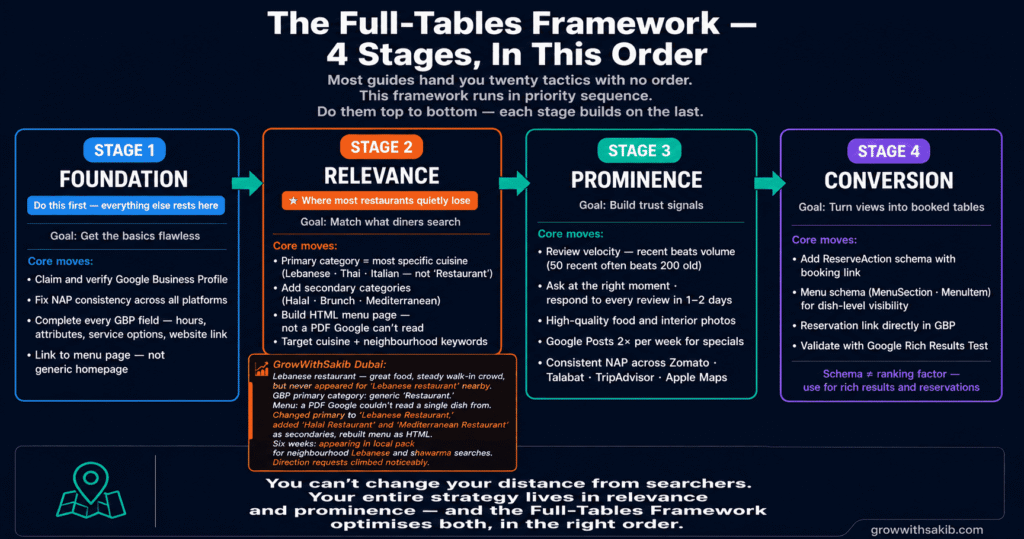
Most guides hand you twenty tactics with no order. This framework runs in four stages, in priority sequence. Do them top to bottom.
| Stage | Goal | Core Moves |
| 1. Foundation | Get the basics flawless | Claim GBP, fix NAP, complete every field |
| 2. Relevance | Match what diners search | Correct primary category, HTML menu, near-me keywords |
| 3. Prominence | Build trust signals | Review velocity, photos, posts, citations |
| 4. Conversion | Turn views into tables | Reservation schema, booking links, fast site |
Stage 1: Foundation – Claim and Complete Your Google Business Profile
Your Google Business Profile (GBP) is the single most important asset in restaurant local SEO. It’s what appears in the map pack, in Google Maps, and when someone searches your name. An incomplete profile is a restaurant with no sign on the door.
Get these right before anything else:
- Claim and verify the profile so you control it – not a customer or a delivery app
- Fix NAP consistency – your Name, Address, and Phone must match exactly across your site, GBP, and every directory
- Complete every field – hours, holiday hours, service options (dine-in, delivery, takeaway), attributes, and website link
- Link to the right page – point the profile to a relevant location or menu page, not a generic homepage
Completeness isn’t busywork – Google rewards it. Restaurants with complete profiles consistently earn more calls and direction requests than half-filled ones. For the foundation that supports all of this, see the guide to Google Business Profile on GrowWithSakib.
Stage 2: Relevance – Category, Menu, and Near-Me Keywords
Relevance is where most restaurants quietly lose. Three moves matter most: your primary category, your menu page, and the keywords you target.
Your primary category is the #1 relevance signal.
This is the highest-leverage setting in your entire profile. A Thai restaurant categorised as “Thai Restaurant” will outrank one wrongly set to “Asian Restaurant” or just “Restaurant” for Thai searches. Be as specific as your cuisine allows, then add secondary categories (e.g. “Halal Restaurant,” “Lebanese Restaurant,” “Brunch Restaurant”) to widen coverage without diluting the primary.
Build an HTML menu page – don’t rely on a PDF.
Google can barely read PDF menus. If your menu is a PDF or an image, search engines and AI answer systems can’t reliably extract your dishes – so you vanish from “restaurants that serve [dish]” searches. Put your full menu in HTML text on a dedicated page, with dish names, descriptions, and prices. This single fix unlocks a huge range of dish-level searches.
Target near-me keywords by cuisine and neighbourhood.
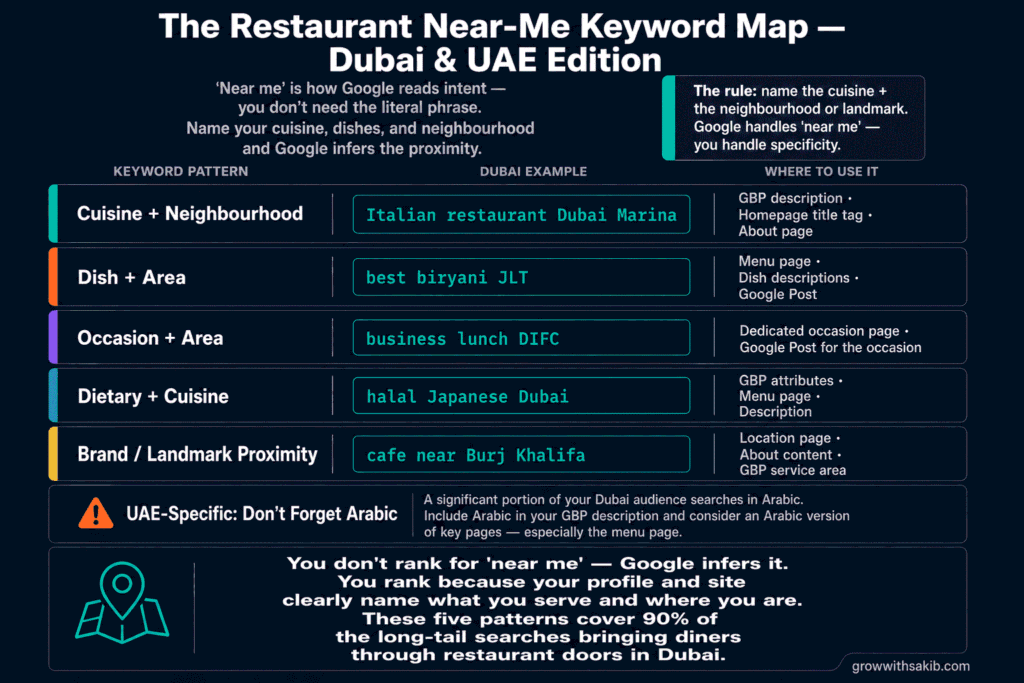
“Near me” is how Google reads intent – you don’t literally need the phrase. Instead, name your cuisine, dishes, and neighbourhood across your profile and site. Here’s a near-me keyword map for a Dubai restaurant:
| Keyword Pattern | Dubai Example | Where to Use It |
| Cuisine + neighbourhood | Italian restaurant Dubai Marina | GBP description, homepage, title tag |
| Dish + area | best biryani JLT | Menu page, dish descriptions |
| Occasion + area | business lunch DIFC | Dedicated page or Google Post |
| Dietary + cuisine | halal Japanese Dubai | Attributes, menu page, description |
| Brand/landmark proximity | cafe near Burj Khalifa | Location page, about content |
For the wider keyword method behind this, see the long-tail keywords guide on GrowWithSakib – restaurant near-me searches are long-tail intent in their purest form.
Stage 3: Prominence – Reviews, Photos, and Citations
Prominence is how trusted and well-known Google thinks you are. For restaurants, reviews are the loudest prominence signal – and recency beats raw volume.
Review velocity and recency beat total count.
A restaurant with 50 reviews from the last three months often outranks one with 200 reviews spanning five years. Google reads a steady flow of recent reviews as a sign you’re active and popular right now. Aim for a consistent trickle, not a one-time push:
- Ask at the right moment – a QR code on the receipt or a polite prompt after a clearly happy meal
- Respond to every review, good or bad, within a day or two – it signals an active, engaged business
- Never buy or fake reviews – it violates Google’s policies and risks your profile
Photos and posts keep you fresh.
Add high-quality photos of food, interior, and exterior regularly. Per data cited by industry sources, businesses with photos earn meaningfully more direction requests on Google Maps. Use Google Posts a couple of times a week for specials and events – fresh activity signals an active, maintained profile.
Build consistent local citations.
A citation is any online mention of your restaurant’s name, address, and phone. They should be identical everywhere – Google cross-checks them to confirm you’re legitimate. We’ll cover which directories matter in the UAE next.
Stage 4: Conversion – Reservation Schema and Booking Links
Ranking is half the job; the other half is turning a search into a booked table. This is where structured data (schema) earns its place.
Schema is code that describes your restaurant to search engines in a format they parse perfectly. The schema.org Restaurant type lets you mark up your name, cuisine, price range, hours, and ratings. Nest a Menu object (Menu – MenuSection – MenuItem) to describe dishes and prices, and add a ReserveAction to expose a booking path.
| Schema Element | What It Does | Priority |
| Restaurant | Core identity: name, cuisine, price, hours, geo | Essential |
| hasMenu / Menu | Describes your menu sections and items | High – aids dish-level + AI answers |
| aggregateRating | Shows your review score in markup | Recommended |
| ReserveAction | Enables a reservation/booking action | High for table-service venues |
Implement it on your location page, then validate with Google’s Rich Results Test. On WordPress, plugins like Rank Math and Yoast can output much of this without code. For the broader configuration, see the technical SEO guide on GrowWithSakib.
Google vs Third-Party Platforms: Where Should Restaurants Be?
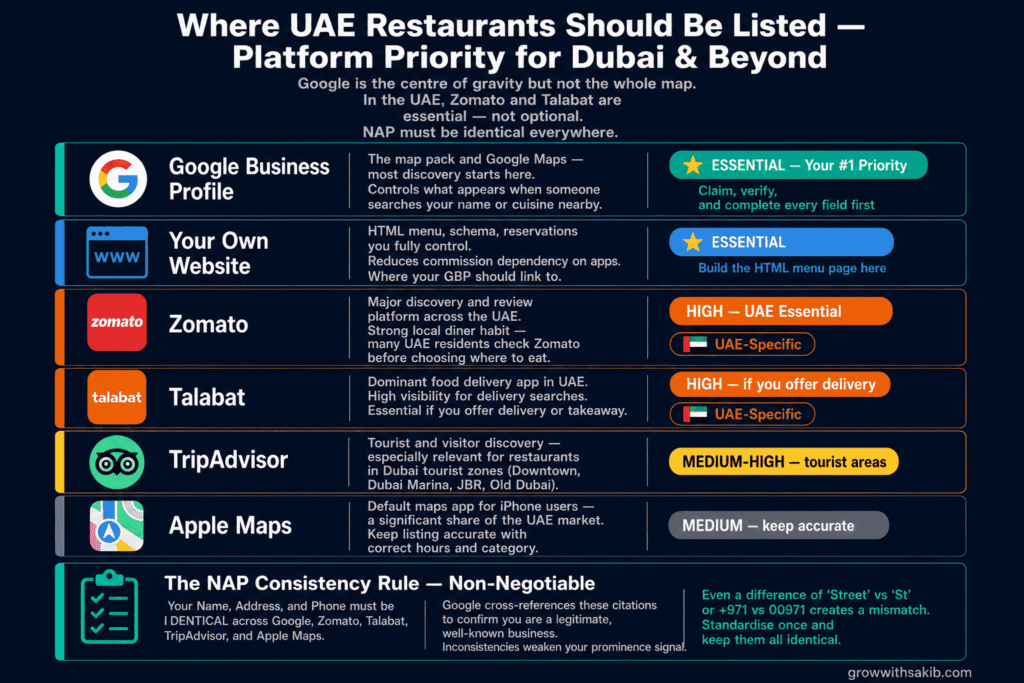
Google is the centre of gravity, but it isn’t the whole map – especially in the UAE. Here’s an honest view of where to invest, and where it differs for Dubai restaurants.
| Platform | Why It Matters | Priority for Dubai/UAE |
| Google Business Profile | The map pack and Maps; most discovery starts here | Essential – your #1 priority |
| Your own website | Menu, schema, reservations you fully control | Essential – reduces app commissions |
| Zomato | Major discovery + review platform across the UAE | High – strong local diner habit |
| Talabat | Dominant UAE food-delivery app | High if you offer delivery |
| TripAdvisor | Tourist and visitor discovery, esp. in Dubai | Medium-High in tourist areas |
| Apple Maps | Default for iPhone users; many in the UAE | Medium – keep listing accurate |
The key in Dubai: keep your NAP identical across Google, Zomato, Talabat, TripAdvisor, and Apple Maps, because Google cross-references them for prominence. And remember a chunk of your audience searches in Arabic – if you serve Arabic-speaking diners, include Arabic in your description and consider an Arabic version of key pages.
Honest Limits: What Local SEO Can and Can’t Do
Local SEO is the highest-ROI marketing most restaurants can do – but set realistic expectations:
- It won’t fix a distance disadvantage entirely – if a competitor is physically closer to most searchers, you compete on relevance and prominence, but proximity still matters.
- Results take weeks, not days – a category fix or review push typically shows movement in four to eight weeks, not overnight.
- Schema won’t rank you on its own – it aids visibility and conversion, but it’s not a ranking shortcut.
- It won’t save a restaurant with bad reviews – SEO brings people to the door; food, service, and genuine reputation keep them coming.
Track your progress with the free Google Search Console keyword research method on GrowWithSakib and the guide to tracking SEO results so you can see which dishes and neighbourhoods are actually pulling diners in.
Common Restaurant Local SEO Mistakes
| Mistake | Why It Hurts | Do This Instead |
| Wrong primary GBP category | Kills relevance for your core cuisine searches | Set the most specific category; add secondaries |
| PDF-only menu | Google can’t read dishes; you miss dish searches | Build an HTML menu page with text and prices |
| Chasing review volume only | Old reviews signal a stale business | Build steady recent review velocity |
| Inconsistent NAP | Weakens prominence; confuses Google | Match NAP exactly everywhere, incl. Zomato/Talabat |
| Ignoring Arabic searchers | Misses a large UAE audience | Add Arabic to description and key pages |
| Treating schema as a ranking hack | Disappointment when rankings don’t jump | Use schema for rich results and reservations |
| Never posting or updating photos | Looks inactive to Google and diners | Post weekly; refresh photos regularly |
Frequently Asked Questions
1. What is local SEO for restaurants?
Local SEO for restaurants is the process of optimising your online presence so your restaurant appears when nearby diners search for somewhere to eat. It centres on your Google Business Profile, an HTML menu page, recent reviews, near-me keywords by cuisine and neighbourhood, and menu and reservation schema. The goal is to rank in the local map pack, where most diners click before choosing where to eat.
2. What is the most important ranking factor for a restaurant?
Your primary Google Business Profile category is the single most important relevance signal. A restaurant correctly categorised as “Thai Restaurant” will outrank one set to the generic “Restaurant” for Thai searches. Choose the most specific category your cuisine allows, then add secondary categories to widen coverage. Beyond category, Google ranks on relevance, distance, and prominence working together.
3. How many Google reviews does my restaurant need to rank?
There’s no magic number. A restaurant with 50 recent, quality reviews often outranks one with 200 old reviews, because Google weighs
recency and velocity heavily. Aim for a steady flow of genuine reviews – a few each week – rather than a one-time push. Respond to every review within a day or two, and never buy fake reviews, which violates Google’s policies.
4. Why does my restaurant menu need to be HTML and not a PDF?
Google can barely read PDF menus, so if your menu is a PDF or image, search engines and AI answer systems can’t extract your dishes. That means you won’t appear for “restaurants that serve [dish]” searches. Put your full menu in HTML text on a dedicated page with dish names, descriptions, and prices to unlock a wide range of dish-level searches.
5. Does schema markup help a restaurant rank higher?
Not directly. Per schema.org’s Restaurant documentation, schema describes your restaurant to search engines, but it’s not a direct ranking factor. What it does is enable rich results, power reservation actions, and help AI systems recommend you. Add Menu and ReserveAction schema for visibility and conversion – validate it with Google’s Rich Results Test – but not as a ranking shortcut.
6. How do I rank for near me restaurant searches?
You don’t need the literal phrase “near me” – Google infers it from the searcher’s location. Instead, name your cuisine, dishes, and neighbourhood across your profile and site: “Italian restaurant Dubai Marina,” “best biryani JLT.” Set the correct primary category, complete your Google Business Profile, and keep your address accurate so Google knows exactly where and what you are.
7. Should my Dubai restaurant be on Zomato and Talabat too?
Yes. In the UAE, Zomato is a major discovery and review platform, and Talabat dominates food delivery. List on both, plus TripAdvisor for tourist areas and Apple Maps for iPhone users. Keep your name, address, and phone identical across all of them – Google cross-references these citations to confirm you’re a legitimate, well-known business.
8. How long does restaurant local SEO take to work?
For an existing profile, expect noticeable movement in four to eight weeks after meaningful changes like a category fix, menu rebuild, or review push. Foundational fixes such as NAP consistency can move rankings within a few weeks. It’s an ongoing effort, not a one-time setup – consistent reviews, posts, and fresh photos compound over months.
Key Takeaways
- Google ranks restaurants on relevance, distance, and prominence – you control relevance and prominence, so that’s where your strategy lives.
- Run the Full-Tables Framework in order: Foundation (GBP + NAP), Relevance (category + menu + keywords), Prominence (reviews + photos), Conversion (schema + booking).
- Your primary GBP category is the #1 relevance signal – set the most specific category your cuisine allows.
- Build an HTML menu page; Google can barely read PDF menus, and you lose every dish-level search.
- Recent review velocity beats raw volume – 50 recent reviews often outrank 200 old ones.
- Target near-me keywords by cuisine and neighbourhood (e.g. Italian restaurant Dubai Marina), not the literal phrase near me.
- In the UAE, list on Zomato, Talabat, TripAdvisor, and Apple Maps with identical NAP, and include Arabic for Arabic-speaking diners.
- Menu and ReserveAction schema aid visibility and reservations but are not a direct ranking factor – validate with the Rich Results Test.