A single great article might get cited by AI once in a while. A well-built topic cluster gets cited again and again, across dozens of related questions, because AI comes to see your site as the default reference on the subject. That shift – from lucky mention to reliable citation – is what this guide is about.
This teaches the full methodology behind topic clusters for AI search. It expands the first tactic from the complete guide to generative engine optimization on GrowWithSakib, and bridges to the broader content strategy guide on GrowWithSakib. If topical authority is new to you, start with the guide to topical authority.
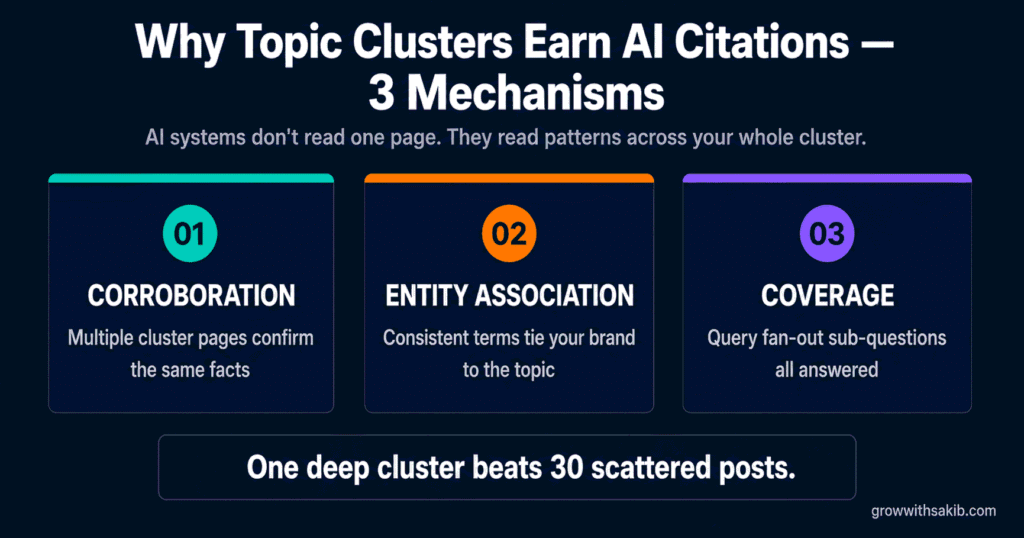
Why Do Topic Clusters Earn AI Citations?
Most guides claim clusters “get more citations” without explaining why. Here’s the actual reason, because understanding it changes how you build. AI engines don’t just evaluate a single page – they assess your entire topical footprint, and a cluster wins through three distinct mechanisms.
Mechanism 1: Corroboration
AI engines prefer sources they can verify against themselves. When three of your cluster pages state the same fact or define a term the same way, each one corroborates the others. That internal agreement raises the AI’s confidence that your information is reliable – the same cross-checking logic covered in how AI search systems actually work on GrowWithSakib. One page is a claim; a cluster is a chorus saying the same thing.
Mechanism 2: Entity Association
When you cover a topic across many pages using consistent terminology, you tie your brand to that topic as an entity in the AI’s model of the world. Repeatedly pairing your brand with the same concepts, tools, and terms builds a semantic signature: the AI learns “this brand is about this subject.” That association is what makes it reach for you when the topic comes up. The deeper method is in the guide to entity optimisation for GEO on GrowWithSakib.
Mechanism 3: Coverage (Query Fan-Out)
AI engines break a question into many sub-questions – a process called query fan-out – and pull from sources that answer them. A single page answers one or two. A cluster answers the whole family of related questions, so your site can be cited across the entire journey: the definition, the how-to, the comparison, the measurement. Coverage is why a cluster earns sustained citations rather than a single hit.
How to Build a Topic Cluster That Gets Cited
Here’s the step-by-step methodology for building an 8-12 article cluster that earns sustained citations. Work through it in order – the sequence matters.
Step 1: Choose a Topic You Can Own
Pick a subject specific enough to genuinely dominate and broad enough to support 8-12 articles. Don’t pick “marketing” – pick a defined niche where you have real expertise. AI rewards focused depth over scattered breadth, so a topic you can cover completely beats a huge one you can only skim.
Step 2: Map Subtopics From Real Questions
Because coverage depends on query fan-out, map your cluster around the actual questions people and AI ask about your topic. List the definition, the how-tos, the comparisons, the mistakes, the measurement, and the edge cases. Each becomes a cluster page. Mine People Also Ask, autocomplete, and the follow-up questions AI tools suggest – those reveal the sub-intents your cluster must answer, exactly the query patterns covered in the answer engine optimisation guide.
Step 3: Build the Pillar Page
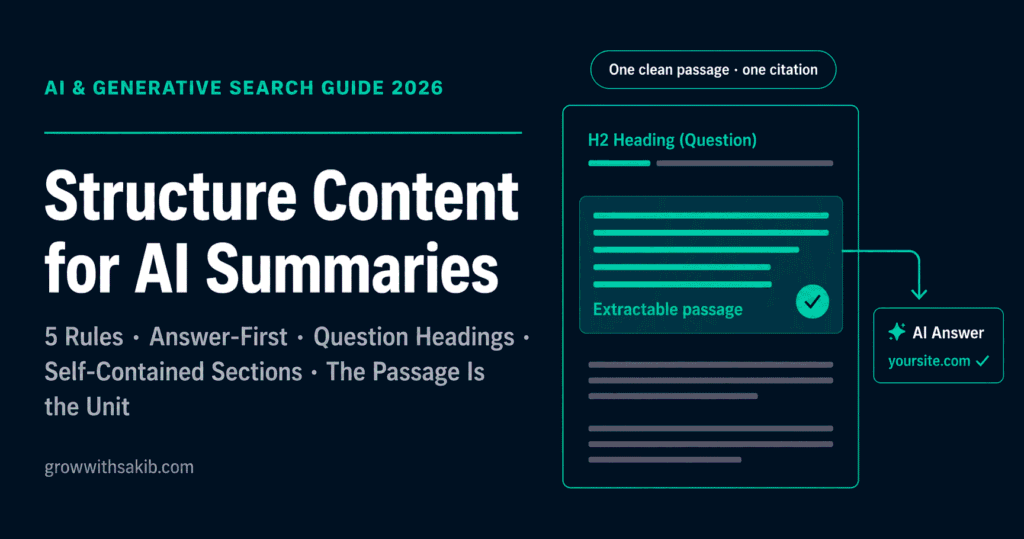
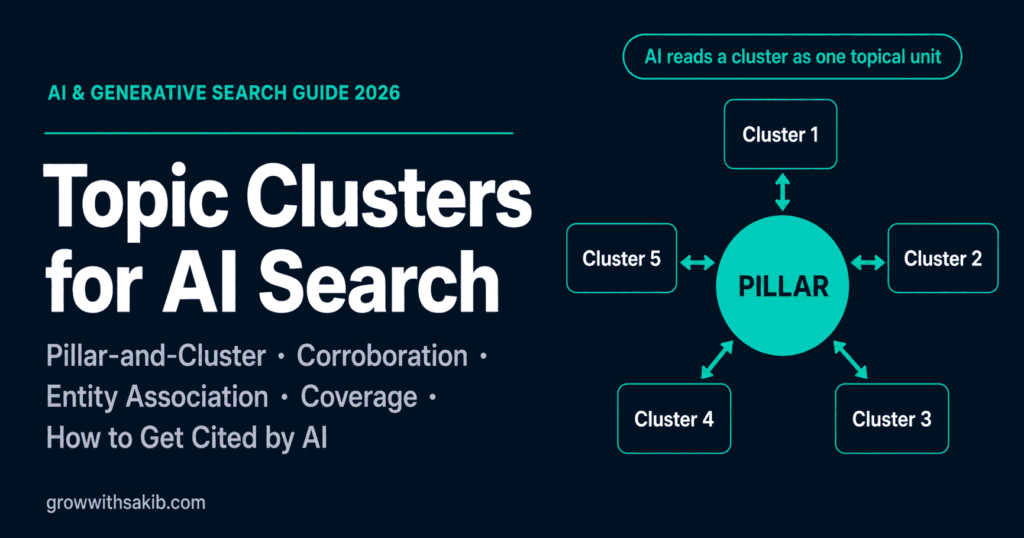
The pillar covers the whole topic at a high level and links out to every cluster page. It’s the hub AI classifies as your authoritative source on the subject. Make it genuinely comprehensive – a thin pillar undermines the whole structure – and give it a clear definition up top that AI can lift, following the direct-answer structure covered in the guide to structuring content for AI summaries.
Step 4: Write Cluster Pages That Are Each Citable
This is where most clusters fail: they nail the architecture but the individual pages aren’t citable. Every cluster page needs its own proof. According to HubSpot’s State of AEO 2026 report, pages featuring outbound links, statistics, author bios, and a visible last-updated date earn more citations across AI Overviews, Gemini, and Perplexity. So each page should lead with a direct answer, back claims with specific data, and cite sources – the approach in statistics-rich content on GrowWithSakib. Architecture gets you considered; citable pages get you cited.
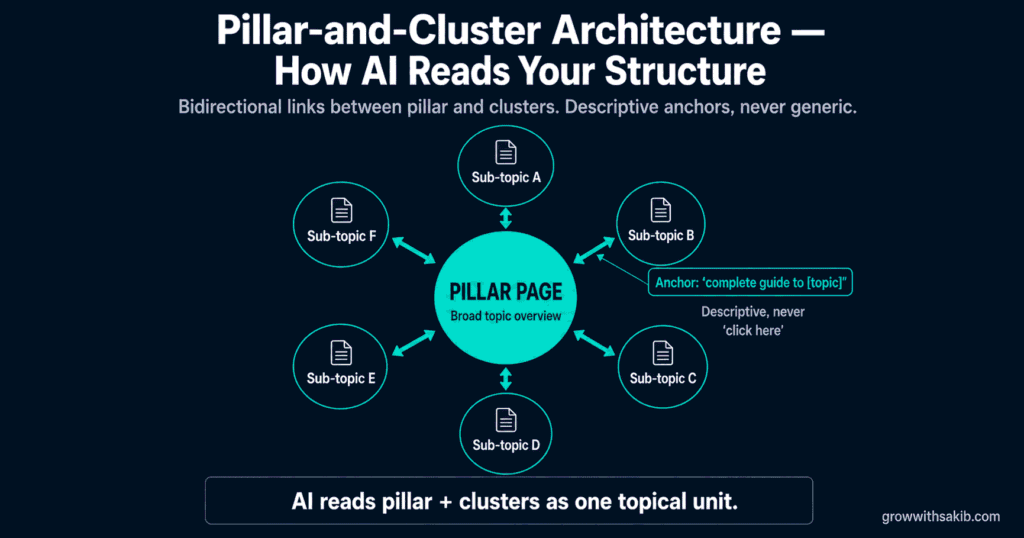
Step 5: Connect With Bidirectional, Descriptive Links
Link every cluster page back to the pillar, link the pillar out to every cluster page, and link related cluster pages to each other – all with descriptive anchor text that names the destination topic. This bidirectional structure is what lets AI read the cluster as one authoritative unit. Keep anchors specific and consistent; they’re part of the authority signal, not decoration. This is distinct from external link building on GrowWithSakib – here you control every link.
Step 6: Keep Terminology and Authorship Consistent
For entity association to work, describe your topic the same way across every page – same key terms, same definitions, same brand name. Have a small set of named, credentialed authors publish across the cluster so the AI reads “this expert, on this topic, has produced many pieces.” Rotating anonymous authors dilutes the signal. Consistency is what turns twelve articles into one recognised entity.
Step 7: Refresh the Whole Cluster, Not Just the Pillar
Freshness is a citation signal, and it applies to every page. Keep a visible last-updated date and refresh facts across the cluster on a schedule – not just the hero page. A cluster where every piece stays current out-signals one where only the pillar is maintained.
| Step / Action | Why It Matters for AI |
|---|---|
| 1. Choose a topic you can own | Focused depth beats scattered breadth |
| 2. Map subtopics from real questions | Covers the query fan-out |
| 3. Build a comprehensive pillar | The hub AI classifies as authoritative |
| 4. Make each cluster page citable | Architecture gets you considered; proof gets you cited |
| 5. Bidirectional descriptive links | Lets AI read the cluster as one unit |
| 6. Consistent terms and authors | Builds entity association |
| 7. Refresh the whole cluster | Freshness signal across every page |
How Many Articles Does a Cluster Need?
A practical floor is around 8-12 connected articles plus a pillar – enough to cover a topic’s main sub-questions convincingly. Competitive topics may grow to 20-30 over time, but quality beats count: a handful of deep, well-sourced, citable pages outperforms a pile of thin ones. Start with the questions that matter most and expand as you go.
How to Measure a Cluster’s AI Performance
Measure the cluster as a whole, not page by page – the point is collective authority. Track three things over time:
- Citation footprint – across a set of your topic’s questions, how often is your brand cited in ChatGPT and Perplexity? Rising coverage means the cluster is working.
- Breadth of queries – are you cited for more related queries over time, including ones you didn’t specifically target? That’s topical authority compounding.
- Consistency – are citations steady across months, not sporadic? Sustained presence is the goal, not a spike.
Run a fixed set of topic prompts monthly and log the results, using the free method in the guide to measuring GEO performance on GrowWithSakib. And before publishing each cluster page, run it through the GEO audit checklist on GrowWithSakib so every piece pulls its weight.
Honest Limits of the Cluster Strategy
Set expectations realistically:
- It compounds slowly – a cluster builds authority over months as pages accumulate, link, and get recrawled. It’s a long game, not a quick win.
- Quality gates everything – a big cluster of thin pages won’t work; each page must genuinely earn its citation with real depth and proof.
- It rides on fundamentals – clusters amplify good content and solid SEO; they don’t rescue weak material or an un-crawlable site.
- Off-site signals still matter – entity association is strengthened by third-party mentions too, so pair your cluster with genuine external validation over time.
The upside makes the patience worth it: a well-built cluster earns you visibility in two systems at once – traditional search rankings and AI citations – from a single investment, as the complete GEO guide outlines across all five core tactics. Build it once, maintain it, and it keeps working across every related question your audience asks.
Common Topic Cluster Mistakes
| Mistake | Why It Hurts | Do This Instead |
|---|---|---|
| Great architecture, thin pages | Structure alone doesn’t earn citations | Make every page citable with real proof |
| Inconsistent terminology | Fragments the entity signal | Use the same terms and definitions throughout |
| Vague anchor text | Wastes the internal-link signal | Use descriptive, specific anchors |
| One-directional linking | AI can’t read the cluster as a unit | Link pillar and clusters both ways |
| Chasing article count | Thin volume underperforms | Prioritise depth over raw number |
| Only refreshing the pillar | Stale cluster pages lose citations | Refresh every page on a schedule |
| Trusting vendor multipliers | Numbers are unverifiable | Build for the mechanism; measure your own |
Frequently Asked Questions
1. What is a topic cluster for AI search?
A topic cluster for AI search is a pillar page plus 8-12 connected articles that together cover one subject thoroughly enough that AI engines treat your brand as a recognised authority on it. The pillar covers the topic broadly; each cluster page answers a specific sub-question; and internal links connect them into one unit. This structure earns sustained AI citations across many related queries rather than a single one-off mention.
2. How do topic clusters help you get cited by AI?
Through three mechanisms. Corroboration: multiple pages confirming the same facts raise the AI’s confidence. Entity association: consistent terminology ties your brand to the topic as an entity. Coverage: the cluster answers the many sub-questions AI breaks a query into. Internal links let AI read it all as one authoritative unit, so your site becomes the default source it cites across related queries.
3. How many articles should a topic cluster have?
A practical floor is around 8-12 connected articles plus a pillar page – enough to cover a topic’s main sub-questions convincingly. Competitive topics can grow to 20-30 over time. But quality beats count: a few deep, well-sourced, citable pages outperform many thin ones. Start with the most important questions your audience asks and expand the cluster as you go, keeping every page genuinely substantial.
4. Does internal linking help with AI citations?
Yes. Internal links are how AI reads your cluster as a connected unit rather than isolated pages. When your pillar and cluster pages link to each other with descriptive, consistent anchor text, AI can trace the relationships and classify the pillar as your authoritative hub on the topic. Use specific anchors that name the destination topic – vague anchors like “click here” waste the signal that helps AI recognise your authority.
5. What is entity association in content clusters?
Entity association is the link AI forms between your brand and a topic when you cover it consistently across many pages. By repeatedly pairing your brand with the same concepts, tools, and terminology, you build a semantic signature that teaches AI “this brand is about this subject.” That association is what makes AI reach for your content when the topic comes up, which is why consistent language across a cluster matters so much.
6. How long does a topic cluster take to earn AI citations?
Expect months, not weeks. Initial citations can appear reasonably quickly for well-optimised pages on an established site, but consistent, dominant citation visibility for a topic usually takes several months of publishing, internal linking, and refreshing. Clusters compound over time as pages accumulate and corroborate each other. Some evidence suggests AI engines reward systematic topical coverage somewhat faster than traditional Google rankings do, but it remains a patient, long-game strategy.
7. Do topic clusters help with Google rankings too?
Yes – that’s a big part of their value. The same comprehensive, interlinked, well-sourced coverage that earns AI citations also signals topical authority to Google’s ranking systems. A cluster is effectively an investment in two systems at once: traditional organic rankings and AI citations. The foundational work overlaps heavily, so you’re not choosing between SEO and GEO – a well-built cluster serves both from a single effort.
8. Can I trust the statistics about cluster citation rates?
Be cautious. You’ll see confident multipliers like “3.2x more citations” or “2.7x from bidirectional linking,” but nearly all are single-vendor figures from proprietary datasets that can’t be independently verified and vary widely between sources. The direction is well-supported – comprehensive, connected coverage earns more citations than isolated pages – but don’t anchor your strategy to a specific number. Build for the mechanism and measure your own citation footprint over time.
Key Takeaways
- A topic cluster – a pillar plus 8-12 connected articles – makes AI treat your brand as the default authority on a subject, earning sustained citations, not one-off mentions.
- Clusters earn citations through three mechanisms: corroboration (pages confirming each other), entity association (consistent language), and coverage (answering the query fan-out).
- Internal links with descriptive, consistent anchor text are how AI reads your cluster as one authoritative unit – vague anchors waste the signal.
- Architecture alone isn’t enough: every cluster page must be individually citable with a direct answer, specific data, sources, an author, and a fresh date.
- Keep terminology and authorship consistent across the cluster – inconsistency fragments the entity signal and splits your authority.
- Aim for 8-12 quality articles as a floor; quality and depth beat raw article count every time.
- Measure the cluster as a whole – citation footprint, breadth of queries, and consistency over months – not page by page.
- Be sceptical of vendor citation multipliers (3.2x, 2.7x, 46%); they’re unverifiable – build for the mechanism and measure your own results.