If you’ve heard the term “GEO” and every explanation left you more confused, this guide is for you. We’ll skip the acronym soup and explain what generative engine optimization is in plain English – what AI search actually means, why ranking number one isn’t the whole game anymore, and what it all means for a regular content creator or business owner.
This is the beginner entry point to the complete guide to generative engine optimization on GrowWithSakib. Start here; once the basics click, the full guide takes you deeper.
First, What Is AI Search?
Before GEO makes sense, you need to picture how search is changing. For 20 years, Google worked one way: you typed a query, and it gave you a list of blue links to click. You did the reading and picking.
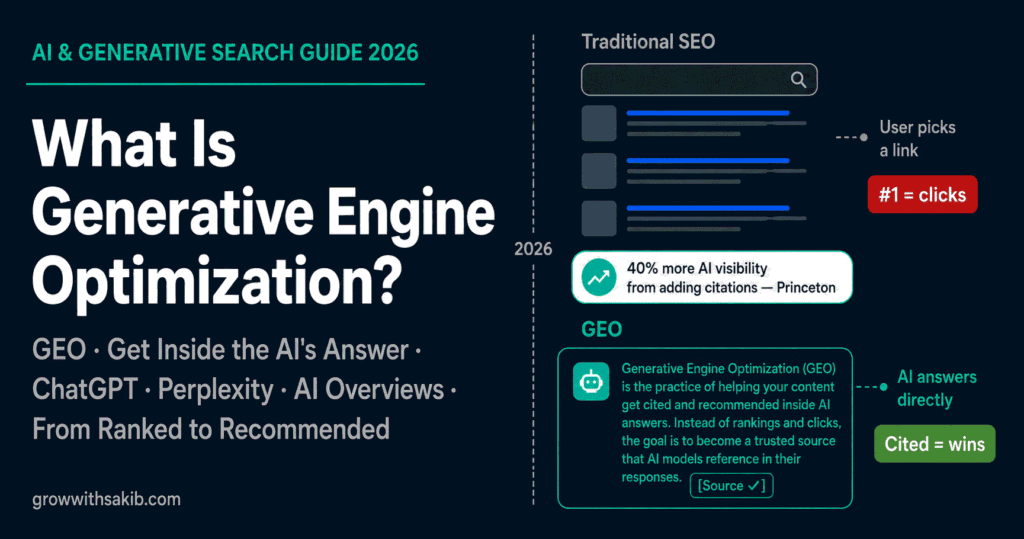
AI search flips that. Now you can ask a tool like ChatGPT, Perplexity, or Google’s AI Overviews (the AI-written summary that appears at the top of many Google searches) a full question – and it writes you a direct answer in sentences, often pulling from several websites at once. You frequently get what you need without clicking any link at all.
A generative engine is simply one of these AI tools that generates a written answer rather than listing pages. “Generative” means it creates new sentences on the spot; it doesn’t just hand you a menu of links. That single change is what created the need for GEO.
So What Is Generative Engine Optimization, Exactly?
Generative engine optimization is the work you do to make your content the kind of thing an AI tool wants to pull into its answer. When someone asks ChatGPT “what’s the best email tool for a small shop?”, several brands get named. GEO is how you become one of the brands that gets named.
The term comes from a 2024 research paper from Princeton and IIT Delhi researchers, who first defined generative engine optimization. They coined “GEO” to describe a brand-new challenge: helping content creators get noticed inside AI-generated answers, which works very differently from ranking on Google.
You’ll see GEO go by other names – answer engine optimization, AI search optimization, large language model optimization. Don’t let the alphabet soup throw you. They all point at the same basic goal: show up inside AI answers. For this guide, we’ll just say GEO.
What Did the Princeton Research Actually Find?
This is the part most beginner guides skip, and it’s the most useful. The founding GEO study didn’t just name the idea – it tested what actually makes AI engines cite a source more often. A few findings matter for beginners:
- Old SEO tricks can backfire. The researchers found that keyword stuffing – cramming keywords in – often performed worse in AI answers. The tactics that gamed old Google don’t work here.
- Adding credible details helps a lot. Adding relevant statistics, quotations, and citing sources measurably increased how often content was surfaced – the study reported visibility gains of up to 40% from these methods.
- Smaller sites can win. In one result, a content change lifted the visibility of a website ranked only fifth in search results by over 100%. AI doesn’t only reward the biggest brand – it rewards the clearest, best-supported answer.
That last point is the hopeful one for beginners: GEO can level the field a little. You don’t need the biggest backlink profile to be cited – you need genuinely clear, credible, well-structured content.
How Is GEO Different From SEO?
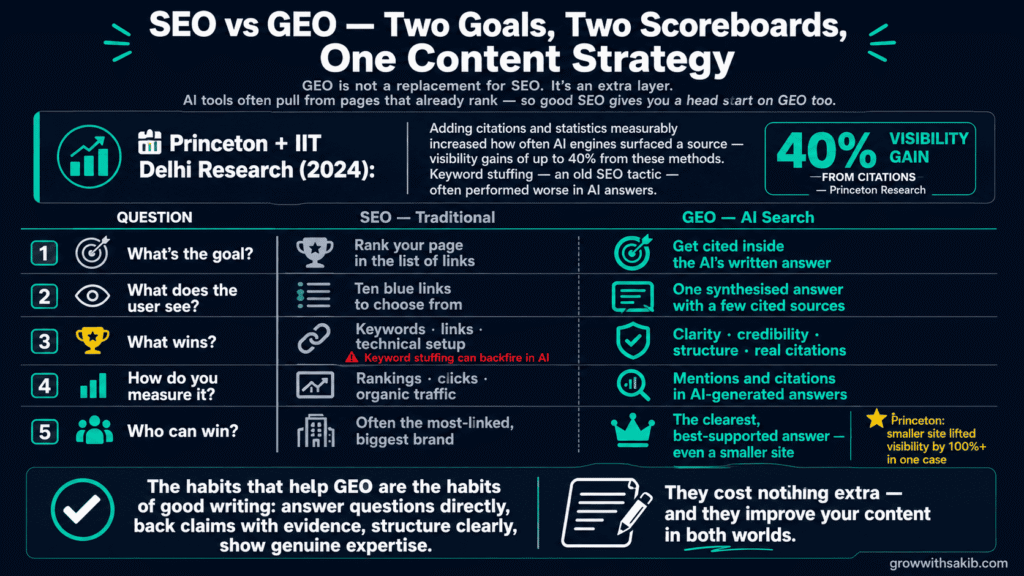
GEO and SEO are cousins, not rivals. SEO (search engine optimization) is everything you do to rank higher in a list of search results. GEO is everything you do to get mentioned inside an AI-generated answer. Here’s the plain contrast:
| Question | SEO (Traditional) | GEO (AI Search) |
| What’s the goal? | Rank your page in the list of links | Get cited inside the AI’s written answer |
| What does the user see? | Ten blue links to choose from | One synthesised answer, with a few sources |
| What wins? | Keywords, links, technical setup | Clarity, credibility, structure, citations |
| How do you measure it? | Rankings, clicks, traffic | Mentions and citations in AI answers |
| Who can win? | Often the most-linked big sites | The clearest, best-supported answer |
Here’s the key thing beginners get wrong: GEO does not replace SEO. The two overlap heavily. AI tools often pull from pages that already rank well, so good SEO gives you a head start. Think of GEO as an extra layer on top of solid SEO, not a replacement for it. If you’re still building SEO basics, the small business SEO guide on GrowWithSakib is the right foundation first.
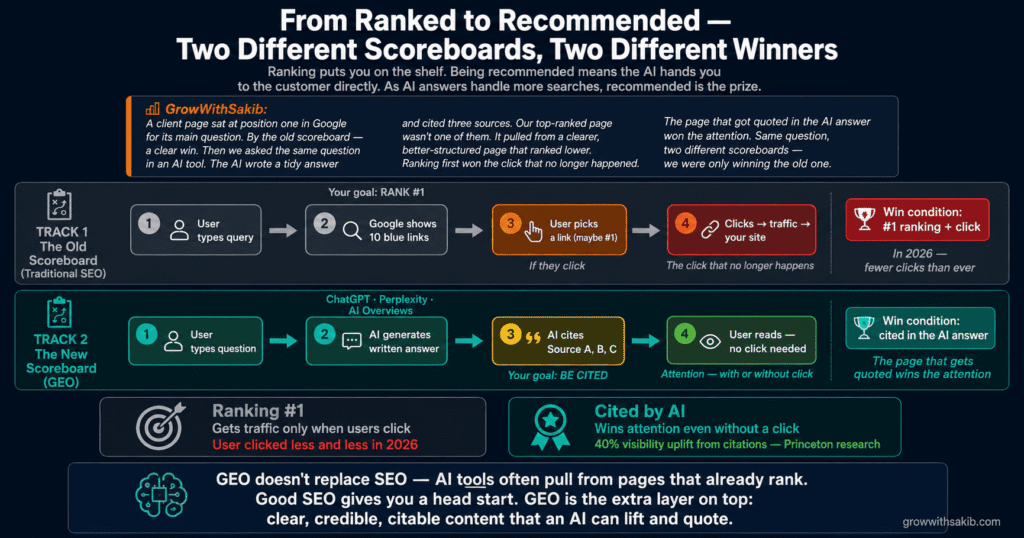
Why Isn’t Ranking Number One Enough Anymore?
For decades, the goal was simple: rank at the top, get the clicks. That logic is cracking for one reason – people increasingly get their answer without clicking anything.
When an AI Overview or ChatGPT answers the question directly on the screen, the searcher is often satisfied right there. No click. If your page ranks first but the AI quotes a different source in its answer, the AI’s chosen source gets the attention and you get nothing – even though you technically “won” the ranking.
This is the shift at the heart of GEO: from ranked to recommended. Ranking puts you on the shelf. Being recommended means the AI hands you to the customer directly. As AI answers handle more searches, being recommended is becoming the prize – and that’s a different skill from climbing the rankings.
What Does GEO Mean for You in Practice?
You don’t need to overhaul anything today. As a beginner, GEO mostly means writing content that’s easy for an AI to understand, trust, and quote. The habits that help, in plain terms:
- Answer real questions directly – lead a section with a clear, complete answer, the way this article opens each part with a definition.
- Back claims with evidence – real statistics, sources, and specifics make your content more quotable, exactly as the research showed.
- Structure clearly – headings, short paragraphs, and lists help an AI pull out a clean chunk to cite.
- Show genuine expertise – clear authorship and first-hand experience signal trust to both Google and AI tools.
If those sound like good writing habits, that’s the point – GEO rewards clarity and credibility, not tricks. The detailed how-to lives in the complete GEO guide on GrowWithSakib; this article is just here to make the idea click.
Should a Beginner Worry About GEO Yet?
Honest answer: understand it now, act on it gradually. AI search is growing fast, but for most small businesses, classic Google search still drives the majority of traffic today. You don’t need to panic or drop everything.
A sensible beginner approach:
- Get your SEO basics solid first – GEO builds on SEO, so a clear, well-structured site helps both at once.
- Adopt GEO-friendly habits as you write – direct answers, evidence, clear structure. They cost nothing extra.
- Watch your industry – if your customers are already asking AI tools for recommendations, move sooner.
The reassuring part: there’s no separate secret playbook fighting against good SEO. The clearer and more credible you make your content, the better you do in both worlds. For where AI search is heading next, the complete GEO guide covers the strategy in full.
Frequently Asked Questions
1. What is generative engine optimization in simple terms?
Generative engine optimization (GEO) is the practice of making your content the kind of thing AI tools like ChatGPT, Google’s AI Overviews, and Perplexity want to mention or cite when they answer questions. Instead of just ranking your page in a list of links like traditional SEO, GEO aims to get your content quoted inside the AI’s written answer itself, where people increasingly look.
2. What does GEO stand for?
GEO stands for generative engine optimization. A “generative engine” is an AI tool that generates a written answer rather than listing web pages – like ChatGPT, Perplexity, or Google’s AI Overviews. The term was coined in a 2024 research paper from Princeton and IIT Delhi. You may also see it called answer engine optimization (AEO) or AI search optimization, which mean much the same thing.
3. Is GEO the same as SEO?
No, but they’re closely related. SEO aims to rank your page in a list of search results. GEO aims to get your content cited inside an AI-generated answer. They overlap heavily because AI tools often pull from pages that already rank well, so good SEO helps your GEO. Think of GEO as an extra layer on top of solid SEO, not a replacement for it.
4. Why isn’t ranking number one on Google enough anymore?
Because people increasingly get answers without clicking. When an AI Overview or ChatGPT answers directly on screen, the searcher is often satisfied with no click. If your page ranks first but the AI cites a different source, that source gets the attention. The shift is from being ranked to being recommended inside the AI’s answer.
5. Which AI tools does GEO apply to?
GEO applies to any tool that generates answers from web content. The main ones in 2026 are ChatGPT, Google’s AI Overviews and AI Mode, Perplexity, Gemini, and Claude. Each works slightly differently, but the core GEO goal is the same across all of them: be the clear, credible source the AI chooses to cite.
6. How do I get my content cited by AI like ChatGPT?
Make your content easy to understand, trust, and quote. Answer questions directly and early, back claims with real statistics and sources, structure content with clear headings and short paragraphs, and show genuine expertise. The founding Princeton GEO research found that adding citations and statistics measurably increased how often AI engines surfaced a source.
7. Does keyword stuffing help with GEO?
No – it can actively hurt. The original GEO study found that keyword stuffing, an old SEO trick, often performed worse in AI-generated answers. Generative engines reward clarity, credibility, and well-supported information, not repeated keywords. Write naturally for a human reader and support your points with evidence instead.
8. Do small businesses have a chance in AI search?
Yes. Encouragingly, the founding research found that clear, well-supported content could lift the visibility of even a lower-ranked site significantly – in one case by over 100%. AI tends to reward the clearest, best-evidenced answer, not just the biggest brand. That gives smaller creators and businesses a genuine opening if their content is genuinely helpful and well-structured.
Key Takeaways
- Generative engine optimization (GEO) is making your content the kind AI tools cite when they answer questions – getting inside the answer, not just the link list.
- A generative engine is an AI tool that writes a direct answer instead of listing pages, like ChatGPT, Perplexity, or Google’s AI Overviews.
- GEO was first defined in a 2024 Princeton and IIT Delhi research paper that tested what makes AI engines cite a source.
- That research found adding statistics and citations boosted AI visibility by up to 40%, while keyword stuffing often made things worse.
- GEO doesn’t replace SEO – it’s an extra layer on top, since AI tools often pull from pages that already rank well.
- Ranking number one isn’t enough anymore because people increasingly get answers without clicking – the shift is from ranked to recommended.
- For beginners, GEO mostly means good habits: answer directly, back claims with evidence, structure clearly, and show real expertise.
- Understand GEO now and adopt its habits gradually; get your SEO basics solid first, since clear, credible content wins in both worlds.