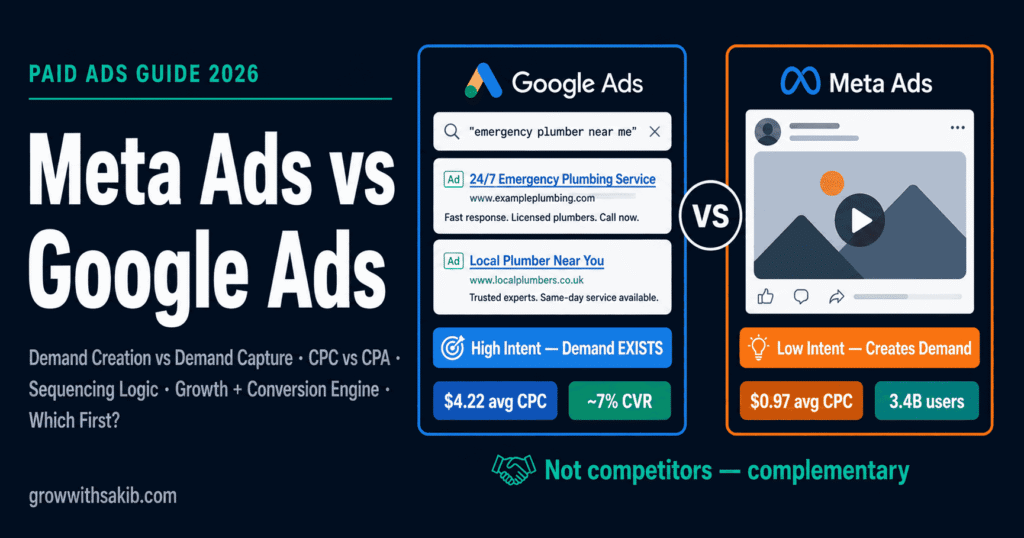
This is the most common question in paid advertising, and most answers get it wrong by treating it as a fight one platform wins. They line up cost per click, declare Meta cheaper, and call it a day. That comparison is not just incomplete — it is actively misleading.
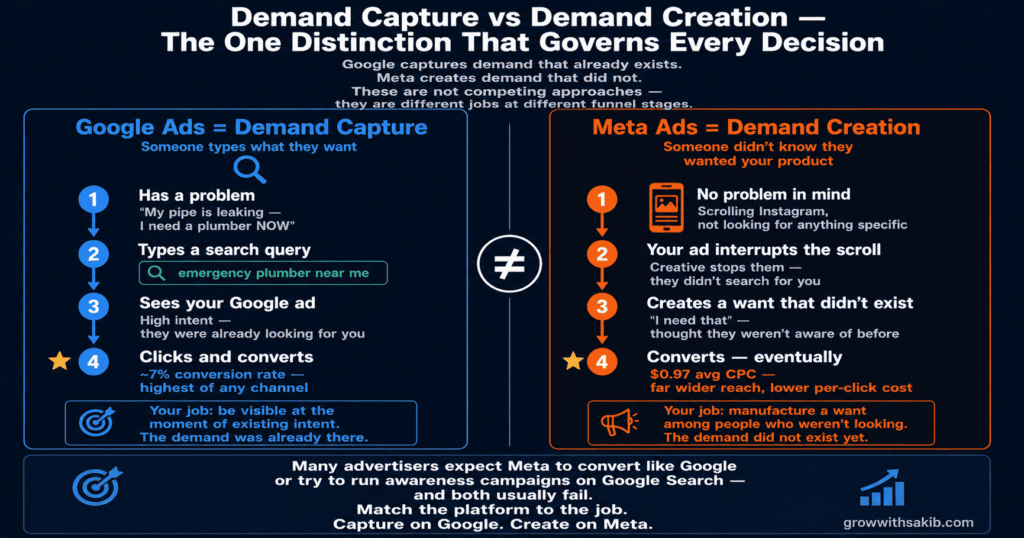
The real distinction is not cost. It is what each platform does. Google Ads captures demand that already exists: someone types ’emergency plumber near me,’ and Google puts you in front of them at the moment of intent. Meta Ads creates demand that did not exist: someone scrolls Instagram, sees your product, and realises they want something they were not even looking for.
This guide explains that distinction and what it means for your business: the real cost and conversion data behind the CPC headlines, which platform fits your business type and stage, why the two compound when run together, and how to decide where your budget should actually go — all within the complete Meta Ads framework.
The Real Distinction: Demand Capture vs Demand Creation
Everything about choosing between these platforms flows from one difference, and it has nothing to do with cost. Google captures demand; Meta creates it. Understand this and every other decision becomes clear.
Google Ads = demand capture
Google Ads works on intent. As RebootIQ’s 2026 comparison frames it, when a user searches ‘car rental near me’ or ‘best tax consultant,’ they already know what they want — Google responds to demand. You are not convincing anyone they have a problem; they have already identified it and are actively searching for a solution. Your job is simply to be visible at that moment.
This is why Google’s clicks convert so well. The person clicking has high intent — they are far along the buying journey, often ready to act. You are capturing demand at the bottom of the funnel, at the moment of highest purchase intent.
Meta Ads = demand creation
Meta works the opposite way. As RebootIQ documents, someone scrolls through Instagram, sees your product, and thinks ‘I need that’ — before that moment, they did not even know it existed. Meta creates new demand. You are interrupting someone who was not looking for you and manufacturing a want that was not there a second ago.
This is why Meta’s clicks convert at a lower rate per click but cost far less and reach vastly more people. You are creating demand at the top of the funnel, among people who had no intent until your creative gave them some — while SEO for small business captures the organic search demand that already exists.
Why Comparing Cost Per Click Is the Wrong Move
The single most common error in this comparison is deciding on cost per click. Meta’s CPC is dramatically lower, so Meta looks cheaper, so people choose Meta. That reasoning is broken, and understanding why is essential to choosing correctly.
The CPC gap is real but misleading
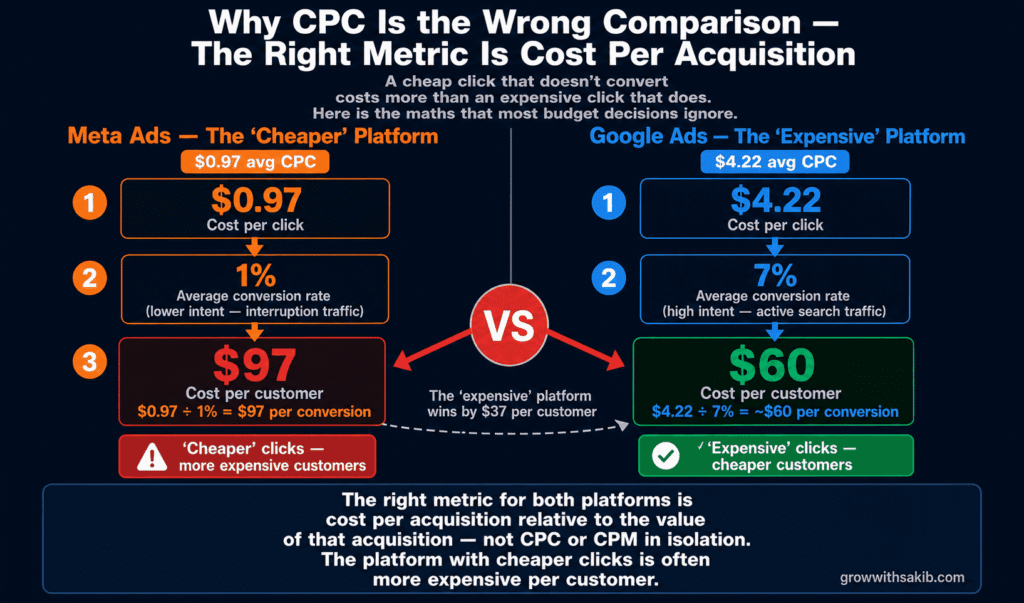
The numbers are not in dispute. As PPC Chief’s 2026 platform data shows, Meta averages $0.50-2.00 CPC against Google’s $2.69, and Ryze AI’s analysis puts the gap at 4.3x — Google $4.22 versus Meta $0.97. On clicks alone, Meta wins easily. But clicks are not customers.
Cheap clicks that don’t convert cost more
Here is the trap. As Around29’s ROI analysis puts it, lower CPC on Meta looks attractive, but if those clicks do not convert, your real cost per customer ends up higher. A $0.97 Meta click with a 1% conversion rate costs $97 per conversion. A $4.22 Google click with a 7% conversion rate costs about $60 per conversion. The ‘expensive’ platform is cheaper per customer, because intent converts.
This is why every serious 2026 analysis lands in the same place. As 511 Digital Marketing concludes, the right metric for both platforms is cost per acquisition relative to the value of that acquisition — not CPC or CPM in isolation. The headline CPC comparison answers a question that does not matter.
They Aren’t Competitors — They’re a Growth Engine and a Conversion Engine
The ‘versus’ in the title is the framing this whole article pushes against. For most businesses past a basic budget, the platforms are not alternatives — they are complementary parts of one system that compound when run together.
Meta builds the demand Google captures
The relationship is mechanical and powerful. As Redclawey’s comparison explains, Meta builds brand awareness that eventually increases branded search volume on Google — which lowers your Google CPCs. The demand you create on Meta today becomes the branded searches you capture on Google tomorrow. Think of Meta as your growth engine and Google as your conversion engine.
Google hits a ceiling that Meta removes
There is a second compounding effect. As Redclawey notes, every dollar of profitable Google Search spend eventually hits a ceiling when you have captured all available search demand — you cannot advertise to demand that does not exist. Meta opens entirely new audience pools Google Search cannot reach, manufacturing the demand that expands your total addressable market beyond what people are already searching for.
This is the same reason single-channel measurement misleads, as covered in our attribution guide: a Meta ad that gets no last-click credit may be driving the branded Google searches that Google then claims. Judge the system on blended results, not platform-siloed ROAS.
Which Platform Fits Your Business? The Decision Framework
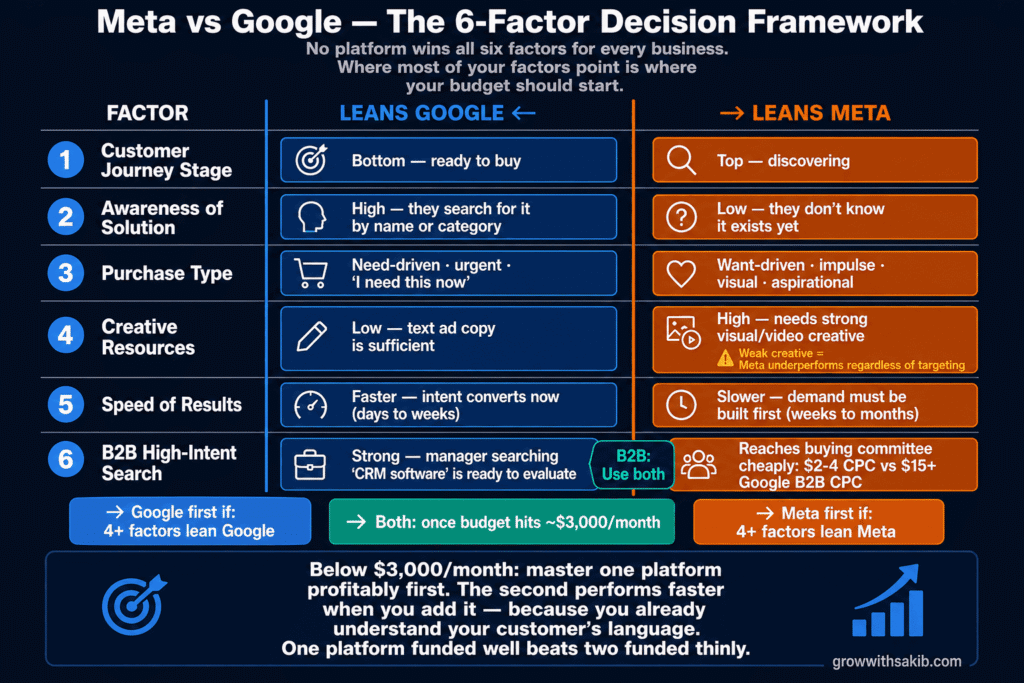
If you must choose one to start — or weight your budget toward one — the decision rests on three things: where your customers are in their journey, how aware they are of your solution, and what creative resources you have. Here is how the factors map.
Choose Google first when…
- You solve an urgent, searched-for problem. Emergency services, repairs, ‘near me’ needs. People actively search; capture them.
- Your solution is a known category. People search for it by name. The demand exists — go capture it.
- You need leads fast. Intent traffic converts quickly; Google delivers buyers now, not later.
- You’re B2B with high-intent searches. As Coby Agency notes, a manager searching ‘CRM software’ is further along than someone browsing a feed.
Choose Meta first when…
- Your product is discovery-led or new. People don’t search for what they don’t know exists. Create the demand.
- You’re visual or lifestyle. Products that sell on aspiration and demonstration thrive in-feed.
- Impulse or emotional purchases. Meta’s environment suits want-driven buying more than need-driven searching.
- You need reach on a budget. As WebConverts documents, Meta’s $0.70 traffic CPC gives far more reach per pound for product and lifestyle brands — and pairs with SEO vs paid ads thinking for businesses deciding how to allocate budget across channels.
| Factor | Leans Google | Leans Meta |
|---|---|---|
| Customer journey stage | Bottom (ready to buy) | Top (discovering) |
| Awareness of solution | High — they search for it | Low — they don’t know it exists |
| Purchase type | Need-driven, urgent | Want-driven, impulse, visual |
| Creative resources | Low — text suffices | High — needs strong visual creative |
| Speed of results | Faster (intent converts now) | Slower (demand must be built) |
| B2B high-intent search | Strong | Reaches committee cheaply, lower intent |
Which Should You Start With? The Sequencing Logic
Most businesses cannot launch both platforms well at once — each needs budget, learning time, and attention. The smart move is to master one, then add the other. Which one you start with depends on your business, and the second platform almost always performs faster than the first.
The sequencing principle
As Coby Agency advises, the sequencing that works is to get one platform — Google or Meta — to a stable, profitable cost per lead with clean tracking first. Then use the audience insights and creative learnings from that platform to inform your expansion onto the second. The second platform almost always performs faster than the first did, because you already understand your customer’s language and behaviour.
Start where your demand reality points
- If people already search for your solution, start with Google. Capture the existing demand, prove profitability, learn your customer’s language from search queries, then expand to Meta to create more demand.
- If your product is discovery-led, start with Meta. Build demand and gather audience and creative insight, then add Google to capture the branded searches your Meta ads generate.
- If you’re a local business, start with whichever matches urgency — Google for emergency or searched services, Meta for discovery and community presence, as covered in our Meta Ads for local business guide.
- If you’re a coach or course creator, Meta typically leads for demand creation and warming, with Google capturing high-intent searches, as covered in our Meta Ads for coaches guide.
The B2B Nuance: It’s Not Simply ‘Google for B2B’
The standard advice is that Google wins B2B because buyers search for solutions. That is half right and worth unpacking, because the full picture is more useful and more favourable to a combined approach.
Google does capture the high-intent B2B searcher. As Coby Agency notes, a marketing manager searching ‘Google Ads agency Netherlands’ is further along the buying journey than someone browsing a feed, and Google generally performs better for capturing that active B2B intent. For bottom-funnel B2B lead capture, Google is usually the stronger first move.
But Meta reaches the B2B buying committee far more cheaply. As Ryze AI documents, B2B software sees Google CPCs exceeding $15 in competitive verticals like ‘CRM software,’ while Meta delivers B2B leads for $2-4 CPC through precise targeting. The catch is intent: those cheaper Meta leads are less far along. The resolution, covered in depth in our B2B Meta guide, is to use Google to capture active searchers and Meta to reach and warm the wider buying committee — the same decision-makers, in a different context, at a fraction of the search CPC.
| B2B Goal | Better Platform | Why |
| Capture active solution searchers | Google Search | Highest intent; ready-to-evaluate buyers |
| Reach the wider buying committee | Meta | $2-4 CPC vs $15+ on Google for the same people |
| Build category awareness / demand | Meta | Creates demand Google can’t capture yet |
| Fastest qualified leads | Google (usually) | Intent converts faster, at higher cost |
How to Split Budget When You Run Both
Once you commit to both platforms, the question becomes allocation. There is no universal split, but there is a logic: fund demand capture to the ceiling of available intent, then invest the rest in demand creation to lift that ceiling.
The allocation logic
- Fund Google to capture available demand. Capture all the profitable, high-intent search demand that exists for your category first — this is your most efficient spend. It is capped by how many people search.
- Invest Meta to create new demand. Once Google captures the existing demand, Meta budget expands the pool — creating the demand that becomes tomorrow’s branded searches and direct conversions.
- Always fund Meta retargeting. Retarget your warm traffic and site visitors on Meta — among the most efficient spend available, as covered in our Meta Ads retargeting strategy guide.
- Measure on blended results. Judge the split on total blended CPA and revenue, not platform-siloed ROAS, because the platforms feed each other in ways single-platform attribution cannot capture.
As Nordsteg recommends, the two platforms complement each other ideally — Meta creates attention and demand at the top of the funnel, Google captures it at the bottom. Weight the split toward whichever stage is your current constraint: if you are capturing all available demand and cannot grow, shift budget to Meta to create more; if you are creating demand but not capturing it efficiently, strengthen Google.
6 Mistakes in Choosing Between Meta and Google
Mistake 1: Deciding on cost per click
CPC is the most cited and least useful metric in this comparison. Meta’s cheaper clicks mean nothing if they convert at a lower rate. Decide on cost per acquisition relative to the value of that acquisition — the platform with cheaper clicks is often more expensive per customer.
Mistake 2: Treating it as a winner-take-all choice
The ‘versus’ framing is the core error. For most businesses past a basic budget, the platforms compound — Meta creates demand that becomes branded Google searches. Asking which to use forever is the wrong question; asking which to use at each funnel stage is the right one.
Mistake 3: Expecting Meta to convert like Google
Meta reaches people with no intent yet, so judging it on bottom-funnel conversion rate makes it look broken when it is doing a different job. Measure Meta on demand creation, reach, and assisted conversions — not on matching Google’s intent-driven conversion rate.
Mistake 4: Running awareness campaigns on Google Search
Google Search is built to capture intent, not create demand. Spending its premium CPC on people who are not searching for you wastes the intent advantage you are paying for. Use Meta to create demand and Google to capture it.
Mistake 5: Splitting a small budget across both
Below roughly $3,000/month, running both usually means neither gets enough data to optimise. Master one profitably first, then add the second — which will perform faster using the first’s learnings. One platform funded well beats two funded thinly.
Mistake 6: Judging each platform in a silo
Platform-reported ROAS hides how the two feed each other — Meta’s demand creation shows up as Google’s branded-search conversions. Measure blended results across both, the way the Meta Ads Guide recommends approaching cross-platform campaign measurement.
Frequently Asked Questions
Is Meta Ads or Google Ads better?
Neither is universally better — they do different jobs. Google Ads captures existing demand (people searching for your solution) with high intent and higher conversion rates. Meta Ads creates new demand (people who don’t know they want your product) with far lower CPC and greater reach. As RebootIQ documents, Google responds to demand while Meta creates it. For most businesses, the best results come from using both at different funnel stages.
Which is cheaper, Meta or Google Ads?
Meta has far lower cost per click — around $0.97 versus Google’s $4.22 in 2026, per Ryze AI — but that is the wrong comparison. The right metric is cost per acquisition relative to the value of the customer. Google’s higher CPC comes with higher intent and roughly 7% conversion rates, so a ‘cheaper’ Meta click that doesn’t convert can cost more per customer than an ‘expensive’ Google click that does.
Should I use both Google and Meta Ads?
For most businesses past about $3,000/month in budget, yes. As Nordsteg notes, the platforms complement each other — Meta creates demand at the top of the funnel, Google captures it at the bottom, and Meta’s awareness lifts your branded Google searches while lowering those CPCs. Below that budget, master one profitably first, then add the second, which performs faster using the first’s learnings.
Which platform converts better?
Google Search converts better per click — around 7% on average versus Meta’s lower per-click rate — because search traffic has active intent. But Meta converts far more people per pound spent because its clicks cost a fraction as much and it reaches vastly more people. As 511 Digital Marketing notes, the right comparison is cost per acquisition relative to value, not conversion rate or CPC in isolation.
Which should I start with?
Start with the platform that matches your demand reality. If people already search for your solution, start with Google to capture that demand. If your product is discovery-led, start with Meta to create demand. As Coby Agency advises, get one platform to a stable, profitable cost per lead first, then expand to the second — it performs faster because you already understand your customer’s language and behaviour.
Is Google or Meta better for B2B?
Google generally performs better for capturing active B2B intent — someone searching ‘CRM software’ is ready to evaluate. But as Ryze AI documents, Meta reaches the same buying committee for $2-4 CPC versus $15+ on Google for competitive B2B keywords. The strongest approach uses Google to capture active searchers and Meta to reach and warm the wider committee cheaply, as covered in our B2B Meta guide.
Does Meta advertising help my Google Ads?
Yes. As Redclawey explains, Meta builds brand awareness that increases branded search volume on Google — and branded searches are cheap, so your blended Google CPCs fall. Meta also opens audience pools Google Search cannot reach, expanding total demand beyond what people already search for. This is why judging the platforms in isolation under-credits Meta’s upstream contribution.
Key Takeaways
- The real distinction is demand capture vs demand creation. Google captures existing demand from people searching; Meta creates new demand among people who didn’t know they wanted your product. Match the platform to the job.
- Cost per click is the wrong comparison. Meta’s $0.97 CPC versus Google’s $4.22 is real but misleading — a cheap click that doesn’t convert costs more per customer. Decide on cost per acquisition relative to acquisition value.
- They compound, they don’t compete. Meta is your growth engine, Google your conversion engine. Meta’s demand creation becomes tomorrow’s branded Google searches, lowering your Google CPCs and expanding your market.
- Google converts better per click; Meta converts more per pound. Google’s ~7% conversion rate reflects intent; Meta’s far cheaper, higher-volume clicks reach people Google can’t. Both truths coexist.
- Choose by journey stage, awareness, and creative resources. Google for urgent, searched-for, known-category needs; Meta for discovery-led, visual, impulse products. Meta demands strong creative to work.
- Master one before adding the other. Below ~$3,000/month, two platforms starve each other of data. Get one profitable, then expand — the second performs faster using the first’s learnings.
- For B2B, it’s not simply ‘Google.’ Google captures active searchers; Meta reaches the same buying committee at $2-4 CPC versus $15+ on Google. Use both for capture plus committee reach.
- Measure blended, not siloed. Platform ROAS hides how Meta feeds Google. Judge the combined system on total CPA and revenue, or you’ll under-credit the platform doing the upstream demand creation.