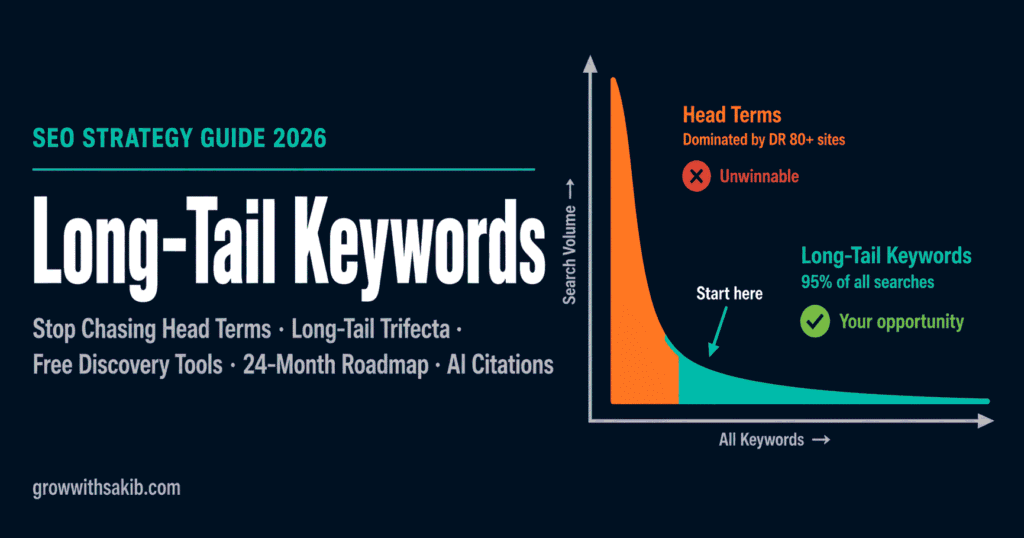
If you’ve ever tried to rank a small business site for “insurance”, “running shoes”, or “crm software”, you’ve experienced the gravity well. Pages with thousands of backlinks, decades of authority, and entire content teams dominate the top 10 — and there’s nothing your site can do about it in the short or even medium term.
This guide makes the case that small businesses should stop chasing high-volume terms entirely for at least the first 12 months. You’ll learn the math behind why head terms are unwinnable, the Long-Tail Trifecta framework for organising your strategy, and a full discovery workflow using only free tools.
If you want the wider strategic context first, the complete small business SEO guide on GrowWithSakib covers how long-tail strategy fits into your overall SEO programme.
What Are Long-Tail Keywords?
Long-tail keywords are search queries with low monthly search volume — typically a few hundred or fewer searches per month, sometimes fewer than ten. They tend to be more specific and longer than head terms, but the defining characteristic is the search volume, not the word count.
This is where most articles get it wrong. WordStream, Shopify, and BrightEdge define long-tail keywords by length — 3-5 words. But Ahrefs’ analysis of the search demand curve by Tim Soulo shows that a one-word keyword can be long-tail if it gets very few searches, and a five-word keyword can be a head term if it gets hundreds of thousands of searches. Length is correlated with volume, not causal.
The Search Demand Curve
The name ‘long-tail’ comes from the shape of search demand. If you plot every Google query in a month, ordered by search volume, the result is a curve with a tiny number of head terms generating massive volume and a vast tail of billions of low-volume queries.
According to Ahrefs’ analysis of their U.S. keyword database, roughly 95% of keywords get fewer than 10 searches per month. Meanwhile, only about 31,000 keywords have search volumes above 100,000/month. The data confirms what the search demand curve theorises: the vast majority of search demand sits in the tail.
Google itself has stated that approximately 15% of daily searches are new — queries Google has never seen before. This is the engine that constantly generates new long-tail queries faster than any tool can index them.
The original concept comes from Chris Anderson’s 2006 book “The Long Tail”, which observed that internet markets reward serving narrow specialised demand at scale. SEO follows the same pattern: many small wins on specific queries compound into a larger total than one big win on a generic query.
Why Small Businesses Should Stop Chasing High-Volume Terms
Most articles tell you head terms are ‘competitive’. They are. But that word obscures what the situation actually looks like in math. Let’s make it concrete.
The Math of Why Head Terms Are Unwinnable
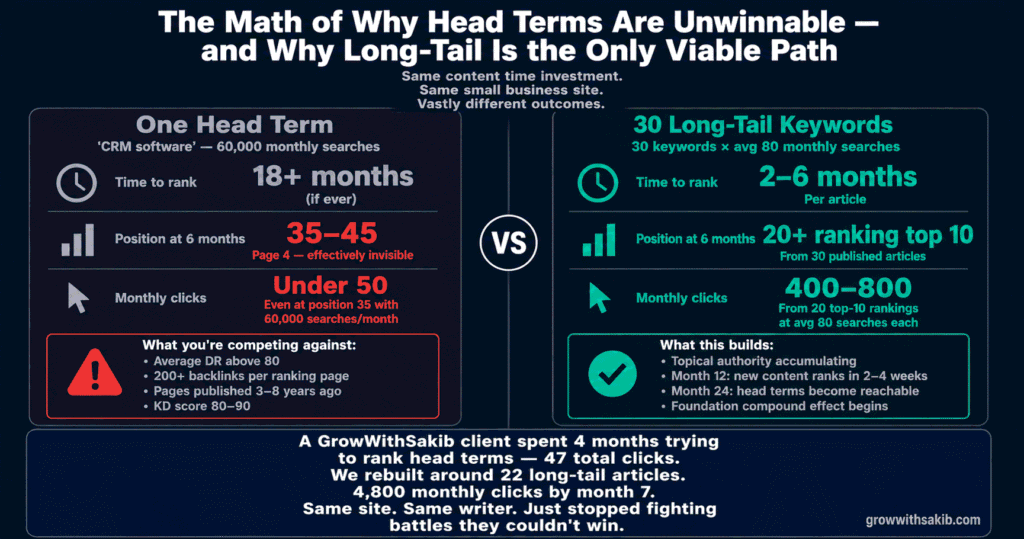
Imagine you target the head term “crm software” with a brand-new small business site. Here’s what you’re up against:
- The top 10 results have an average Domain Rating (DR) above 80
- Each ranking page has 200+ backlinks from authoritative referring domains
- The keyword difficulty is in the 80–90 range
- Content average length: 3,500+ words with original research, comparison tables, video, screenshots, expert interviews
- First-mover advantage: most top-ranking pages were published 3–8 years ago
Even with perfect execution, your new site has roughly a 0% chance of reaching page 1 within 24 months. According to Backlinko’s analysis of Google CTR data, page 2 results average around 1% CTR. Ranking page 2 with 60,000 monthly searches still yields under 600 clicks. Most of those land on results 11-20 with even lower CTR.
The Math of Why Long-Tail Wins
Now target 30 long-tail keywords, each with 80 monthly searches:
1. One head term (60,000 vol)
- Approach: One head term (60,000 vol)
- Time to Rank: 18+ months (if ever)
- Realistic Outcome at 6 Months: Position 35–45
- Total Monthly Clicks: Under 50
2. 30 long-tail keywords (avg 80 vol each)
- Approach: 30 long-tail keywords (avg 80 vol each)
- Time to Rank: 2–6 months
- Realistic Outcome at 6 Months: 20+ ranking top 10
- Total Monthly Clicks: 400–800
Same content time investment. Vastly different outcomes. Long-tail keywords are not a ‘starter strategy’ — they’re the only viable path for small businesses for at least 12 months, and often forever, as the SEO timeline guide explains in full.
The Long-Tail Trifecta: Three Categories That Need Different Treatment
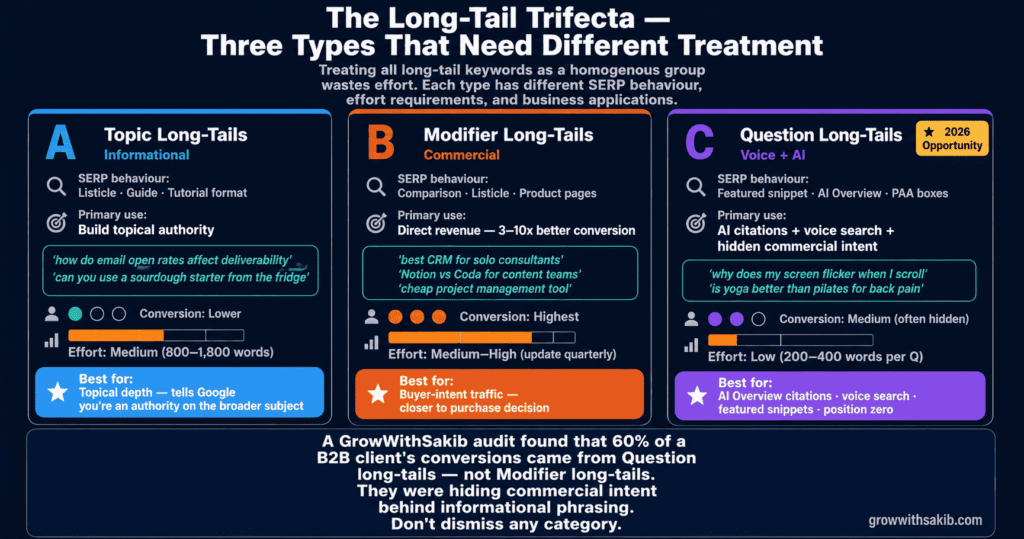
Not all long-tail keywords behave the same way. Treating them as a homogenous group wastes effort. The Trifecta framework organises long-tail into three operational categories — each with different SERP behaviour, effort requirements, and business applications.
| Type | What It Looks Like | SERP Behaviour | Effort |
| A. Topic long-tails | Informational queries | Listicle, guide, tutorial format | Medium |
| B. Modifier long-tails | Commercial qualifiers (best, for X, vs Y, cheap, near me) | Comparison, listicle, product pages | Medium–high |
| C. Question long-tails | Direct questions, conversational, voice | Featured snippet, AI Overview, PAA boxes | Low |
Definition: Informational queries that explore a specific topic or sub-topic. Lower-funnel than head terms but earlier than buying intent.
Examples:
- “how do email open rates affect deliverability”
- “can you use a sourdough starter from the fridge”
- “what causes orange flames in a gas stove”
Best for: Building topical authority. Each Topic long-tail you rank for tells Google your site is an authority on the broader subject — which lifts your rankings across the entire topic cluster.
Page approach: Often warrants a dedicated article. Aim for clear direct-answer formatting in the opening + comprehensive coverage of the specific topic + internal links to related pages.
Effort: Medium — 800–1,800 word articles with examples and supporting depth.
Definition: Commercial queries with qualifying modifiers. The searcher is researching options or comparing, and is closer to a purchase decision.
Common modifiers:
- “best [X] for [audience]” — e.g., “best CRM for solo consultants”
- “[X] vs [Y]” — e.g., “Notion vs Coda for content teams”
- “cheap [X]” / “free [X]” — pricing-led intent
- “[X] near me” — local commercial intent that drives foot traffic and service area leads
- “[X] alternative” — buyer disenchanted with current option
Best for: Direct revenue. Modifier long-tails convert 3-10x better than Topic long-tails because the searcher is closer to action.
Page approach: Comparison pages, product round-up listicles, alternative pages, or commercial landing pages. The SERP almost always shows commercial intent format — match it.
Effort: Medium–high — requires honest competitor analysis, comparison tables, and clear differentiation. Update quarterly to stay fresh.
Definition: Direct questions, typically conversational. These dominate voice search and AI Overview citations in 2026.
Examples:
- “why does my screen flicker when I scroll”
- “how much should I tip a hairdresser in [city]”
- “is yoga better than pilates for back pain”
Best for: Featured snippets, AI Overview citations, voice search. Question long-tails are the cleanest path to position-zero results — and the most valuable for AI-driven traffic in 2026.
Page approach: Often grouped into a single FAQ-style article or as H3 sections within a larger Topic article. Direct 40-60 word answers immediately under the H2 or H3.
Effort: Low — each question can often be answered comprehensively in 200-400 words within a larger page.
How to Find Long-Tail Keywords Without Paid Tools
Most articles assume you have an Ahrefs, Semrush, or Yoast subscription. You don’t need one. Here’s the full free-tools workflow.
Step 1: Google Autocomplete
Type your seed keyword into Google’s search bar but don’t press enter. The autocomplete suggestions are real queries Google receives from real users. Try variations:
- “[seed keyword] + a, b, c…” through the alphabet
- “how to [seed keyword]”
- “why does [seed keyword]”
- “best [seed keyword] for…”
- “[seed keyword] vs…”
Step 2: People Also Ask (PAA) Boxes
Search your seed keyword. The PAA box shows 3-4 related questions Google’s algorithm associates with your query. Click any of them — Google often expands more questions. Each PAA expansion is a high-confidence Question long-tail you can target.
Step 3: Related Searches
Scroll to the bottom of any Google SERP. The “Related Searches” box and the “People Also Search For” suggestions are additional long-tail variations Google has identified for your seed topic.
Step 4: Reddit, Quora, and Niche Forums
Search your seed keyword on Reddit or Quora directly. Threads in niche subreddits or Quora topics reveal the exact questions your target audience asks — often phrased identically to how they’d type them into Google. These are real long-tail goldmines.
Step 5: Free Tools (No Account Required)
- AnswerThePublic — free tier shows question-based long-tails grouped by intent
- Google Trends — surface emerging long-tail variations by region/time
- Google Search Console — your existing site’s Performance report reveals queries already triggering your pages (often unexpected long-tails)
- Ubersuggest free tier — limited daily searches but useful for keyword difficulty estimates
- Moz Keyword Explorer — 10 free queries per month
For a deeper walkthrough of GSC for keyword discovery, see the how to use Google Search Console guide on GrowWithSakib.
Supporting vs Targeting: When Does a Long-Tail Warrant Its Own Page?
This is the question competitor articles skip. Not every long-tail keyword should get its own page. Sometimes a long-tail variation is better served as a section within a larger article.
1. Very low volume (< 30/mo) + closely related to existing article
- Long-Tail Type: Very low volume (< 30/mo) + closely related to existing article
- Treat As…: Section within existing page (H3 or FAQ)
- Rule: Don’t create a thin page for a tiny query — fold it into your existing topical hub
2. Low volume (30–200/mo) + distinct angle
- Long-Tail Type: Low volume (30–200/mo) + distinct angle
- Treat As…: Dedicated article
- Rule: Distinct intent or angle warrants its own page; helps with topical depth
3. Modest volume (200–800/mo) + clear commercial intent
- Long-Tail Type: Modest volume (200–800/mo) + clear commercial intent
- Treat As…: Dedicated commercial page
- Rule: Modifier long-tails with commercial intent usually warrant their own page
4. Question long-tail (voice/AI)
- Long-Tail Type: Question long-tail (voice/AI)
- Treat As…: Often a section, sometimes a hub article for FAQ-heavy topics
- Rule: Group 5+ related questions in a FAQ hub if they share intent
Practical rule: if you can’t fill 600+ words of unique, useful content for a long-tail keyword, it doesn’t deserve its own page. Fold it into a related article, following the on-page SEO checklist to optimise whichever page hosts it.
Stage-Based Long-Tail Strategy by Month
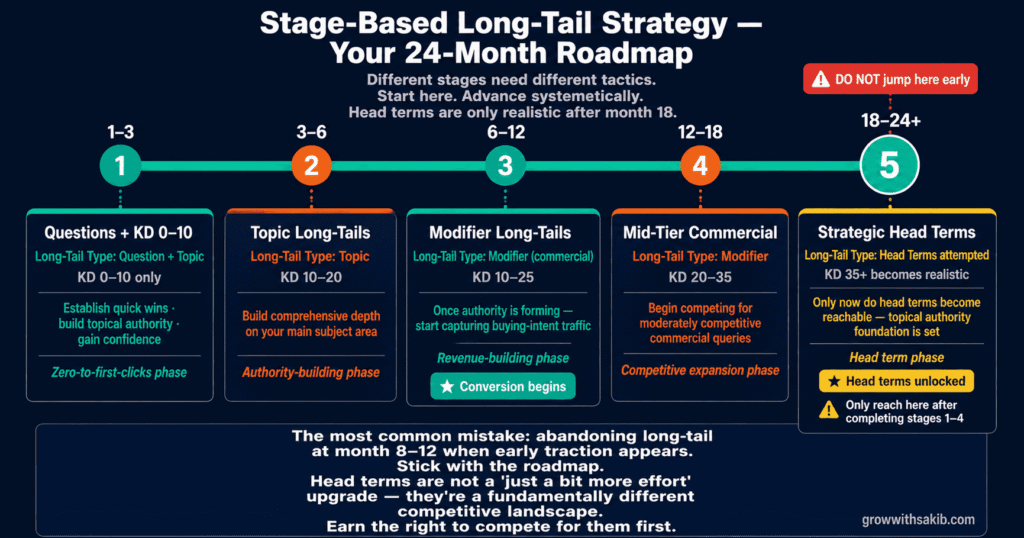
Different stages of a small business site need different long-tail tactics. Here’s the staged roadmap.
1. Month 1–3
- Stage: Month 1–3
- Long-Tail Focus: Question long-tails + very low-KD Topic long-tails (KD 0–10)
- Why: Establish quick wins to build topical authority and confidence
2. Month 3–6
- Stage: Month 3–6
- Long-Tail Focus: Topic long-tails (KD 10–20) covering your core topical area
- Why: Build comprehensive depth on your main subject
3. Month 6–12
- Stage: Month 6–12
- Long-Tail Focus: Modifier long-tails for commercial intent
- Why: Once authority is forming, start capturing buying-intent traffic
4. Month 12–18
- Stage: Month 12–18
- Long-Tail Focus: Mid-tier commercial long-tails (KD 20–35)
- Why: Begin competing for moderately competitive commercial queries
5. Month 18–24+
- Stage: Month 18–24+
- Long-Tail Focus: Strategic head term attempts on topics where you’ve built topical authority
- Why: Only now do head terms become reachable
Long-Tail Keywords and AI Search in 2026
AI search engines — Google AI Overviews, ChatGPT Search, Perplexity, Gemini — strongly favour content that answers specific long-tail queries. This is partly mechanical: AI summarisation requires extractable, specific content. Long-tail-optimised content is structurally easier to cite.
According to Google’s documentation on creating helpful content, AI engines weight expertise, specificity, and clear answer extraction. Question long-tails win all three criteria by design.
Three practical implications for 2026:
- Question long-tails dominate AI Overview citations — pages with clear 40–60 word direct answers tend to get cited more frequently
- Conversational voice queries are growing — long-tail keywords phrased as natural sentences match how users speak to AI assistants
- Zero-click search rewards visibility, not just clicks — even without a click, being cited in an AI Overview builds brand recognition that compounds over time
For the deeper search intent context, see the search intent guide — which covers the generative AI intent type that long-tail content is uniquely suited to satisfy, alongside the E-E-A-T signals that increase AI citation probability.
Common Long-Tail Keyword Mistakes (and What to Do Instead)
| Mistake | Why It Fails | What to Do Instead |
| Defining long-tail by word count only | A 5-word head term is still a head term; a 1-word low-volume term is still long-tail | Use search volume as the primary definition — under a few hundred monthly searches |
| Targeting only 0-volume keywords | Zero-volume keywords often have zero demand; they’re rarely worth pursuing | Target 20–500 monthly searches for most small businesses |
| Creating thin pages for every long-tail variation | Fragments topical authority; wastes content effort | Consolidate related long-tails into hub articles with H3 sections |
| Ignoring Question long-tails because volumes are low | These are the AI Overview goldmine and often hide hidden commercial intent | Build out FAQ-style content alongside main topic pages |
| Treating all long-tails as equal | Topic, Modifier, and Question long-tails need different approaches | Use the Trifecta framework to categorise before deciding page strategy |
| Abandoning long-tail too early for head terms | Most small businesses make this mistake at month 8–12 when traction starts forming | Stick with long-tail for 18–24 months minimum; head terms come naturally once topical authority is built |
Honest Limitations of a Long-Tail Strategy
Long-tail strategy works, but isn’t a silver bullet. The honest caveats:
- Low-volume keywords are low-volume — even ranking #1 for a 50/month keyword yields ~15 clicks. You need dozens of long-tail wins to add up to meaningful traffic
- Time-intensive — producing many long-tail articles requires consistent content capacity. Without it, the strategy stalls
- Some niches have few long-tail opportunities — very narrow B2B SaaS niches may have only 20-50 viable long-tail keywords total. In those cases, head term attempts may eventually be unavoidable
- AI Overviews can reduce click-through — being cited in an AI Overview brings brand exposure but may reduce direct clicks for some informational queries
- Long-tail alone doesn’t replace technical SEO foundations — without indexing, on-page SEO, and basic technical health, no long-tail keyword will rank
For the foundational work that makes long-tail strategy possible, see the on-page SEO checklist, the technical SEO guide, and the how long does SEO take guide for realistic timeline expectations.
Frequently Asked Questions
1. What are long-tail keywords?
Long-tail keywords are search queries with low monthly search volume — typically a few hundred or fewer searches per month — often longer and more specific than ‘head’ terms but defined by their volume, not their word count. According to Ahrefs’ analysis of search demand, roughly 95% of all U.S. search queries get fewer than 10 searches per month — meaning long-tail keywords represent the vast majority of real search demand.
2. Why are long-tail keywords better for small businesses?
Long-tail keywords are typically less competitive, have clearer search intent, convert at higher rates, and are reachable for new sites without high domain authority. A small business targeting 30 long-tail keywords at 80 monthly searches each can realistically rank for 20+ within 6 months — generating 400–800 monthly clicks — while attempts at head terms with the same effort typically produce under 50 clicks.
3. How long should a long-tail keyword be?
Length doesn’t define long-tail — search volume does. A one-word query with only 60 monthly searches is long-tail; a five-word query with 100,000 monthly searches is a head term. That said, most long-tail keywords happen to be 3-7 words because specific queries naturally use more descriptive words. Focus on the volume threshold (under a few hundred monthly searches), not the word count.
4. How do I find long-tail keywords for free?
Use Google autocomplete (type seed keyword + each letter A-Z), the People Also Ask boxes on Google SERPs, related searches at the bottom of Google results, Reddit and Quora threads in your niche, Google Trends, Google Search Console’s Performance report for existing queries triggering your site, and free tiers of AnswerThePublic, Ubersuggest, and Moz Keyword Explorer.
5. How many long-tail keywords should I target per page?
One primary long-tail keyword per page, with 3-7 closely related semantic variants and Question long-tails covered in H3 sections or a FAQ. Don’t try to rank a single page for 20+ keywords — Google penalises unfocused content. Group related long-tails strategically: one Topic long-tail per article, with relevant Question long-tails folded in as sub-sections.
6. Should I avoid head keywords entirely?
For at least the first 12–24 months of a new small business site, yes. Head terms are dominated by sites with years of authority and hundreds of backlinks — you cannot win them with realistic effort. After 18-24 months of building topical authority through long-tail content, strategic head term attempts become viable for topics where you’ve already demonstrated depth.
7. Do long-tail keywords work for AI search and voice search?
Yes — exceptionally well. AI engines like Google AI Overviews, ChatGPT Search, and Perplexity preferentially cite content with clear answers to specific queries. Question long-tails are structurally optimised for AI citation. Voice search queries are also predominantly long-tail because people speak in full conversational sentences — making long-tail-optimised content the natural fit for both channels.
8. What’s a good keyword difficulty score for long-tail keywords?
For new small business sites, target keyword difficulty (KD) scores between 0 and 20 in the first 6 months. Move to KD 20–35 between months 6–18 as authority builds. KD 35+ is typically only realistic after 18–24 months of consistent SEO work. KD is tool-specific (Ahrefs, Semrush, and Moz calculate it differently) so use one tool’s KD consistently rather than mixing scores.
Key Takeaways
- Long-tail keywords are defined by search volume (low), not word count. A one-word query with 60 monthly searches is long-tail; a five-word query with 100,000 is not.
- Small businesses should stop chasing high-volume head terms for at least the first 12–24 months. The math is brutal: 30 long-tail keywords often produce 10x more traffic than one head term attempt.
- Use the Long-Tail Trifecta: Topic long-tails (informational, build authority), Modifier long-tails (commercial, high conversion), Question long-tails (AI Overview and voice gold).
- Find long-tail keywords with free tools: Google autocomplete, People Also Ask, related searches, Reddit, Quora, Google Search Console, and free tiers of AnswerThePublic and Ubersuggest.
- Don’t create thin pages for every long-tail. Consolidate related variations into hub articles with H3 sections. The rule: if you can’t fill 600+ words of unique content, fold it in.
- Stage your long-tail strategy: Questions + KD 0–10 in months 1–3, Topic long-tails (KD 10–20) in months 3–6, Modifier long-tails in months 6–12, head terms only after month 18+.
- Question long-tails dominate AI Overview citations and voice search. They’re often disguised commercial intent — don’t dismiss them as ‘just informational’.
- Long-tail strategy is not a silver bullet. It requires consistent content capacity, technical SEO foundations, and 12+ months of patience to compound.