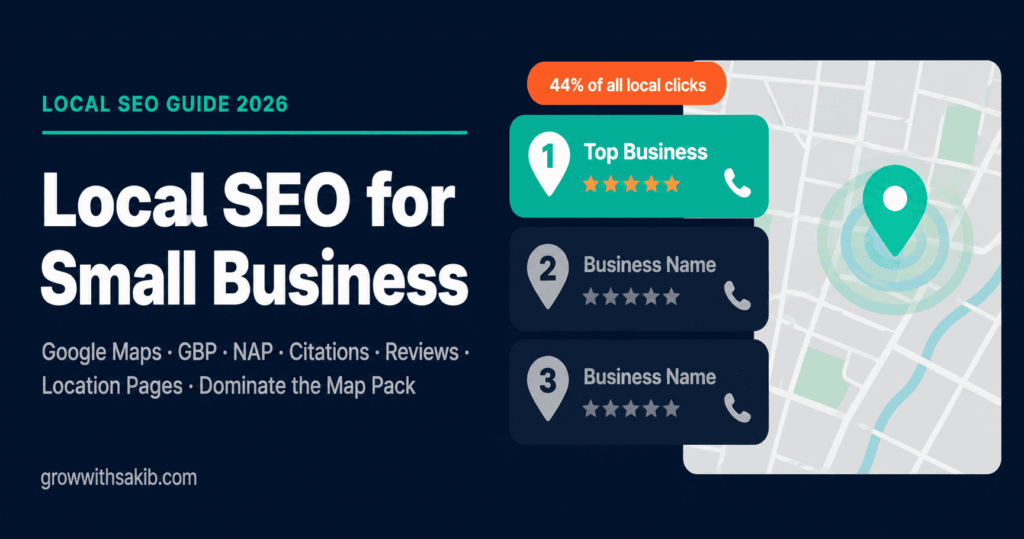
I want you to do something right now. Open Google and search for the service you provide — plumber, accountant, dentist, solicitor, whatever your business is — followed by your city or town. Look at what comes up. Specifically, look at the three businesses that appear in the map results above the organic links.
Those three businesses are capturing the majority of the calls, the clicks, and the customers from that search. Research shows the local 3-pack receives 44% of all clicks on local search results pages. The nine businesses on page one below the map receive most of the remainder. Everyone on page two and beyond receives almost nothing.
If your business is not in those results, you are invisible to people actively searching for exactly what you offer, right now, in the area you serve. Local SEO is the process of changing that — and for most small businesses, it produces faster, more directly revenue-connected results than any other form of digital marketing.
After working with local businesses across dozens of markets and categories, the pattern is consistent: local SEO is the single highest-ROI marketing investment available to most small businesses. It reaches people at the precise moment they intend to buy, it compounds over time without ongoing ad spend, and it is an area where small businesses can genuinely outrank larger competitors by being more active, more complete, and more locally relevant.
What Is Local SEO and How Is It Different from Regular SEO?
Local SEO is the practice of optimising your digital presence so your business appears when people search for services in a specific geographic area — whether they type ‘plumber near me,’ ‘best coffee shop in [city],’ or simply ‘accountant’ while physically located in your area.
It uses many of the same signals as standard SEO — content quality, backlinks, technical health — but adds a geographic layer that standard SEO does not address: proximity, local citations, Google Business Profile signals, and location-specific keyword targeting.
| Standard SEO | Local SEO |
|---|---|
| Targets broad, non-geographic keywords | Targets keywords with geographic intent or near-me searches |
| Competes nationally or globally | Competes within a specific city, region, or service area |
| Success measured by organic rankings and traffic | Success measured by map pack position, calls, and direction requests |
| No Google Business Profile requirement | GBP is the most critical ranking factor — foundational, not optional |
| Backlinks from any relevant source | Local citations and geographically relevant backlinks matter most |
| Location pages optional | Location pages essential for multi-location or service-area businesses |
How Google determines local rankings — the three factors
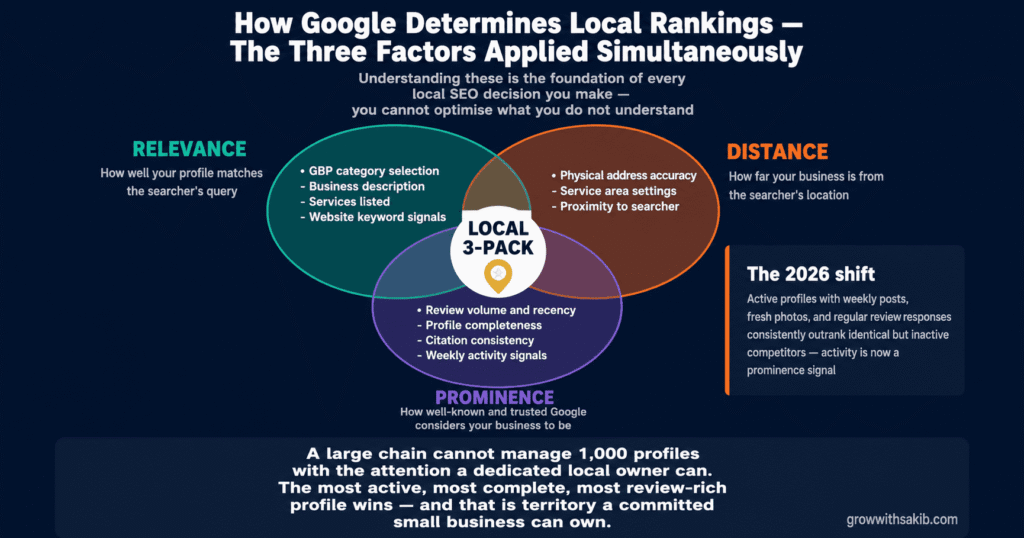
Google has publicly confirmed that local search rankings are determined by three factors applied simultaneously. Understanding these is the foundation of every local SEO decision you make.
- Relevance: How well your business profile and website match the searcher’s query. Controlled through your GBP category, business description, services listed, and keyword-rich website content.
- Distance: How far your business is from the searcher’s location. You cannot move your business — but you can define your service area accurately and create content that signals which areas you serve.
- Prominence: How well-known and trusted Google considers your business to be — based on review volume and quality, backlinks, citation consistency, profile completeness, and overall online presence. This is the factor most influenced by ongoing optimisation work.
The 8-Step Local SEO Framework for Small Businesses
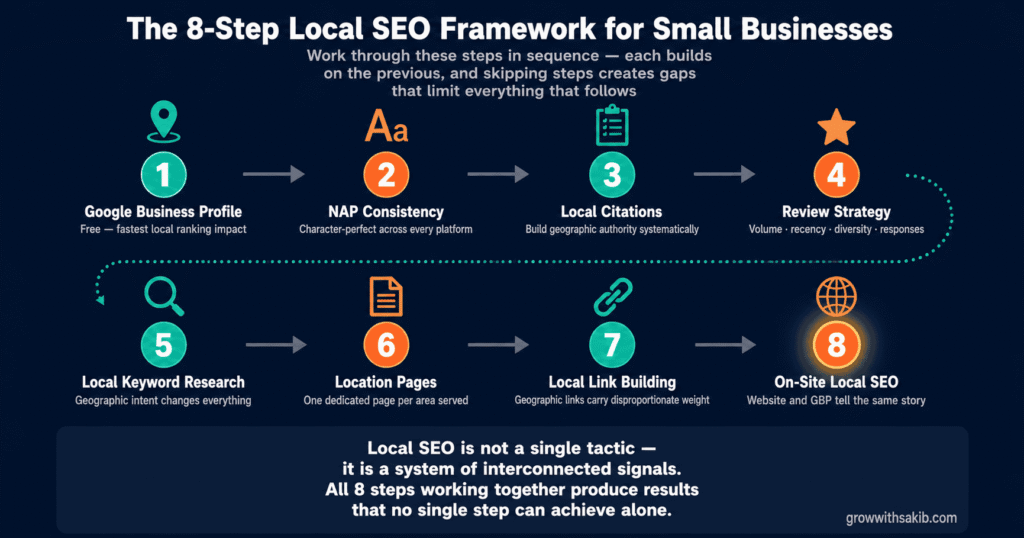
Local SEO is not a single tactic — it is a system of interconnected signals. Work through these steps in sequence. Each one builds on the previous, and skipping steps creates gaps that limit the effectiveness of everything that follows.
Your Google Business Profile is the most powerful tool in SEO for small business — and the one with the fastest impact. A fully optimised GBP can move a business from invisible to the local 3-pack within 30–60 days. For the complete, element-by-element GBP optimisation process, see our dedicated Google Business Profile Guide. Here is what matters most at the local SEO strategy level:
- Primary category is your most important decision: Choosing ‘Emergency Plumber’ instead of ‘Plumber’ or ‘Home Services’ changes which searches you appear for more than any other single edit. Always use the most specific, accurate category available.
- Profile completeness is a direct ranking signal: Google’s 2025 update rewarded complete, accurate profiles and suppressed thin or outdated ones. Fill every available field — services, attributes, business description, hours, photos, Q&A.
- Weekly activity compounds ranking over time: Businesses that actively manage their GBP — posting weekly, responding to reviews within 24 hours, adding fresh photos monthly — consistently outrank identical competitors with inactive profiles. Activity signals a legitimate, operational business.
- Video verification is now the default: New listings require a continuous, unedited video showing your signage, interior, and a live management action. Plan for this before attempting to claim a new profile.
NAP consistency — Name, Address, Phone number — is one of the most misunderstood local ranking factors. These three pieces of information must be absolutely identical — character by character — everywhere your business appears online: your website, your GBP, Yelp, Facebook, LinkedIn, industry directories, review platforms, and every local citation source.
Even minor inconsistencies create ranking problems. ‘Street’ vs ‘St’, ‘Suite 4’ vs ‘#4’, ‘+1 555’ vs ‘(555)’, using your trading name in one place and your registered company name in another — Google interprets these as potentially different businesses. That ambiguity reduces your prominence score and suppresses your local rankings.
How to audit your NAP consistency
- Search your exact business name in Google and check the top 20 results for any mention of your business
- Check your NAP on: Google Business Profile, your website (footer, contact page, about page), Yelp, Facebook Business Page, LinkedIn, Apple Maps, Bing Places, TripAdvisor (if applicable), and any industry-specific directories
- Run an automated citation audit using BrightLocal or Moz Local — both scan 50+ directories simultaneously and flag inconsistencies
- Fix inconsistencies starting with the highest-authority platforms first: GBP, your own website, Yelp, Facebook
- Use one single reference document for your official NAP — copy and paste from it every time rather than typing it from memory
A local citation is any online mention of your business’s name, address, and phone number — whether or not it includes a link to your website. Citations help Google verify that your business is real, operates at the address you claim, and serves the area you say it does. They are a core component of the prominence factor in local rankings.
The most important citations come from high-authority, geographically relevant sources. A listing in your country’s national business directory is more valuable than a listing in a generic global directory. A listing in your industry’s primary directory is more valuable than a listing in an unrelated one.
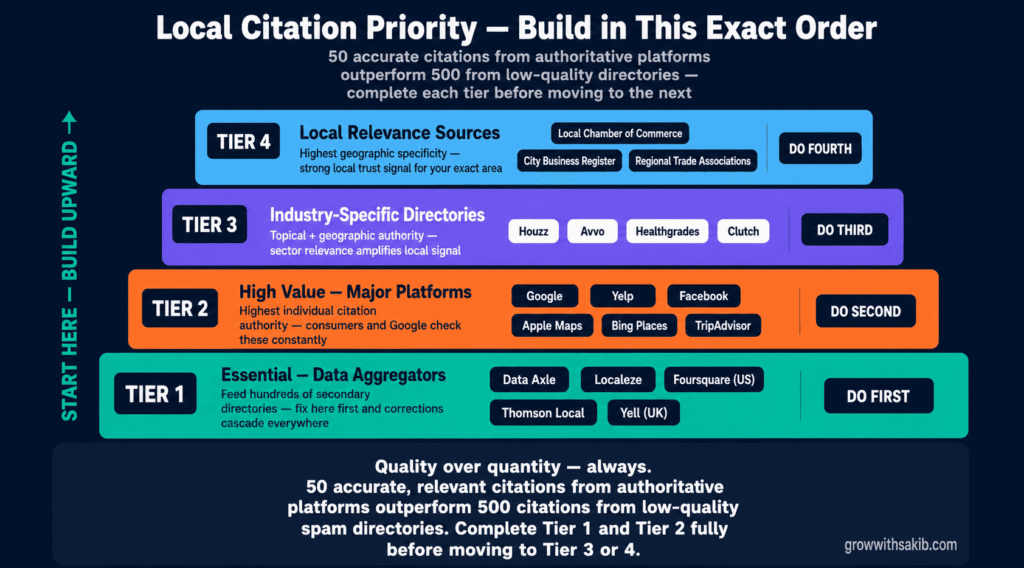
The citation priority list
| Priority | Citation source type | Examples |
|---|---|---|
| Tier 1 — Essential | Major data aggregators — feed hundreds of directories | Data Axle, Localeze, Foursquare (US); Thomson Local, Yell (UK) |
| Tier 2 — High value | Major review and business platforms | Google, Yelp, Facebook, Apple Maps, Bing Places, TripAdvisor |
| Tier 3 — Industry-specific | Directories relevant to your specific sector | Houzz (home services), Avvo (legal), Healthgrades (healthcare), Clutch (agencies) |
| Tier 4 — Local relevance | Your city’s local business directories and chamber of commerce | Local Chamber of Commerce, City Business Register, Regional trade associations |
Reviews are simultaneously one of the strongest local ranking signals and one of the most powerful conversion drivers — building a systematic Google review acquisition process is what separates the top-ranked businesses from everyone else. A business with 80 genuine 4.7-star reviews will outrank and out-convert a competitor with 8 reviews of similar quality — all other signals being equal.
Google evaluates three review dimensions independently: volume (total number of reviews), recency (how recently reviews were posted — a business receiving reviews weekly outranks one that received 200 reviews two years ago), and diversity (reviews from different accounts, locations, and time periods carry more weight than clustered patterns that suggest coordination).
Building a systematic review acquisition process
- Create your direct Google review link from your GBP dashboard: Profile → Get more reviews → Copy link
- Shorten the link with bit.ly or a branded shortener for easier sharing
- Build the request into your service completion process: ask within 24–48 hours of delivery when satisfaction is highest
- The ask that converts: ‘If you were happy with the work, I’d genuinely appreciate a Google review — it makes a real difference for a small business. Here’s the direct link, it takes about 2 minutes.’ Personal and specific beats generic every time.
- Send one follow-up to non-responders after 5 days — never more than once
- Respond to every review within 24 hours — positive and negative
Responding to negative reviews — the practice that separates professionals
A negative review responded to professionally is not a disaster — it is an opportunity. Potential customers reading your review responses are evaluating how you handle adversity before deciding whether to contact you. A thoughtful, specific response to a negative review demonstrates more character than ten positive reviews with no engagement.
- Respond within 24 hours: Speed signals that you actively manage your business and care about customer experience.
- Acknowledge the specific issue: Never respond with a generic ‘we’re sorry you had a bad experience.’ Reference what went wrong specifically.
- Move resolution offline: ‘Please contact us directly at [email/phone] so we can make this right.’ This demonstrates action without airing the details publicly.
- Never argue or be defensive: Potential customers reading the exchange will sympathise with the reviewer if you appear dismissive. The audience for your response is every future customer who reads that review.
Local keyword research follows the same principles as standard keyword research — search intent, difficulty, volume — but adds a geographic dimension that changes which keywords are worth targeting. A keyword that appears impossible for a national audience becomes highly accessible when combined with a specific location modifier.
The local keyword formula
[Service/product] + [Location modifier] = Local keyword
| Broad keyword (avoid) | Local keyword (target) | Location modifier types |
|---|---|---|
| Plumber | Emergency plumber [city] | City name, neighbourhood, postcode |
| Accountant | Self-assessment accountant [city] | Borough, district, county |
| Restaurant | Best Thai restaurant [city centre] | Area within city, landmark proximity |
| Solicitor | Family solicitor near [town] | Near me, nearby, [town name] |
| Dentist | NHS dentist accepting new patients [city] | Service-specific + location |
How to find local keywords your competitors are ranking for
- Google Search Console: Filter by queries containing your city or area name — these are the local keywords already driving impressions to your site, often with quick wins available.
- Ahrefs or Semrush: Enter a competitor’s domain and filter their keyword rankings by location modifiers — for a full process on competitor keyword research, the complete guide covers every tool and method in detail. Every keyword they rank for locally that you do not is a direct opportunity.
- Google autocomplete: Type your primary service into Google from a location in your target area. Every autocomplete suggestion is a real search query sorted by frequency in your region.
- People Also Ask boxes: Local versions of PAA questions reveal the specific local queries Google is currently answering — and exactly what format your content needs to be to earn those positions.
If your business serves multiple locations — whether through multiple physical premises or as a service-area business covering multiple towns or cities — you need a dedicated page for each location you want to rank in. A single generic page trying to rank in five different cities will rank weakly in all five. Five dedicated location pages will each rank strongly in their respective area.
What makes a location page actually rank
Most location pages fail because they are thin, templated, and identical except for the city name swapped in. Google identifies these as low-quality duplicate content and ranks them accordingly. A location page that earns strong local rankings is genuinely specific to that location.
- Genuine local content: Mention specific neighbourhoods you serve within that city. Reference local landmarks, districts, or commonly known areas. Describe any specific challenges or characteristics of working in that area.
- Local social proof: Reviews and testimonials from customers in that specific location. A quote from a client in [city] on your [city] page is far more credible than generic testimonials.
- Location-specific structured data: LocalBusiness schema with the specific address, phone number, and hours for that location.
- Embedded Google Map: An embedded map showing your exact location or service area reinforces the geographic signal of the page.
- Location-specific keyword targeting: The page’s title tag, H1, and first paragraph should all include the location name naturally — not forced.
Standard link building focuses on topically relevant links from authoritative sites in your industry. Local link building adds a geographic dimension — links from locally relevant sources carry disproportionate weight for local rankings because they confirm your business’s genuine presence and reputation in a specific area.
The most effective local link building sources
- Local Chamber of Commerce: Membership typically includes a directory listing with a dofollow link. High local authority, strong trust signal, and often the first local citation Google checks.
- Local news and publications: Getting mentioned in your local newspaper, regional business magazine, or local blog earns editorial links from sources with strong local relevance. Pitch stories around genuinely newsworthy angles — a community initiative, a notable client result, original local data. If you are also running paid local campaigns, Meta Ads for local business pairs well with organic local SEO to accelerate visibility.
- Supplier and partner links: Businesses you work with, refer clients to, or supply are natural link exchange opportunities. ‘We use [supplier] for all our X’ earns a natural mention from a relevant local business.
- Sponsorships and community involvement: Sponsoring a local sports team, charity event, or community initiative typically earns a link from the organisation’s website. These are geographically highly relevant and often from domains Google trusts.
- Local professional associations: Trade associations, professional bodies, and industry groups that operate regionally often maintain member directories with links.
- Local business directories with editorial standards: Not every directory — but established, locally trusted ones. Your regional Chamber directory, your city’s business register, and sector-specific local platforms.
Your Google Business Profile and your website work as a system. Each reinforces the other — or undermines the other. A GBP that lists ‘Manchester’ as your location while your website’s contact page shows a different address sends conflicting signals. A website with no mention of your local service areas provides no reinforcing content for the geographic terms your GBP is trying to rank for.
On-site local SEO elements
- NAP in the footer: Your exact NAP — matching your GBP — should appear in the footer of every page on your site. This creates a site-wide geographic signal and ensures your information is findable regardless of which page a visitor lands on.
- Local keywords in page titles and H1s: Your most important service pages should include your city or region in the title tag and H1. ‘Professional Window Cleaning Services’ becomes ‘Professional Window Cleaning Services in [City].’
- LocalBusiness schema on your homepage and contact page: Structured data that explicitly tells Google your business name, address, phone, hours, and geographic coordinates. This is the clearest possible on-site geographic signal available.
- Dedicated ‘Areas We Serve’ page: A page listing all the cities, towns, and postcodes you cover — with brief, genuine content about each area — creates a comprehensive geographic content signal and a natural hub for internal linking from location pages.
- Local content in blog posts: Blog posts that reference specific local areas, local events, local landmarks, or locally relevant topics build geographic relevance over time. ‘How [City]’s New Planning Regulations Affect Home Extensions’ is local content that builds relevance for home improvement services in that area.
Local SEO and AI Search in 2026 — The New Visibility Layer
Local search is changing in 2026 in ways that most local SEO guides have not yet addressed. Google AI Overviews now appear for a growing share of local searches — not just informational queries but ‘best X in [city]’ and ‘X near me’ searches. Voice search through smart speakers, phones, and car systems has made conversational local queries mainstream. And AI chatbots are increasingly being used to find local recommendations.
How to optimise local content for AI search citation
The principles that make local content rankable in traditional search and citeable in AI-generated responses overlap significantly — but AI search adds specific requirements.
- Answer local questions directly in the first paragraph: ‘What is the best time to service a boiler in [city]?’ should be answered in the first 150 words of the relevant blog post — not after a lengthy introduction. AI systems extract answers at the passage level.
- Use question-format headings for local FAQs: ‘How much does a solicitor cost in [city]?’ as an H2 is more likely to appear in an AI Overview than ‘Solicitor Costs [City]’ as a heading. Natural language question format matches how AI systems identify answerable content.
- Include specific local data points with named sources: ‘According to [City] Council’s 2025 planning report…’ or ‘Based on average prices across 15 [City]-based providers…’ These specifics are what AI systems select when generating cited answers.
- Schema markup for local FAQs: FAQ schema on locally-focused Q&A content directly feeds AI Overviews for local queries — making it one of the highest-value technical investments in 2026. Combined with LocalBusiness schema, this creates a comprehensive structured data foundation for AI search visibility.
Voice search and local SEO — the near-me optimisation
Voice searches are overwhelmingly local and conversational. ‘Hey Google, find a plumber near me open now’ and ‘Alexa, what’s the best Indian restaurant nearby?’ represent search behaviour that is qualitatively different from typed queries. Optimising for voice local search requires content and GBP elements that directly answer these spoken question formats.
- Ensure your GBP hours are always accurate: ‘Open now’ voice searches depend entirely on your GBP hours being current. A business that shows as ‘closed’ when it is actually open loses those searches entirely.
- Include FAQ content with conversational answers: Questions like ‘Do you offer same-day service?’ and ‘How much does [service] cost?’ answered directly on your website or in your GBP Q&A feed voice search results.
- Optimise for ‘near me’ even without the phrase in content: ‘Near me’ searches are geo-targeted by the search engine — you rank for them through your GBP location accuracy, your website’s NAP consistency, and your local citation coverage. No need to write ‘near me’ into your content.
Local SEO Tools Worth Using
You do not need every tool. Start with free tools and add paid ones when your strategy has matured enough to use them effectively.
| Tool | Best for | Free or paid |
|---|---|---|
| Google Business Profile | Primary local ranking asset — profile management and insights | Free |
| Google Search Console | Local keyword performance, local clicks, and impressions | Free |
| Google Trends | Local search trend analysis and seasonal patterns by region | Free |
| BrightLocal | Citation auditing, review monitoring, local rank tracking | Paid — 14-day trial |
| Moz Local | Automated citation submission and NAP consistency monitoring | Paid — limited free check |
| Ahrefs | Local keyword research and competitor local ranking analysis | Paid — limited free tools |
| Semrush | Local keyword gap analysis and citation audit | Paid — 7-day trial |
| Whitespark | Local citation finder and link prospecting for local businesses | Freemium |
How to Measure Local SEO Performance
The most common mistake in local SEO measurement is tracking national organic traffic when local performance is the goal. Your business could have stagnant organic traffic overall while local performance is growing significantly — or vice versa. Track local-specific metrics.
The metrics that measure local SEO accurately
- GBP Insights — monthly: Profile views, search query types (direct vs discovery), calls, direction requests, and website clicks from your GBP. This is your most direct local performance data. Discovery searches (people finding you without searching your name) measure genuine local SEO reach.
- Local keyword rankings — monthly: Track your position for your 5–10 primary local keywords using BrightLocal or Semrush’s position tracking. Rankings are a leading indicator — improvements show before traffic increases.
- Phone calls from Google: GBP Insights tracks calls placed directly from your profile. This is a direct revenue signal — each call is a potential customer who found you through local search.
- Direction requests: High-intent visitors physically navigating to your location. A growing direction requests count is one of the clearest signals that local SEO is producing real-world business results.
- Review velocity: Track new reviews per month. Consistent review acquisition is a ranking signal — monitor whether your review request process is maintaining a consistent flow or needs attention.
Local SEO Mistakes That Cost Small Businesses Rankings Every Day
| The mistake | What it costs | The fix |
|---|---|---|
| 01. Inconsistent NAP across directories | Conflicting geographic signals — prominence score suppressed | Audit all citations with BrightLocal; fix inconsistencies starting with GBP and website |
| 02. Choosing a broad GBP primary category | Missing all specific-intent local searches | Research the most specific accurate category — ‘Emergency Plumber’ not ‘Plumber’ |
| 03. No systematic review acquisition process | Competitors with more reviews outrank and out-convert you | Build a 24-hour post-service text message review request into every job completion |
| 04. Zero location pages for multiple service areas | Ranking weakly in all areas instead of strongly in each one | Create a dedicated, genuinely specific page for every area you want to rank in |
| 05. Ignoring GBP Insights — flying blind | No visibility into what is working or declining in local rankings | Review GBP Insights monthly — especially Discovery vs Direct search split |
| 06. Keyword stuffing the GBP business name | Profile suspension or suppression — immediate ranking loss | Use only your real business name — keywords belong in description and services |
| 07. No response to reviews — positive or negative | Lost conversion signal and lower ranking prominence score | Respond to every review within 24 hours — set up email notifications from GBP |
| 08. Thin, templated location pages | Google treats these as low quality — ranks them weakly or not at all | Each location page must contain genuinely different, locally relevant content |
Local SEO Checklist — The Complete Reference
Google Business Profile
| What to do | Why it matters |
|---|---|
| ☐ Profile claimed, verified, and secured with two-factor authentication | Unverified profiles cannot be managed and are vulnerable to hijacking |
| ☐ Most specific possible primary category selected | Category is the single biggest local ranking lever — specificity matters |
| ☐ All services listed with individual descriptions and prices where possible | Services expand search query matching beyond category alone |
| ☐ Business description written with natural keyword inclusion (750 characters) | Description helps Google understand what you offer and who you serve |
| ☐ Minimum 25 photos uploaded — exterior, interior, team, and work samples | Profiles with photos receive 42% more direction requests than those without |
| ☐ One Google Post published per week | Weekly posting is the most consistent activity ranking signal |
| ☐ All reviews responded to within 24 hours | Response speed is tracked — it is a ranking signal |
| ☐ Q&A section populated with 8–10 common questions and answers | Proactive Q&A prevents incorrect answers from third parties |
NAP and citations
| What to do | Why it matters |
|---|---|
| ☐ NAP is identical on GBP, website footer, and all directory listings | Character-level inconsistency splits geographic authority signals |
| ☐ Business listed on all Tier 1 data aggregators | Aggregators feed hundreds of secondary directories — fix here first |
| ☐ Listed on Google, Yelp, Facebook, Apple Maps, and Bing Places | Tier 2 platforms carry the highest individual citation authority |
| ☐ Industry-specific directory listings completed | Sector-relevant citations carry topical + geographic authority |
| ☐ Local Chamber of Commerce listing active | High local trust signal — often the first citation Google checks |
On-site local SEO
| What to do | Why it matters |
|---|---|
| ☐ Exact NAP in the footer of every page | Site-wide geographic signal — consistent with GBP |
| ☐ LocalBusiness schema on homepage and contact page — validated with Rich Results Test | Explicit structured data geographic signal — directly feeds AI Overviews |
| ☐ Primary service pages include location name in title tag and H1 | On-page geographic relevance signal for core service keywords |
| ☐ Dedicated location page for each area served — with genuinely local content | One strong location page per area beats one generic page for all areas |
| ☐ ‘Areas We Serve’ page with links to individual location pages | Geographic hub page — internal link architecture for local authority |
| ☐ FAQ content with question-format headings targeting local intent | Voice search and AI Overview compatibility — conversational local queries |
Reviews and reputation
| What to do | Why it matters |
|---|---|
| ☐ Direct Google review link created and saved for easy sharing | Friction reduction — make it as easy as one click |
| ☐ Review request sent within 24–48 hours of every service completion | Recency of reviews matters — consistent cadence beats periodic bursts |
| ☐ Response to every new review within 24 hours (positive and negative) | Response rate is a ranking signal — Harvard Business Review: +31% conversion |
| ☐ Minimum 1 new review per week maintained as an ongoing target | Review velocity — consistent new reviews outperform historical volume |
Local SEO Is the Most Direct Path from Marketing Investment to Revenue
Every other form of digital marketing involves reaching people who might be interested in what you offer. Local SEO reaches people who are actively searching for exactly what you offer, in exactly the area you serve, at the precise moment they intend to make a decision.
The eight steps in this guide — GBP optimisation, NAP consistency, citation building, review strategy, local keyword research, location pages, local link building, and on-site optimisation — are not complicated individually. What makes local SEO effective is doing all of them consistently, maintaining them over time, and understanding how they work together as a system rather than treating any one element as the complete solution.
At GrowWithSakib, local SEO is where we start with every small business client — not because it is the most sophisticated marketing strategy, but because it connects directly to revenue faster than anything else available. When the phone rings from a customer who found you on Google Maps, that is local SEO working exactly as intended.This article is part of the GrowWithSakib SEO for Small Business Guide. For the complete Google Business Profile optimisation process referenced in Step 1, see our dedicated Google Business Profile Guide.
Frequently Asked Questions
How long does local SEO take to produce results?
Google Business Profile optimisation typically produces visible ranking improvements within 30–60 days — faster than any other SEO investment. Review acquisition starts producing ranking improvements within 4–8 weeks of implementing a systematic process. Location page and on-site optimisation changes typically show impact within 6–12 weeks. Full local SEO authority — where your business consistently occupies the top 3 positions for multiple local keywords — typically takes 6–12 months of consistent work.
Can a service area business rank locally without a physical address?
Yes. Service area businesses — plumbers, electricians, cleaners, consultants, mobile therapists — can hide their address on their GBP and instead specify the cities, towns, and postcodes they serve. Google ranks service area businesses in the areas they specify. The key difference is that you lose the proximity advantage of having a physical address visible in a specific location. Compensate by being more comprehensive on reviews, citations, and locally relevant content than competitors with physical locations.
How many Google reviews do I need to rank in the local 3-pack?
There is no minimum threshold — but context matters. In a competitive urban market for a popular service, you may need 50+ reviews to be competitive. In a smaller market or a niche service category, 15–20 genuinely recent reviews may be sufficient. The more important factors are recency (are you receiving reviews consistently?), quality (4.5+ average rating), and response rate (are you responding to all reviews?). A business with 20 reviews received over the past 3 months often outranks one with 80 reviews last received two years ago.
What is the difference between local SEO and Google Business Profile optimisation?
Google Business Profile optimisation is one component of local SEO — the most important single component, but not the complete picture. Local SEO also includes NAP consistency across all citations, on-site local keyword optimisation, location page architecture, local link building, review management, and local content strategy. A perfectly optimised GBP on a website with inconsistent NAP, no local content, and zero local links will be outranked by a competitor with a slightly weaker GBP but stronger supporting signals.
Does local SEO work for online-only businesses?
Local SEO is designed for businesses that serve customers in specific geographic areas — whether physically or as a service area business. A purely online business with no geographic service area (an e-commerce store shipping globally, an online SaaS product) does not benefit from local SEO. However, online businesses that also have physical premises, want to attract customers from specific regions, or offer location-based services benefit significantly from local SEO.
How does AI search affect local SEO in 2026?
Google AI Overviews now appear for a growing share of local searches — including ‘best X in [city]’ and comparative local queries. These AI-generated answers increasingly pull content from GBP listings, local FAQ pages, and locally-relevant website content. Businesses that appear in local AI Overviews gain visibility in zero-click searches — the user gets an answer that includes your business without needing to visit your site. The signals that earn AI Overview inclusion in local search are the same as traditional local ranking signals: GBP completeness, review quality, schema markup, and locally-specific content — all applied with greater precision.