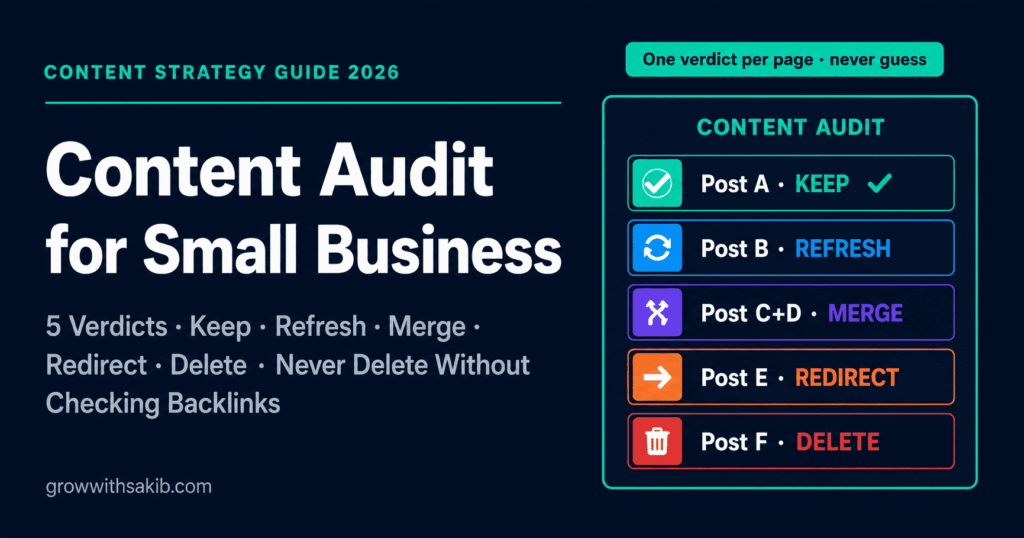
Every published page is either helping your site or quietly hurting it. Over time, information goes stale, rankings slip, and thin or duplicate posts drag down the pages you actually care about. A content audit finds those pages and forces a clear decision on each one – and often, the fix isn’t writing more, it’s fixing what you already have.
This is step of the content strategy for small business guide on GrowWithSakib, made into a repeatable process. Note the distinction from the content mapping guide on GrowWithSakib: that audit finds gaps in your funnel coverage; this one finds gaps in your performance – the pages that are underachieving and how to fix them.
What Is a Content Audit (and Why It Works)
A content audit reviews every page against real performance data, then assigns each a clear action. It works because of a simple truth: content decays. A post that ranked well two years ago slowly loses position as information ages and competitors publish fresher pieces. Refreshing that decayed page – which already has backlinks, crawl history, and some authority – is one of the highest-ROI activities in SEO.
The proof is in the case studies. When HubSpot audited its blog, it found roughly 3,000 underperforming posts; removing and consolidating them lifted traffic to the remaining pages and freed up crawl budget. And content agency Animalz reported that refreshing existing articles for one client drove an average traffic increase of around 515% across the updated pages. You’re not always short of content – you’re short of maintained content.
Step 1: Build Your Inventory and Pull the Data
You need two free tools: Google Search Console (clicks, impressions, average position per page) and Google Analytics (engagement and conversions). List every URL in a spreadsheet, then pull the last 3 to 12 months of data for each. For each page, capture clicks, impressions, average position, last-updated date, and whether it has any backlinks or conversions.
For a blog with a few dozen posts, this takes an afternoon – no paid crawler needed. The setup is the same one in the guide to using Google Search Console on GrowWithSakib. Building the inventory is the slow part; the decisions move fast once the data is in front of you.
Step 2: Find Your Underperformers in Search Console
These are the specific signals that flag a page needing attention:
| Signal in Search Console | What It Means | Likely Action |
|---|---|---|
| Few or zero clicks (under ~10/month) | Page isn’t earning traffic | Refresh, merge, or delete |
| Declining clicks over time | Content decay – it’s fading | Refresh (usually recoverable) |
| Ranking on page 2 (positions 8-20) | ‘Striking distance’ – close to page 1 | Refresh – fastest win |
| High impressions, low CTR | Ranking but title/meta not clicked | Rewrite title and meta |
| Two pages, same query | Keyword cannibalisation | Merge into one |
| Outdated info, but still ranks | Aging but valuable | Refresh the content |
The single best opportunity is usually the striking-distance page – something sitting at position 8-15 that a solid refresh can lift onto page one, where the clicks are. These are quick, high-impact wins hiding in plain sight in your Search Console data.
Step 3: Give Each Page a Verdict
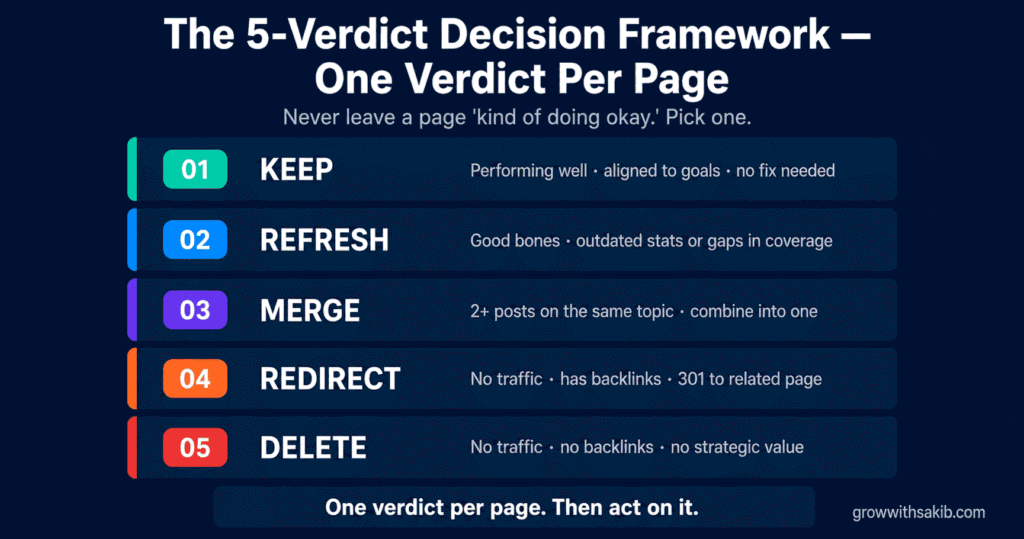
Now the core of the audit: assign every underperforming page one clear verdict. This decision framework tells you which:
| Verdict | When to Choose It | How to Do It |
|---|---|---|
| Keep | Performing fine or serves a purpose (About, legal) | Leave it; mark done |
| Refresh | Has value (impressions, rank, backlinks) but is decaying or outdated | Update the content substantially (Step 4) |
| Merge | Two+ pages compete for the same intent | Combine into one strong page; 301 the weaker |
| Redirect | Has backlinks or history but no longer needs to exist | 301 to the closest relevant live page |
| Delete | Zero traffic, no backlinks, no value, can’t be saved | Remove – but see the safety rule below |
Step 4: Refresh the Pages Worth Saving
Refreshing is where the traffic recovery happens. But a real refresh is not changing “2025” to “2026” in the title. It means substantively improving the page. Work through this checklist:
- Update the facts – replace outdated statistics, dates, prices, screenshots, and tool names with current, sourced information.
- Fill the gaps – compare against what now ranks on page one and add the sections, questions, or depth your page is missing.
- Fix the structure – add clear question headings and direct answers so it’s easy to read and easy for AI to extract.
- Repair links – fix broken links and add fresh internal links to and from related pages.
- Sharpen the title and meta – if impressions are high but clicks are low, a better title is the quickest win.
- Then update the date – only after making real changes, so the fresh date reflects genuine improvement.
Keep the URL and the backlinks; change the content and the date. Apply the same care you would to writing a blog post that ranks on GrowWithSakib – a refresh is a rewrite, done well.
Step 5: Merge, Redirect, and Delete Safely
For the non-refresh verdicts, do them cleanly so you gain authority instead of losing it:
- Merging – combine the best of both pages into the stronger URL, then 301-redirect the weaker one to it. This concentrates split authority. In one Backlinko case, consolidating competing pages via 301s produced a 466% increase in organic clicks.
- Redirecting – point the retired URL to the most relevant live page with a 301, and update any internal links that pointed to the old URL.
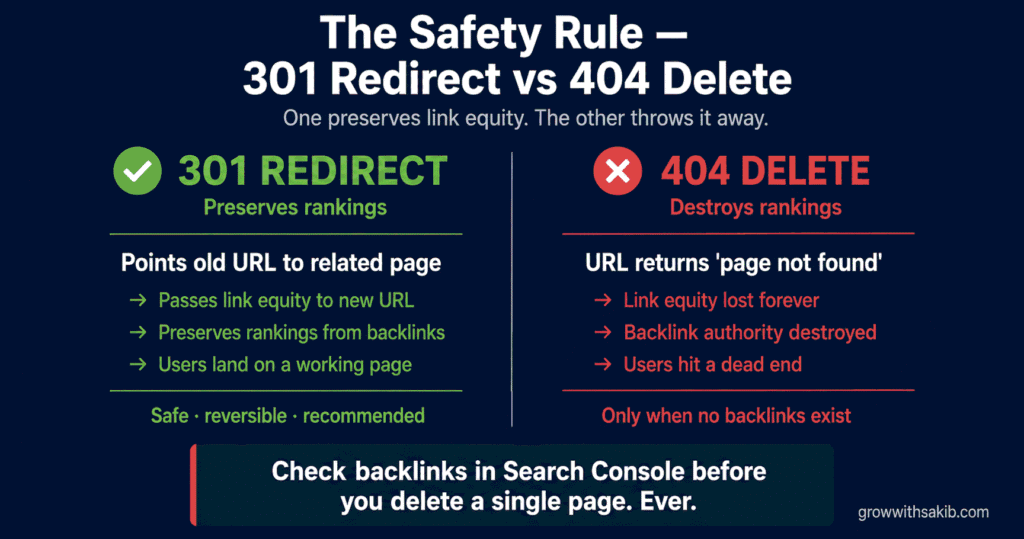
- Deleting – only for pages with no traffic, no backlinks, and no purpose. Batch removals in small groups and watch Search Console’s index coverage for unexpected drops.
Merging is often the single most rewarding audit action, because keyword cannibalisation is so common – and fixing it is exactly the kind of consolidation that building proper content clusters on GrowWithSakib prevents in the first place.
Step 6: Measure the Results
A refresh isn’t done when you hit publish – it’s done when you’ve checked whether it worked. Note each page’s before-numbers (impressions, clicks, average position), then watch for early movement at 2 to 4 weeks and reliable trends at 8 to 12 weeks. Request re-indexing in Search Console to speed up recognition.
Read Search Console data directionally, not to the decimal – if a refreshed page shows a solid climb, trust the direction. Track it with the guide to tracking results on GrowWithSakib, and log every change (what you updated, when) so you can see what’s working and repeat it.
The Freshness Factor: Why Refreshing Helps AI Citations Too
Refreshing doesn’t just recover Google rankings – it also helps you get cited by AI. Freshness has become a real signal: Ahrefs analysed 17 million AI citations and found AI-cited content is around 25.7% fresher on average than standard organic results. Recently updated pages are simply more likely to be pulled into AI answers.
Two honest nuances keep this accurate:
- It’s platform-dependent – ChatGPT and Perplexity show the strongest preference for fresh content, while Google AI Overviews behave more like traditional search and weight freshness least. Same pattern we see across AI surfaces.
- It’s query-dependent – freshness matters most for time-sensitive topics (pricing, comparisons, news, fast-moving fields) and least for stable, evergreen definitions. Google has always treated freshness as query-dependent, not a blanket rule.
The practical takeaway: build a refresh cadence – review your top pages roughly quarterly, refresh the ones that are decaying with substantive updates, and you’ll defend both your rankings and your AI citations at once. Deepen this with the guide to measuring GEO performance on GrowWithSakib.
How to Prioritise (Don’t Refresh Everything)
- Start with quick, high-impact wins – striking-distance page-two pages and decaying former page-one pages recover fastest for the least effort.
- Focus on your top 20% – the pages driving the most traffic and conversions deserve attention first; don’t try to refresh the whole site at once.
- Then fix cannibalisation – merging competing pages often produces a noticeable lift.
- Retire dead weight last – clearing zero-value pages improves overall site quality over time, but it’s lower urgency than recovering traffic.
Audit on a schedule – every 3 to 6 months for an active blog. A content audit isn’t a one-time clean-up; it’s routine maintenance that keeps your whole library earning its place. Schedule the refreshes into your content calendar on GrowWithSakib alongside new content.
Common Content Audit Mistakes
| Mistake | Why It Hurts | Do This Instead |
|---|---|---|
| Deleting backlinked pages (404) | Destroys link equity permanently | 301-redirect instead of deleting |
| Changing only the date | Google flags date-only edits as spam | Update the content substantially first |
| Judging pages by traffic alone | Kills pages that convert or support others | Weigh backlinks, conversions, internal links |
| Refreshing everything at once | Burns out; dilutes effort | Start with the top 20% and quick wins |
| Ignoring cannibalisation | Two pages split the ranking | Merge competing pages into one |
| Trusting shaky freshness stats | Builds strategy on unverified numbers | Anchor on verified data; act directionally |
| Auditing once and stopping | Decay returns | Re-audit every 3-6 months |
Frequently Asked Questions
1. How do I do a content audit for my small business?
List every page in a spreadsheet, then pull the last 3-12 months of data from Google Search Console (clicks, impressions, position) and Google Analytics (engagement, conversions) – both free. Find the underperformers: pages with few clicks, declining traffic, page-two rankings, or competing with each other. Give each one a verdict – keep, refresh, merge, redirect, or delete – then act. For a blog with a few dozen posts, the whole audit takes about an afternoon.
2. Should I update, merge, or delete an underperforming page?
Refresh it if it has value (impressions, rankings, backlinks, or conversions) but the content is outdated or thin – this is the usual, highest-ROI choice. Merge it if another page targets the same intent, combining them into one stronger page. Redirect it if it has backlinks or history but no longer needs to exist. Delete it only if it has zero traffic, no backlinks, and no purpose – and even then, 301-redirect rather than returning a 404 if it has any links.
3. How do I find underperforming pages in Google Search Console?
Look for specific signals: pages with very few clicks (under about ten a month), pages whose clicks are declining over time (content decay), pages ranking on page two (positions 8-20, called striking distance), and pages with high impressions but low click-through (a title problem). Also look for two pages ranking for the same query, which signals cannibalisation. The striking-distance pages are usually your best opportunity, since a refresh can push them onto page one.
4. How do I refresh content to recover lost traffic?
Make substantive improvements, not cosmetic ones: update outdated statistics, dates, and screenshots; add the sections and depth that now-higher-ranking pages have; fix the structure with clear question headings and direct answers; repair broken links and add internal links; and sharpen the title and meta. Keep the same URL to preserve backlinks. Only after making real changes should you update the publish date – then request re-indexing in Search Console to speed up recognition.
5. Does changing the publish date help SEO?
Only if you also substantially update the content. Google has explicitly warned that changing a page’s date without meaningful changes is manipulative, and John Mueller called date-only edits noise that won’t help. AI engines also compare page versions across crawls and discount cosmetic changes. A fresh date signals freshness only when it reflects genuine improvement – new data, added sections, updated facts. The rule of thumb: if a returning reader wouldn’t notice any difference, it’s not a real update.
6. Will deleting old content hurt my rankings?
It can, if you delete the wrong pages or delete them the wrong way. Removing a page that has backlinks without a 301 redirect destroys the link equity it built and can cause ranking drops. But removing genuinely worthless pages – zero traffic, no links, no purpose – can actually help by improving your site’s overall quality signal, as HubSpot found when it pruned thousands of underperforming posts. Always check backlinks first, redirect rather than 404, and remove in small batches.
7. Does content freshness affect AI citations?
Yes. Ahrefs analysed 17 million AI citations and found AI-cited content is around 25.7% fresher on average than standard organic results, so recently updated pages are more likely to be cited. The effect is strongest on ChatGPT and Perplexity and weakest on Google AI Overviews, and it matters most for time-sensitive topics like pricing and comparisons. Be wary of precise per-bucket multipliers you may see quoted – many are unverified – but the direction is clear: fresher content earns more citations.
8. How often should I do a content audit?
For an active blog, every three to six months strikes the right balance between keeping content fresh and leaving time to create new pieces. Larger or fast-moving sites may audit more often; a small, slow-changing site can stretch to once or twice a year. Rather than one big annual overhaul, many small businesses do better with a rolling approach – refreshing a few high-value pages each month – so maintenance becomes a steady habit instead of an overwhelming project.
Key Takeaways
- A content audit reviews every page and gives each a clear verdict – keep, refresh, merge, redirect, or delete – using free tools (Google Search Console and Analytics).
- Content decays over time; refreshing a decayed page that already has backlinks and authority is one of the highest-ROI activities in SEO.
- Find underperformers by their Search Console signals: few clicks, declining traffic, page-two ‘striking distance’ rankings, low CTR, and competing pages.
- The safety rule: never delete a page with backlinks without a 301 redirect – a 404 destroys link equity, a 301 preserves it.
- A real refresh is substantive – update facts, fill gaps, fix structure, repair links – not just changing the date, which Google flags as manipulative.
- Merging competing pages concentrates split authority and often produces a noticeable ranking lift (one Backlinko case saw a 466% clicks increase).
- Freshness is a real AI-citation signal (Ahrefs: AI-cited content is ~25.7% fresher), strongest on ChatGPT and for time-sensitive topics – but ignore unverified per-bucket multipliers.
- Prioritise the top 20% of pages and quick wins first, measure results at 2-4 and 8-12 weeks, and re-audit every 3-6 months.