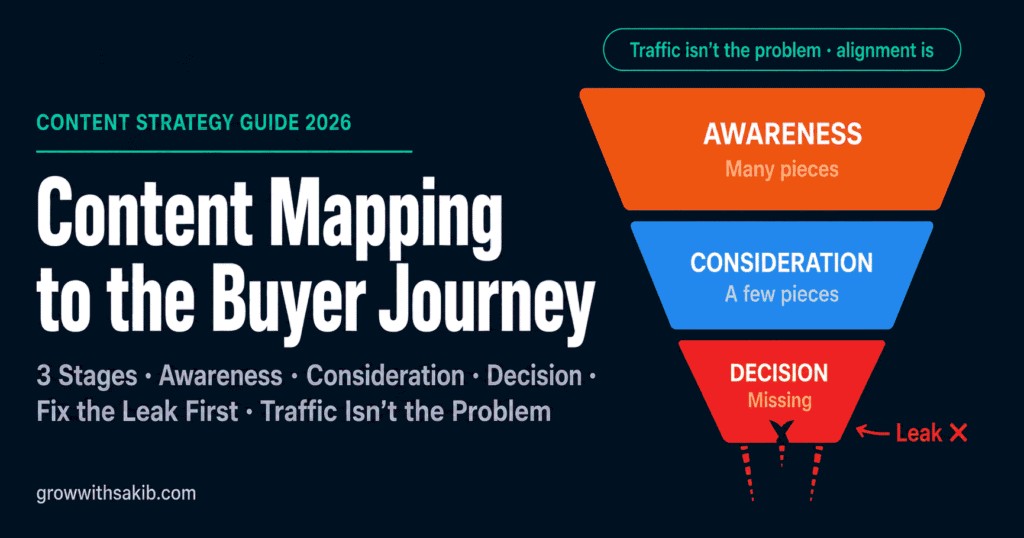
You publish blog post after blog post. Traffic climbs. And yet the sales don’t follow. Here’s the usual reason: you have twenty articles for people who’ve never heard of you, and nothing for someone who’s ready to buy. Your content attracts readers but never guides them to a decision. Content mapping fixes that mismatch.
This is step eight of the content strategy for small business guide on GrowWithSakib, which flags the funnel-gap problem directly. Here we teach how to diagnose and fix it. It builds on understanding your buyer from the content audience profile guide on GrowWithSakib – that’s who moves through the journey; this article is about matching content to where they are in it.
What Is Content Mapping and the Buyer Journey?
The buyer journey is the path someone travels from first realising they have a problem to deciding what to buy. It has three classic stages (you may see them labelled TOFU, MOFU, and BOFU – top, middle, and bottom of funnel – but plain names work fine):
- Awareness – the buyer realises they have a problem but doesn’t yet know the solution. They’re searching to understand and name it.
- Consideration – they understand the problem and are researching and comparing possible solutions.
- Decision – they’ve chosen a type of solution and are deciding which provider to buy from.
Content mapping is simply matching each piece of content to the stage it serves – so a reader always finds what they need to take the next step, instead of hitting a dead end. The framework was popularised by HubSpot, and it turns a random pile of posts into a path that leads toward a sale.
The Three Stages: What to Write for Each
Each stage needs a different kind of content, because the buyer wants something different. Here’s the map:
| Stage | What the Buyer Wants | What to Write | Keyword Signals |
|---|---|---|---|
| Awareness | To understand their problem | Blog posts, how-tos, guides, checklists | how to, what is, why, tips, ideas |
| Consideration | To compare solutions | Comparisons, case studies, webinars, deep guides | best, vs, compare, review, options |
| Decision | To choose a provider | Pricing, case studies, demos, testimonials, service pages | pricing, cost, hire, near me, [brand] |
Awareness: Educate, Don’t Sell
At this stage the reader isn’t ready to be sold to – they’re trying to name their problem. Write helpful, educational content that answers their questions without pitching. If you’re talking about your product here, it’s not Awareness content. This is where most blog posts live, and where writing a blog post that ranks on GrowWithSakib and building content clusters on GrowWithSakib pays off.
Consideration: Compare and Prove
Now the reader is weighing options. Give them content that helps them compare honestly – “X vs Y” guides, in-depth how-it-works pieces, case studies, and buyer’s guides. This is the stage most small businesses under-serve, so prospects stall or drift to a competitor who answered their comparison questions.
Decision: Remove the Last Doubts
Here the reader is choosing a provider. They need proof and practical details: pricing or pricing context, detailed case studies with results, testimonials, demos or free trials, and clear service pages. This content is the least glamorous to write and the most directly tied to revenue – and it’s almost always the thinnest part of a small business’s content.
The Audit: Count Your Content by Funnel Stage
Here’s the exercise that reveals your problem in thirty minutes. It’s simple, and almost everyone is surprised by the result.
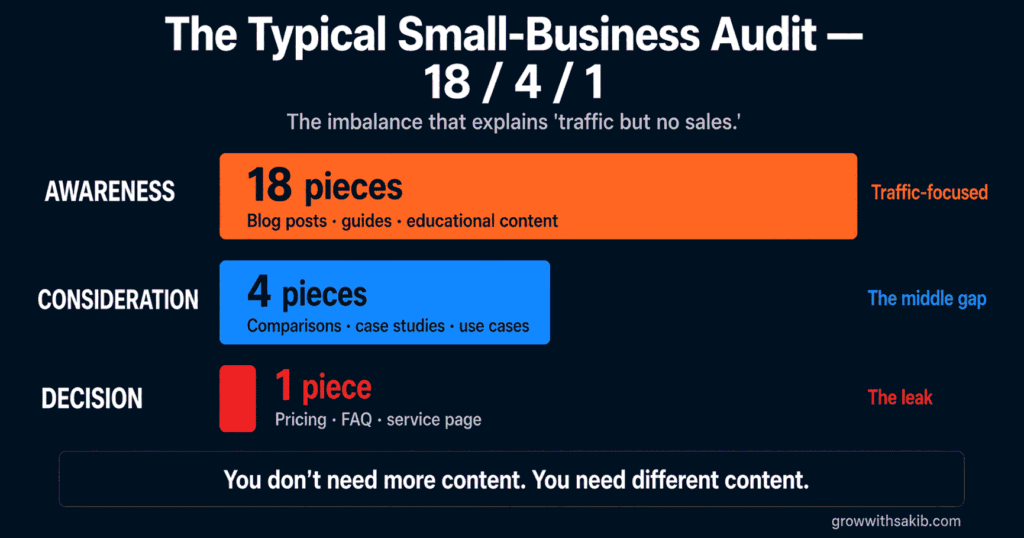
Here’s what a typical small-business result looks like – and why it explains the “traffic but no sales” problem:
| Stage | Pieces of Content | Verdict |
|---|---|---|
| Awareness | 18 | Heavily over-produced |
| Consideration | 4 | Thin |
| Decision | 1 | Critical gap – this is why sales stall |
This pattern – lots of Awareness, little Decision – shows up in almost every audit. It happens because Awareness content earns traffic and traffic feels like progress, while the harder, less “exciting” Decision content is what actually closes. You’re not short of content; you’re unbalanced.
Which Gaps to Fix First
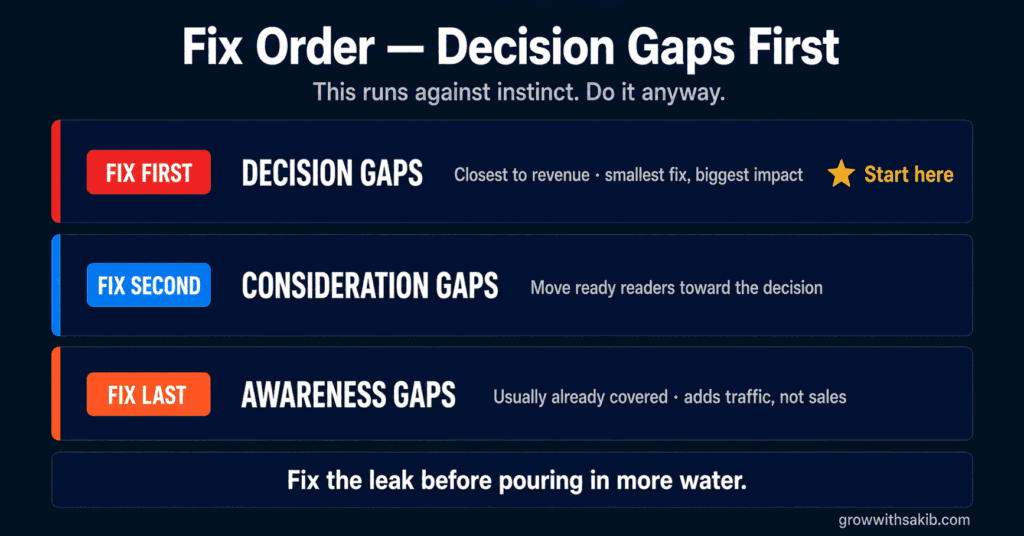
Not all gaps are equal. Prioritise by how close they are to revenue:
- Decision gaps first – these sit right before the sale, so filling them converts the traffic you already have. Highest impact, fastest payback.
- Consideration gaps second – these keep researching buyers from drifting to competitors. Fill them to move Awareness readers forward.
- Awareness gaps last – only if you genuinely lack top-of-funnel reach. Most small businesses already have too much here, not too little.
This runs against instinct – it’s tempting to keep writing Awareness posts because they get traffic. But if the goal is sales, the Decision gap is the leak costing you money right now. Fix the leak before pouring in more water. Slot the fixes into your content calendar on GrowWithSakib.
How to Measure Each Stage
Each stage has its own success metric – judging Awareness content by sales, or Decision content by traffic, leads you astray. Track the right signal for each:
| Stage | What Success Looks Like | Metric to Track |
|---|---|---|
| Awareness | Reaching new people | Traffic, impressions, new visitors, rankings |
| Consideration | Deepening engagement | Time on page, return visits, email signups, downloads |
| Decision | Driving action | Demo/quote requests, pricing-page visits, sales, sign-ups |
Free tools cover all of this: Google Analytics for traffic and engagement, Google Search Console for impressions and rankings, and your contact-form or booking data for Decision actions – the setup in the guide to tracking results on GrowWithSakib. Watch whether readers actually flow from Awareness pieces toward Decision pages; that flow is the whole point of mapping.
An Honest Note on the Funnel
- The journey isn’t linear – people jump around, circle back, and enter mid-funnel. The stages are a planning tool, not a rigid track. Use them to spot gaps, not to force a straight line.
- Balance beats volume – the goal isn’t equal counts in each stage; it’s having enough at each to move people forward. Match the balance to how your buyers actually decide.
- Quality gaps count too – ten near-identical Awareness posts effectively count as one. If a cell is full of repetitive pieces, treat it as a gap to consolidate, not coverage.
- One audience is fine to start – big teams map multiple personas against stages. Most small businesses can map a single primary audience first, and add a persona layer only if they serve genuinely distinct groups.
Done well, content mapping turns publishing from a volume game into a system that moves readers toward a sale – and makes it obvious what to write next. Review the map each quarter as your content and buyers evolve.
Common Content Mapping Mistakes
| Mistake | Why It Hurts | Do This Instead |
|---|---|---|
| Only writing Awareness content | Traffic but no conversions | Balance the funnel; fill Decision gaps |
| Selling in Awareness content | Pushes away early researchers | Educate first; save the pitch for later |
| Judging every piece by sales | Kills strong top-of-funnel posts | Measure each stage by its own metric |
| Skipping the audit | Gaps stay invisible | Count your content by stage first |
| Fixing Awareness gaps first | Ignores the real revenue leak | Prioritise Decision gaps |
| Counting repetitive posts as coverage | Fake coverage hides a gap | Treat duplicate angles as one piece |
| Mapping once and forgetting | Map goes stale | Review the map quarterly with data |
Frequently Asked Questions
1. What is content mapping in the buyer journey?
Content mapping is the practice of aligning each piece of content with a stage of the buyer journey – Awareness, Consideration, or Decision – so readers always find what they need to take the next step toward buying. Awareness content educates about a problem, Consideration content helps compare solutions, and Decision content helps choose a provider. Mapping turns a random pile of blog posts into a path that guides prospects from first learning about their problem to making a purchase.
2. What are the three stages of the buyer journey?
The three stages are Awareness, Consideration, and Decision (sometimes labelled top, middle, and bottom of funnel). In Awareness, the buyer realises they have a problem and searches to understand it. In Consideration, they understand the problem and research possible solutions. In Decision, they’ve chosen a type of solution and are deciding which provider to buy from. Each stage needs different content, because the buyer wants something different at each point in their journey.
3. How do I audit my content by funnel stage?
Run the count-your-content exercise: list every piece of content you’ve published, tag each with a single stage (Awareness, Consideration, or Decision), then count how many you have in each. The stage with the fewest pieces – usually Decision – is your gap. Score honestly: zero pieces in a stage is a critical gap, one is a weak spot, two or more is covered. Be strict when tagging; if a post talks about your product, it isn’t Awareness content.
4. What content should I create for each funnel stage?
For Awareness, write educational content – blog posts, how-to guides, and checklists that help readers understand their problem without pitching. For Consideration, create comparisons, case studies, buyer’s guides, and in-depth how-it-works pieces that help them evaluate options. For Decision, produce pricing or pricing context, detailed case studies with results, testimonials, demos, and clear service pages. Match the format to what the buyer needs at that moment rather than defaulting to more blog posts.
5. Which funnel stage do most small businesses neglect?
The Decision stage, and often Consideration too. In almost every content audit, businesses have far too much Awareness content and very little for Decision. It happens because Awareness content earns traffic, which feels like progress, while the harder Decision content – comparisons, pricing, case studies – is what actually converts. This imbalance is the usual reason a site gets plenty of traffic but few sales, and fixing the Decision gap is typically the fastest way to turn existing traffic into revenue.
6. How do I measure content at each funnel stage?
Use a different metric for each stage, because they do different jobs. Measure Awareness content by reach – traffic, impressions, new visitors, and rankings. Measure Consideration content by engagement – time on page, return visits, email signups, and downloads. Measure Decision content by action – demo or quote requests, pricing-page visits, and actual sales. Free tools like Google Analytics and Search Console cover all of this. Judging an Awareness post by sales, or a Decision page by traffic, gives misleading conclusions.
7. Which content gaps should I fix first?
Fix Decision gaps first, because they sit right before the sale and convert the traffic you already have – the highest impact for the least new content. Fix Consideration gaps second to keep researching buyers from drifting to competitors. Fix Awareness gaps last, since most small businesses already have too much top-of-funnel content, not too little. This runs against the instinct to keep writing blog posts, but if the goal is sales, the Decision gap is the leak costing you money right now.
8. Is the buyer journey really linear?
No – real buyers jump around, circle back, and often enter in the middle rather than at the start. The three stages are a planning tool for spotting gaps, not a rigid track everyone follows in order. Someone might read a comparison before any awareness content, or revisit educational pieces while deciding. Use the stages to make sure you have content for each mindset, but don’t assume every prospect marches through them neatly – map for flexibility, not a straight line.
Key Takeaways
- Content mapping aligns each article with a buyer-journey stage – Awareness, Consideration, or Decision – so readers always find what they need to move forward.
- Run the count-your-content audit: list every piece, tag each by stage, count them, and find the gap – usually a critical shortage of Decision content.
- The classic imbalance is lots of Awareness content and almost no Decision content, which is the usual reason a site gets traffic but few sales.
- Write educational content for Awareness, comparisons and proof for Consideration, and pricing, case studies, and service pages for Decision.
- Fix Decision gaps first – they sit closest to revenue and convert the traffic you already have; fix Awareness gaps last.
- Measure each stage by its own metric: reach for Awareness, engagement for Consideration, and action (leads, sales) for Decision.
- Be strict when tagging – if a post talks about your product, it isn’t Awareness content, and repetitive posts count as one, not many.
- The journey isn’t linear and the goal is balance, not equal counts – review your map quarterly as your content and buyers evolve.