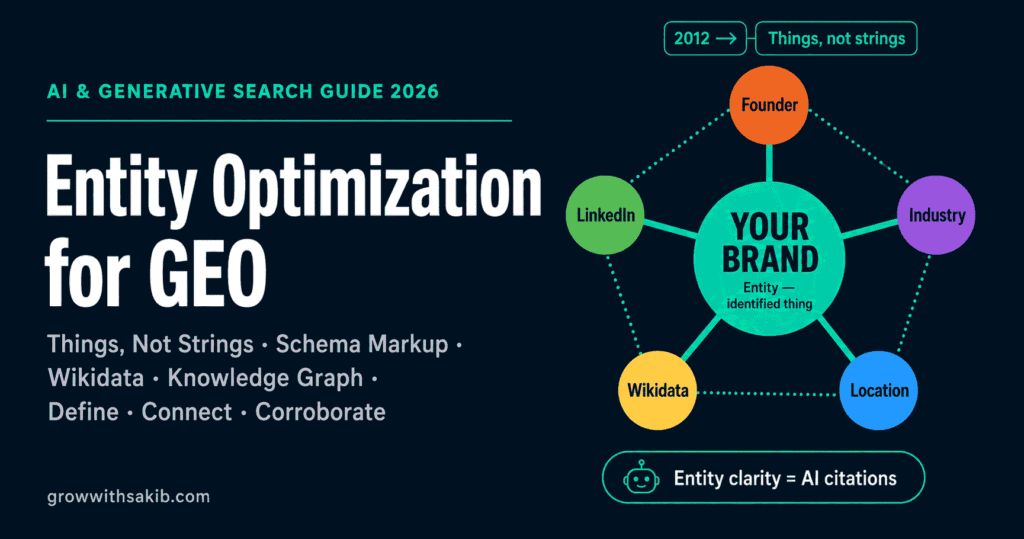
Here’s a problem that stops many brands cold in AI search: their content is excellent, but the AI doesn’t know who they are. It can’t confidently recommend a brand it can’t clearly identify. Entity optimization is how you fix that – it’s the work of becoming a recognized thing in the machine’s model of the world, not just another string of words.
This is an advanced topic, so we’ll go deep – but stay practical. This article expands one tactic from the complete guide to generative engine optimization on GrowWithSakib, and it bridges into the technical schema layer. If GEO itself is new to you, start with what generative engine optimization is.
What Is an Entity, and Why Does AI Care?
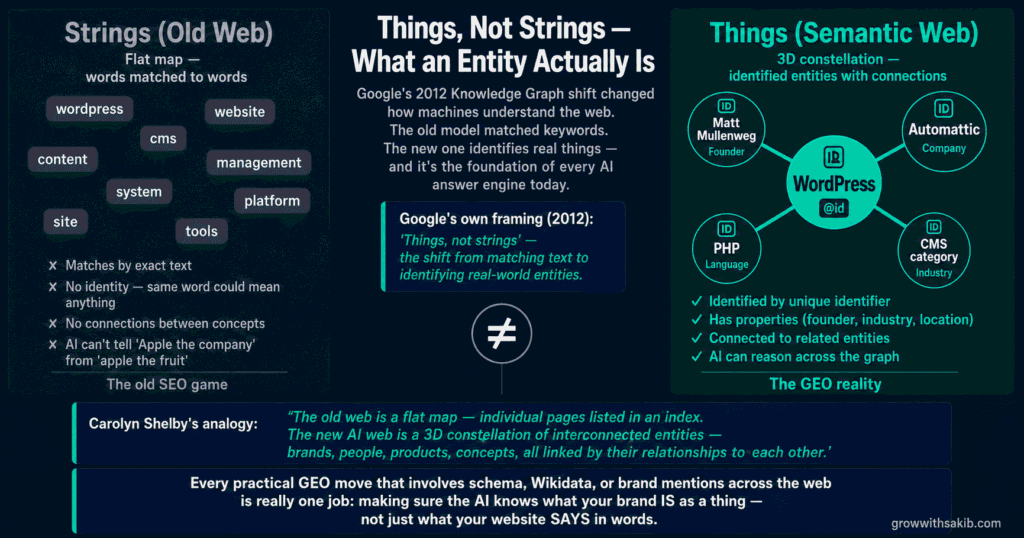
An entity is any thing that can be distinctly identified – a person, a company, a product, a place, or a concept. “Nike” is an entity. “Serena Williams” is an entity. “Generative engine optimization” is an entity. A keyword, by contrast, is just a string of characters. The entity is the real-world thing the string refers to.
This distinction is the foundation of modern search. Back in 2012, Google introduced its Knowledge Graph with the now-famous phrase “things, not strings” – a shift from matching words to understanding real-world entities and how they relate to each other. The Knowledge Graph is Google’s giant database of these entities and their relationships.
AI answer engines run on the same principle. They don’t cite “a page with the right keywords” – they cite entities they recognize and trust. SEO analyst Carolyn Shelby of Yoast captures the shift well: keyword SEO is like working on a flat map, while entity SEO lives in three-dimensional space where models treat brands, authors, and facts like stars clustered in constellations, as quoted in industry coverage. Your job is to become a bright, clearly-placed star.
How Does AI Recognize and Use Entities?
AI grounds its answers in entities through a three-part process: it resolves the entity (works out which real thing you are), disambiguates it (tells you apart from similarly-named things), and draws on what it knows about that entity to decide whether to cite you.
The key word is disambiguation. If your brand is called “Apex” – and so are fifty other companies – the AI needs strong signals to know which Apex you are. Clear, consistent identity signals resolve that ambiguity. Weak or conflicting signals leave the AI uncertain, so it plays safe and cites a competitor it can identify.
Google builds entity confidence through corroboration – cross-checking what your site, your structured data, public databases, and third-party sources all say about you. When every signal agrees, your entity becomes stable and trusted. When they disagree, it fragments. That single idea drives the whole method below.
The Define-Connect-Corroborate Model
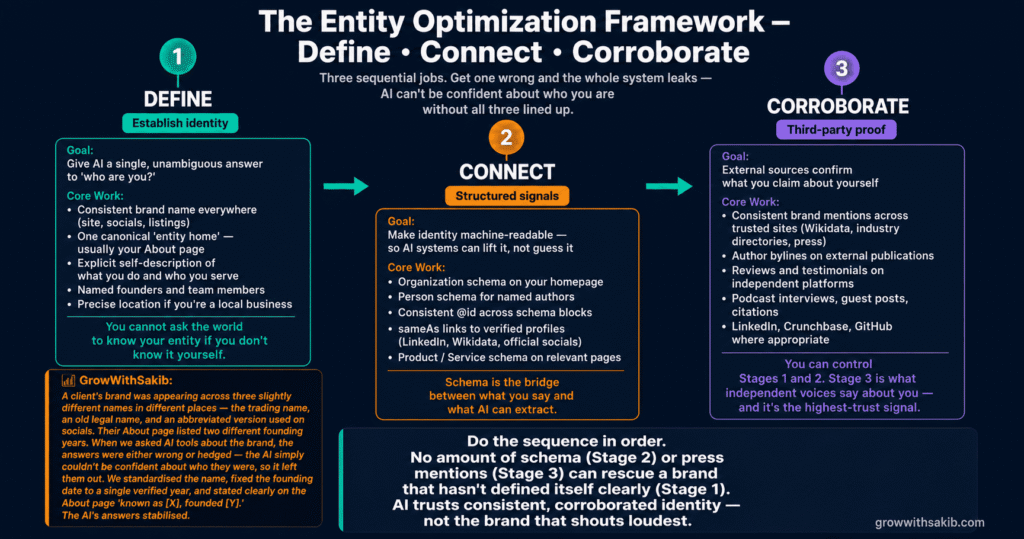
Entity optimization isn’t a black box. It comes down to three stages, in order. Each one makes your entity clearer and harder for AI to ignore.
| Stage | Goal | Core Work |
| 1. Define | A clear, consistent identity | Say exactly who you are, the same way, everywhere |
| 2. Connect | Link to the public knowledge graph | Structured data with sameAs and @id |
| 3. Corroborate | Third-party confirmation | Consistent mentions on trusted external sources |
Stage 1: Define – Say Who You Are, Consistently
Before AI can recognize your entity, you have to define it clearly – and identically – everywhere it appears. The most common reason AI can’t resolve a brand is inconsistency: the name, description, or key facts differ across the website, social profiles, and directories.
Start with an entity home.
The entity home – a concept formalised by Jason Barnard of Kalicube – is the single canonical URL that anchors your identity, almost always your About page. It should state, in plain language, exactly who you are, what you do, and the facts that define you: founding, founders, location, and focus. This becomes the reference point every other signal points back to.
Then enforce consistency across every surface:
- One exact brand name – pick a canonical spelling and use it identically everywhere, no variations.
- One core description – the same clear sentence about who you are on your site, LinkedIn, and every profile.
- Consistent key facts – founding year, founders, location, and category must match across all sources.
- Named people as entities – your founder and key experts are entities too; give them consistent bios and credentials.
Stage 2: Connect – Link to the Knowledge Graph With Schema
Once your identity is consistent, connect it to the public knowledge graph so machines can resolve it precisely. This is where structured data (schema markup) earns its place – and where entity optimization bridges into technical SEO.
Schema, built on the Schema.org vocabulary, translates your identity into a machine-readable format. Google’s own Organization structured data documentation confirms that adding Organization markup with properties like founder, logo, and location can influence how you appear, including in the Knowledge Panel.
Two schema properties matter most for entities:
| Property | What It Does | Why It Matters for Entities |
| @id | Assigns your entity a unique identifier | Lets you reference the same entity consistently across your schema |
| sameAs | Links your entity to authoritative profiles | Connects you to Wikipedia, Wikidata, LinkedIn – proving which entity you are |
The sameAs property is the entity-linker. By pointing your Organization schema’s sameAs at your Wikidata entry, LinkedIn company page, and other verified profiles, you tell Google “this entity is the same as those known entities” – powerful disambiguation. Connect your schema types too: link your Organization to your Person (founder) and Article (author) markup so relationships are explicit. For the full implementation, see the technical SEO guide on GrowWithSakib.
Stage 3: Corroborate – Earn Third-Party Confirmation
AI doesn’t take your word for who you are – it corroborates. Google explicitly cross-references your own signals against independent sources, so third-party confirmation is what turns a claimed identity into a trusted one.
The corroboration sources that build entity trust:
- Wikidata – the open knowledge base many AI systems draw on; a well-sourced Wikidata entry is high-value entity corroboration.
- Authoritative mentions – being named and described consistently on trusted industry sites, publications, and directories.
- Consistent profiles – LinkedIn, Crunchbase, and relevant platforms all describing you the same way.
- Third-party citations of your work – when recognized experts or publications reference your research or people by name.
Notice this overlaps heavily with digital PR and link building on GrowWithSakib – but the goal is different. You’re not chasing link equity; you’re building a chorus of independent sources that all describe the same clear entity. Consistency across that chorus is what stabilises you in the Knowledge Graph.
Named Entities vs Vague Category Terms
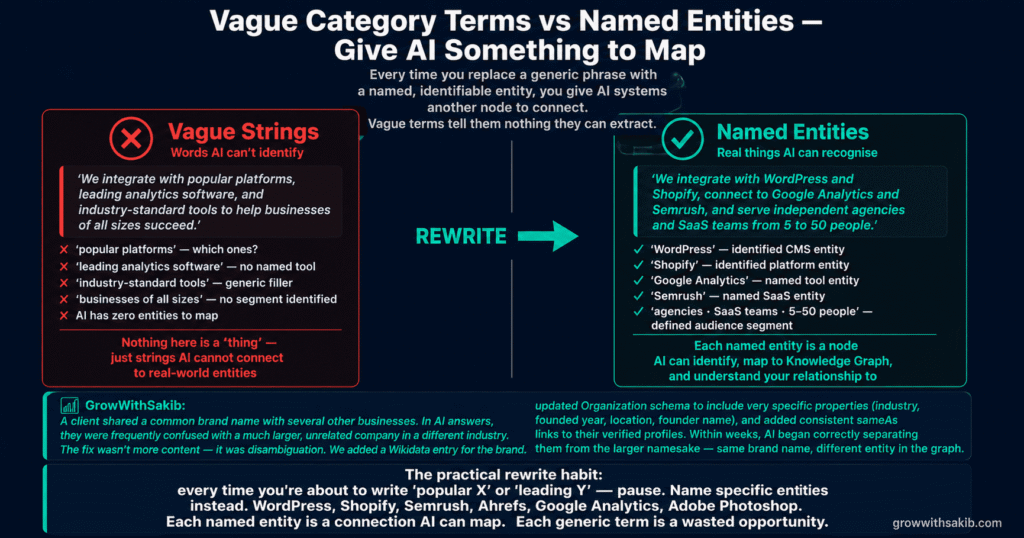
Here’s the idea most guides skip, and it changes how you write. AI grounds answers in named entities, so content that names specific entities is far more useful to it than content full of vague category strings.
Apply this everywhere. Name the specific tools you integrate with, the technologies you use, the standards you follow, the industries you serve, and the recognized competitors you’re an alternative to. Every named entity is a relationship the AI can add to its map of who you are – building your place in the constellation Shelby described.
Honest Limits: What Entity Optimization Can’t Do
Entity optimization is powerful, but it’s the slowest-moving lever in GEO, and some of it is outside your control. Be realistic:
- You can’t force a Knowledge Panel – schema and consistency improve your chances, but Google decides whether to create one. Treat a panel as a possible outcome, not a guaranteed deliverable.
- Entity authority is slow – corroboration builds over months as sources accumulate and align. This is a compounding, long-game investment, not a quick win.
- Schema is reinforcement, not magic – markup helps machines read signals you’ve already made consistent. It can’t manufacture an identity you haven’t built.
- Small and new brands start behind – established entities with years of corroboration have a real head start. You can absolutely build entity authority, but set the timeline honestly.
Beware anyone quoting precise percentages for entity work – many circulating figures are vendor-stated and hard to verify. The reliable truth is directional and well-documented: consistent, connected, corroborated entities are easier for AI to recognize and cite. Build for that, and pair it with statistics-rich, well-structured content on GrowWithSakib, since a recognized entity still needs citable content to be cited for something.
Common Entity Optimization Mistakes
| Mistake | Why It Hurts | Do This Instead |
|---|---|---|
| Inconsistent name and facts | Fragments your entity; AI can’t resolve it | One exact name, description, and fact set everywhere |
| No entity home | No canonical anchor for your identity | Make your About page the reference point |
| Vague category strings | Gives AI no entities to map | Name specific tools, tech, and partners |
| Schema with no sameAs | Misses the entity-linking opportunity | Point sameAs at Wikidata, LinkedIn, verified profiles |
| Disconnected schema snippets | Relationships stay hidden | Link Organization to Person and Article markup |
| Ignoring third-party corroboration | Identity stays unverified | Earn consistent mentions on trusted sources |
| Expecting fast results | Disappointment; abandoning too early | Treat entity authority as a months-long game |
Frequently Asked Questions
1. What is entity optimization for GEO?
Entity optimization for GEO is the practice of making AI systems recognize your brand, people, and products as clearly-defined entities – distinct things with a stable identity – rather than vague keywords. You define your entity consistently everywhere, connect it to the public Knowledge Graph with structured data, and corroborate it across trusted third-party sources, so AI can confidently identify and cite you by name in its answers.
2. What is an entity in SEO?
An entity is any thing that can be distinctly identified – a person, company, product, place, or concept. “Nike” is an entity; a keyword is just a string of characters that refers to it. Google introduced this “things, not strings” approach with its Knowledge Graph in 2012. AI answer engines cite entities they recognize and trust, not just pages with matching keywords.
3. What is the Google Knowledge Graph?
The Google Knowledge Graph is a giant database of entities – people, places, things, and concepts – and the relationships between them. Launched in 2012 under the phrase “things, not strings”, it lets Google understand real-world things rather than just matching words. It powers Knowledge Panels and increasingly feeds AI answers, so being a recognized entity within it supports AI visibility.
4. How does schema markup help entity optimization?
Schema markup translates your identity into a machine-readable format so AI can resolve your entity precisely. The most important properties are @id (a unique identifier for your entity) and sameAs (which links you to authoritative profiles like Wikidata and LinkedIn). Per Google’s Organization documentation, Organization markup can influence how you appear, including in the Knowledge Panel.
5. What is the difference between entity SEO and keyword SEO?
Keyword SEO focuses on matching the specific words people search. Entity SEO focuses on making search engines and AI understand what your brand actually is – a recognized thing with a stable identity and relationships. Keyword SEO helps you rank for strings; entity SEO helps you get recognized and cited by name in AI answers. In 2026 you need both, but entity clarity is what earns AI citations.
6. Why does AI cite my competitors but not me?
Often because AI can clearly identify your competitor as an entity but not you. If your brand name, description, and key facts are inconsistent across your site and profiles, AI can’t confidently resolve your entity, so it cites a competitor it can identify. Fix this by defining your identity consistently, adding Organization schema with sameAs, and earning consistent third-party mentions.
7. What is an entity home?
An entity home is the single canonical URL that anchors your brand’s identity – a concept formalised by Jason Barnard of Kalicube, and almost always your About page. It states clearly who you are, what you do, and your defining facts, and it carries your Organization schema. Every other signal about your brand points back to it, giving AI one authoritative reference point for your entity.
8. How long does it take to build entity authority?
Entity authority is the slowest-moving lever in GEO – expect months, not weeks. It builds through corroboration as consistent signals accumulate across your site, structured data, and third-party sources. You can’t force a Knowledge Panel or rush the process; it compounds over time. Small and newer brands start behind established entities, so set realistic timelines and treat it as a long-game investment.
Key Takeaways
- Entity optimization makes AI recognize your brand as a distinct, identifiable thing – an entity – rather than a vague keyword, so it can cite you by name.
- AI cites entities it recognizes and trusts; Google’s Knowledge Graph works on ‘things, not strings,’ understanding real-world entities and their relationships.
- Follow the Define-Connect-Corroborate model: define your identity consistently, connect it with schema, and corroborate it across trusted sources.
- Consistency is everything – conflicting names, facts, or descriptions fragment your entity so AI can’t resolve it and cites a competitor instead.
- Use schema’s @id and sameAs to link your entity to Wikidata, LinkedIn, and other verified profiles – the strongest disambiguation signal you control.
- Name specific entities (real tools, technologies, partners) instead of vague category terms – every named entity is a relationship AI can map.
- Corroboration from third-party sources turns a claimed identity into a trusted one; it overlaps with digital PR but aims at identity, not link equity.
- Be honest about limits: you can’t force a Knowledge Panel, entity authority takes months, and schema reinforces identity rather than creating it.