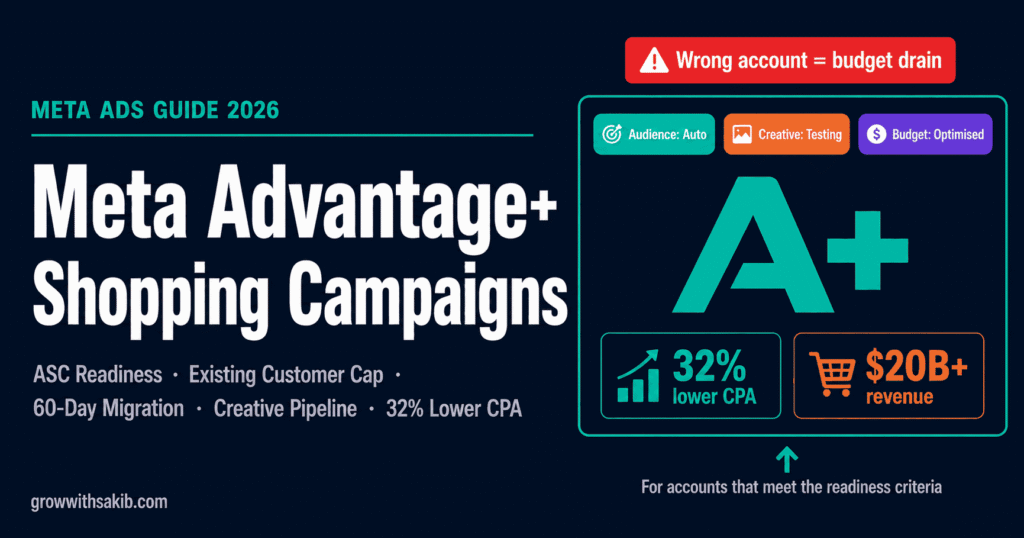
Most guides present Advantage+ Shopping Campaigns as a straightforward win: less management, lower CPA, better ROAS — and the complete Meta Ads Guide covers where ASC fits within a full-funnel paid advertising strategy. And for the right accounts, that is accurate. For the wrong accounts, it burns budget faster than the manual campaigns it replaced.
The difference between these two outcomes comes down to whether your account meets the conditions the algorithm needs to perform. The guide you’re reading covers both sides — who should use ASC, who should not, and exactly how to set it up correctly for the accounts where it delivers.
What Advantage+ Shopping Campaigns Are — and What Changed in 2025
Advantage+ Shopping Campaigns launched in 2022 as Meta’s first fully automated e-commerce campaign type. They replaced the previous model — separate prospecting and retargeting campaigns with manually defined audiences — with a single campaign where Meta’s algorithm handles targeting decisions dynamically.
The core trade-off: you give up granular audience control in exchange for algorithmic efficiency. There are no custom audiences, no lookalike tiers, no interest targeting layers. You set a budget, define your existing customer audience, upload creative assets, and let the algorithm find buyers across Meta’s entire inventory.
The early 2025 rename: Advantage+ Shopping becomes Advantage+ Sales
In early 2025, Meta renamed Advantage+ Shopping Campaigns to Advantage+ Sales Campaigns. The name change reflects a meaningful expansion in scope. ASC now supports e-commerce sales, lead generation, and app installs — not exclusively online shopping. This matters for advertisers searching under the old name: the campaign type itself still works identically for e-commerce, but the label in Ads Manager now says ‘Advantage+ Sales.’
How Advantage+ Shopping Campaigns Actually Work
Understanding the mechanism — not just the outcome — is what separates effective ASC management from passive spending.
The Andromeda algorithm: why ASC performs differently from manual
ASC is powered by Andromeda, Meta’s core ranking model that underwent a major overhaul in 2024–2025. As Alex Neiman’s 2026 practitioner guide, based on $50M+ in managed Meta spend, explains: Andromeda functions as a retrieval engine — it does not search for pre-defined audiences but continuously computes conversion probability scores across Meta’s entire active user base in real time. Every impression is an opportunity for the algorithm to recalibrate.
This is fundamentally different from how manual campaigns work. In a manual campaign, you define an audience and Meta delivers within that pool. In ASC, Meta’s algorithm dynamically identifies which users across its full inventory are most likely to convert for your specific offer, given your creative signals, your pixel data, and the historical conversion patterns of your account.
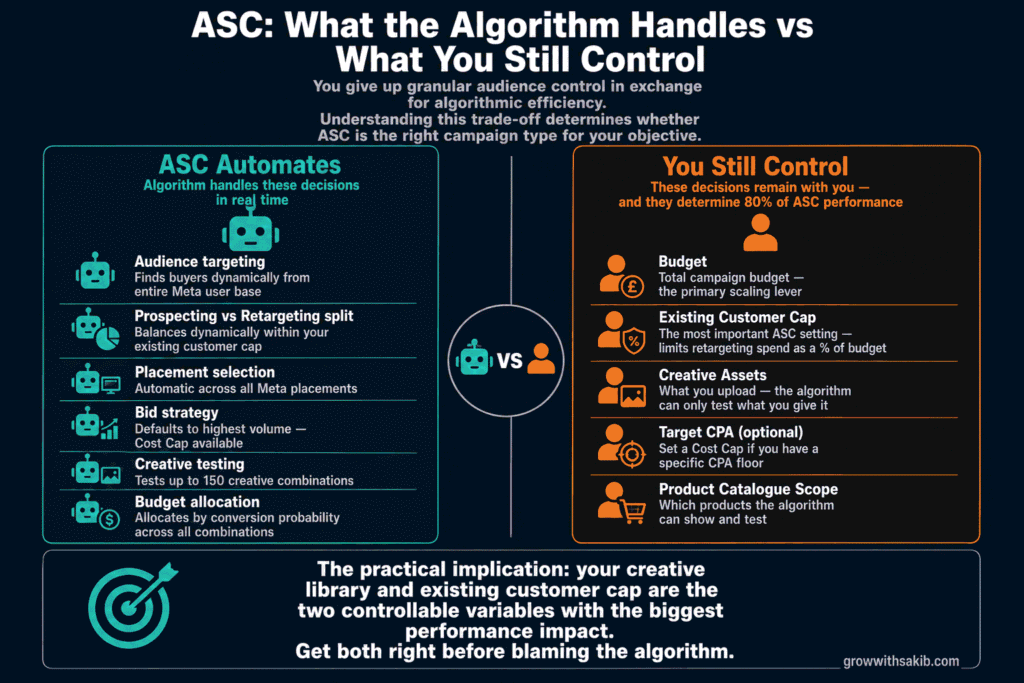
What ASC automates — and what you still control
| Decision | ASC (Automated) | Manual Campaign (Your Control) |
|---|---|---|
| Audience targeting | Algorithm finds buyers dynamically from entire user base | You define custom audiences, lookalikes, interest layers |
| Prospecting vs retargeting split | Algorithm balances dynamically within your existing customer cap | You manage in separate ad sets or campaigns with manual budgets |
| Placement selection | Automatic across all Meta placements | You can restrict to specific placements |
| Bid strategy | Automatically uses highest volume; Cost Cap available | You choose from multiple bid strategies |
| Creative testing | Algorithm tests up to 150 creative combinations | You manage A/B tests manually or via DCO |
| Budget allocation | Single campaign budget; algorithm allocates by conversion probability | You split budgets across multiple ad sets |
| What YOU control in ASC | Budget, existing customer cap, creative assets, target CPA (optional), product catalogue scope | Everything above |
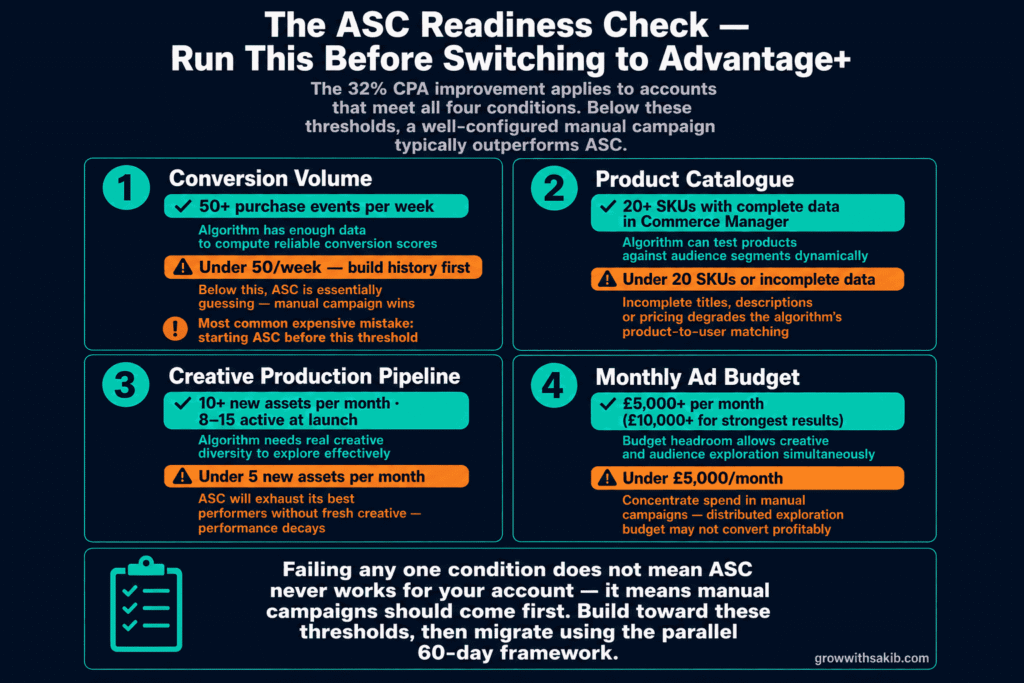
Is Your Account Ready for ASC? The 4-Condition Readiness Check
The 32% CPA improvement headline applies to accounts that meet the algorithm’s data requirements. Below those thresholds, ASC can be less efficient than a well-managed manual campaign. Here are the four conditions that determine readiness.
Condition 1: Conversion volume — minimum 50 purchase events per week
ASC needs at least 50 purchase events per week to optimise effectively, as confirmed in the Meta Business Help Center’s learning phase documentation. Below this threshold, the algorithm does not have enough conversion data to compute reliable conversion probability scores across the audience pool. It is essentially guessing.
If your account generates fewer than 50 purchases per week, run a standard manual campaign until you build sufficient conversion history. Then migrate to ASC. Starting ASC prematurely is one of the most common and most expensive setup mistakes.
Condition 2: Product catalogue — 20+ SKUs with complete data
ASC performs at its best when you have a substantial product catalogue connected to Meta Commerce Manager. The algorithm can then dynamically test different products against different user segments and identify which products convert for which audiences. Single-product advertisers or those with very small catalogues lose much of this capability.
Catalogue quality matters as much as catalogue size. Products must have complete titles, accurate descriptions, quality images, and correct pricing. As noted by Adligator’s 2026 ASC guide, the algorithm uses catalogue data to match products to user intent — incomplete data degrades this matching.
Condition 3: Creative pipeline — 10+ new assets per month
ASC can test up to 150 creative combinations, but it optimises through creative exploration. If you cannot supply a consistent stream of fresh creative assets, the algorithm’s exploration capability stalls. As Alex Neiman’s practitioner playbook documents, citing Motion’s 2026 study of over 550,000 ads, only approximately 6% of ads drive the majority of spend — meaning you need creative volume to statistically hit winners.
The practical minimum: 8–15 active creatives at any time, with 3–5 new assets added every 1–2 weeks. If your creative production cannot support this cadence, ASC will exhaust its best performers without replacement and performance will decay.
Condition 4: Budget headroom — above £5,000–£10,000/month
ASC needs budget headroom to explore creative combinations and audience segments simultaneously. Below approximately £5,000/month (roughly $6,000/month), the algorithm often cannot generate sufficient conversion events from its creative exploration to optimise effectively. The Adverge Media 2026 setup guide documents that accounts above £10,000/month see the most consistent performance gains from ASC.
Lower-budget accounts can still use ASC, but may see better results running a tighter manual campaign that concentrates spend rather than distributing it across exploratory combinations — and combining it with SEO for small business to build organic traffic that reduces dependence on paid spend.
| Condition | ASC Ready | Consider Manual First |
|---|---|---|
| Weekly purchase events | 50+ per week | Under 50 per week — build conversion history first |
| Product catalogue | 20+ SKUs, complete data in Commerce Manager | Under 20 SKUs, or incomplete product data |
| Creative production | 10+ new assets per month; 8–15 active at launch | Under 5 new assets per month — ASC will exhaust winners |
| Monthly ad budget | £5,000+ (ideally £10,000+) | Under £5,000 — concentrate spend in manual campaigns |
When NOT to Use Advantage+ Shopping Campaigns
This is the section missing from virtually every ASC guide published in 2026 — including guides from agencies that sell ASC management services. Here are the four specific conditions where manual campaigns consistently outperform ASC.
1. Niche products with small addressable markets
ASC’s strength is its ability to find buyers across a broad population. For products with a genuinely small potential audience — highly specialised B2B equipment, niche luxury goods, locally restricted services — the algorithm’s broad search space becomes a liability. It spends budget exploring segments it will never convert profitably.
Manual campaigns with precisely defined audiences, smaller budgets, and tighter targeting controls outperform ASC in these scenarios because you can concentrate spend on the small segment where conversion probability is actually high — the Meta Ads for local business guide covers the manual targeting approach that works best for geographically constrained audiences.
2. When you need strict audience separation for testing
ASC merges prospecting and retargeting into a single campaign. You cannot see a clean split of spend or performance between new and existing customer acquisition without relying on the existing customer cap data and Shopify/analytics cross-referencing. If you need to run structured creative tests with clean audience isolation, or if you need to measure incrementality with precise holdout groups, manual campaigns give you the control ASC removes — the Meta Ads A/B testing guide covers the full structured testing framework.
3. When entering a completely new market or category
ASC learns from your existing pixel history and conversion data. When you launch in a new country, introduce a completely new product category with no conversion history, or pivot your audience demographic significantly, ASC has no signal to build its model from. A manual campaign — even a broad one — allows you to collect conversion data and build an audience foundation before transitioning to ASC optimisation.
4. When creative production is limited
If your team cannot produce 8–15 creative variations and refresh them monthly, ASC will underperform a simpler manual campaign. The algorithm needs creative diversity to explore. A manual campaign with 3–4 well-tested creatives and manual audience targeting often delivers better results than ASC with 3 stale creatives and no refresh pipeline.
How to Set Up Meta Advantage+ Shopping Campaigns: Step-by-Step
The setup itself is relatively straightforward. The decisions you make during setup — especially the existing customer cap and creative selection — have the largest long-term impact on performance.
- Step 1: Prerequisites check. Confirm your Meta Pixel is correctly installed and firing purchase events. Verify Conversions API (CAPI) is configured alongside the Pixel — ASC’s algorithm learns from conversion data, and Pixel-only tracking misses 15–30% of iOS purchase events. Confirm your product catalogue is connected and complete in Meta Commerce Manager.
- Step 2: Create the campaign. In Meta Ads Manager, click ‘Create’ and select ‘Sales’ as the objective. Under campaign type, choose ‘Advantage+ Shopping Campaign’ (now labelled ‘Advantage+ Sales’ in updated accounts). The interface will differ from standard campaign creation — there are no ad set audience controls.
- Step 3: Define your existing customer audience. Upload your existing customer list as a custom audience. This tells ASC who your existing customers are, enabling the budget cap to work correctly. Use a complete, recently refreshed customer list — not a list from 18 months ago with no updates.
- Step 4: Set the existing customer budget cap. Set the cap as a percentage of your total campaign budget. For most e-commerce brands, 10–25% is the starting range. Start at 20% and adjust based on your new-vs-returning customer ratio in Shopify or your analytics platform after 14 days.
- Step 5: Upload creative assets. Load 8–15 genuinely different creatives at launch — not variations of the same concept. Include a mix of static product images, lifestyle images, short-form video, and UGC-style content. Name each creative descriptively for performance tracking later. The algorithm will begin testing combinations immediately.
- Step 6: Set your budget and bidding. ASC defaults to Highest Volume (lowest cost) bidding. If you have a specific CPA target, you can set a Cost Cap. For initial testing, start with Highest Volume and introduce a Cost Cap once the campaign has exited the learning phase and established a baseline CPA.
- Step 7: Allow 7–14 days before evaluating. As documented in Meta’s learning phase guidance, ASC requires approximately 50 optimisation events per week to exit the learning phase. During this period, CPA will be volatile. Resist the urge to make changes — each significant edit resets the learning phase clock.
The Existing Customer Budget Cap: The Most Important ASC Setting
The existing customer budget cap is the single most impactful setting within an ASC campaign. Without it, the algorithm consistently over-allocates budget to existing customers — because they convert more reliably than cold prospects, and the algorithm optimises for conversion probability, not new customer acquisition.
Why the cap matters mechanically
Left uncapped, ASC will find that retargeting your existing customers produces the cheapest conversions in your account — because these people already know your brand and are much closer to a repeat purchase decision. The algorithm follows the conversion probability gradient and allocates more budget there. Your new customer acquisition rate drops. Your reported ROAS looks good. Your actual business growth does not.
As Adligator’s 2026 ASC guide explains: without a cap, ASC effectively becomes an expensive retargeting campaign with a small prospecting component. The cap forces budget allocation toward new customer acquisition — which is usually the primary business objective.
How to calibrate your cap
- Starting point: set the cap at 20% for most e-commerce brands. This means 80% of budget goes to prospecting for new customers, 20% can be spent on existing customers.
- Lower the cap (to 10–15%) when: your new customer acquisition costs are acceptable but your returning customer ratio is too high — more than 40% of conversions from existing customers.
- Raise the cap (to 25–30%) temporarily when: new customer acquisition costs are spiking and you need the algorithm to find lower-cost conversions to stabilise CPA while it continues learning. This is a short-term tactic, not a permanent setting.
- Monitor in Shopify or analytics: track your new-vs-returning customer ratio weekly, not in Meta’s dashboard. Meta’s attribution model does not clearly separate new and returning conversions — your e-commerce platform’s data is more reliable.
Creative Strategy for ASC: What the Algorithm Actually Needs
In standard manual campaigns, creative selection is about finding your best ad and running it. In ASC, creative strategy is about building a diverse creative library that gives the algorithm enough signal variety to identify winners across different audience segments and placements.
Creative volume and diversity requirements
- Launch with 8–15 creatives: not variations of one concept — genuinely different angles, formats, and messaging approaches, as the Meta Ads creative testing guide explains through the concept-vs-variation framework. The algorithm needs real creative diversity to explore effectively.
- Refresh 3–5 new creatives every 1–2 weeks: do not wait for performance to decay before refreshing. By the time fatigue is visible in CPA data, you have already lost efficiency. Proactive creative refreshes keep the algorithm in exploration mode.
- Do not pause underperforming creatives immediately: ASC allocates budget away from poor performers naturally. Only pause ads with CPA 2x or more above your campaign average, and only after they have received enough impressions for the data to be statistically meaningful.
- Include multiple formats: static product images, lifestyle images, short-form video (15–30 seconds), UGC-style content, and catalogue-based dynamic product ads — for specs and placement performance of each, see the Meta ad formats guide. Different formats perform in different placements and for different audience segments.
UGC vs polished creative: what the data shows
The evidence is consistent across multiple 2026 studies. As MHI Growth Engine’s e-commerce benchmark report documents, UGC (user-generated content — authentic, creator-filmed, slightly imperfect) outperforms polished brand creative by 48% on CTR and 26% on CPA across most e-commerce verticals.
The mechanism: UGC passes the ‘native content’ test. It looks like something a friend shared, not an ad. In a feed environment where people are actively avoiding advertising, content that does not immediately register as an ad generates higher engagement and lower CPM.
Practical implication for ASC: prioritise UGC and creator content in your creative mix. Studio-produced creative still has a role — particularly for brand awareness placements and premium product categories — but it should not be the majority of your creative library in 2026.
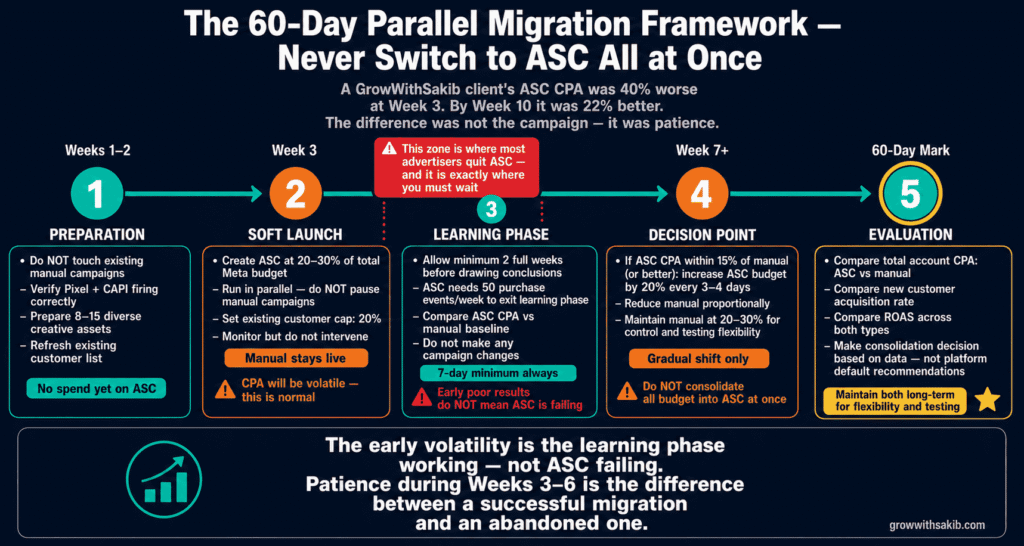
How to Migrate from Manual Campaigns to ASC Without Losing Performance
The most dangerous ASC mistake is switching entirely from manual to ASC at once, losing your stable manual performance, and then having no fallback while the ASC algorithm learns. The correct migration approach is gradual and evidence-based.
The 60-day parallel migration framework
- Weeks 1–2 (Preparation): Do not touch your existing manual campaigns. Ensure your Pixel + CAPI tracking is verified and firing correctly. Prepare 8–15 diverse creatives. Upload and refresh your existing customer list.
- Week 3 (Soft launch): Create your first ASC campaign at 20–30% of your current total Meta budget. Run it in parallel with your existing manual campaigns — do not pause or reduce manual campaigns yet. Set the existing customer cap at 20%.
- Weeks 3–6 (Learning and evaluation): Allow the ASC campaign to run for at least two full weeks before drawing conclusions, as confirmed by Meta’s learning phase requirements. The learning phase requires 50 optimisation events per week. Compare ASC CPA and new customer ratio against your manual campaign baseline.
- Week 7+ (Decision point): If ASC CPA is within 15% of your manual campaign CPA (or better), gradually increase ASC budget by 20% increments every 3–4 days. Reduce manual campaigns proportionally. Maintain manual campaigns at 20–30% of total budget for audience control and testing flexibility.
- 60-day evaluation: After 60 days, compare total account CPA, new customer acquisition rate, and ROAS across both campaign types. Make the consolidation decision based on data, not on either platform’s default recommendation.
Optimising ASC After Launch: What to Touch and What to Leave Alone
The most common post-launch mistake is treating ASC like a manual campaign that needs frequent intervention. ASC performs best when you give the algorithm stability. The second most common mistake is never touching it and assuming ‘set and forget’ means ‘always optimal.’
The correct intervention checklist
- DO: Add new creatives regularly (every 1–2 weeks). This is the primary lever available to you and the most impactful optimisation action.
- DO: Monitor creative-level CPA in the ad breakdown view. Pause creatives spending at 2x+ above campaign average CPA after receiving meaningful impression volume.
- DO: Scale budget gradually (max 20% increase every 3–4 days) — follow the full scaling framework in the Meta Ads playbook for how budget increases interact with campaign structure across all campaign types.
- DO: Adjust the existing customer cap based on new-vs-returning ratio. Review monthly and adjust 5–10 percentage points in either direction based on your new customer acquisition data.
- DO NOT: Change campaign objective, bid strategy, or audience definition. These changes trigger a full learning phase reset.
- DO NOT: Pause and restart the campaign. Pauses of 7+ days reset learning phase progress. If you need to reduce spend, lower budget — do not pause.
- DO NOT: Add interest targeting or lookalike audiences as hard constraints. ASC is designed to operate without manual audience definitions. Adding them restricts the algorithm’s exploration space and undermines the core benefit of the campaign type.
Frequently Asked Questions
What is the difference between Advantage+ Shopping and Advantage+ Sales Campaigns?
They are the same campaign type — Meta renamed Advantage+ Shopping Campaigns to Advantage+ Sales Campaigns in early 2025. The name change reflects an expanded scope: the campaign type now supports lead generation and app installs in addition to e-commerce purchases. The setup, optimisation approach, and algorithm are unchanged. You may see either name depending on when your Ads Manager account was last updated. The official Meta documentation uses the Advantage+ Sales Campaign label.
How much budget do I need for Advantage+ Shopping Campaigns?
ASC needs sufficient budget to generate at least 50 purchase conversions per week — the minimum for the algorithm to exit the learning phase and optimise effectively. Your minimum budget depends on your average CPA. If your average CPA is £40, you need approximately £2,000/week (£40 × 50) to meet the conversion threshold. In practice, ASC performs most consistently for brands spending £5,000–£10,000+ per month. Below this level, a manual campaign may deliver more predictable results.
What is the existing customer budget cap and what should I set it to?
The existing customer budget cap limits the percentage of your ASC budget that can be spent on people who have already purchased from you. Without it, the algorithm over-indexes on retargeting because existing customers convert at higher rates. Start at 20% for most e-commerce brands — this ensures 80% of budget goes toward new customer acquisition. Monitor your new-vs-returning customer ratio in Shopify or your analytics platform weekly and adjust by 5–10 percentage points based on performance data.
How many creatives do I need for Advantage+ Shopping Campaigns?
Launch with 8–15 genuinely different creative assets — different angles, formats, and messaging approaches, not minor variations of one concept. Plan to add 3–5 new assets every 1–2 weeks to prevent creative fatigue. As Motion’s 2026 creative benchmarks document, only approximately 6% of ads drive the majority of ASC spend — you need creative volume to statistically hit winners. Include a mix of static images, lifestyle photos, short-form video, and UGC-style content.
How long does the ASC learning phase last?
The learning phase requires approximately 50 purchase optimisation events per week. For accounts generating 50–100 weekly conversions, this typically takes 7–14 days. As documented in the Meta learning phase guidance, significant changes reset the learning clock. For more detail, see our guide to the Meta ads learning phase.
Should I run ASC alongside my manual campaigns or replace them?
Start by running ASC alongside your manual campaigns — never replace them outright before validating performance. Use the parallel migration framework: launch ASC at 20–30% of total Meta budget, evaluate for 60 days, then gradually shift budget toward ASC if it performs at or below manual campaign CPA. Maintain manual campaigns at 20–30% of budget for creative testing and audience control, even after successful ASC migration. As Purpose Digital’s ASC case study documents, the brands achieving the strongest results run both campaign types rather than exclusively one or the other.
Are Advantage+ Shopping Campaigns available for all business types?
ASC was originally designed for e-commerce brands optimising toward purchase conversions, but following the 2025 rename to Advantage+ Sales Campaigns, it now supports lead generation and app install objectives as well. However, ASC works best for businesses with a product catalogue, significant conversion volume, and a consistent creative production pipeline. Very small businesses, niche advertisers with limited addressable markets, and businesses without sufficient conversion data typically see better results from well-configured manual campaigns, as confirmed by Adligator’s 2026 readiness analysis.
Key Takeaways
- Advantage+ Shopping Campaigns were renamed Advantage+ Sales Campaigns in early 2025 and now support e-commerce, lead gen, and app installs — not just online shopping.
- The 32% CPA improvement applies to accounts that meet four readiness conditions: 50+ weekly purchase events, 20+ SKUs, 10+ new creatives per month, and £5,000+ monthly budget. Below these thresholds, manual often wins.
- The existing customer budget cap is the most important ASC setting. Without it, ASC over-indexes on retargeting existing customers. Start at 20% and adjust based on new-vs-returning customer data from Shopify or analytics.
- Creative velocity is the primary optimisation lever inside ASC. Launch with 8–15 diverse assets, add 3–5 new creatives every 1–2 weeks, and only pause ads spending 2x+ above campaign average CPA.
- UGC outperforms polished brand creative by 48% on CTR and 26% on CPA across most e-commerce verticals in 2026. Prioritise authentic, creator-filmed content in your ASC creative mix.
- Never replace manual campaigns with ASC immediately. Run both in parallel for 60 days using the 20-30% budget allocation framework before making consolidation decisions.
- Do not intervene in ASC during the learning phase. The first 7–14 days will show volatile CPA. Changes during this period reset the learning clock and extend the instability.
- Check your existing customer cap status if your ASC campaign was created between February and March 2025 — the cap was temporarily removed during this period and may not be active on older campaigns.