Every SEO conversation eventually arrives at the same anxious question: “What’s my domain authority?” Then the next one: “Why is it so low?” And then: “How do I increase it?”
This guide answers all three honestly. You’ll learn what domain authority actually is (and what it isn’t), how the three main competing metrics work, why Google doesn’t officially use any of them, and a stage-by-stage playbook for building DA from zero with realistic monthly milestones.
If you want the broader strategic context first, the complete small business SEO guide on GrowWithSakib covers how authority fits into your overall SEO strategy.
What Is Domain Authority?
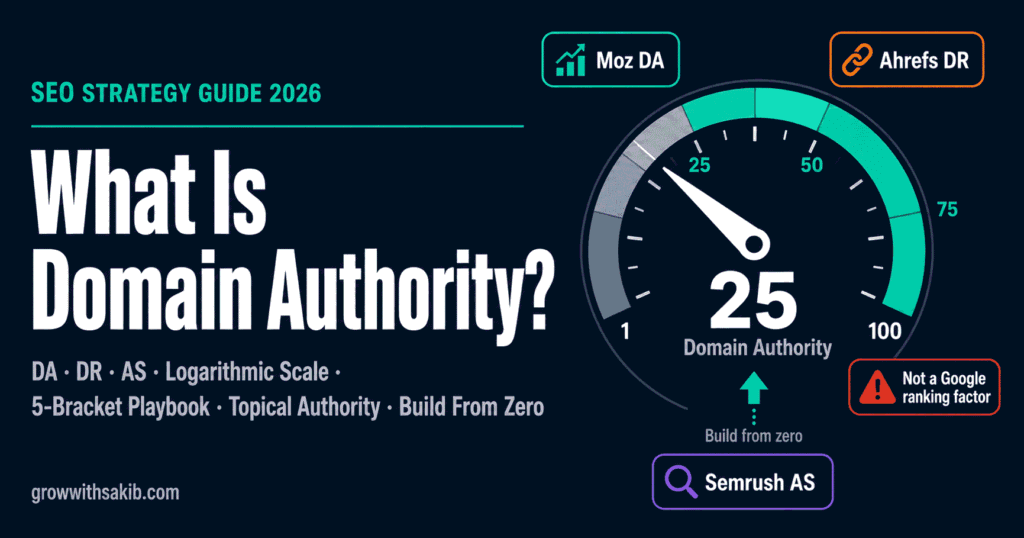
Domain authority is a third-party SEO metric — not made by Google — that predicts how likely a website is to rank in search engines compared to other websites. It was originally developed by Moz around 2009, on a scale from 1 to 100.
The score reflects the strength of a website’s overall backlink profile — how many quality websites link to it, the diversity of those linking domains, and the trustworthiness of those links. The higher the number, the stronger the site’s ability to rank.
Domain Authority Is Not a Google Ranking Factor
This is the most important fact most articles bury: Google does not use Moz’s Domain Authority (or any third-party authority metric) in its ranking algorithm. Google’s representatives, including former Webmaster Trends Analyst John Mueller, have stated this directly on multiple occasions. Domain Authority is a predictive metric designed to correlate with ranking ability, not cause it — which is why the complete SEO framework focuses on the underlying signals Google actually uses.
So why does DA matter at all? Three reasons:
- It’s a useful competitive benchmark — you can see how your site compares to similar competitors
- It correlates with real ranking performance because it measures the same underlying signals Google does (link equity, backlink quality)
- Many link-prospecting and outreach tools use it to qualify which sites are worth pursuing for backlinks
Domain Authority vs Domain Rating vs Authority Score
Three competing metrics dominate the SEO industry, and most articles conflate them. They’re not the same. Each tool calculates authority differently.
1. Domain Authority (DA)
- Metric: Domain Authority (DA)
- Tool: Moz
- Scale: 1–100
- What It Measures: Backlink profile strength + spam score (machine learning model)
- Best For: Competitive benchmarking, classic SEO outreach
2. Domain Rating (DR)
- Metric: Domain Rating (DR)
- Tool: Ahrefs
- Scale: 0–100
- What It Measures: Strength of website’s backlink profile only
- Best For: Link prospecting, competitive link analysis
3. Authority Score (AS)
- Metric: Authority Score (AS)
- Tool: Semrush
- Scale: 0–100
- What It Measures: Backlinks + organic traffic + spam signals (multi-factor)
- Best For: Holistic authority benchmarking, content gap analysis
Recent research summarised in Wikipedia’s domain authority entry found these three metrics correlate strongly with each other (ρ ≈ 0.9), so they’re broadly interchangeable for tracking authority over time. The differences matter at the margins, not the broad strokes.
Practical rule: pick one metric and track it consistently. Don’t switch metrics mid-strategy — comparing a DA score this month with a DR score next month is meaningless.
How Domain Authority Is Calculated
Moz’s Domain Authority 2.0 update, launched in March 2019, uses a machine learning model trained on Google’s actual SERP data. Moz now monitors more than 35 trillion links in its index. The major calculation factors are:
- Linking root domains — the number of unique websites that link to your domain (more important than total link count)
- Total link quantity — overall backlinks across all referring domains
- Link quality — the authority and trustworthiness of linking sites
- Spam Score — Moz’s measure of how likely a site is spammy
- Predictive correlation — how closely a site’s link profile resembles those that rank well
The Logarithmic Scale Trap
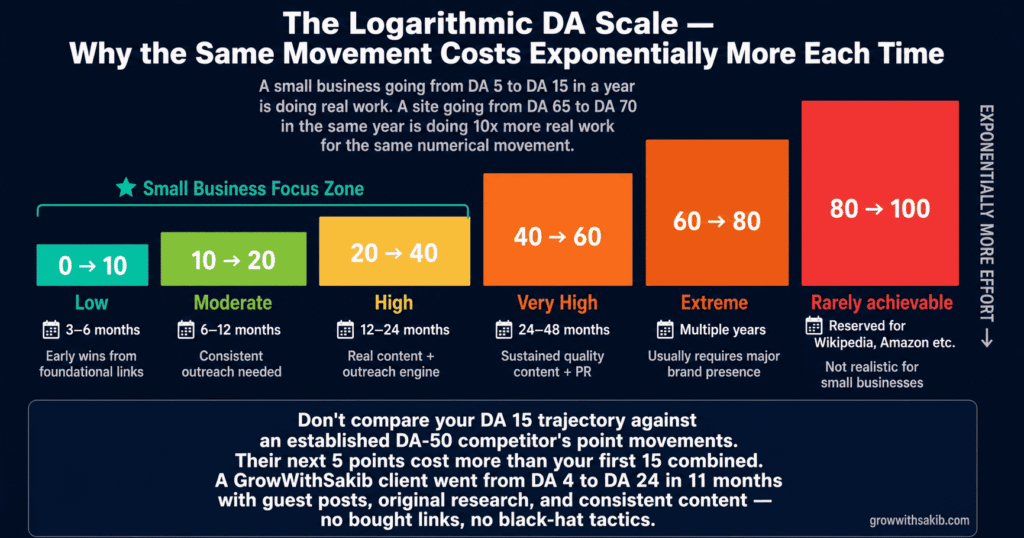
DA is logarithmic — not linear. That single fact explains why your DA seems to climb fast at first and then crawl.
1. 0 → 10
- DA Movement: 0 → 10
- Approximate Effort Required: Low — early wins from foundational links
- Typical Timeline: 3–6 months
2. 10 → 20
- DA Movement: 10 → 20
- Approximate Effort Required: Moderate — needs consistent outreach
- Typical Timeline: 6–12 months
3. 20 → 40
- DA Movement: 20 → 40
- Approximate Effort Required: High — requires real content + outreach engine
- Typical Timeline: 12–24 months
4. 40 → 60
- DA Movement: 40 → 60
- Approximate Effort Required: Very high — sustained quality content + PR
- Typical Timeline: 24–48 months
5. 60 → 80
- DA Movement: 60 → 80
- Approximate Effort Required: Extreme — usually requires major brand presence
- Typical Timeline: Multiple years
6. 80 → 100
- DA Movement: 80 → 100
- Approximate Effort Required: Rarely achievable for non-major-brand sites
- Typical Timeline: Reserved for Wikipedia, Amazon, etc.
Practical implication: a small business going from DA 5 to DA 15 in a year is doing real work. A site going from DA 65 to DA 70 in the same year is doing 10x more real work for the same numerical movement. Don’t compare your trajectory against established competitor brands’ point movements.
What Is a Good Domain Authority Score?
There’s no universal good or bad DA. It’s a relative metric. A DA of 25 might be excellent for a 14-month-old small business site and disappointing for a 10-year-old industry publisher in the same niche.
Realistic DA expectations by business stage:
| Business Stage | Realistic DA Target | Notes |
| New site (0–6 months) | 1–10 | Just getting indexed and earning first links |
| Early-stage (6–12 months) | 10–20 | Foundation links + consistent content publishing |
| Growth-stage (12–24 months) | 20–35 | Compound growth from content + outreach |
| Established small business (2–4 years) | 30–50 | Steady authority and brand visibility |
| Mature niche brand (4+ years) | 40–60 | Recognised industry authority |
| Major publication / household brand | 60–100 | Decades of media coverage and links |
Most important benchmark: your DA should be roughly equal to or higher than the average DA of the top 10 pages ranking for your target keywords. If they’re at DA 35 and you’re at DA 8, you have a long road before you’ll rank for those terms — and that’s normal.
How to Check Your Domain Authority
Free options for checking DA:
- Moz Link Explorer — 10 free queries per month at no signup, or unlimited with a free Moz account
- Ahrefs Website Authority Checker — free DR check at ahrefs.com/website-authority-checker
- Semrush Authority Score — limited free queries via semrush.com domain analytics
- MozBar browser extension — shows DA on any page you visit
For tracking DA over time, paid plans on any of the three tools give you historical data and competitor tracking. For most small businesses, free tools are enough — DA only needs to be checked monthly, not daily.
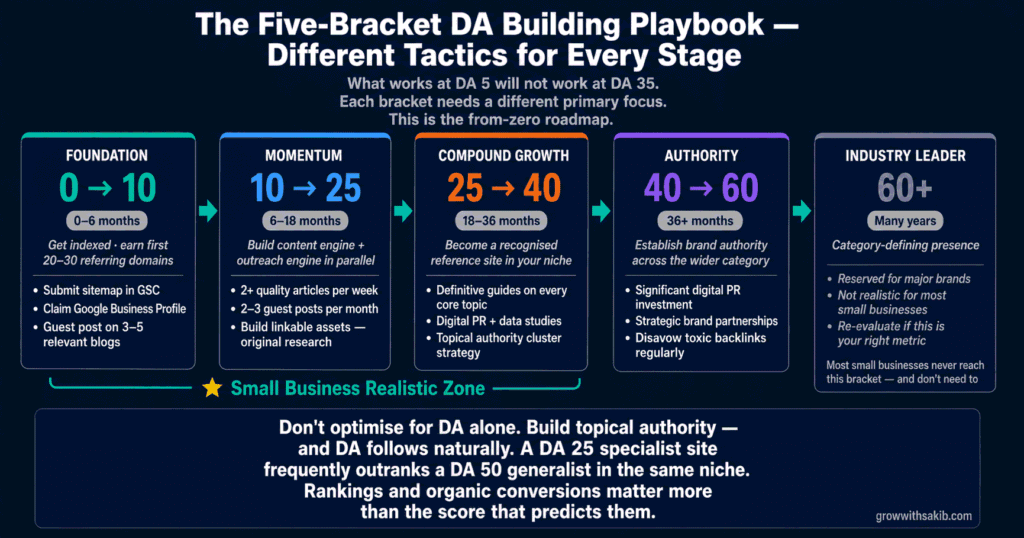
The Five-Bracket From-Zero Playbook
Different DA stages need different tactics. What works at DA 5 won’t work at DA 35, and vice versa. Here’s the staged playbook.
Typical timeline from launch: 0–6 months
Goal: Get indexed, earn first 20–30 referring domains
Tactics:
- Verify and submit your sitemap in Google Search Console
- Build out a complete on-page SEO foundation (titles, metas, headings, internal links)
- Publish 12–20 cornerstone articles targeting long-tail keywords
- Claim and optimise your Google Business Profile (if local)
- Get listed in 10–15 high-quality industry directories
- Submit guest post pitches to 3–5 relevant blogs in your niche
- Earn brand mentions through founder LinkedIn presence + community participation
Typical timeline: 6–18 months
Goal: Build content engine + outreach engine running in parallel
Tactics:
- Consistent content publishing — 2+ quality articles per week
- Active guest posting on 2–3 relevant sites per month — using the outreach templates in the link building guide to maintain response rates
- Build linkable assets: original research, comprehensive guides, free tools — the E-E-A-T guide covers how to make your content authoritative enough to attract natural links.
- Pitch journalist requests via Featured.com, Help A Reporter (HARO replacements) for news mentions
- Run a digital PR campaign or two — original data stories earn the most links
- Update and republish older content to attract refresh-driven backlinks
Typical timeline: 18–36 months
Goal: Become a recognised reference site in your niche
Tactics:
- Publish definitive guides on every core topic in your niche — following the keyword research process to ensure each guide targets achievable terms at your current authority level.
- Build topical authority through content hubs and cluster strategy
- Earn editorial mentions in industry publications
- Run podcast appearances, conference speaking, and webinar collaborations
- Audit and disavow toxic backlinks where appropriate
- Maintain content freshness across the entire archive
Typical timeline: 36+ months
Goal: Establish brand authority across the wider category
Tactics:
- Significant digital PR investment with original research
- Strategic partnerships with adjacent brands
- Build community/membership platforms that drive natural mentions
- Expand into adjacent topical territories
- Maintain strict quality control — at this stage, low-quality backlinks can drag DA backward
Reality check: Most small businesses never reach this bracket — and don’t need to. DA 60+ is the territory of category-defining publications, major SaaS brands, and established media. If you’re operating a small business and aiming above DA 60, re-evaluate whether DA is your right success metric.
Domain Authority vs Topical Authority: The Difference That Matters
Domain authority measures the strength of your entire website across all topics. Topical authority measures your strength within a specific subject area. For small businesses, topical authority usually matters more.
A site with DA 25 that is deeply focused on a single niche can outrank sites with DA 60 that cover broader, less-focused territories. Google increasingly rewards depth over breadth. A specialist plumbing site that has published 200 articles on plumbing will frequently outrank a general home-improvement site with 10 plumbing articles, even if the general site has higher DA.
Practical implication: don’t optimise for DA alone. Build topical authority — covered in depth in the topical authority guide on GrowWithSakib — and DA tends to follow naturally.
Common Domain Authority Myths (Debunked)
| Myth | Reality |
| “DA is a Google ranking factor” | Google does not use Moz DA. It’s a third-party metric that correlates with ranking ability but doesn’t cause rankings |
| “You need DA 50 to compete” | Not true. Many DA 15–25 sites rank top-3 for high-value keywords by winning on topical depth and intent match |
| “Buying high-DA backlinks lifts DA quickly” | Bought links risk Google penalties and Moz Spam Score elevation. Short-term DA bump, long-term ranking damage |
| “DA never goes down” | DA can drop when Moz updates its model, competitors gain links, or your site loses authority signals. Monthly fluctuations of ±2 points are normal |
| “All DA 50 sites are equal” | DA doesn’t account for topical fit. A DA 50 finance blog linking to your gardening site is worth less than a DA 25 gardening blog |
| “DA increases automatically with age” | Age alone doesn’t increase DA. Old sites with no active link acquisition often see DA decline as competitors grow |
How AI Search Engines Treat Domain Authority
AI search engines — Google AI Overviews, ChatGPT Search, Perplexity, Gemini — use their own internal authority signals that don’t map cleanly to Moz DA. According to Google’s documentation on creating helpful content, AI engines cite sources based on E-E-A-T signals — experience, expertise, authoritativeness, and trustworthiness — which include but extend beyond backlink-based authority.
Three practical observations for 2026:
- AI engines tend to cite high-DA domains more often, but topical authority and clear expertise signals matter equally
- Author bylines, named credentials, and original research drive AI citation probability — DA doesn’t directly
- Sites with high topical depth (many pages on the same subject) get AI-cited more often than higher-DA generalist sites
Common Domain Authority Mistakes (and What to Do Instead)
1. Obsessing over DA instead of rankings
- Mistake: Obsessing over DA instead of rankings
- Why It Causes Problems: DA is a benchmark; rankings are the outcome
- What to Do Instead: Track organic clicks, conversions, and keyword rankings as primary — the SEO results tracking guide shows exactly how to set up this measurement framework.
2. Buying backlinks for DA growth
- Mistake: Buying backlinks for DA growth
- Why It Causes Problems: Risks Google penalty and Moz Spam Score elevation
- What to Do Instead: Earn links through original research, digital PR, guest posting
3. Targeting irrelevant high-DA sites
- Mistake: Targeting irrelevant high-DA sites
- Why It Causes Problems: DA 50 links from off-topic sites are weaker signals
- What to Do Instead: Prioritise topical relevance over raw DA
4. Comparing your DA to category-leader sites
- Mistake: Comparing your DA to category-leader sites
- Why It Causes Problems: Demoralising and pointless — they have years of head start
- What to Do Instead: Compare to sites of similar age and niche; track YoY trend, not absolute
5. Ignoring Moz Spam Score on linking sites
- Mistake: Ignoring Moz Spam Score on linking sites
- Why It Causes Problems: Spam Score elevation can hurt your DA
- What to Do Instead: Use Moz Spam Score to qualify link prospects before outreach
6. Treating DA fluctuations as algorithm penalties
- Mistake: Treating DA fluctuations as algorithm penalties
- Why It Causes Problems: DA fluctuates with model updates and competitor activity
- What to Do Instead: Monthly ±2 point variations are normal; focus on 6-month trend
Honest Limitations of Domain Authority
Every metric has caveats. These are DA’s honest ones:
- Not a Google ranking factor — DA correlates with rankings but doesn’t cause them. Google uses its own undisclosed authority signals.
- Relative, not absolute — your DA only means something compared to similar competitors. Cross-niche DA comparisons are misleading.
- Lagging indicator — DA updates monthly and reflects backlink crawl data with some delay. Your real ranking performance moves faster.
- Subject to Moz model updates — Moz adjusts the algorithm periodically. Score movements may not reflect actual link profile changes.
- Topical fit matters more — a DA 25 page in your niche often outranks a DA 50 generalist page. Don’t worship the number.
- Manipulable by black-hat tactics — bought links, PBNs, and exchange schemes can temporarily inflate DA but invite Google penalties.
For the complementary work that builds real authority alongside DA, see the link building strategy guide, the topical authority guide, and the on-page SEO checklist. For monitoring authority through Google’s own tools, see the how to use Google Search Console guide.
Frequently Asked Questions
1. What is a good domain authority score?
There’s no universal good DA. It’s relative to your niche and business stage. For most small business sites, DA 20–30 is solid within 12–18 months of consistent SEO work. The most useful benchmark is your DA versus the average of the top 10 ranking pages for your target keywords. If they’re at DA 35 and you’re at DA 10, you have authority gap to close.
2. Is domain authority a Google ranking factor?
No. Google does not use Moz’s Domain Authority — or Ahrefs’ Domain Rating, or Semrush’s Authority Score — as a ranking factor. Google representatives, including John Mueller, have confirmed this multiple times. DA is a third-party metric that correlates with ranking ability because it measures similar underlying signals (link equity, backlink quality), but it doesn’t cause rankings.
3. How long does it take to build domain authority?
Most small business sites go from DA 1 to DA 10 within 3–6 months of foundational SEO work. DA 10 to DA 20 typically takes another 6–12 months. Reaching DA 30+ usually takes 18–24 months of consistent content and link building. Higher brackets take exponentially longer — DA is logarithmic, so each subsequent point costs more effort than the last.
4. What’s the difference between DA, DR, and Authority Score?
All three predict ranking ability on a 1–100 scale, but they’re calculated differently. Moz DA uses a machine learning model on backlink data and spam signals. Ahrefs DR measures backlink profile strength only. Semrush AS combines backlinks, organic traffic, and spam signals. The three correlate strongly (ρ ≈ 0.9), so pick one and stick with it for consistency.
5. How can I check my domain authority for free?
Use Moz Link Explorer (10 free queries/month), the Ahrefs Website Authority Checker, or Semrush domain analytics with a free account. The MozBar browser extension also shows DA on any page you visit. For ongoing tracking, paid plans add competitor benchmarking and historical data.
6. Can I increase my domain authority quickly?
Not really — and the sites that try (through bought links, PBNs, or link exchange schemes) usually trigger Google penalties that hurt rankings even if DA temporarily rises. Sustainable DA growth comes from publishing valuable content, earning natural backlinks through digital PR and guest posting, and building topical authority. Expect 3–6 months for visible DA movement from genuine effort.
7. Why is my domain authority going down?
DA can drop for several reasons: Moz updating its model (causes industry-wide score adjustments), competitor sites gaining authority faster than yours, you losing backlinks from deindexed or shut-down sites, or your site picking up high-Spam-Score backlinks. Monthly ±2 point fluctuations are normal. A sustained decline over 3–6 months suggests genuine authority loss worth investigating.
8. Does domain authority matter for AI search like ChatGPT and Perplexity?
Indirectly. AI engines tend to cite sources from higher-DA domains because they’ve been trained on web data where high-DA sites appear more often. However, AI citation also depends heavily on E-E-A-T signals — author credentials, original research, topical depth, and clear expertise — which Moz DA doesn’t directly measure. A high-topical-authority site with moderate DA often gets cited more than a high-DA generalist site.
Key Takeaways
- Domain authority is a third-party SEO metric (Moz DA, Ahrefs DR, Semrush AS) that predicts ranking ability on a 1–100 logarithmic scale. None of them are official Google ranking factors.
- The three competing metrics correlate strongly (ρ ≈ 0.9) — pick one and track it consistently. Don’t switch metrics mid-strategy.
- DA is logarithmic. Moving from DA 10 to DA 20 takes far less effort than moving from DA 70 to DA 80. Don’t compare your trajectory to category leaders.
- Realistic small business targets: DA 1–10 in months 0–6, DA 10–20 in months 6–12, DA 20–35 in months 12–24. Above DA 50 is rare for non-major-brand sites.
- Topical authority often matters more than DA for small businesses. A DA 25 specialist site frequently outranks a DA 50 generalist in the same niche.
- Use the Five-Bracket From-Zero Playbook: foundation (0–10), momentum (10–25), compound growth (25–40), authority (40–60), industry leader (60+) — each bracket needs different tactics.
- Avoid DA-boosting black-hat tactics. Bought links and exchange schemes inflate DA temporarily but invite Google penalties that damage rankings long-term.
- Don’t obsess over DA. Track organic clicks, keyword rankings, and conversions as primary metrics. DA is a useful secondary trend indicator, not the goal.