Every article on SEO vs paid ads tells you the same thing: ‘It depends on your goals.’ ‘Use both.’ ‘They work together.’ All technically true, all completely useless when you have a $2,000 monthly budget and three weeks until you need leads.
This guide gives you a real answer. Not a hedge. You’ll work through a 5-question decision framework, get one of three concrete recommendations, and walk away with a first-$1,000 playbook you can run this week. Plus the honest scenarios where each channel is the wrong call.
If you want the broader strategic context first, the complete small business SEO guide on GrowWithSakib covers how organic search fits into your overall marketing system.
What Is SEO and What Are Paid Ads? Quick Definitions
1. SEO (Search Engine Optimisation)
- Channel: SEO (Search Engine Optimisation)
- Definition: Optimising your website to rank in unpaid (organic) search results on Google
- How You Pay: Time and content investment — no per-click fee
- When Traffic Stops: Traffic continues for months/years after work stops
2. Paid Ads (PPC)
- Channel: Paid Ads (PPC)
- Definition: Paying platforms (Google Ads, Meta Ads) to display your ads in search results or social feeds
- How You Pay: Per click, per impression, or per conversion
- When Traffic Stops: Traffic stops the moment you pause spend
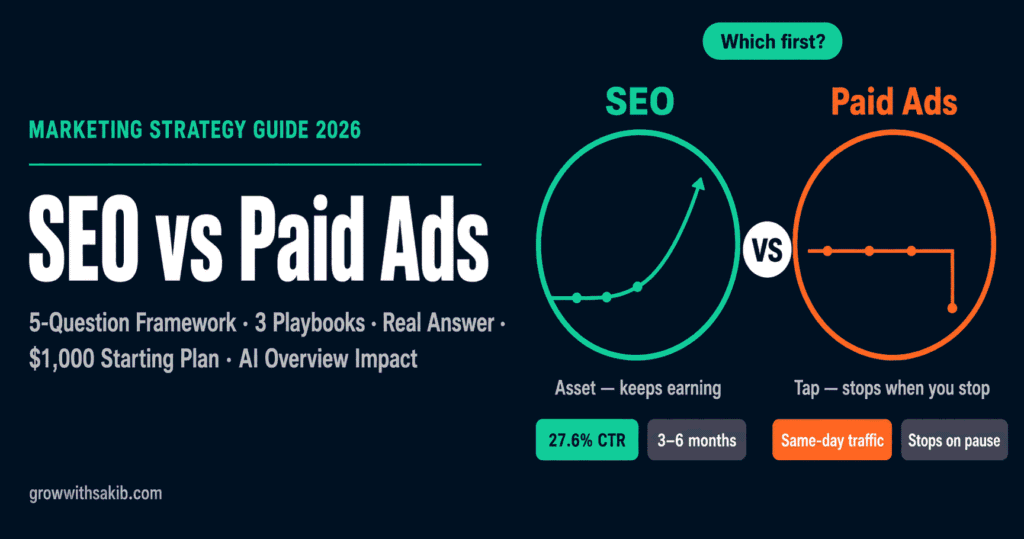
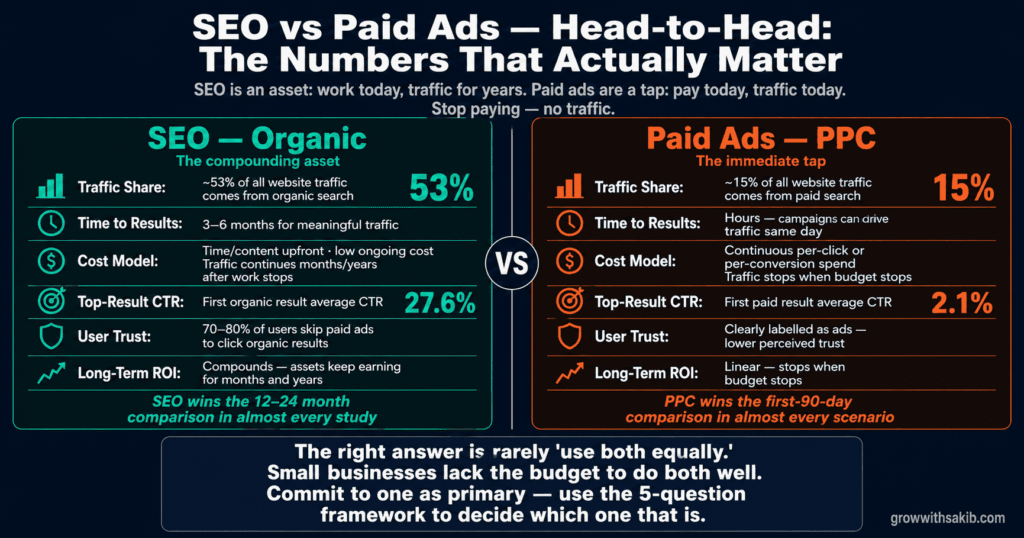
Both channels target the same end goal — qualified visitors who convert into customers — but they take fundamentally different paths to get there. SEO is an asset: work today, traffic for years. Paid ads are a tap: pay today, traffic today. Stop paying, no traffic.
Head-to-Head Comparison: SEO vs Paid Ads
1. Time to first results
- Factor: Time to first results
- SEO (Organic): 3–6 months for meaningful traffic
- Paid Ads (PPC): Hours — campaigns can drive traffic same day
2. Cost model
- Factor: Cost model
- SEO (Organic): Time/content upfront, low ongoing cost
- Paid Ads (PPC): Continuous per-click or per-conversion spend
3. Long-term ROI
- Factor: Long-term ROI
- SEO (Organic): Compounds — assets keep earning
- Paid Ads (PPC): Linear — stops when budget stops
4. Traffic share
- Factor: Traffic share
- SEO (Organic): Around 53% of all website traffic comes from organic search
- Paid Ads (PPC): Around 15% of all website traffic comes from paid search
5. User trust
- Factor: User trust
- SEO (Organic): 70–80% of users skip paid ads to click organic results
- Paid Ads (PPC): Lower trust — clearly labelled as ads
6. Top-result CTR
- Factor: Top-result CTR
- SEO (Organic): First organic result averages roughly 27.6% CTR
- Paid Ads (PPC): First paid result averages roughly 2.1% CTR
7. Control / speed of change
- Factor: Control / speed of change
- SEO (Organic): Slow — changes take weeks to reflect
- Paid Ads (PPC): Fast — pause, scale, or pivot within hours
8. Audience targeting precision
- Factor: Audience targeting precision
- SEO (Organic): Keyword and intent-based only
- Paid Ads (PPC): Demographic, geographic, behavioural, retargeting
9. Best for
- Factor: Best for
- SEO (Organic): Long-term brand building, content depth, compounding asset
- Paid Ads (PPC): Quick validation, launches, seasonal pushes, competitive head terms
The traffic share and trust figures come from BrightEdge’s research on organic search traffic and Backlinko’s analysis of Google CTR data. These numbers have remained directionally consistent for years.
The First-90-Days Decision Framework
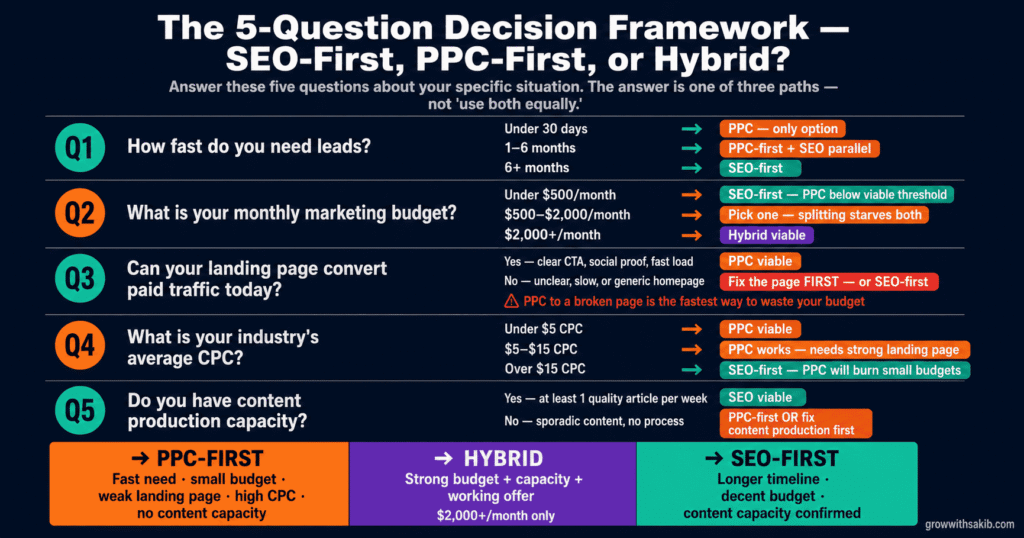
Forget the abstract pros and cons. Answer five questions about your specific situation and you’ll get a definitive starting recommendation.
Question 1: How fast do you need leads?
- Less than 30 days → PPC. SEO cannot deliver this fast.
- 1–6 months → PPC-first with SEO running in parallel.
- 6+ months → SEO-first.
Question 2: What is your total monthly marketing budget?
- Under $500/month → SEO-first. PPC budgets below $500 are usually below the threshold for meaningful data.
- $500–$2,000/month → Pick one channel. Splitting both ways usually starves both.
- $2,000+/month → Hybrid is viable.
Question 3: Can your landing page convert paid traffic today?
This is the question almost every competitor article skips. Before sending paid traffic anywhere, your landing page needs:
- A clear value proposition above the fold
- One primary call-to-action (not five competing CTAs)
- Social proof (reviews, testimonials, case studies, logos)
- A working contact form or checkout flow
- Mobile-optimised design and fast load time (under 3 seconds)
If the answer is no → SEO-first OR fix the landing page before spending a dollar on PPC. PPC traffic to a broken page is the fastest way to waste your budget.
Question 4: What is your industry’s average cost per click?
Google Ads CPCs vary wildly by industry. Legal, insurance, and finance can hit $50–$100+ per click. Local services often sit at $2–$10. According to Google’s official Google Ads documentation, you can check estimated CPCs for any keyword in Keyword Planner before launching.
- Under $5 CPC → PPC is viable on small budgets
- $5–$15 CPC → PPC works but only with strong landing pages and clear targeting
- Over $15 CPC → SEO-first. PPC will burn through small budgets faster than you can iterate
Question 5: Do you have content production capacity?
- Yes — at least one quality article per week → SEO viable
- No — sporadic content, no consistent process → PPC-first OR fix content production before committing to SEO
The First-$1,000 Playbook for Each Path
Playbook 1 — SEO-First ($1,000 over 90 days)
| Allocation / What to Spend On |
| $0 / Set up Google Search Console and Google Analytics 4 — both free |
| $0 – $50 / Sign up for free SEO tools (Google Keyword Planner, Ahrefs Webmaster Tools, Ubersuggest free tier) |
| $200 – $400 / Content production — 6–10 articles targeting low-competition long-tail keywords |
| $300 – $500 / Technical SEO audit and fix list (Core Web Vitals, indexing, site speed, on-page) |
| $100 – $200 / Initial link-building outreach to 20–30 relevant sites |
By month 3, expect first impressions in GSC, some long-tail rankings, and the foundation for compound growth. For the timeline expectations, see the how long does SEO take guide on GrowWithSakib.
Playbook 2 — PPC-First ($1,000 over 90 days)
| Allocation / What to Spend On |
| $50–$150 / Landing page fix (single CTA, social proof, fast load, mobile-friendly) — DIY or freelancer |
| $600–$800 / Google Ads spend — focused on 3–5 high-intent transactional keywords with clear commercial intent |
| $0 / Set up Google Ads conversion tracking and link to GA4 — free |
| $50–$100 / A/B test 2–3 ad variants to find the winning headline + CTA combination |
| $100–$150 / Re-allocate to scale winning campaigns in weeks 8–12 |
Start with exact match and phrase match keywords for high-intent transactional queries — never broad match on a small budget. For Meta Ads specifically, see the complete Meta Ads guide for the campaign structure that makes small budgets work. The official Google Ads Help Center provides setup walkthroughs.
Playbook 3 — Hybrid ($1,000 over 90 days)
This works only if your monthly marketing budget is $2,000+. Below that, the hybrid path usually starves both channels.
| Allocation / What to Spend On |
| $500 / PPC on 2–3 high-intent transactional keywords for immediate revenue |
| $300 / Content production — 4–6 articles targeting informational long-tail keywords (top-of-funnel) |
| $100 / Technical SEO fixes (audit + core fixes) |
| $100 / Retargeting ads to organic visitors who haven’t converted |
Use PPC for transactional searches (where intent is high and conversion is fast). Use SEO for informational and commercial searches (where the audience is researching). Retarget the SEO traffic with cheap paid ads.
When SEO Is the Wrong Choice
Most articles never tell you this. Here are five scenarios where SEO will fail you — and PPC is the better starting point.
- You need leads in under 30 days. SEO cannot deliver this. PPC can.
- Your industry has ‘one-off’ search behaviour. Emergency plumbing, locksmiths, urgent legal — buyers search once, buy fast, never return. For these businesses, Meta Ads for local business often delivers the fastest and most targeted immediate reach. PPC captures this; SEO investment doesn’t compound the way it does for repeat industries.
- You have no content production capacity or appetite. SEO without content is like a restaurant without food. If you cannot consistently publish, do not commit to SEO yet.
- You’re testing a new product or market. PPC validates faster. Spend $500 on ads to see whether anyone buys before committing 6 months to ranking content for the same offer.
- Your competitive landscape is hyper-aggressive. If your competitors include Wikipedia, Amazon, Forbes, or sites with 10+ years of authority, SEO will take 18+ months to break in. PPC bypasses authority entirely.
When Paid Ads Are the Wrong Choice
And here are five scenarios where PPC will burn money.
- Your landing page does not convert organic traffic today. Paid traffic will not magically convert better than organic. Fix the page first.
- Your average customer value is below $50. In most industries, CPC and conversion economics don’t work below this threshold for small businesses.
- Your monthly budget is under $500. PPC under $500/month produces too little data to optimise meaningfully. Most of the budget goes to learning, not winning.
- You sell something that requires 5+ touchpoints before purchase. PPC is one-touch attribution; consideration purchases work better with content/SEO that builds trust over weeks.
- Your industry CPC is above $20–$30. Legal, insurance, finance, and high-end B2B SaaS often have CPCs that small business budgets cannot sustain. SEO is the alternative.
How AI Overviews Are Changing the SEO vs PPC Decision in 2026
Most articles still treat the SEO vs PPC question as if AI search doesn’t exist. It does. AI Overviews, ChatGPT Search, Perplexity, and Gemini are now reshaping how clicks distribute. According to Google’s documentation on AI Overviews, these summaries can appear on a substantial portion of queries — and they cite source content directly.
Two things this changes:
- 1. Zero-click search is rising. Industry data widely cited in 2025–2026 puts zero-click searches at roughly 60% of all Google searches. This compresses both SEO and PPC click volume — but PPC is more vulnerable because ads still need a click to charge you.
- 2. Citation in AI Overviews is the new top of funnel. Pages that get cited in AI summaries gain brand exposure even when the user doesn’t click. SEO content optimised for AI citation (structured, extractable, with named entities) gains visibility that PPC simply cannot replicate.
Practical implication: in 2026, the SEO investment case is stronger than ever for top-of-funnel and consideration content, and the PPC investment case is strongest for bottom-of-funnel transactional queries where users are still clicking through to buy.
How to Integrate SEO and Paid Ads (4-Phase Hybrid Playbook)
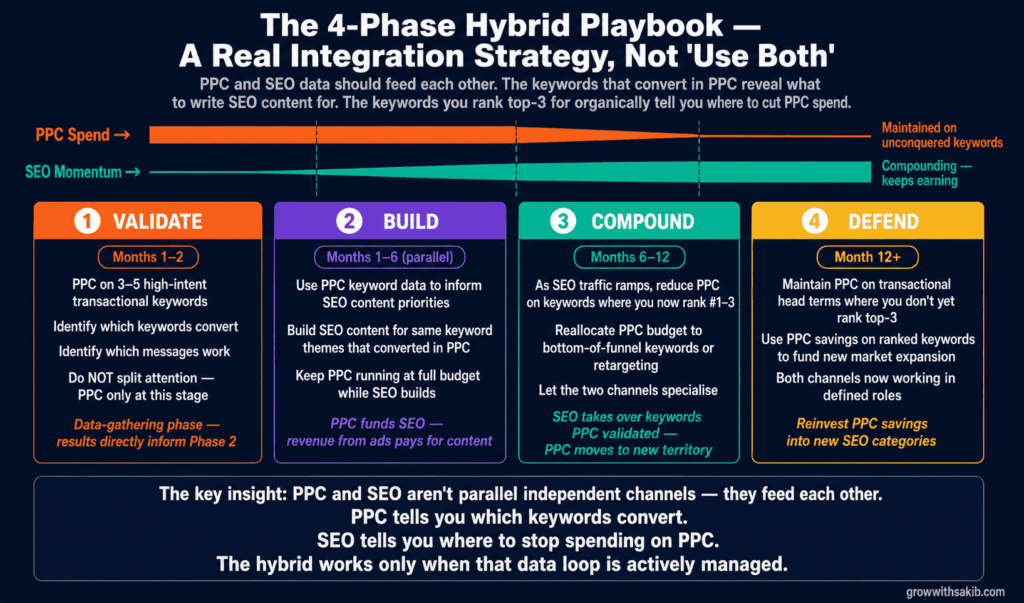
If you’ve committed to hybrid, here’s how to actually run it — not ‘use both’ but a real 4-phase sequence.
1. Phase 1 — Validate
- Timing: Months 1–2
- What to Do: PPC on 3–5 high-intent transactional keywords. Use the results to identify which keywords convert and which messages work.
2. Phase 2 — Build
- Timing: Months 1–6 (parallel)
- What to Do: Use the PPC keyword data to inform SEO content priorities. Build SEO content for the same keyword themes that converted in PPC — the keyword research guide covers how to evaluate difficulty and search volume for each of these themes before committing to content.
3. Phase 3 — Compound
- Timing: Months 6–12
- What to Do: As SEO traffic ramps, gradually reduce PPC spend on keywords where you now rank #1–3 organically — tracking SEO results monthly in Search Console confirms when this threshold is reached. Reallocate that PPC budget to either bottom-of-funnel keywords or retargeting.
4. Phase 4 — Defend
- Timing: Month 12+
- What to Do: Maintain PPC on transactional head terms where you don’t yet rank top-3 organically. Use the cost savings on organic-ranked keywords to fund new market or category expansion.
The key insight: PPC and SEO data should feed each other. The keywords that convert in PPC reveal what to write SEO content for. The keywords you rank #1–3 for organically tell you where to cut PPC spend.
Common SEO vs Paid Ads Mistakes (and What to Do Instead)
1. Splitting a $500 budget 50/50
- Mistake: Splitting a $500 budget 50/50
- Why It Fails: Both channels get starved; neither produces useful data
- What to Do Instead: Pick one channel until you cross $2,000/month
2. Running PPC to a generic homepage
- Mistake: Running PPC to a generic homepage
- Why It Fails: No clear CTA, no focused message, traffic doesn’t convert
- What to Do Instead: Build a dedicated landing page with one primary CTA
3. Stopping PPC the day SEO starts working
- Mistake: Stopping PPC the day SEO starts working
- Why It Fails: Loses high-intent transactional traffic that PPC handles best
- What to Do Instead: Reduce PPC on ranked keywords only; keep PPC on transactional queries where you don’t rank top-3
4. Comparing channels on first-click conversion only
- Mistake: Comparing channels on first-click conversion only
- Why It Fails: PPC wins on attribution; SEO wins on long-term value
- What to Do Instead: Measure customer lifetime value, not first-click — SEO leads often retain 2–3x longer
5. Treating ‘use both’ as a strategy
- Mistake: Treating ‘use both’ as a strategy
- Why It Fails: Vague; produces unfocused spend across both
- What to Do Instead: Commit to one channel as your primary; the other as secondary
6. Optimising PPC for clicks instead of conversions
- Mistake: Optimising PPC for clicks instead of conversions
- Why It Fails: Cheap clicks don’t pay back if they don’t convert
- What to Do Instead: Set conversion tracking from Day 1; optimise for CPA, not CPC
Honest Limitations of This Framework
Every decision framework has caveats. These are the honest ones:
- Industry variation is huge — local services, e-commerce, B2B SaaS, and informational sites all have very different SEO and PPC economics
- Stats are directional, not predictive — the 53% organic traffic share is an average; your specific market might differ wildly
- Channel mix evolves — what’s right at $2,000/month is not right at $20,000/month — re-evaluate quarterly
- Attribution is hard — most customers touch multiple channels before converting; first-click and last-click both undercount the truth
- AI search is still evolving — best practices for both SEO and PPC in an AI-Overview-dominated world are likely to shift through 2026
For the deeper foundations underneath this decision, see the on-page SEO checklist (for the SEO execution side), the guide on tracking SEO results (for measuring channel performance), and the search intent guide (for understanding why some keywords are better matched to SEO vs PPC).
Frequently Asked Questions
1. Is SEO better than paid ads for small business?
It depends on your timeline and budget. SEO compounds over time and produces a long-term asset, but takes 3–6 months for meaningful results. Paid ads work immediately but stop the moment you stop spending. For small businesses with under 6 months of cash runway, start with paid ads. For businesses with 12+ months of runway, content capacity, and a working offer, start with SEO.
2. Can I do SEO and paid ads at the same time?
Yes — but only if your monthly marketing budget is $2,000 or higher. Below that, splitting spend across both channels usually starves both. Above that threshold, the hybrid approach is highly effective: use PPC for high-intent transactional keywords and SEO for informational and comparison content. PPC data also reveals which keywords convert, informing your SEO content priorities.
3. Which has better ROI — SEO or paid ads?
SEO typically has higher long-term ROI because the traffic compounds. Once a page ranks, it continues earning for months or years without ongoing per-click cost. Paid ads have predictable short-term ROI but stop the moment you pause spend. Most marketers consider SEO the higher-ROI channel over a 12–24 month period — but PPC wins in the first 90 days because SEO hasn’t ramped up yet.
4. How much should a small business spend on Google Ads?
Most small business Google Ads campaigns need a minimum of $500–$1,000/month to produce meaningful data and reach the optimisation threshold. Below $500, too much budget goes to learning and not enough to winning campaigns. According to the Google Ads Help Center, actual costs vary widely by industry — legal and insurance keywords often have CPCs above $50, while local services often sit at $2–$10 per click.
5. How long before SEO starts paying off?
Most small business SEO investments produce first signals (impressions, long-tail rankings) within 30–60 days and meaningful traffic by months 3–6. Significant compounding growth typically appears between months 6 and 12. Competitive head terms can take 12–24 months. For the full timeline expectations, see the how long does SEO take guide on GrowWithSakib.
6. Do paid ads help SEO rankings?
Not directly. Google has explicitly stated that paid ad spend is not a ranking factor in organic search. However, paid ads can help indirectly — by driving brand search volume, increasing returning visitor signals, generating data on which keywords convert (which informs SEO content), and supporting brand entity growth which can boost AI Overview citations.
7. Why do users trust organic results more than paid ads?
Industry data consistently shows that 70–80% of users skip paid ads to click organic results. This is because users perceive organic rankings as earned (Google’s algorithm signalled the page is relevant) while paid ads are clearly labelled and seen as promotional. The trust gap shows up directly in CTR: the top organic result averages around 27.6% CTR per Backlinko’s analysis of Google CTR data, versus around 2.1% for the first paid result.
8. Should I stop paid ads once my SEO is working?
Reduce — don’t stop. Once you rank in the top 3 organically for a keyword, you can usually cut PPC on that specific keyword and reallocate that budget. But keep PPC running on transactional head terms where you don’t yet rank top-3, plus retargeting campaigns to organic visitors who didn’t convert. Most successful small businesses keep some paid ad presence even with strong SEO.
Key Takeaways
- The right answer is rarely ‘use both equally from day one’ — small businesses lack the budget and bandwidth. Commit to one channel as primary.
- Use the 5-question Decision Framework: timeline, budget, landing page readiness, industry CPC, and content capacity. The answer is one of three: SEO-first, PPC-first, or Hybrid.
- Below $500/month, pick one channel. Below $2,000/month, hybrid usually starves both.
- Never send paid traffic to a landing page that can’t already convert organic visitors. Fix the page first.
- SEO takes 3–6 months for meaningful results but compounds for years. PPC delivers immediately but stops the moment spend stops.
- SEO is the wrong choice when you need leads in under 30 days, have no content capacity, or are testing an unvalidated offer.
- PPC is the wrong choice when your customer value is under $50, your industry CPC is over $20, or your monthly budget is below $500.
- AI Overviews and zero-click search have strengthened SEO’s case for top-of-funnel content and PPC’s case for bottom-of-funnel transactional queries.