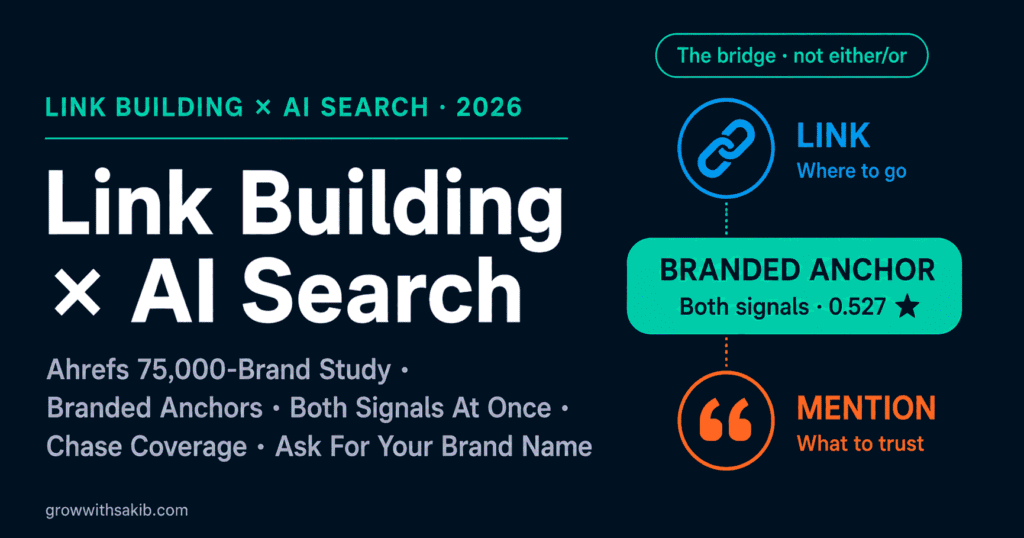
For twenty years, off-page SEO meant one thing: get more links. Then AI search arrived, and a single dataset scrambled the hierarchy. If you’ve seen the headline – “brand mentions beat backlinks 3-to-1” – you’ve probably also seen the conclusion people are drawing from it: stop building links.
That conclusion is wrong, and the people who published the data say so. Here’s what it actually shows, and what a link builder should do about it. This is the AI-search bridge for the link building guide for beginners on GrowWithSakib, and the off-page half of the generative engine optimisation guide on GrowWithSakib.
The Data: What Ahrefs Found
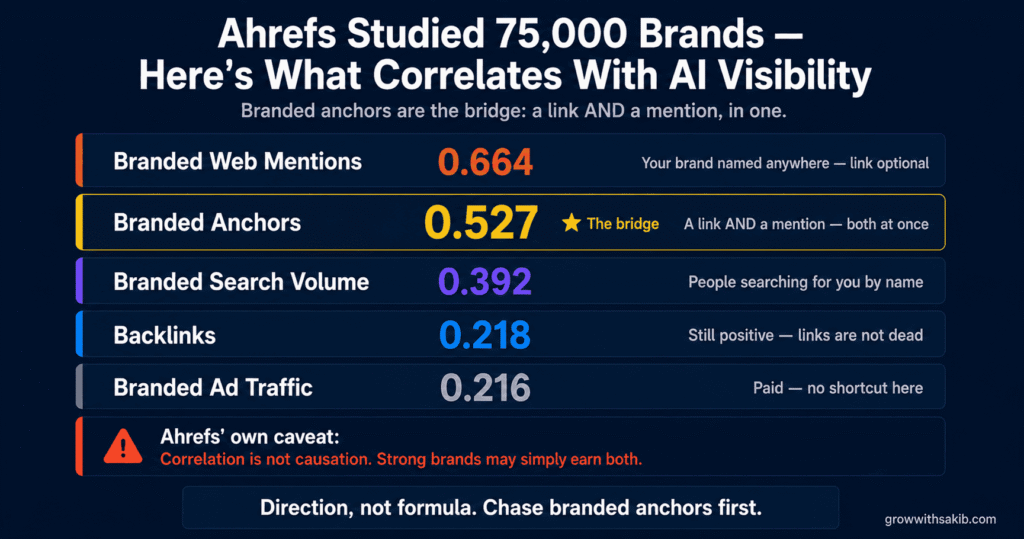
Ahrefs analysed 75,000 brands to see which signals predict whether a brand gets mentioned in Google’s AI Overviews. These are Spearman correlations:
| Signal | Correlation With AI Overview Visibility | What It Is |
|---|---|---|
| Branded web mentions | 0.664 | Your brand named anywhere – with or without a link |
| Branded anchors | 0.527 | A link whose anchor text is your brand name |
| Branded search volume | 0.392 | People searching for you by name |
| Backlinks | 0.218 | Total links pointing at your site |
| Branded ad traffic | 0.216 | Paid – weak, and no shortcut here |
Two things leap out. First, the top three signals are all off-site brand signals, not link metrics. Second, brands with the most web mentions earn up to ten times more AI Overview mentions than the next quartile down – and brands in the bottom half of web mentions are, in Ahrefs’ framing, essentially invisible to AI systems.
Ahrefs’ December 2025 follow-up extended the analysis to ChatGPT and Google AI Mode and found the same rank order everywhere. Branded mentions scored 0.709 in AI Mode, 0.664 in AI Overviews and 0.656 in ChatGPT. Branded anchors reached 0.628 in AI Mode – crossing into genuinely strong correlation territory.
Now the Honest Part: What This Does NOT Prove
No, Backlinks Are Not Dead
The “stop chasing backlinks” takes get one thing badly wrong: 0.218 is a positive correlation. Links didn’t score zero. They scored lower than brand signals – which is a very different claim.
- Links still drive discovery – crawlers follow links. A page nothing links to is a page that is harder to find, index, and therefore cite.
- Links still drive classic rankings – and classic rankings still feed AI answers, which draw on the pages that rank. Ranking well remains a route into the citation set.
- Google says links still matter – just less than people think. As covered in the beginner’s guide to backlinks on GrowWithSakib, Gary Illyes has said links aren’t a top-three ranking factor and haven’t been “for some time” – but he also said they remain important.
- The claim is about the margin – the honest reading is that the next unit of off-page effort buys more AI visibility if it earns a mention than if it earns a bare link. That’s a budgeting insight, not an obituary.
The Signal Nobody Is Talking About: Branded Anchors
This lands hard on a habit this cluster has warned about repeatedly. The classic link builder’s instinct is to push exact-match commercial anchor text – “best plumber in Dubai” rather than your brand name. We’ve already established that pattern is the clearest manipulation signal there is, as covered in the backlink audit on GrowWithSakib.
Now it loses twice. Exact-match anchors look manipulative to Google and forfeit the branded-anchor signal that correlates most strongly with AI visibility. The anchor that was always safest – your brand name – turns out to be the one that also buys AI presence. That’s a rare case where the honest play and the optimal play are the same play.
Which Link Building Strategies Produce Which Signals?
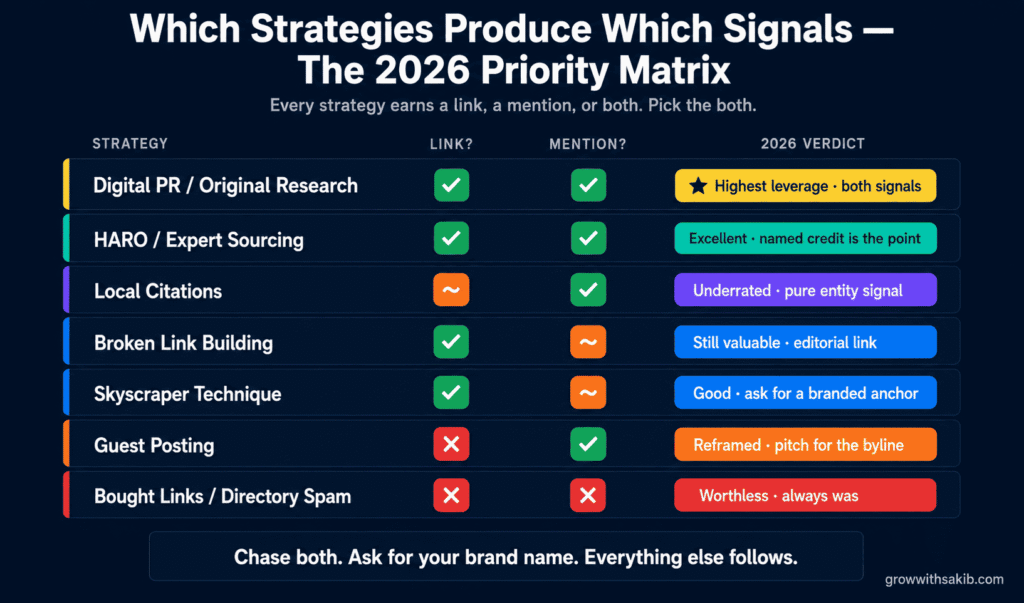
This is the practical payoff. Every strategy in this pillar produces links, mentions, or both – and now you can prioritise accordingly:
| Strategy | Earns a Link? | Earns a Brand Mention? | 2026 Verdict |
|---|---|---|---|
| Digital PR / original research | Yes | Yes – named in editorial coverage | Highest leverage. Produces both |
| HARO / expert sourcing | Usually | Yes – you’re named as the expert | Excellent. Named credit is the point |
| Local citations | Rarely (often nofollow) | Yes – your NAP, everywhere | Underrated. Pure entity signal |
| Broken link building | Yes | Sometimes | Still valuable – a genuine editorial link |
| Skyscraper technique | Yes | Sometimes (if branded anchor) | Good – ask for a branded anchor |
| Guest posting | Self-placed, devalued | Yes – your byline and bio | Reframed: pitch for the byline, not the link |
| Bought / directory spam | Low quality | No | Worthless for both. Always was |
| The Reframe That Changes Your Priorities Look at the guest posting row. Google’s John Mueller has said links you place in your own guest posts on GrowWithSakib should be nofollowed and are largely ignored – which made guest posting look like a poor investment. But a guest post gives you a byline: your name, your brand, published on a credible site. Under the AI-visibility data, that byline is the actual asset – it’s exactly the branded mention that correlates most strongly with citations. The link was never the prize. The advice was right all along (write for the audience, not the link); we just now have data explaining why. |
Rethinking Unlinked Mentions
Every SEO has been taught the same reflex: find unlinked brand mentions, email the site, convert them into links. The unspoken assumption was that a mention without a link is a wasted link.
The data says otherwise. An unlinked mention is the exact signal that correlated at 0.664. It is not a failed link – it is a standalone asset. Which changes the calculus in two ways:
- Still ask for the link – converting a mention gets you both signals, and it’s the warmest outreach that exists (they already chose to mention you). The template is in the outreach guide on GrowWithSakib.
- But stop treating a refusal as a loss – if they say no, you still have the mention, and the mention was carrying most of the AI-visibility value anyway. The old framing had you writing off your best asset as a failure.
A Combined Off-Page Strategy for 2026
None of this means abandoning link building. It means choosing the tactics that produce both signals, and asking for the brand name when you do. Concretely:
- Prioritise tactics that earn coverage, not just links: digital PR and original research on GrowWithSakib first, then expert sourcing. Both produce a link AND a named mention.
- When you earn a link, ask for a branded anchor. A link that says your brand name is worth more than double a generic one – and it’s an easier ask than a keyword anchor, because it feels natural to the editor.
- Stop chasing exact-match commercial anchors entirely. They now lose on both fronts.
- Treat unlinked mentions as wins. Convert them where you can; don’t mourn the ones you can’t.
- Keep the honest link building running: broken link building and genuine editorial links still drive discovery, indexing and rankings – and rankings still feed AI answers.
- Get your local citations consistent on GrowWithSakib if you’re a local business – they’re a pure entity signal, and AI systems draw on them for local queries.
The through-line: a backlink tells an AI system where to go; a brand mention tells it what to trust. You want both – and the good news for anyone who has read this pillar is that the tactics we’ve been recommending all along, for entirely different reasons, are the ones that produce them.
Common Mistakes in AI-Era Off-Page Strategy
| Mistake | Why It Hurts | Do This Instead |
|---|---|---|
| Concluding ‘links are dead’ | 0.218 is still positive; links drive discovery and rankings | Rebalance the margin, don’t abandon links |
| Treating correlation as causation | Ahrefs explicitly warn against this | Use it as a direction, not a formula |
| Still chasing exact-match anchors | Looks manipulative AND forfeits the branded-anchor signal | Ask for branded anchors |
| Ignoring unlinked mentions | They’re the strongest correlated signal you have | Count them as wins; convert where possible |
| Buying ‘AI visibility’ packages | Sold on a number its own authors hedged | Earn genuine coverage instead |
| Writing off guest posts entirely | The byline is a branded mention | Pitch for the byline and the audience |
| Building links nobody reads | A link from an unread site produces no mention | Chase coverage on sites with real audiences |
Frequently Asked Questions
1. Do backlinks still matter for AI search visibility?
Yes, but less than brand mentions. Ahrefs studied 75,000 brands and found backlinks correlate with AI Overview visibility at 0.218, while branded web mentions correlate at 0.664 – roughly three times stronger. Crucially, 0.218 is still a positive correlation, so links are not dead. They also drive crawling, discovery and classic rankings, and classic rankings still feed AI answers. The honest reading is about the margin: the next unit of off-page effort buys more AI visibility if it earns a mention rather than a bare link.
2. Are brand mentions better than backlinks?
For AI search visibility specifically, the correlation is about three times stronger: 0.664 for branded web mentions versus 0.218 for backlinks in Ahrefs’ 75,000-brand study, with the top three signals all being off-site brand signals. But Ahrefs themselves stress that correlation is not causation, and that all the measured correlations were moderate to weak. It’s equally possible that already-strong brands simply earn both. Treat it as a direction for where to spend effort, not a formula.
3. What is a branded anchor and why does it matter?
A branded anchor is a backlink whose anchor text is your brand name, rather than a keyword. It matters because it’s both signals at once – a link and a brand mention – and it correlated at 0.527 with AI Overview visibility, more than double the 0.218 for generic backlinks, rising to 0.628 in Google’s AI Mode. Ahrefs describe branded anchors as deliberate endorsements: someone chose to link to you by name. When you earn a link, ask for your brand name as the anchor.
4. Should I stop using exact-match anchor text?
Yes. Exact-match commercial anchors now lose twice. They’ve always been the clearest manipulation signal in a backlink profile – dozens of unrelated sites using an identical money keyword is a paid-link footprint, not a coincidence. And under the AI-visibility data they also forfeit the branded-anchor signal, which correlates more than twice as strongly as generic backlinks. Your brand name is simultaneously the safest anchor and the one that buys the most AI visibility.
5. Are unlinked brand mentions worth anything?
Considerably more than SEOs have traditionally assumed. The standard advice is to hunt unlinked mentions and convert them into links, treating an unlinked mention as a wasted link. But an unlinked mention is precisely the signal that correlated at 0.664 with AI visibility – it’s a standalone asset, not a failure. Still ask for the link, since converting gets you both signals and it’s the warmest outreach there is. But if they decline, you keep the thing that carried most of the value.
6. Is guest posting still worth doing for AI search?
Yes – but for the byline, not the link. Google’s John Mueller has said links you place in your own guest posts should be nofollowed and are largely ignored algorithmically, which made guest posting look like a poor investment. But a guest post gives you a byline: your name and brand published on a credible site, which is exactly the branded mention that correlates most strongly with AI citations. The old advice – write for the audience, not the link – now has data behind it.
7. Which link building strategies help AI visibility most?
The ones that produce a link and a named brand mention together. Digital PR and original research rank highest: journalists cite your data, name your brand, and link to you. Expert sourcing platforms like HARO are close behind, since being quoted by name is the entire point. Local citations are underrated – they’re a pure entity signal that AI systems draw on for local queries. Broken link building still earns genuine editorial links. Bought links and directory spam remain worthless for both.
8. Can I buy AI search visibility?
No, and be sceptical of anyone selling it. Ahrefs found that paid signals like branded ad traffic correlated only weakly (around 0.216) with AI Overview visibility – roughly the same as plain backlinks. More importantly, the headline correlation everyone is selling against is one its own authors have explicitly hedged with a correlation-is-not-causation warning. Genuine coverage on sites people actually read is the only reliable route, and it can’t be purchased in a package.
Key Takeaways
- Ahrefs studied 75,000 brands: branded web mentions correlate with AI Overview visibility at 0.664 versus 0.218 for backlinks – roughly three to one.
- The top three signals are all off-site brand signals: web mentions (0.664), branded anchors (0.527) and branded search volume (0.392).
- Ahrefs explicitly warn that correlation is not causation, and that all correlations were moderate to weak. Strong brands may simply earn both.
- Backlinks are NOT dead: 0.218 is still positive, and links drive discovery, indexing and classic rankings – which still feed AI answers.
- The bridge is branded anchors (0.527, rising to 0.628 in AI Mode): a link whose anchor text is your brand name – both signals at once.
- So exact-match commercial anchors now lose twice: they look manipulative to Google AND forfeit the branded-anchor signal.
- Unlinked mentions are not failed links – they’re the strongest correlated signal. Convert them where you can, but never write them off.
- Prioritise the tactics that produce both: digital PR and original research first, then expert sourcing – and always ask for the brand name.