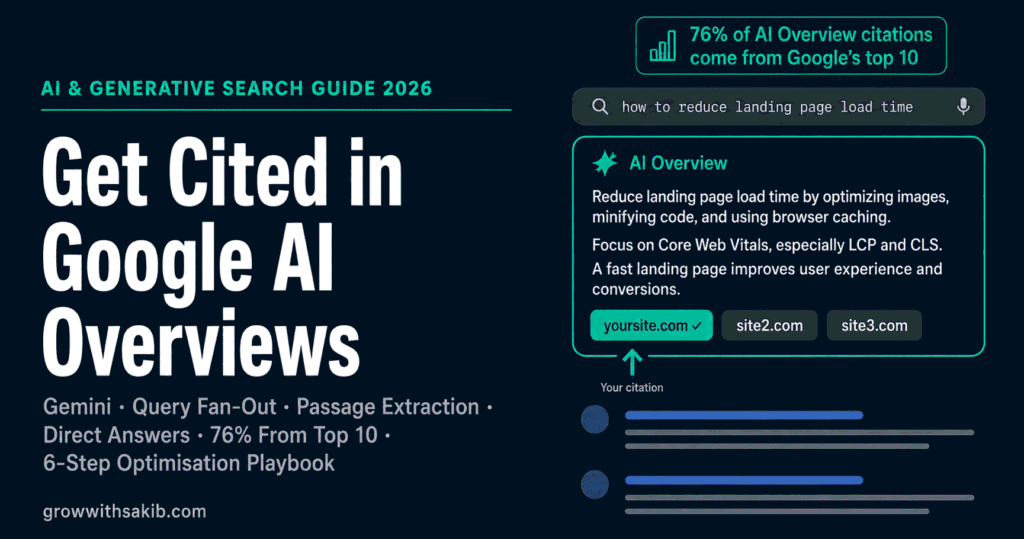
Google AI Overviews are the AI-written summaries at the top of many search results – and being cited inside one is fast becoming more valuable than ranking first. For most site owners, Google is the highest-volume AI platform, so this is where AI visibility efforts pay off most.
This guide cuts through the hype to show how to get cited in Google AI Overviews, starting from what Google actually says. It’s the platform-specific companion to the complete guide to generative engine optimization on GrowWithSakib. If GEO is new to you, start with what generative engine optimization is.
What Does Google Officially Say About Getting Cited?
Start here, because it demolishes a lot of noise. In its official AI features and your website documentation, Google states plainly: “There are no additional requirements to appear in AI Overviews or AI Mode, nor other special optimizations necessary.”
Google goes further and kills a popular myth directly: “You don’t need to create new machine readable files, AI text files, or markup to appear in these features. There’s also no special schema.org structured data that you need to add.” So anyone selling you “mandatory AI Overview schema” is contradicting Google’s own documentation.
That’s the liberating part: you’re not learning a brand-new discipline. You’re doing strong SEO, then making your answers easy for Gemini to lift. Everything below builds on that.
How Do Google AI Overviews Choose Sources?
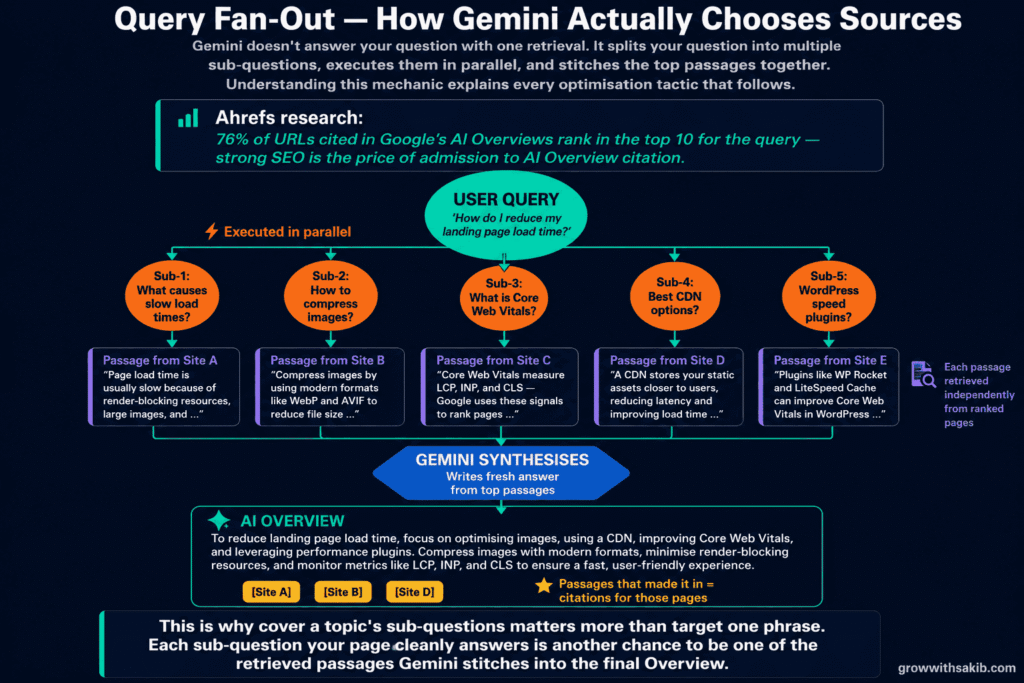
AI Overviews use a technique Google calls query fan-out. Rather than answering your exact query alone, Gemini breaks it into multiple related sub-questions and searches for all of them at once. At Google I/O 2025, Head of Search Elizabeth Reid described it as breaking a question into subtopics and issuing a multitude of queries simultaneously, as Google documented.
Then it does passage extraction: it pulls specific passages from indexed pages that best answer each sub-question and synthesises them into one summary, citing the sources. So two things decide whether you’re cited – whether your page is in the eligible pool (you rank and are indexed), and whether it contains a clean passage that answers a sub-question. For the deeper mechanism, see how AI search systems actually work on GrowWithSakib.
Does ranking still matter? Yes – a lot, though less absolutely than before.
Ahrefs data shows that roughly 76% of AI Overview citations come from pages ranking in Google’s top 10, and other analyses find 94-97% of AI Overviews include at least one link from the organic top 20. Ranking is clearly the strongest prerequisite. That said, the share is declining – AI increasingly cites some lower-ranked pages with especially clean, relevant answers, which is the opening for well-structured content.
How Are AI Overviews Different From ChatGPT and Perplexity?
All three use retrieval and synthesis, but the source of truth differs – and that changes your strategy.
| Feature | Google AI Overviews | ChatGPT / Perplexity |
| Powered by | Gemini | GPT / Perplexity models |
| Main source | Google’s search index + Knowledge Graph | Live web + training data (varies) |
| Ranking link | Strongly tied to Google rankings | Looser tie to Google rankings |
| Best lever | Rank well, then structure for extraction | Broad web presence and mentions |
| Where to check | Google Search + Search Console | The tools themselves, directly |
The practical takeaway: for AI Overviews, your Google ranking is the foundation, because Gemini pulls from Google’s index. That’s different from Perplexity, which leans more on live web retrieval and off-site presence. Good news: the extraction-friendly structure that wins AI Overviews helps everywhere. See how GEO and SEO compare on GrowWithSakib for the overlap.
The Step-by-Step AI Overview Optimisation Checklist
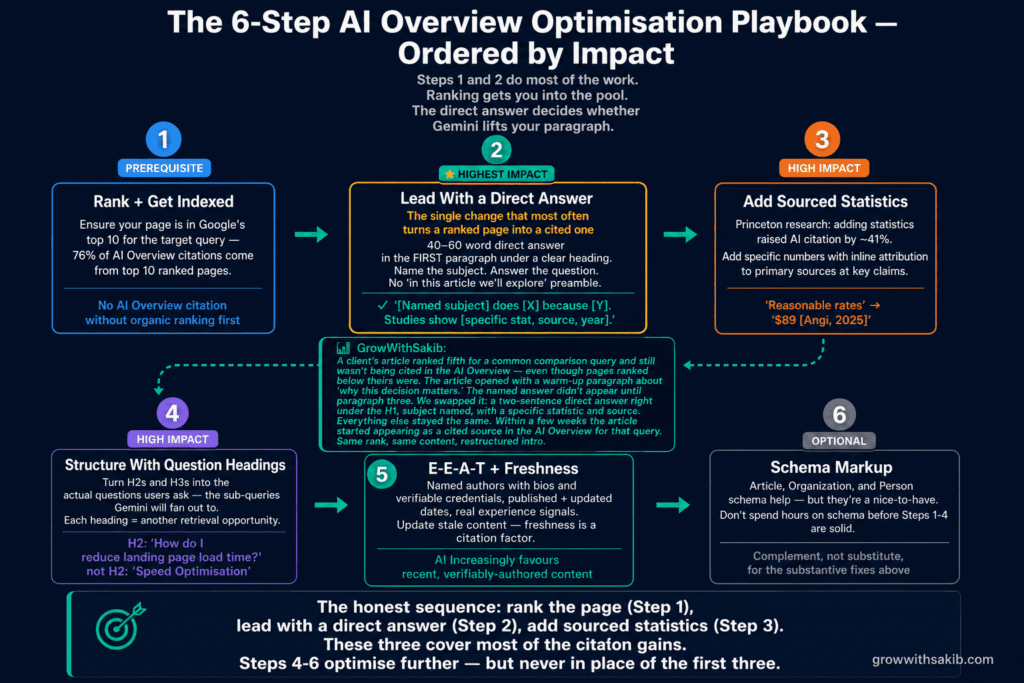
Here’s the practical sequence, ordered by impact. None of it is exotic – it’s disciplined SEO plus extraction-friendly writing.
Step 1: Make Sure You Rank and Are Indexed
Since AI Overviews draw from the ranked pool, this is non-negotiable. Confirm the page is indexed (check in Search Console), that Googlebot isn’t blocked in robots.txt, and that your key content is in the HTML, not hidden behind JavaScript or a login. If you don’t rank at all, fix that first with the small business SEO guide on GrowWithSakib.
Step 2: Lead Every Section With a Direct Answer
This is the single highest-impact change. Put the direct answer to each section’s implied question in the first one or two sentences, then expand. Gemini extracts clean, self-contained passages – so front-load the answer and don’t bury it after a long warm-up. The full method is in how to structure content for AI summaries on GrowWithSakib.
Step 3: Back Claims With Specific, Sourced Facts
AI Overviews favour verifiable specifics over vague claims. “Most businesses improve” is not citable; “conversion rose 27% in a 2025 study” is. Add real statistics with named sources – the approach in statistics-rich content on GrowWithSakib.
Step 4: Use Question-Based Headings and FAQs
Because query fan-out searches many sub-questions, headings phrased as real questions map directly to what Gemini is looking for. Add an FAQ section where each question gets a crisp, complete answer in its first sentence – these make excellent, discrete citation targets.
Step 5: Strengthen E-E-A-T and Freshness
Google’s guidance leans on E-E-A-T – experience, expertise, authoritativeness, trustworthiness. Show clear authorship and credentials, and keep content current, since AI favours fresh, accurate information. Review and update key pages on a schedule. The trust picture is covered in the guide to E-E-A-T on GrowWithSakib.
Step 6: Structured Data (Helpful, Not Required)
Here’s the honest version: Google says schema is not required for AI Overviews. But structured data still helps machines understand your content and can earn rich results in normal search, which supports overall visibility. Add it for its real benefits – just don’t believe anyone who calls it a mandatory AI Overview hack.
| Step / Action | Impact |
|---|---|
| 01. Rank and get indexed | Prerequisite – no ranking, no citation |
| 02. Lead with the direct answer | Highest-impact content change |
| 03. Add specific, sourced facts | Makes passages citable |
| 04. Question headings + FAQs | Matches query fan-out sub-questions |
| 05. Strengthen E-E-A-T + freshness | Signals a trustworthy source |
| 06. Structured data (optional) | Helps understanding; not required |
How to Check If You Appear in AI Overviews
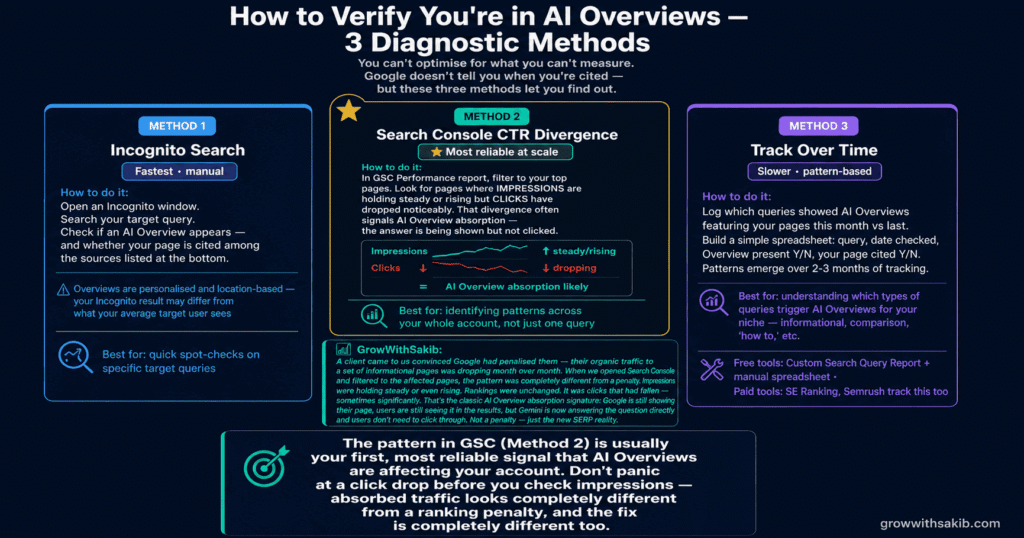
You can’t improve what you can’t see. Google Search Console doesn’t yet separate AI Overview citations cleanly, so combine these three practical methods:
Method 1: The Incognito Search Check
Open an incognito browser window (to avoid personalised results), search your target query, and see whether an AI Overview appears and who it cites. Incognito gives you a cleaner, more neutral view of what a typical searcher sees. Check your important queries this way regularly and log who’s being cited.
Method 2: The Search Console Pattern
In Google Search Console, AI feature traffic is folded into the “Web” search type in the Performance report. The tell-tale pattern of AI Overview exposure is rising impressions with a falling click-through rate on a query – your page is being shown in the Overview area but earning fewer clicks. Watch for that divergence on your key pages.
Method 3: Track Over Time
Citation patterns shift as Google tunes its models, so treat this as ongoing monitoring, not a one-off. Keep a simple log of which queries trigger an Overview, whether you’re cited, and who else appears. Specialist AI-visibility tools can automate this at scale, but the manual method costs nothing and builds real intuition.
Honest Limits: What You Can and Can’t Control
Set expectations realistically. Getting cited in AI Overviews is influenceable, not guaranteed, and some of it is outside your hands:
- Nothing is guaranteed – Google is explicit that following best practice raises your probability of being cited but doesn’t promise it.
- It’s volatile – AI Overviews appear and disappear on a query as Google tunes its systems, and your citation can come and go with them.
- Ranking is still the gatekeeper – if you don’t rank in the pool Gemini draws from, structure alone won’t get you cited.
- Be wary of precise stat promises – many circulating figures (exact correlation coefficients, “X% from schema”) are vendor-stated and hard to verify. Build on Google’s documented fundamentals, not on someone’s benchmark.
The reassuring reality: because AI Overviews “is still SEO,” the work compounds. Every improvement that helps you get cited also strengthens your normal rankings and your visibility in other AI tools. You’re not gambling on one surface – you’re building durable quality.
Common AI Overview Mistakes
| Mistake | Why It Hurts | Do This Instead |
|---|---|---|
| Chasing a ‘special AIO hack’ | Google says none exists | Do strong SEO plus clean extraction |
| Believing schema is mandatory | Contradicts Google’s own docs | Add schema for its real benefits, not as a hack |
| Ignoring rankings | AIO draws from the ranked pool | Rank first, then optimise extraction |
| Burying the answer | Gemini can’t extract it cleanly | Lead each section with a direct answer |
| Vague, unsourced claims | Not citable | Add specific, sourced facts |
| Set-and-forget | Citations shift as models change | Monitor incognito + Search Console regularly |
| Trusting inflated stats | Many are unverifiable vendor numbers | Rely on Google’s documented fundamentals |
Frequently Asked Questions
1. How do I get cited in Google AI Overviews?
Rank well in normal search first, then make your answers easy to extract: lead each section with a direct answer, back claims with specific sourced facts, use question-based headings, and keep content current. Per Google’s official documentation, there’s no special optimisation or schema required – AI Overviews draw mainly from pages that already rank, so strong SEO plus clean, self-contained answers wins.
2. Do I need special schema to appear in AI Overviews?
No. Google states directly that “there’s no special schema.org structured data that you need to add” and “you don’t need to create new machine readable files, AI text files, or markup” to appear in AI Overviews. Anyone calling schema a mandatory AI Overview requirement contradicts Google’s own documentation. Structured data still helps machine understanding and earns rich results, so it’s worth adding for those real benefits.
3. How do Google AI Overviews choose their sources?
AI Overviews are generated by Gemini using a technique called query fan-out: it breaks your query into multiple sub-questions, searches Google’s index for each, extracts clean passages that answer them, and synthesises a cited summary. So being cited depends on being in the ranked, indexed pool and having a clear, self-contained passage that directly answers a sub-question.
4. Does ranking number one guarantee an AI Overview citation?
No. Ranking helps a lot – Ahrefs found about 76% of AI Overview citations come from top-10 pages – but it’s not a guarantee, and the share is declining as AI cites some lower-ranked pages with cleaner answers. A page can rank first yet be skipped if its answer is buried, while a fifth-ranked page with a crisp, direct answer gets cited instead.
5. How are Google AI Overviews different from ChatGPT?
Google AI Overviews are powered by Gemini and draw mainly from Google’s search index and Knowledge Graph, so they’re strongly tied to your Google rankings. ChatGPT and Perplexity rely more on live web retrieval and training data, with a looser link to Google rankings. For AI Overviews, ranking well is the foundation; for the others, broad web presence and mentions matter more.
6. How do I check if my page appears in AI Overviews?
Use three methods. Search your target query in an incognito window and see if an Overview appears and who it cites. In Google Search Console, watch for rising impressions with falling click-through rate on a query – the fingerprint of AI Overview exposure. And track it over time, since citations shift as Google tunes its models. Specialist tools can automate this, but the manual method works.
7. Why isn’t my page cited even though it ranks well?
Usually because your answer isn’t cleanly extractable. AI Overviews pull self-contained passages, so if your key answer is buried after a long introduction, hedged with qualifiers, or split across sections, Gemini can’t lift it – even from a top-ranking page. Rewrite the opening of each section to lead with a direct, specific answer, and it becomes far more likely to be cited.
8. Is it worth optimising for AI Overviews if they reduce clicks?
Yes. AI Overviews can lower click-through rates, but being the cited source is valuable for brand visibility and still earns the clicks that go to deeper content. The alternative – being absent from the Overview entirely – is worse. Since optimising for AI Overviews “is still SEO,” the same work strengthens your rankings and your visibility across other AI tools too.
Key Takeaways
- Google states there’s no special optimisation or schema required for AI Overviews – appearing in them ‘is still SEO,’ built on the same fundamentals.
- AI Overviews are generated by Gemini using query fan-out: it splits your query into sub-questions and extracts clean passages from indexed pages to answer them.
- Ranking is the strongest prerequisite – about 76% of AI Overview citations come from top-10 pages – though the share is declining as cleaner lower-ranked answers break in.
- The highest-impact change is leading every section with a direct answer, so Gemini can extract a clean, self-contained passage.
- Back claims with specific sourced facts, use question-based headings and FAQs, and strengthen E-E-A-T and freshness.
- Schema isn’t required but is still worth adding for machine understanding and rich results – just not as a mandatory ‘AIO hack.’
- Check if you appear using incognito searches plus the Search Console pattern of rising impressions with falling click-through rate.
- Nothing is guaranteed and AI Overviews are volatile – but since it’s still SEO, every improvement compounds across rankings and other AI tools.