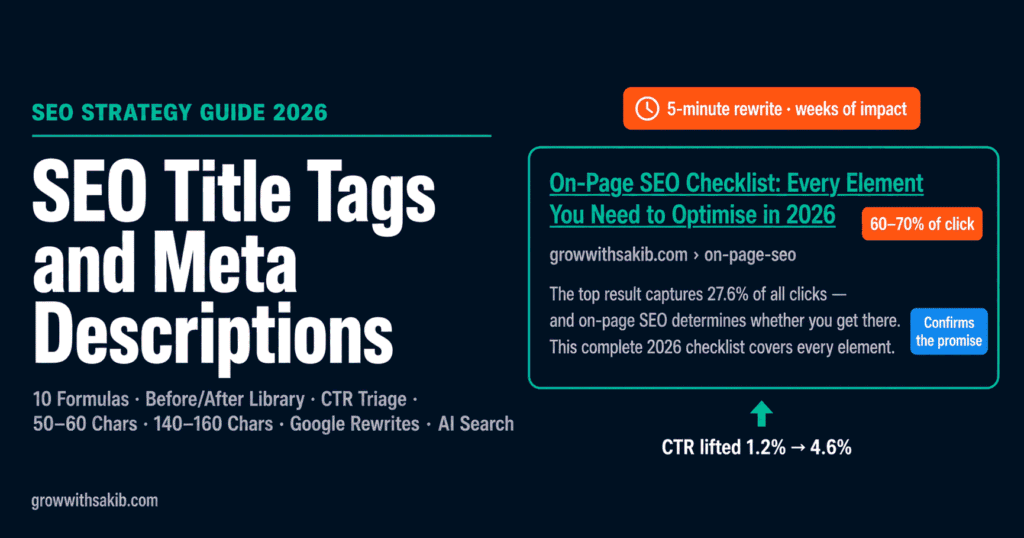
Title tags and meta descriptions are the highest-leverage on-page SEO change you can make. A 5-minute rewrite can lift click-through rate by 2–4 percentage points within weeks — adding hundreds of monthly clicks without ranking changes. This guide gives you 10 plug-and-play formulas, a before/after library across page types, and a GSC-based method for identifying which pages to fix first.
If you want the wider context, the on-page SEO checklist on GrowWithSakib covers the 12 on-page elements that move rankings. This article goes deep on the two that move CTR the most.
The Click Anatomy: Why You Should Write Them Together
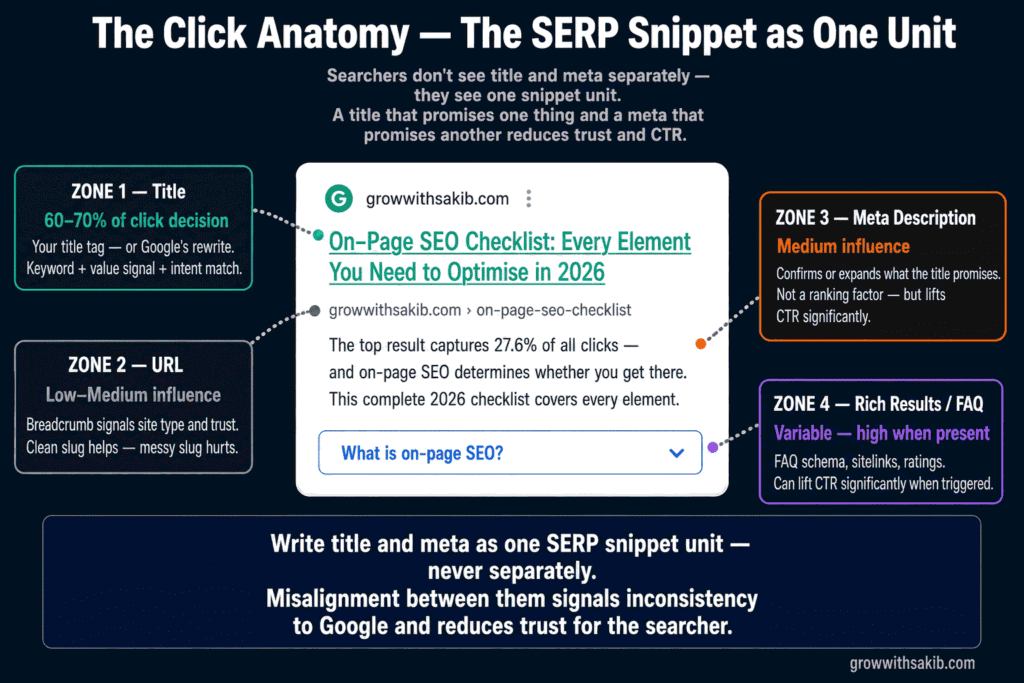
Most articles split title tag and meta description into separate guides. That’s backwards. Searchers don’t see them separately — they see them as one SERP snippet unit. The Click Anatomy treats this unit as the real object to optimise.
The four zones of a typical SERP snippet:
1. Title (blue)
- Zone: 1. Title (blue)
- What It Is: The clickable headline (your title tag, or Google’s rewrite)
- Influence on Click Decision: Highest — about 60-70% of click decision
2. URL
- Zone: 2. URL
- What It Is: The breadcrumb or full URL display
- Influence on Click Decision: Low–medium — signals site type and trust
3. Meta description (grey)
- Zone: 3. Meta description (grey)
- What It Is: The 2-line snippet beneath the URL
- Influence on Click Decision: Medium — confirms or expands what the title promises
4. Rich results / sitelinks / FAQ
- Zone: 4. Rich results / sitelinks / FAQ
- What It Is: Optional structured-data enhancements
- Influence on Click Decision: Variable — can lift CTR significantly when they appear
Search engines reward consistency across all four zones. A title that promises one thing and a meta description that promises another reduces trust and CTR. They must work together. Google’s Search Central guidance on titles and guidance on snippets both emphasise this alignment.
Title Tag Length: The Pixel Width Truth
Most articles say “50-60 characters”. That’s directionally right but technically wrong. Google measures title display in pixel width, not characters. The letter W is roughly 5x wider than the letter I — so two 58-character titles can display very differently.
| Display Context | Approximate Pixel Limit | Character Equivalent (Mixed Text) |
| Desktop SERPs | ~600 pixels | 55–60 characters |
| Mobile SERPs | ~570 pixels | 50–55 characters |
| Titles with all-caps words | Same pixel limit, fewer chars fit | 45–50 characters |
| Titles with narrow letters (i, l, f, r) | Same pixel limit, more chars fit | 60–65 characters |
Safe rule for small business: target 50-58 characters with average letter width. Get the keyword and value in the first 40 characters so it survives mobile truncation. Test the pixel width if your title uses many wide letters (W, M, capital letters).
5 Title Tag Formulas (Plug and Play)
Different page types deserve different title formulas. These five cover most small business use cases.
5 Meta Description Formulas (Plug and Play)
Same approach for meta descriptions — different page types need different patterns.
The Before/After Rewrite Library
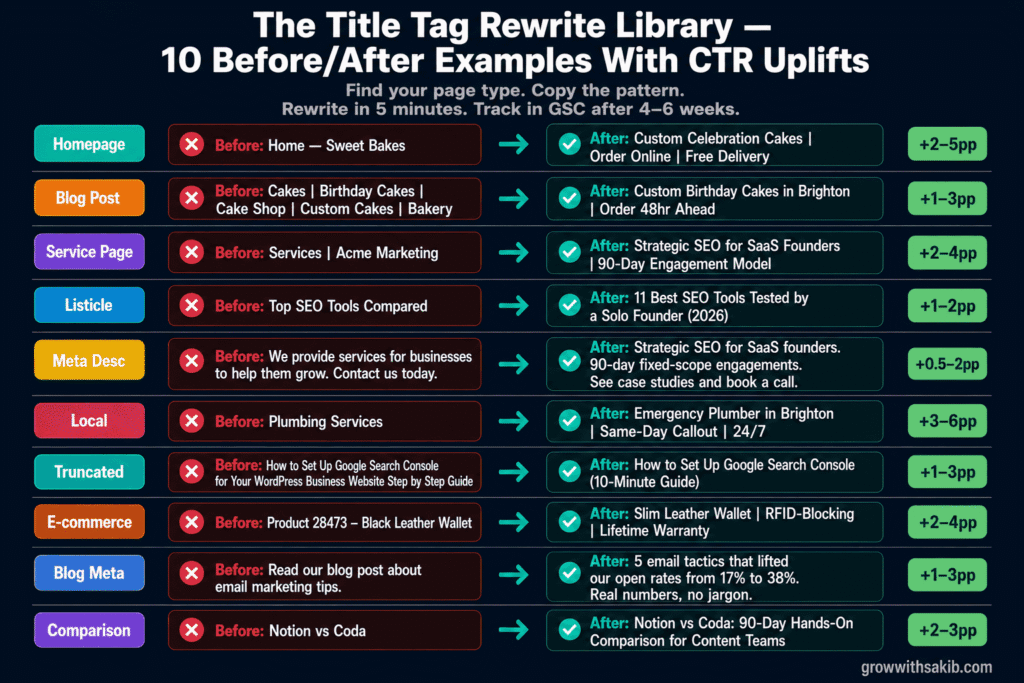
Concrete examples beat abstract rules. Here are 10 real before/after pairs across page types, with the typical CTR uplift you can expect from each kind of fix.
1. The Brand-Only Title
Typical CTR uplift: 2-5 percentage points. The brand-only title leaves visitors guessing about what you offer.
2. The Keyword-Stuffed Title
Typical CTR uplift: 1-3 percentage points. Stuffed titles often get rewritten by Google anyway.
3. The Generic Service Page
Typical CTR uplift: 2-4 percentage points. Specificity beats generic every time.
4. The Missing Year on Listicle
Typical CTR uplift: 1-2 percentage points. Year + specificity + voice signal trust.
5. The Vague Meta Description
Typical CTR uplift: 0.5-2 percentage points.
6. The Local Service Title
Typical CTR uplift: 3-6 percentage points. Local intent loves location + speed signals — and a fully optimised Google Business Profile amplifies these same signals in the local map pack.
7. The Truncated Title
Typical CTR uplift: 1-3 percentage points. Truncated titles look broken in SERPs.
8. The Ecom Product Title
Typical CTR uplift: 2-4 percentage points.
9. The Boring Meta Description
Typical CTR uplift: 1-3 percentage points.
10. The Featureless Comparison
Typical CTR uplift: 2-3 percentage points. Time-spent and audience qualifier signal real testing.
Why Does Google Rewrite My Title?
If you’ve ever seen your carefully written title rewritten in Google’s SERP, you’re not alone. According to Google’s own analysis and confirmed in their Search Central documentation on title links, Google rewrites titles when their algorithms detect a mismatch between your title and what the page actually delivers, or when the title fails certain quality criteria.
Four main reasons Google rewrites titles:
| Reason | What Triggers It | How to Prevent It |
| Keyword stuffing | Title contains repeated or excessive keywords | Use the primary keyword once, naturally |
| Title doesn’t match content | Title promises something the page doesn’t deliver | Ensure title accurately reflects page content by confirming search intent alignment first. |
| Title is too long | Title exceeds display pixel limit | Stay under 60 characters / 600 pixels |
| Duplicate or boilerplate | Same title across multiple pages on your site | Make every title unique |
When Google rewrites your title, it usually pulls from your H1, anchor text pointing to the page, or content within the page. To regain control, fix the underlying issue listed above — Google then reverts to your written title on the next crawl.
Meta Description: The Honest Truth
Meta descriptions are not a direct ranking factor. Google has stated this repeatedly. But meta descriptions heavily influence click-through rate — which IS a signal Google uses to refine rankings over time.
Google’s own Search Central guidance on snippets confirms that meta descriptions are used as page snippets only when they’re clear, accurate, and relevant to the user query. Otherwise, Google generates its own snippet from the page content.
What Makes a Meta Description Get Used by Google?
- It accurately reflects the page content
- It’s relevant to the searcher’s query
- It contains the keyword(s) the user searched (without stuffing)
- It’s within the safe character range (140-160 chars)
- It’s unique to that page (no duplicates across your site)
Practical implication: Google overrides your meta description for roughly half of queries anyway. But writing strong meta descriptions still pays off because:
- When they ARE used, they directly influence CTR
- They give Google a starting point — better starting points produce better auto-generated snippets
- They control your message on social shares (Facebook, LinkedIn pull from meta) — and for businesses running Meta Ads alongside SEO, consistent messaging between meta descriptions and ad copy strengthens brand recognition across channels.
The CTR Triage Method: Find Your Highest-Leverage Pages
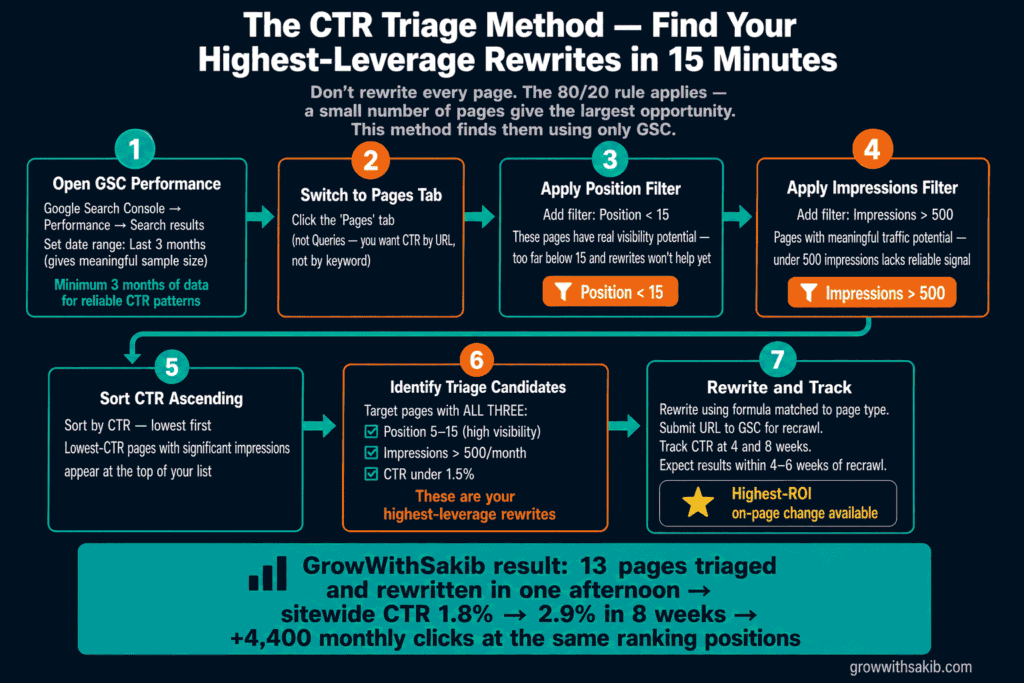
Don’t rewrite every page on your site. The 80/20 rule applies — a small number of pages give you the largest CTR opportunity. Here’s how to find them using only Google Search Console.
Step-by-Step Triage in GSC
- Open Google Search Console and go to Performance → Search results
- Set date range to Last 3 months — gives meaningful sample size
- Switch to the Pages tab — see CTR by URL
- Add a Position filter: Position less than 15 — these are pages with potential visibility
- Add an Impressions filter: Impressions greater than 500 — pages with meaningful traffic potential
- Sort by CTR ascending — lowest-CTR pages at top
- The first 5-15 pages in that list are your highest-leverage rewrites
For a deeper walkthrough of using GSC for this kind of analysis, see the how to use Google Search Console guide on GrowWithSakib — and pair it with the keyword research guide to ensure the keywords in your rewritten titles match actual search demand.
How AI Overviews and AI Search Treat Title Tags
AI search engines — Google AI Overviews, ChatGPT Search, Perplexity — read your title tag and meta description as core signals of what your page is about. AI engines use these elements to decide whether to cite your page in generated answers.
Three practical implications for 2026:
- Clarity beats cleverness for AI citation — vague or pun-heavy titles get cited less often than direct, descriptive ones
- Question-based titles correlate with AI Overview citations — titles framed as questions or direct-answer promises tend to win AI citation more reliably
- Meta description specificity matters more for AI — AI engines often summarise the meta description when deciding whether to cite the page
For the broader AI search strategy, see the search intent guide — which covers the generative AI intent type that title and meta clarity uniquely support.
Common Title Tag and Meta Description Mistakes
| Mistake | Why It Fails | What to Do Instead |
| Keyword stuffing | Looks spammy; Google often rewrites stuffed titles | Use primary keyword once, naturally, with a value signal |
| Duplicate titles across pages | Confuses Google; every page needs its own | Audit in GSC under Indexing → Pages; write unique titles for each as part of your complete small business SEO audit. |
| Truncated titles | Get cut off in SERPs with ‘…’ — look broken | Stay under 60 characters / 600 pixels |
| Brand-only titles | ‘Home — Brand’ tells nobody anything | Lead with the page’s value; brand at the end if at all |
| Missing meta descriptions | Google auto-generates one — usually a worse one | Always write one, even if Google sometimes overrides it |
| No CTAs in meta | Misses the opportunity to nudge clicks | End with a soft CTA verb: ‘Learn how’, ‘See the comparison’, ‘Get the guide’ |
| Treating title/meta as set-and-forget | Stale titles slowly lose CTR as competitors update theirs | Re-audit every 6 months using the triage method |
| Writing for keywords, not humans | Looks like SEO, performs like SEO from 2010 | Write for the person scanning the SERP; they decide the click |
Honest Limitations
Title and meta optimisation works, but has limits. The honest caveats:
- Google rewrites approximately half of titles anyway — even perfect titles get overridden when Google’s algorithm thinks it has a better fit
- CTR uplift is position-dependent — moving CTR from 0.5% to 2% has bigger impact at position 4 than at position 15
- Test before rolling out to high-traffic pages — a strong-ranking page with high traffic shouldn’t be the first place you experiment
- Meta descriptions don’t directly affect rankings — they affect CTR, which over time influences rankings, but it’s an indirect path
- Click-through rate depends heavily on intent match — even great copy can’t fix a page that doesn’t match the SERP intent
For the foundational SEO work that supports CTR optimisation, see the on-page SEO checklist, the search intent guide, and the guide on tracking SEO results for measuring whether your rewrites worked.
Frequently Asked Questions
1. How long should an SEO title tag be?
SEO title tags should be 50–60 characters, with a safe sweet spot around 55. Google measures titles by pixel width (~600 pixels), so wide letters (W, M, capitals) reduce the effective character count. Place your primary keyword in the first 40 characters so it survives mobile truncation, which displays roughly 50–55 characters before cutting off with an ellipsis.
2. How long should a meta description be?
Meta descriptions should be 140–160 characters. Google occasionally displays up to 160 on desktop and around 120 on mobile. Include the primary keyword once (Google bolds matched terms in SERPs), deliver a clear value proposition, and end with a soft CTA. Don’t pad to hit 160 — concise and compelling beats long and rambling every time.
3. Why is Google rewriting my title tag?
Google rewrites titles when its algorithms detect keyword stuffing, a mismatch between title and page content, excessive length, or duplicate titles across your site. According to Google’s Search Central documentation on title links, fixing these underlying issues usually returns control to your written title on the next crawl.
4. Is meta description a ranking factor?
No — Google has confirmed meta descriptions are not a direct ranking factor. However, they strongly influence click-through rate, and CTR is a signal Google uses to refine rankings over time. A well-written meta description can lift CTR by 0.5–2 percentage points without any ranking change — and the resulting engagement signals often produce ranking improvements over the following weeks.
5. How do I check my CTR in Google Search Console?
Open Google Search Console, go to Performance → Search results, and look at the CTR metric. Switch to the Pages tab to see CTR by URL. To find rewrite candidates, filter for Position less than 15, Impressions greater than 500, and sort by CTR ascending — the lowest-CTR pages with significant impressions are your highest-leverage rewrites.
6. Should I include my brand name in every title tag?
Not necessarily. For brand-led pages (homepage, contact, about), include your brand name. For content pages (blog posts, guides, comparisons), brand name at the end adds little value and consumes character budget. Test it: if your brand is well-known to your audience, it can lift CTR; if not, the space is better spent on value signals.
7. How often should I update my title tags?
Audit every 6 months using the CTR Triage Method. Rewrite pages where CTR has declined or where new SERP entrants are outperforming you. For evergreen content with year references (e.g., ‘2026 Guide’), update the year annually. Don’t rewrite high-performing titles just because they’re old — if CTR is strong and stable, leave them alone.
8. Can the same title tag work for AI search and traditional Google?
Yes, but with a slight bias toward clarity over cleverness. AI engines like Google AI Overviews, ChatGPT Search, and Perplexity tend to cite pages with direct, descriptive titles more often than puns or vague headlines. The same writing principles apply: clear primary keyword, specific value signal, no stuffing — but lean toward direct phrasing when AI citation matters to your strategy.
Key Takeaways
- Title tags and meta descriptions are consumed together as one SERP snippet unit — write them together, not separately.
- Target 50–60 characters for titles, 140–160 for meta descriptions. Google measures titles by pixel width (~600px), so wide letters reduce the effective character budget.
- Use plug-and-play formulas matched to page type: Listicle, How-To, Definition, Commercial, Local for titles; Promise, Outcome, Hook, Setup, Booking for metas.
- Title tag rewrites typically lift CTR by 1–5 percentage points within 4–6 weeks of Google recrawling — the highest-ROI on-page change available.
- Use the CTR Triage Method in GSC to find pages with position 5–15, impressions >500, and CTR under 1.5% — your highest-leverage rewrites live here.
- Google rewrites approximately half of titles. The four main triggers are keyword stuffing, content mismatch, excessive length, and duplicates — fix these to regain control.
- Meta descriptions are not a direct ranking factor but heavily influence CTR. CTR over time influences rankings, so the path is indirect but real.
- For AI Overviews and AI search citation, prioritise clarity and specificity over cleverness — direct titles get cited more often than puns or vague headlines.