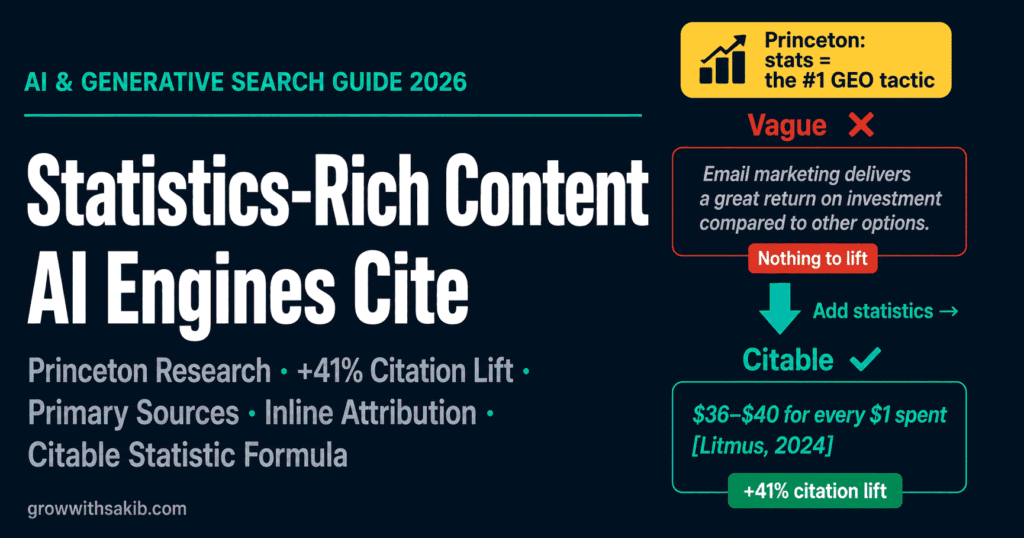
If you do one thing to get cited by AI, do this. When researchers tested what makes generative engines quote a source, the standout winner wasn’t clever formatting or keywords – it was specific statistics. Learning to write statistics-rich content for AI is the highest-leverage GEO skill there is.
But “add statistics” is advice, not a skill. This guide gives you the skill: where to find citable data, how to attribute it so it counts, why a precise number beats a vague phrase, and how to structure a stat so an AI can lift it. It’s a deep expansion of one tactic from the complete guide to generative engine optimization on GrowWithSakib – the one research ranks highest.
What Does the Research Actually Say?
The foundational GEO study from Princeton, the Allen Institute for AI, and IIT Delhi (Aggarwal et al., published at KDD 2024) tested nine content changes across 10,000 queries to see which made AI engines cite a source more often. Statistics Addition came out on top, lifting citation visibility by a relative 41%.
For context, the same study found quotation addition lifted visibility by 28%, and adding citations to credible sources lifted it by up to 115% for lower-ranked pages – while keyword stuffing performed about 10% worse than doing nothing. The old tricks lose; specific, well-supported facts win.
Why do numbers win? The mechanism matters.
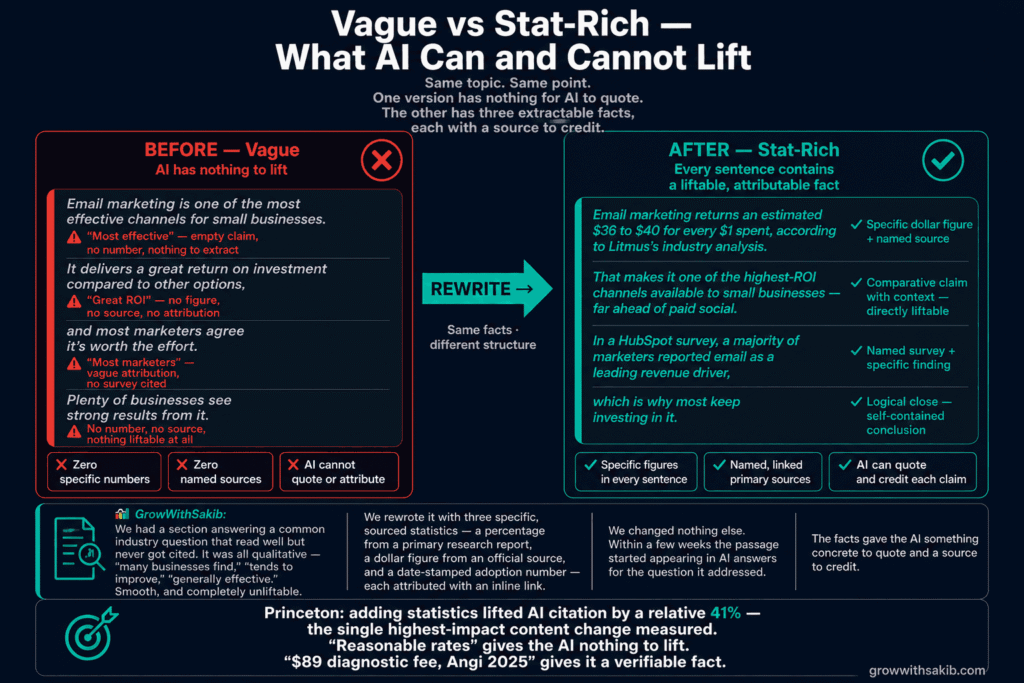
An AI engine builds answers by lifting reusable chunks of text. A specific statistic is the perfect chunk: it’s a self-contained, verifiable fact the model can drop into its answer with almost no rewriting. As one analysis of the paper put it, generative engines treat numeric facts as extractable units that can be reused with low rewrite cost. A vague phrase like “reasonable rates” gives the AI nothing to lift; “$89 diagnostic fee” gives it a fact. For how that extraction works, see how AI search systems actually work on GrowWithSakib.
Before and After: A Vague Paragraph Rewritten
Here’s the whole idea in one example. Same point, two ways of writing it – one invisible to AI, one citable.
Look at what changed. “Great return on investment” became “$36 to $40 for every $1 spent,” attributed to a named source with a link. “Most marketers agree” became a specific survey finding. Each sentence now contains a liftable, attributable fact. An AI answering “is email marketing worth it for small business?” can quote the after version directly – and credit you.
Note: the figures above are illustrative of the technique. Always pull the current number from the primary source yourself before publishing, since these change – which brings us to the actual skill.
Step 1: Where to Find Citable Statistics
You can’t add data you don’t have. The good news: enormous amounts of citable, free, primary data exist. The trick is going to primary sources – the organisation that actually produced the number – not a blog quoting a blog quoting a number.
| Source Type | Examples | Best For |
|---|---|---|
| Statistics databases | Statista, Our World in Data | Market sizes, adoption, trends |
| Government data | Census, BLS, Eurostat, gov.uk | Demographics, economics, employment |
| Research organisations | Pew Research, Gartner, McKinsey | Behaviour, industry forecasts |
| Official platform reports | Google, Meta, industry leaders | Platform-specific benchmarks |
| Your own data | Your analytics, surveys, results | Original stats nobody else has |
The highest-value option is the last one. Original data nobody else has – your own survey, your anonymised client results, a small study you run – is the most citable content of all, because the AI can only get it from you. The Princeton study itself found citing credible sources lifted visibility by up to 115% for lower-ranked pages, and original research is the ultimate citable source.
Step 2: How to Attribute Statistics Correctly
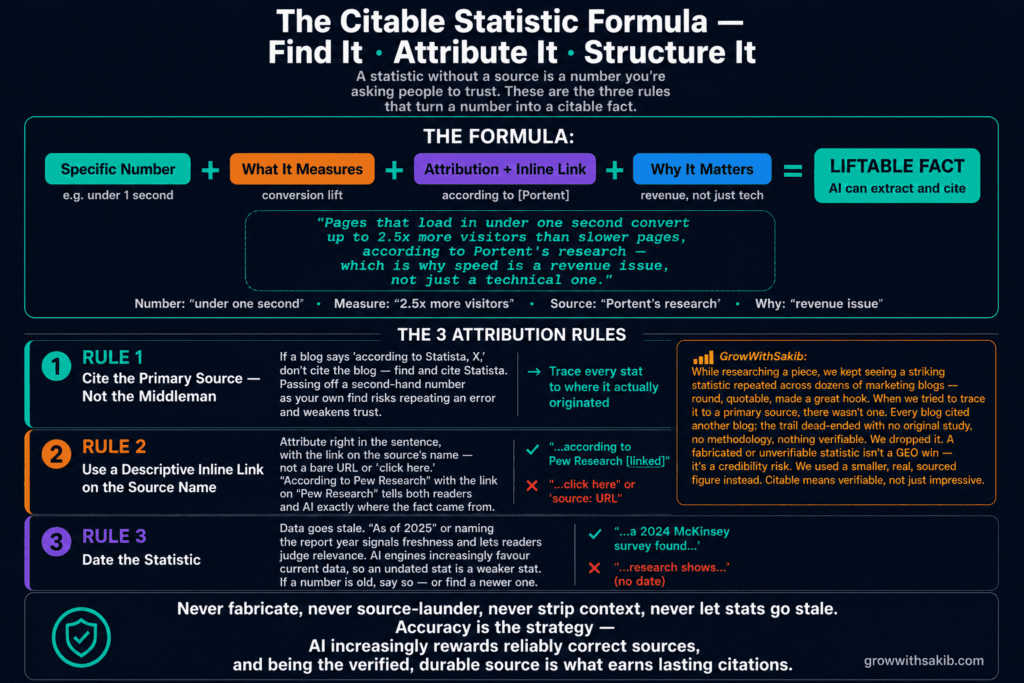
A statistic without a credible source is just a number you’re asking people to trust. Correct attribution is what turns a number into a citable fact – for both AI and human readers. Follow three rules.
Rule 1: Cite the Primary Source, Not the Middleman
If a blog says “according to Statista, X,” don’t cite the blog – find and cite Statista. Passing off a second-hand number as if you found it (“source laundering”) risks repeating an error and weakens trust. Trace every stat to where it actually originated.
Rule 2: Use a Descriptive Inline Link on the Source Name
Attribute right in the sentence, with the link on the source’s name – not a bare URL or “click here.” “According to Pew Research” with the link on “Pew Research” tells both readers and AI exactly where the fact came from. This is the inline-anchor style used throughout the on-page SEO checklist on GrowWithSakib.
Rule 3: Date the Statistic
Data goes stale. “As of 2025” or naming the report year signals freshness and lets readers judge relevance. AI engines increasingly favour current data, so an undated stat is a weaker stat. If a number is old, say so – or find a newer one.
Step 3: How to Structure a Statistic for Extraction
Finding and attributing a stat isn’t enough – it has to sit in a structure an AI can lift cleanly. A buried number in a long, winding sentence is hard to extract. The format that works:
Practical structuring tips:
- Lead sections with the stat – a data point in the first sentence under a heading is prime extraction real estate.
- One clear stat per sentence – don’t cram three numbers into one clause; give each its own liftable sentence.
- Use a stat in your direct answer – the 40-60 word answer at the top of a section is far stronger with a number in it.
- Bold or surface key figures sparingly – it helps human scanning without harming extraction.
The Cardinal Rule: Never Fabricate or Misuse Statistics
This tactic has a dark side worth naming plainly. The pressure to add impressive numbers can tempt people to invent them, round them generously, or strip their context. Don’t.
- Never invent a statistic – a made-up number that gets cited spreads misinformation under your name and destroys trust the moment it’s checked.
- Never cite a stat you can’t trace – if you can’t find the primary source, don’t use it, however good it sounds.
- Never strip context – “sales rose 50%” means little without the base, period, and source. Misleading framing is its own failure.
- Never let a stat go stale silently – revisit data periodically; an outdated figure presented as current is a quiet form of inaccuracy.
This isn’t just ethics – it’s strategy. AI engines and their makers are increasingly tuned to trust and accuracy, and being a reliably correct source is what earns durable citations. Accuracy is the moat. For the broader trust picture, see the guide to E-E-A-T and content trust on GrowWithSakib.
Common Mistakes With Statistics-Rich Content
| Mistake | Why It Hurts | Do This Instead |
|---|---|---|
| Vague claims (‘great results’) | AI has no fact to lift or cite | Replace with a specific, sourced number |
| Citing the middleman blog | Repeats errors; weakens trust | Trace and cite the primary source |
| Bare URLs or ‘click here’ | Poor attribution for AI and readers | Inline link on the source’s name |
| Undated statistics | Looks stale; AI favours current data | Date the stat or find a newer one |
| Cramming many stats per sentence | Hard to extract a clean unit | One clear, liftable stat per sentence |
| Using untraceable ‘viral’ stats | Risks spreading misinformation | Only use verifiable, sourced figures |
| Fabricating or rounding loosely | Destroys credibility when checked | Use exact, real numbers only |
Frequently Asked Questions
1. Do statistics really help content get cited by AI?
Yes – they’re the single highest-impact tactic in the research. The foundational Princeton GEO study found that adding statistics raised a page’s AI citation rate by a relative 41%, more than any other change tested. AI engines treat specific numbers as extractable facts they can reuse with little rewriting, so a precise, sourced statistic is far more citable than a vague qualitative claim.
2. Where do I find citable statistics for my content?
Go to primary sources: statistics databases like Statista and Our World in Data, government data (Census, BLS, Eurostat), research organisations like Pew Research and Gartner, and official platform reports. The most citable data of all is your own – original surveys, anonymised client results, or small studies you run, because AI can only get those numbers from you.
3. How do I attribute a statistic correctly?
Follow three rules: cite the primary source (the organisation that produced the number, not a blog quoting it), put a descriptive inline link on the source’s name rather than a bare URL, and date the statistic so its freshness is clear. Correct attribution is what turns a number into a citable, trustworthy fact for both AI engines and human readers.
4. Why do specific numbers beat vague claims for AI citation?
Because AI builds answers by lifting reusable chunks, and a specific number is a perfect self-contained chunk it can drop in with almost no rewriting. “Reasonable rates” gives the AI nothing to quote; “$89 diagnostic fee” gives it a verifiable fact. Analyses of the Princeton study describe generative engines treating numeric facts as extractable units reused with low rewrite cost.
5. How many statistics should I include per page?
There’s no fixed number – aim for one strong, relevant, sourced statistic per key claim rather than a target count. The Princeton research suggests even 2-3 well-placed statistics can meaningfully lift citation likelihood. Quality and relevance beat volume: a few precise, primary-sourced, well-structured numbers outperform a page stuffed with weak or untraceable figures.
6. Is the 41% statistics boost guaranteed?
No – treat it as direction, not a promise. The Princeton finding came from a simulated benchmark, and the lift was measured by adding statistics to a page that had none, so the gain is smaller for pages that already include some. The relative ranking of tactics is likely durable, but the exact percentage may have shifted. The reliable takeaway: statistics strongly help citation.
7. Can I use statistics I found on another blog?
Only after tracing them to the primary source. If a blog cites “Statista, 42%,” find that Statista figure and cite Statista directly. Citing the blog (“source laundering”) risks repeating an error and weakens trust. If you can’t find any primary source for a striking statistic, don’t use it – an untraceable number is a credibility risk, not a citation win.
8. What’s the biggest mistake with data-driven content?
Fabricating or misusing statistics. Never invent a number, cite a stat you can’t trace, strip away its context, or present stale data as current. A made-up figure that gets cited spreads misinformation under your name and collapses your credibility when checked. Accuracy is the strategy: AI engines increasingly reward reliably correct sources, so verifiable data is what earns durable citations.
Key Takeaways
- Adding statistics is the highest-impact GEO tactic – Princeton research found it lifted AI citation by a relative 41%, more than any other change tested.
- Specific numbers beat vague claims because AI treats them as extractable units it can reuse with low rewrite cost – ‘$89 fee’ is liftable, ‘reasonable rates’ is not.
- Find citable data at primary sources: Statista, government data, Pew and Gartner, official reports – and best of all, your own original research.
- Attribute correctly: cite the primary source not the middleman, use an inline link on the source’s name, and date the statistic.
- Structure each stat as a self-contained sentence – lead with the number, name the subject, keep one liftable fact per sentence.
- Rewrite vague paragraphs into stat-rich ones: replace ‘great ROI’ with a specific, sourced figure that an AI can quote and credit.
- Never fabricate, source-launder, strip context from, or let statistics go stale – accuracy is the strategy, since AI rewards reliably correct sources.
- Treat the +41% figure as direction not a guarantee – it’s from a simulated benchmark measuring stats added to a page that had none.