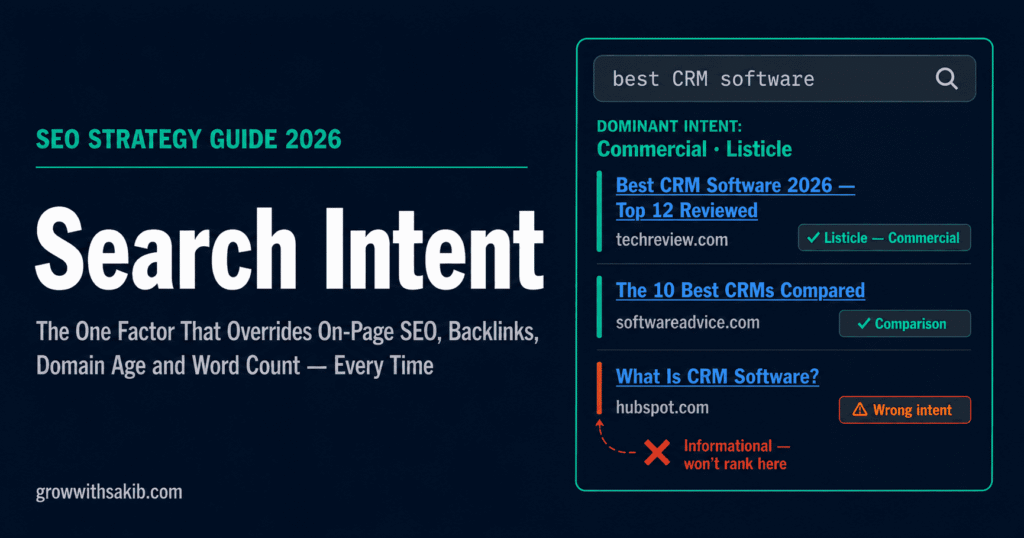
You can write the best content on the internet, build dozens of quality backlinks, fix every Core Web Vital, and still rank at position 22. There’s one reason this happens more than any other: search intent mismatch. Your page is technically excellent — it just isn’t answering the question searchers are actually asking.
This guide explains what search intent is, proves why it overrides almost every other SEO factor, covers all six intent types (including 2026’s generative AI intent), and gives you a 5-step diagnostic test you can run today using nothing but the Google SERP. No paid tools needed.
If you want the wider strategic context, the complete small business SEO guide on GrowWithSakib covers how intent fits with the rest of your SEO foundation. For specific on-page items affected by intent, see the on-page SEO checklist.
What Is Search Intent in SEO?
Search intent (also called user intent or keyword intent) is the underlying goal behind a search query — the reason a user typed those specific words into Google. According to Google’s Search Quality Evaluator Guidelines, Google’s ranking algorithms are designed to identify and prioritise content that satisfies what the user actually wants, not just content that contains matching keywords.
Google’s own How Search Works documentation puts relevance — the alignment between query and content — at the centre of ranking. Every other ranking factor (links, on-page SEO, page experience) is downstream of that single relevance signal. And relevance is, fundamentally, intent.
Two queries with similar keywords can have very different intent:
| Query | Likely Intent | What Google Surfaces |
| “best running shoes” | Commercial (researching options) | Listicles, comparison reviews |
| “buy nike running shoes size 10” | Transactional (ready to purchase) | Product pages, Nike.com, retailers |
| “how to clean running shoes” | Informational (learning) | How-to guides, video tutorials |
| “running shoes near me” | Local (find a store) | Map pack, local retailers |
Why Search Intent Overrides Every Other SEO Factor
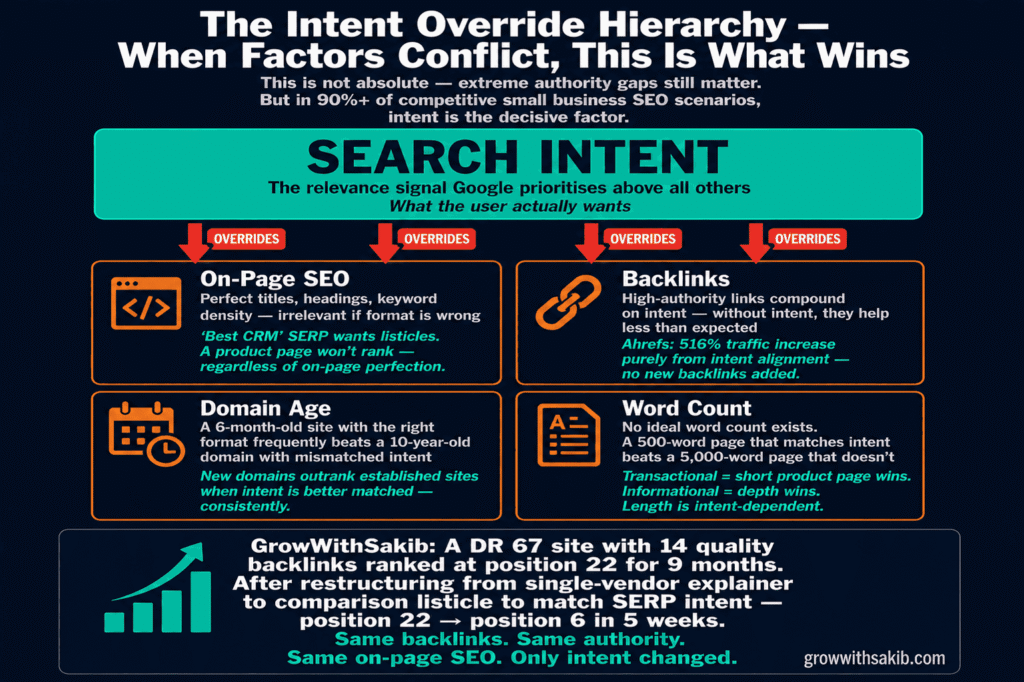
Most articles treat intent as one ranking factor among many. That’s not quite right. When intent conflicts with other factors, intent almost always wins. Here are the four head-to-head comparisons that prove it.
Intent vs. On-Page SEO
A page with a perfectly optimised title tag, ideal meta description, clean heading structure, and on-target keyword density will still fail if the format doesn’t match the SERP. Search for ‘best CRM software’ — Google shows comparison listicles. If your page is a single-product landing page (with perfect on-page SEO), you will not rank for that query, no matter how clean the technical implementation.
Implication: On-page SEO is downstream of intent. Get intent right first, then optimise on-page within that format — the complete SEO framework covers how these layers work together.
Intent vs. Backlinks
Backlinks are one of Google’s strongest ranking signals. But a high-authority page with many backlinks will still get outranked by a lower-authority page that matches intent better. Ahrefs published a documented case study where their own landing page wasn’t ranking — not for lack of backlinks, but because it lacked the free-tool functionality that ‘backlink checker’ searchers expected. After adding the tool to match intent, traffic increased 516% within six months.
Implication: Backlinks compound on top of intent alignment. Without intent match, they help less than expected.
Intent vs. Domain Age
New domains often outrank older, more established sites when intent is better matched. This happens constantly in queries where SERPs reward freshness or a specific format. A 6-month-old site with the right content format frequently beats a 10-year-old domain with mismatched intent.
Implication: Domain age is real but not decisive. Intent match is.
Intent vs. Word Count
There’s no ideal word count in SEO. A 500-word page that perfectly matches intent often outranks a 5,000-word page that doesn’t. For a transactional query like ‘buy ergonomic office chair’, the short, well-structured product page wins. For an informational query like ‘how does ergonomic seating affect posture’, the depth-and-detail article wins. Word count is intent-dependent.Implication: There is no universal ‘right length’. Length is a function of intent and the SERP norm.
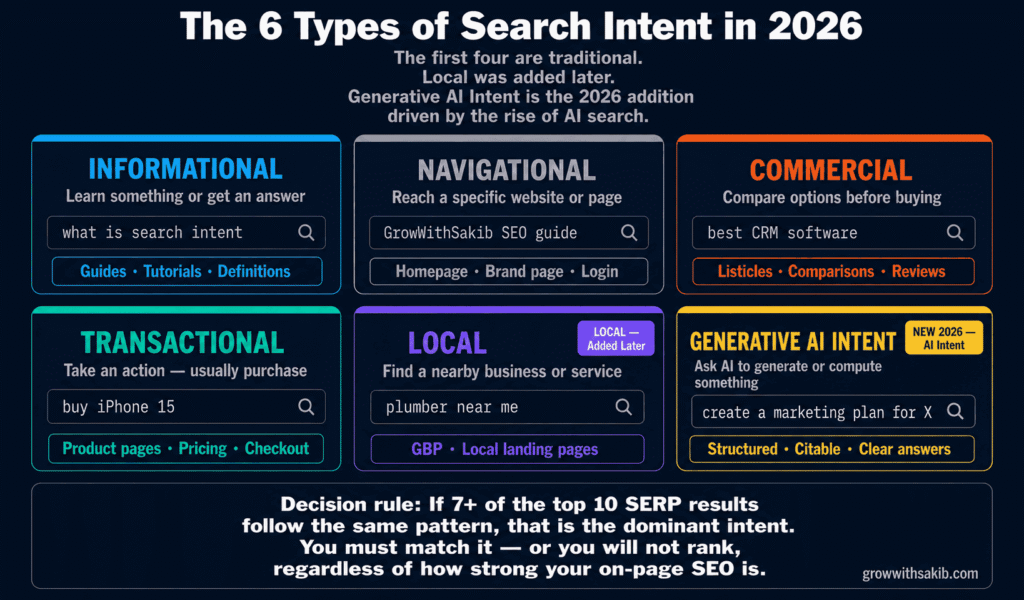
The 6 Types of Search Intent in 2026
The traditional SEO framework recognised four intent types. The 2026 framework — covered in SE Ranking’s analysis of search intent types — adds Local and the new Generative AI Intent, driven by the rise of AI search tools.
1. Informational
- Intent Type: Informational
- What Users Want: Learn something or get an answer
- Example Queries: “what is search intent”, “how does Google rank pages”
- Best Content Format: Guides, tutorials, definitions, explainers
2. Navigational
- Intent Type: Navigational
- What Users Want: Reach a specific website or page
- Example Queries: “Ahrefs blog”, “GrowWithSakib SEO guide”
- Best Content Format: Homepage, brand page, login pages
3. Commercial
- Intent Type: Commercial
- What Users Want: Compare options before buying
- Example Queries: “best CRM software”, “Ahrefs vs Semrush”
- Best Content Format: Listicles, comparisons, reviews
4. Transactional
- Intent Type: Transactional
- What Users Want: Take an action — usually purchase
- Example Queries: “buy iPhone 15”, “Ahrefs pricing”
- Best Content Format: Product pages, pricing pages, checkout
5. Local
- Intent Type: Local
- What Users Want: Find a nearby business or service
- Example Queries: “plumber near me”, “coffee shop SW1”
- Best Content Format: Google Business Profile, local landing pages
6. Generative AI
- Intent Type: Generative AI
- What Users Want: Ask AI to generate or compute something
- Example Queries: “create a marketing plan for X”, “explain Y in simple terms”
- Best Content Format: Structured, citable content with clear answers
The New One: Generative AI Intent
Generative AI intent is the newest category, driven by users increasingly asking AI tools (Google AI Overviews, ChatGPT Search, Perplexity, Gemini) to generate, calculate, summarise, or create something for them. Queries like ‘create a 30-day content plan for a yoga studio’ or ‘summarise the differences between four-day work weeks across countries’ fall here.
For traditional Google search, generative AI intent often triggers an AI Overview at the top of the SERP. Pages that get cited in those overviews tend to have: clear structured answers, named entities, extractable lists and tables, and visible author credentials. Optimising for this intent means writing content AI can cleanly extract — which is the foundation of Generative Engine Optimization (GEO).
How to Identify Search Intent (5-Step Test, No Paid Tools)
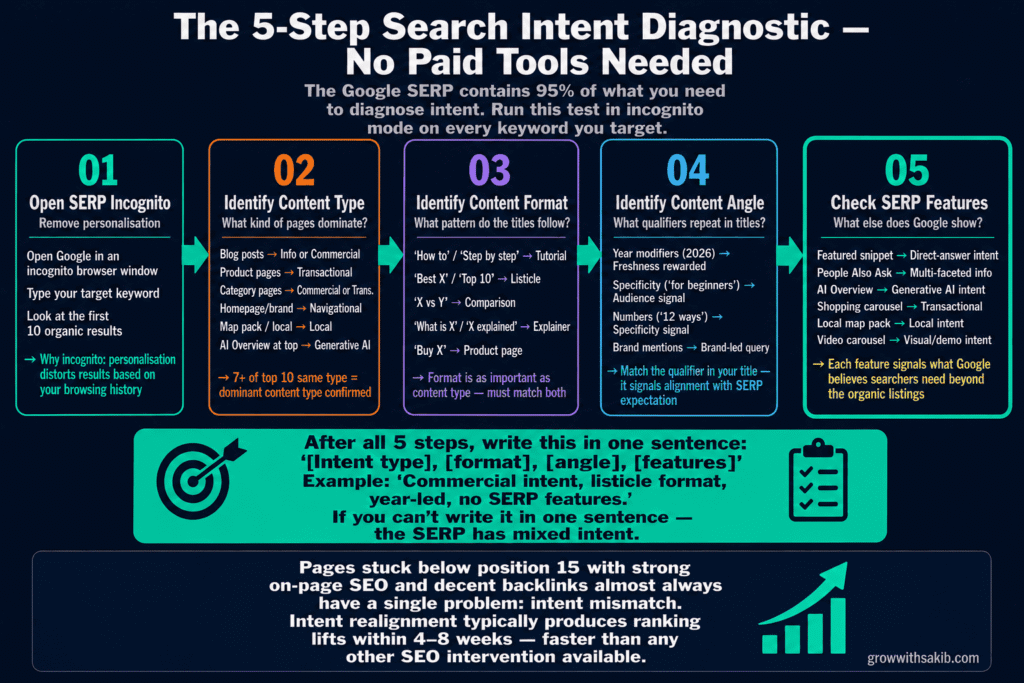
Most articles teach intent identification using paid tools (Ahrefs Keywords Explorer, SE Ranking AI Visibility Tracker). You don’t need them. The Google SERP itself contains 95% of what you need to diagnose intent. Here’s the 5-step test.
Step 1: Open the SERP in an incognito window
Type your target keyword into Google in an incognito browser window. This removes personalisation that could distort the results. Look at the first 10 organic results.
Step 2: Identify the dominant content type
Look at the URLs and titles. Are most results:
- Blog posts? → Informational or commercial intent
- Product pages? → Transactional intent
- Category or listing pages? → Commercial or transactional
- Homepage or brand pages? → Navigational intent
- Map pack / local listings? → Local intent
- AI Overview at top of SERP? → Likely generative AI intent in play
Decision rule: If 7+ of the top 10 are the same content type, that’s the dominant intent. You must match it.
Step 3: Identify the dominant content format
Within the dominant content type, what’s the format pattern? Look at the titles:
- “How to” / “Step by step” → Tutorial format
- “Best X” / “Top 10” / “X reviewed” → Listicle / comparison format
- “X vs Y” → Comparison format
- “What is X” / “X explained” → Definition / explainer format
- “Buy X” / Brand product page → Product format
Step 4: Identify the dominant content angle
Look for repeated qualifiers in the top-ranking titles:
- Year modifiers (2026, latest, updated) → Freshness is rewarded
- Specificity (‘for beginners’, ‘for small business’, ‘free’) → Audience or qualifier signal
- Numbers (’12 ways’, ‘7 tools’) → Specificity in the listicle format
- Brand mentions → Brand-led queries
Step 5: Check the SERP features
Beyond the organic listings, what else does Google show?
| SERP Feature | What It Signals About Intent |
| Featured snippet | Specific direct-answer informational intent |
| People Also Ask box | Multi-faceted informational intent — many related sub-questions |
| AI Overview at the top | Generative AI intent — Google is providing the answer itself |
| Shopping ads / product carousel | Strong transactional or commercial intent |
| Local map pack | Local intent |
| Video carousel | Visual/demonstration intent (consider video content) |
| News carousel | Recency-driven informational intent |
Bottom line: After this 5-step test, you should be able to say in one sentence what the dominant intent is — e.g., “Commercial intent, listicle format, freshness-led, mostly blog posts with current-year qualifiers.” If you can’t say it in one sentence, the SERP probably has mixed intent — covered in the next section.
How to Handle Mixed Search Intent
Some queries don’t have a single clean intent. Google shows a mix of content types because users themselves arrive with different goals. Mangools’ analysis of mixed search intent calls this ‘fractured’ or ‘blended’ intent.
A classic example: ‘best air fryer’. The SERP usually shows:
- Listicle reviews (commercial intent)
- A product page or two (transactional intent)
- An informational ‘what is an air fryer’ explainer (informational intent)
- Sometimes an AI Overview (generative intent)
The Decision Rule for Mixed Intent
When a SERP has mixed intent, follow this order:
- Identify the dominant intent — the format that occupies most of the top 10 results
- Build your page around the dominant intent
- Add secondary intent sections inside the page — e.g., add a brief ‘what is an air fryer’ section to a listicle page
- Don’t try to satisfy 3+ intents on a single page — that produces unfocused content that ranks for none of them
Edge case: When two intents are equally dominant (4–4 split in the top 10), publish two separate pages — one for each intent — and link them with internal anchor text like “Looking to buy? See our product comparison page.”
How to Align an Existing Page with Search Intent
Diagnosis is half the work. Alignment is the other half. Once you’ve identified the dominant intent for your target keyword, here’s how to bring a stagnant page into alignment.
1. A single-product explainer
- If Your Page Is…: A single-product explainer
- And the SERP Wants…: A comparison listicle
- Then Do This: Restructure into a multi-option listicle with your product included as one of several
2. A long-form tutorial
- If Your Page Is…: A long-form tutorial
- And the SERP Wants…: A short product page
- Then Do This: Move the tutorial content to a sibling page; replace this one with a focused product page
3. A landing page with no tool
- If Your Page Is…: A landing page with no tool
- And the SERP Wants…: An interactive tool or calculator
- Then Do This: Build or embed the tool (Ahrefs’ 516% case study followed exactly this path)
4. A blog post
- If Your Page Is…: A blog post
- And the SERP Wants…: A category / hub page
- Then Do This: Restructure as a hub with internal links to the deeper content; preserve traffic via 301 redirects
5. Informational content
- If Your Page Is…: Informational content
- And the SERP Wants…: Transactional listings
- Then Do This: Move informational content to a /guides/ subfolder; build new transactional pages on the original URL
Common Search Intent Mistakes (and What to Do Instead)
1. Picking intent from the keyword itself
- Mistake: Picking intent from the keyword itself
- Why It Fails: Keywords look transactional but the SERP serves informational content — Google decides intent, not your guess
- What to Do Instead: Always check the SERP first, then classify intent
2. Forcing one content type to serve all intents
- Mistake: Forcing one content type to serve all intents
- Why It Fails: Produces unfocused content that satisfies nobody
- What to Do Instead: One page = one dominant intent. Sibling pages for secondary intents.
3. Targeting transactional keywords with blog content
- Mistake: Targeting transactional keywords with blog content
- Why It Fails: Blog posts almost never rank for transactional queries
- What to Do Instead: Use product / category / pricing pages for transactional intent
4. Ignoring AI Overview signals
- Mistake: Ignoring AI Overview signals
- Why It Fails: If Google shows an AI Overview, you need extractable content to be cited — not long meandering prose
- What to Do Instead: Add direct-answer sections, clean tables, named entities
5. Assuming intent never changes
- Mistake: Assuming intent never changes
- Why It Fails: SERPs shift as user behaviour shifts — what was informational last year may now be commercial
- What to Do Instead: Re-check intent for important keywords every 6–12 months
6. Optimising for ‘best of’ intent with brand-only content
- Mistake: Optimising for ‘best of’ intent with brand-only content
- Why It Fails: If 8 of 10 results are multi-brand listicles, your single-brand listicle won’t rank
- What to Do Instead: Include competitors honestly in your listicle — even if you’re one of the products listed
Intent Drift: When Search Intent Shifts Over Time
Search intent is not static. SERPs evolve as user behaviour changes, new content formats emerge, and Google refines its ranking algorithms. A page that perfectly matched intent two years ago may now be misaligned without any change to the page itself.
Signs of Intent Drift
- Steady traffic decline for a page that used to perform well
- Average position drifting downward over 3–6 months with no algorithm update
- Impressions in Google Search Console steady but clicks dropping
- A new SERP feature appearing at the top of your target query (AI Overview, video carousel, knowledge panel)
- Top 3 results changing format from what they were 6–12 months ago
How to Monitor for Intent Drift
Run the 5-step diagnostic test every 6–12 months on your most important commercial pages. Use Google Search Console’s Performance report to spot pages with declining CTR or position trends. For more on the GSC workflow, see the how to use Google Search Console guide on GrowWithSakib.
Honest Limitations of Intent-Based SEO
The override hierarchy is real but not absolute. These are the honest caveats:
- Extreme authority gaps still matter — a brand-new site won’t outrank Wikipedia on a competitive query through intent alignment alone
- Intent isn’t deterministic — Google’s algorithm continually re-tests SERPs. What appears intent-aligned today may shift
- Mixed intent is genuinely hard — even with the decision rule, some queries don’t have a clean dominant intent
- AI search is still evolving — best practices for generative AI intent are likely to change through 2026 as AI Overviews and other engines refine their citation logic
- Intent-perfect content still needs the foundations — title tags, internal links, page speed, and basic on-page SEO all still matter; intent is the top of the stack, not the only thing
Intent alignment is one of the highest-leverage SEO interventions available. But it lives within a broader system — for the rest of the foundation, see the keyword research guide (for finding the right intent-matched keywords), the on-page SEO checklist (for the within-page optimisation that follows intent), and the technical SEO fundamentals article (for the foundations everything else builds on).
Frequently Asked Questions
1. What is search intent in SEO?
Search intent is the goal behind a search query — what the user actually wants when they type those words into Google. According to Google’s Search Quality Evaluator Guidelines, relevance to that intent is the most important ranking signal. Your page must match what searchers want, not just contain the keywords they searched.
2. What are the 6 types of search intent?
The six types are: informational (learning), navigational (reaching a specific site), commercial (comparing options), transactional (taking action like buying), local (finding nearby businesses), and generative AI intent (asking AI to generate or compute something). The first four are traditional; local was added later; generative AI intent is the 2026 addition reflecting the rise of AI search.
3. How do I identify search intent for a keyword?
Open Google in an incognito window and search the keyword. Then check: content type (blog vs product vs category), content format (listicle, tutorial, comparison), content angle (year qualifiers, audience signals), and SERP features (featured snippets, AI Overview, map pack, shopping carousel). If 7+ of the top 10 results follow the same pattern, that’s the dominant intent.
4. Why does search intent override other SEO factors?
Google’s ranking algorithms prioritise relevance — and relevance is fundamentally about intent match. When intent doesn’t match, Google views your page as less relevant regardless of how strong your backlinks, on-page SEO, or domain age are. Ahrefs documented a 516% traffic increase purely by aligning a landing page with intent — without changing links or authority.
5. Can a keyword have multiple search intents?
Yes. Queries like ‘best CRM software’ often have mixed intent — commercial (comparison), informational (what is a CRM), and sometimes transactional (free trials). When SERPs show mixed results, identify the dominant intent (the format that occupies most of the top 10) and build your page around that. Add secondary intent sections within the page, but don’t try to serve 3+ intents from one page.
6. What is generative AI search intent?
Generative AI intent is the newest category, recognised by SE Ranking’s 2026 search intent framework. It describes queries where users ask AI tools to create, calculate, summarise, or generate something — like ‘create a marketing plan for a yoga studio’. Optimising for this intent means structured, extractable content with clear answers, named entities, and visible expertise signals that AI engines can cite.
7. How long does it take to see results from fixing search intent?
Intent realignment is one of the fastest-acting SEO interventions. Pages with intent mismatch fixes typically see ranking lifts within 4–8 weeks of Google recrawling. Pages stuck below position 15 for months often jump into the top 10 once intent is aligned — without any changes to backlinks or domain authority. For the full timeline expectations, see the how long does SEO take guide on GrowWithSakib.
8. Do I need a paid tool to find search intent?
No. The Google SERP itself contains 95% of what you need. Paid tools like Ahrefs Keywords Explorer, Semrush Keyword Magic Tool, or SE Ranking can automate intent classification at scale, but they’re not necessary for diagnosing intent on individual pages. Run the 5-step SERP analysis in incognito mode and you’ll get the same answer manually.
Key Takeaways
- Search intent overrides on-page SEO, backlinks, domain age, and word count when they conflict. Get intent right first; everything else compounds on top.
- There are 6 intent types in 2026: informational, navigational, commercial, transactional, local, and generative AI intent.
- Use the 5-step diagnostic test in an incognito Google window — no paid tools needed. Check content type, format, angle, and SERP features.
- Decision rule for dominant intent: if 7+ of the top 10 results follow the same pattern, that’s the intent you must match.
- For mixed intent: identify the dominant intent, build the page around it, add secondary intent sections within the page. Don’t try to serve 3+ intents from one page.
- Intent realignment is one of the fastest-acting SEO fixes — ranking lifts typically appear within 4–8 weeks of Google recrawling.
- Generative AI intent is the new frontier — optimise for AI Overview citation with structured content, named entities, and clear extractable answers.
- Re-check intent for important pages every 6–12 months. Intent drifts as user behaviour and SERPs evolve.