Ask any experienced SEO professional what single factor most reliably separates websites that rank from websites that don’t — and the answer is almost always the same: links.
Not the length of your content. Not your keyword density. Not even how polished your website looks. The websites that consistently appear on the first page of Google are almost always the ones with the strongest, most relevant backlink profiles.
For beginners, this creates an obvious question: if backlinks are so important, why does nobody explain them clearly without immediately trying to sell you something? This guide fixes that. It covers everything from the absolute basics to advanced strategies — with real data, honest advice, and a clear path forward whether you are starting with zero backlinks or trying to accelerate an existing site.
What Is Link Building? The Complete Beginner’s Foundation
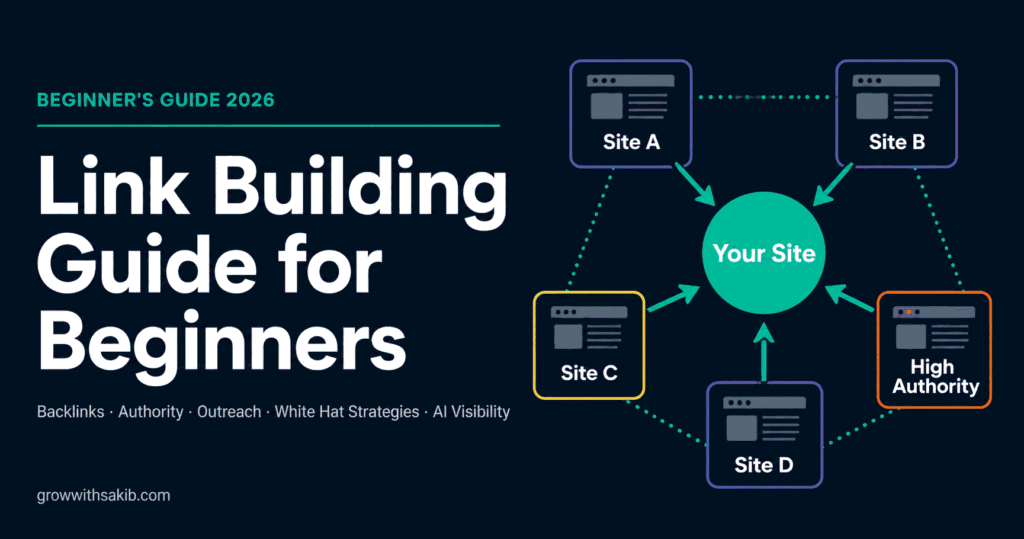
A backlink is simply a hyperlink on one website that points to another website. When Website A links to your website, that is a backlink for you.
Google’s founders, Larry Page and Sergey Brin, built the original PageRank algorithm on a single insight: links between websites function like votes of confidence. A page that many reputable websites link to must be valuable — otherwise, why would trustworthy sources recommend it? That logic, refined over two decades, still underpins how Google evaluates authority today.
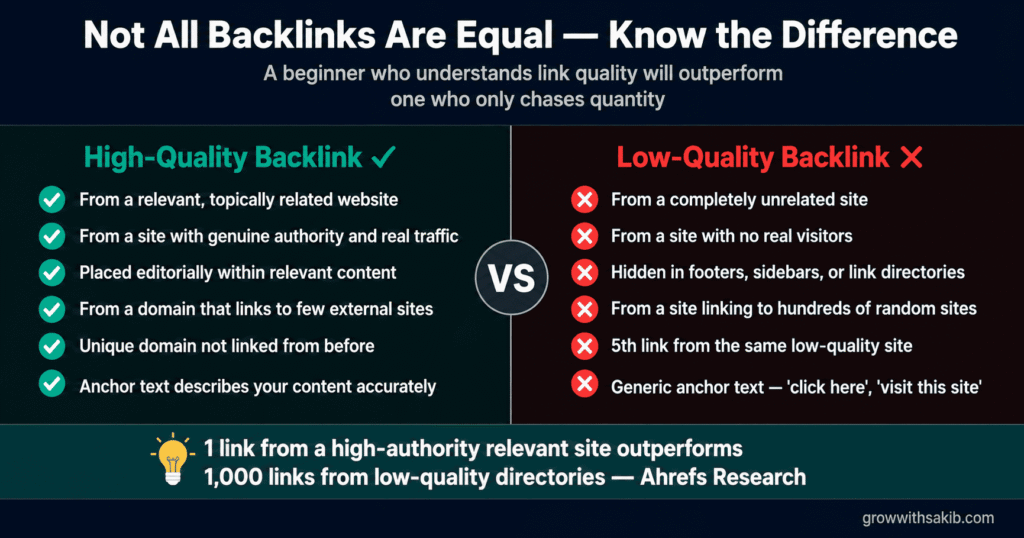
Not all backlinks are equal — understanding link quality
This is the single most important concept in link building. A beginner who understands link quality will outperform an experienced SEO professional who focuses only on link quantity.
High-quality backlink signals
- From a relevant, topically related website
- From a site with genuine authority and real traffic
- Placed editorially within relevant content
- From a domain that links to few external sites
- Unique domain you have not been linked from before
- Anchor text that describes your content accurately
Low-quality backlink signals
- From a completely unrelated site
- From a site with no real visitors
- Hidden in footers, sidebars, or link directories
- From a site linking to hundreds of random sites
- 5th link from the same low-quality site
- Generic anchor text (‘click here’, ‘visit this site’)
The five types of backlinks — and their SEO value
| Link type | What it means | SEO value | Example |
|---|---|---|---|
| Dofollow | Passes SEO authority (link juice) to your site | High — counts as a ranking vote | Most editorial and guest post links |
| Nofollow | Does not pass authority — rel=’nofollow’ attribute | Low direct SEO — still drives traffic | Wikipedia, most forum links |
| UGC | User-generated content — rel=’ugc’ | Low direct SEO | Blog comments, forum posts |
| Sponsored | Paid or affiliate links — rel=’sponsored’ | Must be disclosed — no ranking benefit | Paid placements, affiliate links |
| Editorial | Earned naturally — no request needed | Highest quality — strongest signal | News mentions, organic citations |
The practical takeaway for beginners: focus your energy on earning dofollow, editorial links from relevant websites. Nofollow and UGC links are not worthless — they drive real traffic and contribute to a natural-looking link profile — but they should not be the primary goal of your strategy.
How Google evaluates backlinks in 2026
Google’s link evaluation has become significantly more sophisticated. Three factors matter most:
- Topical relevance: A link from a website covering the same or closely related subject matters more than a link from an unrelated site — even if the unrelated site has higher authority. A Dubai-based restaurant getting linked from a food critic’s blog is more valuable than a link from a generic business directory.
- Domain authority and trust: Links from established sites with real audiences, genuine traffic, and editorial standards carry far more weight than links from newly created sites with no history.
- Link placement: A link placed within the main body of an article carries more value than a link buried in a footer, sidebar, or comment section. Editorial placement — where the author chose to link because your content added value — is the gold standard.
Why Link Building Matters More Than Most Beginners Realise
Many beginners treat link building as an optional add-on to their SEO strategy — something to consider after content and technical SEO are perfect. This is a costly misunderstanding.
Content without backlinks is like a brilliant book published with no distribution. The content may be excellent — but if no authoritative source points to it, Google has no signal to trust it above the thousands of competing pages on the same topic. Link building is how you earn Google’s trust at scale.
The compounding effect — why consistency beats intensity
Link building produces compounding returns in a way that most other SEO activities do not. Each new backlink you earn raises your domain authority slightly. Higher domain authority makes your next piece of content rank faster and higher. Faster rankings attract more organic traffic. More traffic increases the probability that new websites discover and link to your content organically.
This flywheel effect is slow to start — typically taking 3–6 months to become visible — but becomes self-reinforcing over time. Websites that build links consistently for 12–24 months develop a compounding authority advantage that becomes extremely difficult for competitors to overcome quickly.
Link building and AI search visibility in 2026
Beyond Google rankings, backlinks now influence AI search visibility. Ahrefs research found that brand mentions across independent websites correlate with AI citation probability at 0.664 — significantly higher than backlinks alone at 0.218. In practical terms: when credible websites in your industry mention and link to your content, AI systems like ChatGPT, Perplexity, and Google AI Overviews are more likely to recognise your brand as an authoritative source and cite you in their generated responses.
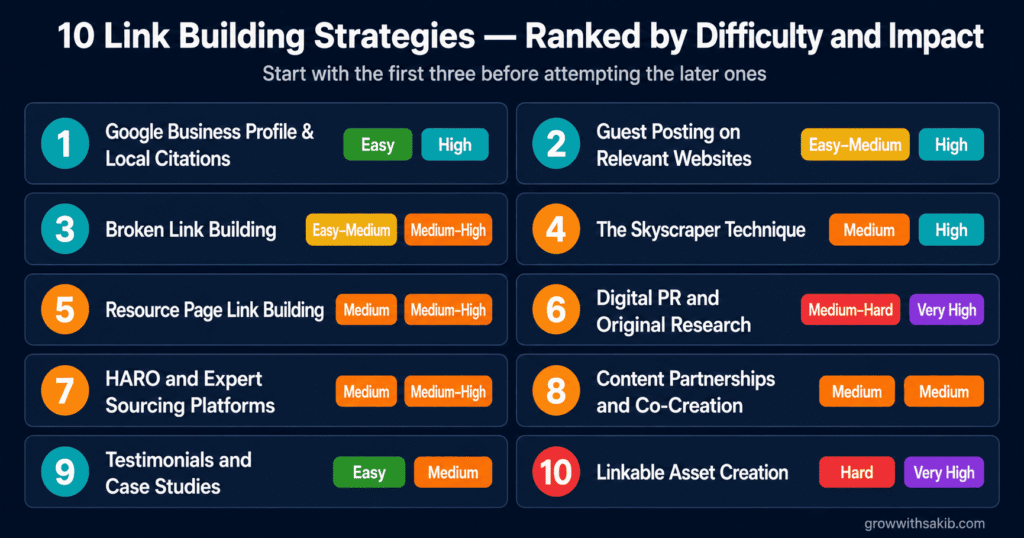
10 Link Building Strategies for Beginners — Ranked by Difficulty and Impact
These are the strategies that consistently produce results in 2026 — ordered from most accessible for beginners to most advanced. Start with the first three before attempting the later ones.
For any local or service business, this is the fastest and most impactful starting point. Your Google Business Profile, when properly set up, creates an authoritative backlink to your website from one of the most trusted domains on the internet — Google itself. Local citation building (listing your business on relevant directories with consistent NAP information) builds geographic authority signals that are foundational for local ranking.
- Claim and fully verify your Google Business Profile at business.google.com
- List your business on UAE-specific directories: Yellow Pages UAE, Dubai Chamber, Gulf Business Directory
- Add your site to industry-specific directories relevant to your niche
- Ensure your Name, Address, and Phone number (NAP) are identical across every listing.
- For Dubai businesses: list on Bayut, Dubizzle, and relevant local platforms depending on your industry
Guest posting means writing an article for another website in exchange for a backlink to yours. It is one of the most reliable and sustainable link building strategies available — because it creates genuine value for both parties. The host site gets quality content; you get a relevant backlink and exposure to a new audience.
- Find targets: search Google for ‘[your niche] write for us’ or ‘[your niche] guest post guidelines’
- Qualify each target: check that the site has real traffic (use Ahrefs or SimilarWeb), genuine editorial standards, and relevance to your niche
- Study their existing content before pitching — propose topics they have not covered recently
- Write a pitch email under 100 words: who you are, the specific topic you want to write about, and why their audience would find it valuable
- Write the article to their standard — not below it. A mediocre guest post earns a mediocre link
- Add your backlink naturally within the content, not forced into the author bio alone
Broken link building is one of the most beginner-friendly advanced strategies. You find links on other websites that point to pages that no longer exist (404 errors), then offer your relevant content as a replacement. The website owner benefits by fixing a broken link; you benefit from the backlink. Everyone wins.
- Install the free browser extension ‘Check My Links’ or ‘LinkMiner’
- Visit relevant websites and blogs in your niche and run the extension to find broken external links
- Use Ahrefs’ Broken Link Checker for more systematic prospecting at scale
- Create or identify content on your site that genuinely replaces what the broken link was pointing to
- Contact the website owner: mention the specific broken link, where you found it, and offer your content as a natural replacement
- Keep outreach emails short, specific, and genuinely helpful — not a generic mass email
Coined by Brian Dean of Backlinko, the Skyscraper Technique involves finding content that has already earned significant backlinks in your niche, creating a definitively better version, and then reaching out to everyone who linked to the original. The logic: if they already linked to content on this topic, they clearly think it is link-worthy. Show them something better.
- Use Ahrefs Content Explorer to find high-backlink content in your niche
- Analyse what makes the existing content linkable — data, comprehensiveness, unique angle, visual design
- Create something genuinely better: more current data, more depth, better examples, cleaner formatting
- Use Ahrefs to find all websites linking to the original content
- Contact each site: mention that you noticed they linked to [original article], explain that you have published an updated, more comprehensive version, and ask if they would consider linking to yours
- Send personalised emails — reference their specific context, not a template
Many websites maintain ‘resource pages’ — curated lists of useful tools, guides, and references for their audience. Getting your content listed on a relevant resource page earns a high-quality editorial backlink with minimal ongoing effort.
- Search Google for: ‘[your niche] resources’, ‘[your topic] useful links’, ‘[your industry] tools and guides’
- Qualify: the page should be actively maintained, topically relevant, and on a site with genuine authority
- Create genuinely useful content worth including — comprehensive guides, original tools, or data-driven research
- Contact the page owner: introduce yourself, reference the specific resource page, and explain clearly why your content adds value to their existing list
- Do not spam — send personalised, specific outreach to pages where your content genuinely belongs
Publishing original research, surveys, or data studies is the most powerful link building strategy available — and one of the most underused by small businesses. When you produce data that journalists, bloggers, and industry publications want to cite, you earn editorial backlinks from high-authority sources that are nearly impossible to replicate through outreach alone.
- Identify a question in your niche that no existing data answers clearly
- Conduct a survey (Google Forms is free), analyse public data, or document a pattern from your own client work
- Publish the findings as a dedicated research page or data study
- Create a visual summary (infographic or chart) that journalists can embed easily
- Send a press release to relevant publications, industry blogs, and journalists who cover your niche
- Example: at GrowWithSakib, publishing data from our own client research across Dubai businesses earned links from three regional marketing publications — without any paid placement
Help A Reporter Out (HARO) and similar platforms (Qwoted, SourceBottle, ResponseSource) connect journalists seeking expert quotes with sources willing to provide them. When a journalist uses your quote, they typically link back to your website. A single HARO placement in a major publication can be worth more than dozens of directory links.
- Sign up at helpareporter.com (free tier available) and select categories relevant to your expertise
- Check emails three times daily — journalists have tight deadlines and early responses win
- Write responses that are specific, quotable, and genuinely expert — not generic
- Keep responses under 200 words and lead with your most valuable insight immediately
- Include your name, title, and website URL at the end of every response
- Be patient — HARO link building takes consistency. Expect 1 placement per 10–15 quality responses
Partnering with complementary businesses or content creators to produce joint content — interviews, collaborative guides, expert roundups — naturally generates backlinks from both partners’ audiences. Both parties share the content; both earn backlinks.
- Identify businesses in your space that complement rather than compete with you
- Propose a specific collaboration: an interview, a joint webinar, a co-authored guide, or an expert roundup
- Each partner publishes on their own site and links to the partner’s contribution
- For Dubai-based businesses: local business communities, Dubai Chamber of Commerce events, and UAE-specific industry groups are natural starting points for partnerships
- Document the collaboration on both sites with proper attribution and backlinks
Writing testimonials for tools, services, or products you genuinely use often earns a backlink from the vendor’s testimonials page. Similarly, becoming a case study for a tool you use can earn a high-authority link from a company with significant domain authority.
- List the tools, services, and software your business actively uses and has genuine results with
- Contact the company’s marketing team and offer a specific, results-focused testimonial
- Mention a real outcome: ‘Using [tool], we reduced our content production time by 40%’ performs better than ‘Great tool, highly recommend’
- Ask if they publish customer case studies — offer to participate if your results are strong
- This strategy works especially well with SEO tools (Ahrefs, Semrush), hosting providers, and industry-specific software
A linkable asset is a piece of content so genuinely useful that other websites naturally link to it over time without outreach. The upfront investment is high — but the compounding returns are exceptional. Examples include free tools, comprehensive calculators, original datasets, authoritative ultimate guides, and visual explainers.
- Identify what your audience needs that does not exist anywhere in a genuinely useful form
- Examples: a free keyword difficulty calculator, an original industry survey, a comprehensive template library, or a visual guide that explains a complex concept clearly
- Invest properly in quality — a linkable asset that earns 200 natural backlinks over two years will outperform 10 guest posts in long-term SEO impact
- Promote the asset at launch through social media, email lists, and direct outreach to relevant publications
- Update it annually — the content that continues earning links is content that stays accurate and useful
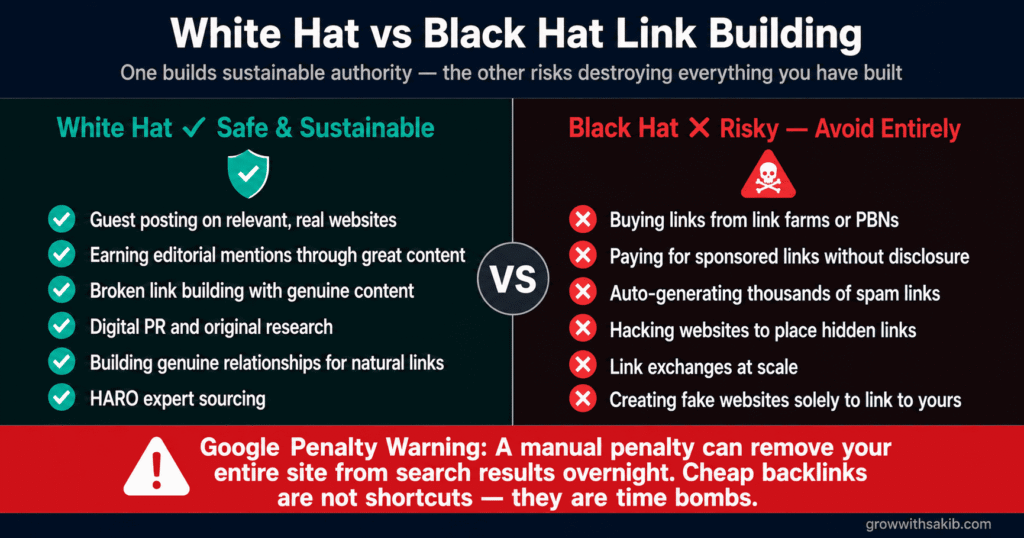
White Hat vs Black Hat Link Building — What Beginners Must Understand
Before investing time or money in link building, you need to understand the distinction between strategies that build sustainable authority and strategies that risk destroying everything you have built.
| White hat (safe and sustainable) | Black hat (risky — avoid entirely) |
|---|---|
| Guest posting on relevant, real websites | Buying links from link farms or PBNs |
| Earning editorial mentions through great content | Paying for ‘sponsored’ links without disclosure |
| Broken link building with genuine content | Auto-generating thousands of spam links |
| Digital PR and original research | Hacking websites to place hidden links |
| Building genuine relationships for natural links | Link exchanges (‘I link to you, you link to me’ at scale |
| HARO expert sourcing | Creating fake websites solely to link to yours |
How to Audit Your Existing Backlink Profile
Before building new links, understand what you already have. A backlink audit reveals your current baseline, identifies toxic links that may be dragging your rankings down, and highlights the link gaps between you and your competitors.
Step-by-step backlink audit for beginners
- Open Google Search Console (free) → Links section → Top linking sites. This shows you which domains are already linking to you and which pages are earning the most links.
- Export your backlink profile from Ahrefs, Semrush, or Moz. Check each linking domain for relevance, authority, and traffic. Links from completely unrelated, low-traffic sites are the first to investigate.
- Identify toxic links: signs include sites with no real content, exact-match anchor text overdose (more than 30% of links using the same keyword phrase), sites in foreign languages with no connection to your niche, and sites flagged by Google as spam.
- Compare your profile to 3 top-ranking competitors using Ahrefs or Semrush. The domains linking to them but not to you represent your highest-priority outreach targets.
- Disavow truly toxic links: if you identify links that are clearly harmful and cannot be removed by contacting the site owner, use Google’s Disavow Tool as a last resort. Do not disavow aggressively — removing good links is a common beginner mistake.
Essential Link Building Tools for Beginners
You do not need all of these. Start with the free tools and add paid ones as your strategy scales.
Google Search Console
- Best for: Backlink overview
- What it does: Shows top linking domains and pages — the best free starting point
- Free/Paid: Free
Ahrefs
- Best for: Full backlink analysis
- What it does: Most comprehensive backlink database. Competitor gap analysis, link prospecting, broken link finding
- Free/Paid: Paid (limited free)
Semrush
- Best for: Backlink audit + outreach
- What it does: Toxic link identification, competitor backlink analysis, outreach tools
- Free/Paid: Paid (free trial)
Moz Link Explorer
- Best for: Domain authority check
- What it does: DA scores, spam score, link profile overview for prospectingeach tools
- Free/Paid: Free (limited)
Hunter.io
- Best for: Email finding for outreach
- What it does: Find contact emails for any domain — essential for outreach campaigns
- Free/Paid: Free (25/month) + Paid
Check My Links
- Best for: Broken link finding
- What it does: Browser extension that finds 404 errors on any page — great for broken link building
- Free/Paid: Free
HARO (Help a Reporter)
- Best for: Editorial link earning
- What it does: Connect with journalists seeking expert quotes — earn high-authority editorial links
- Free/Paid: Free + Paid tiers
BuzzSumo
- Best for: Linkable content research
- What it does: Find the most-linked content in any niche — powers Skyscraper Technique
- Free/Paid: Paid (limited free)
Link Building Outreach — How to Write Emails That Get Responses
Most link building strategies require outreach — contacting website owners, editors, and journalists to request or earn backlinks. This is also where most beginners fail, because they send generic, self-serving emails that get ignored or deleted.
The anatomy of an outreach email that works
- Subject line: Specific, not clickbait. ‘Quick question about your [topic] article’ outperforms ‘Partnership opportunity’ every time.
- Opening: Reference something specific about their work — an article they wrote, a position they took, a tool they built. One sentence that proves you actually read their content.
- The ask: State it clearly and without apology. Vague emails create friction. ‘I noticed you linked to [broken page] — I have created an updated version at [your URL] that might be a good replacement’ is better than three paragraphs of build-up.
- What they get: Every outreach email should make clear what value the recipient receives — not just what you want. Fix a broken link. Add new information their audience would benefit from. Offer a perspective they have not published.
- Length: Under 120 words. Every additional word reduces your response rate. If you cannot make your case in 120 words, the pitch is not ready.
Outreach email template — broken link building
Link Building Mistakes Beginners Make
These are the most common and costly link building errors — and the fix for each.
| Mistake | Consequence | What to do instead |
|---|---|---|
| Buying cheap bulk backlinks | Google penalty — site removed from search results | Build links through genuine content and relationships |
| Ignoring link relevance | Low-quality signal even from high-DA sites | Only pursue links from topically relevant websites |
| Over-optimised anchor text | Triggers Penguin algorithm flag as manipulation | Vary anchor text naturally — brand name, URL, generic, and keyword mix |
| Chasing quantity over quality | Many weak links create a messy, low-trust profile | 10 quality links beat 1,000 directory links every time |
| Building links before fixing technical SEO | Links land on pages Google cannot index or trust | Fix crawlability and indexing issues before starting outreach |
| Sending template outreach to everyone | Near-zero response rate — wastes weeks of effort | Personalise every email — one specific reference per contact |
| Expecting results within weeks | Abandoning strategy before it compounds | Commit to 6–12 months before evaluating impact |
| Ignoring internal links | Authority from external links stays siloed on one page | Internally link from high-backlink pages to important target pages |
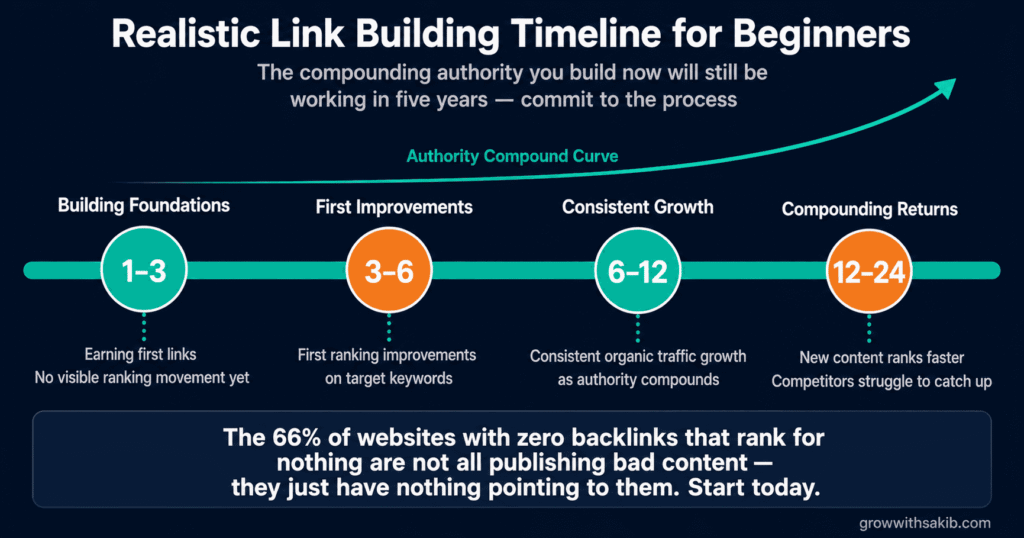
How to Measure Link Building Success
Link building is a long-term investment — and measuring it requires patience and the right metrics. Here is what to track and how often.
Monthly metrics
- Referring domains growth: Track the number of unique domains linking to your site in Google Search Console or Ahrefs. Consistent monthly growth — even 5–10 new domains — compounds significantly over 12 months.
- Domain Rating (Ahrefs) or Domain Authority (Moz): These scores increase slowly — expect a 1–3 point rise per month with consistent link building. A jump of 10+ points in a month is suspicious and may indicate low-quality link velocity.
- Organic keyword rankings: The ultimate proof of link building success. Track your target keywords monthly in Google Search Console or Ahrefs.
Quarterly metrics
- Organic traffic growth: Compare quarter-over-quarter organic sessions in Google Analytics 4. Link building impact typically shows up in traffic 3–6 months after the links are acquired.
- Competitor backlink gap: Run a competitor analysis in Ahrefs or Semrush to see how your referring domain count compares to your top 3 competitors. The gap tells you how much work remains.
- Link quality audit: Check for any new toxic or irrelevant links that appeared in your profile. Disavow if necessary.
Link building is the part of SEO that requires the most patience — and produces the most durable results. The 66% of websites with zero backlinks that rank for nothing are not all publishing bad content. Many are publishing genuinely good work that nobody can find because nothing points to it.
The businesses I have helped build authority at GrowWithSakib share one pattern: they stopped chasing shortcuts and started building genuine assets. A well-researched guide that earns 50 editorial backlinks over 18 months will outperform any link scheme — and those 50 links will still be working in five years.
Start with your Google Business Profile if you have not already — it is free, fast, and foundational. Then pick one strategy from this guide that matches your current resources and commit to it for 90 days. Track your referring domains. Watch your rankings. Then add the next strategy.
The compounding authority you build through consistent, legitimate link building is one of the few genuinely durable competitive advantages in digital marketing. Start building it today.
Frequently Asked Questions
How many backlinks do I need to rank?
There is no universal number — it depends entirely on the competitiveness of your target keyword. A local keyword like ‘SEO expert in Dubai’ might require 20–50 quality backlinks to rank on page one. A national keyword like ‘link building guide’ might require 200–500. Use Ahrefs or Semrush to check how many referring domains the current top-ranking pages have for your specific keyword — that is your realistic benchmark.
Is link building still relevant in 2026 with AI search?
More relevant than ever. Links remain one of Google’s confirmed top-three ranking factors. In AI search, brand mentions across credible external sources directly influence citation probability — and many of those mentions come through the same content and relationship strategies that produce backlinks. A strong link profile improves visibility in both traditional and AI search simultaneously.
Can I do link building myself or do I need to hire someone?
The foundational strategies — Google Business Profile, local citations, guest posting, broken link building — are entirely manageable as a beginner with 3–5 hours per week. More advanced strategies like Digital PR, large-scale outreach campaigns, and linkable asset creation benefit from dedicated time or professional help. Start with what you can manage consistently, and add complexity as your baseline grows.
How do I know if a backlink is hurting or helping me?
Check the linking site for three things: relevance (does it relate to your topic?), real traffic (use SimilarWeb or Ahrefs — zero traffic sites are usually low quality), and editorial standards (is there real human-written content?). Red flags include sites with dozens of external links per page, sites in unrelated languages, and sites with near-identical content across every page. Use Google Search Console to monitor if specific link acquisitions coincide with ranking drops.
What is anchor text and how should I manage it?
Anchor text is the clickable text of a hyperlink. If a website links to yours with the text ‘SEO guide for beginners,’ that phrase is the anchor text. A natural, healthy anchor text profile includes a mix of: your brand name, your domain URL, generic phrases (‘click here,’ ‘read more’), descriptive phrases related to your content, and some exact keyword matches. Over-optimisation — where the majority of links use the same exact keyword as anchor text — triggers Google’s Penguin algorithm as a manipulation signal.
Is guest posting safe in 2026?
Guest posting on genuine, relevant websites with real audiences is completely safe and effective. Guest posting at scale on low-quality sites purely for links — what Google calls ‘link schemes’ — carries penalty risk. The distinguishing factor: if the content you are creating would genuinely serve the host site’s readers, guest posting is legitimate and valuable. If you are producing thin content purely as a vehicle for a link, it is a scheme.
How long does it take for a new backlink to impact rankings?
Typically 4–12 weeks from when Google discovers and processes the link. You can accelerate discovery by sharing the linking page on social media or submitting it through Google Search Console’s URL inspection tool. However, a single backlink rarely produces a dramatic ranking change — the impact of link building is cumulative and becomes visible after multiple quality links accumulate over several months.