Here is the hard truth: most small businesses publish content the same way they buy lottery tickets — with hope but without a plan. A blog post goes up when someone has time. Three Instagram posts go out that week. A newsletter gets sent when someone remembers. Then six weeks pass, nothing happens, and the business owner concludes that content marketing does not work.
It does work. But only when it is built on a real strategy.
After more than a decade working in SEO and content strategy, I have seen the same pattern repeat itself with businesses of every size. The businesses that succeed with content are not the ones that publish the most. They are the ones that publish with purpose — with a clear understanding of their audience, their keywords, their funnel, and their goals.
This guide gives you the exact framework I use to build content strategies for small businesses in 2026 — one that works for traditional Google SEO and for AI search engines like ChatGPT, Gemini, and Google AI Overviews. Every statistic is sourced. Every step is actionable. Nothing is generic.
What Is Content Strategy — And Why Does It Matter?
Content strategy answers five core questions before you write a single word:
- Who are you creating content for — specifically?
- What problems does your content solve for that person?
- What keywords are they using to find those answers?
- Which content formats will reach them most effectively?
- What business outcome does each piece of content serve?
Think of it this way: a blog without a strategy is a diary. A blog with a strategy is a sales asset.
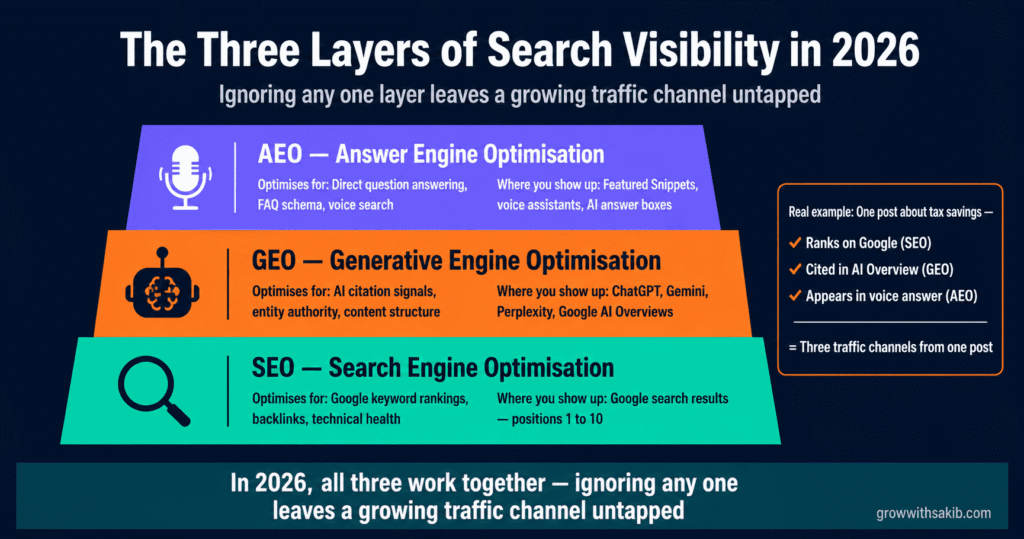
SEO, GEO, and AEO: The Three Layers of Visibility in 2026
| Layer | What It Optimises For | Where You Show Up |
|---|---|---|
| SEO | Google keyword rankings, backlinks, technical health | Google search results — positions 1 to 10 |
| GEO | AI citation signals, entity authority, content structure | ChatGPT, Gemini, Perplexity, Google AI Overviews |
| AEO | Direct question answering, FAQ schema, voice search | Featured Snippets, voice assistants, AI answer boxes |
Step One: Define Your Content Goals
Before writing anything, you need to know what you want your content to achieve. This sounds obvious — but most small businesses skip it entirely, publishing content because they feel they should rather than because each piece serves a defined purpose.
Every piece of content should serve at least one of these five goals:
- Drive organic search traffic — attracting new visitors through Google and AI search.
- Generate leads — capturing emails, consultation requests, or direct enquiries.
- Build topical authority — becoming the recognised expert in your subject area.
- Nurture existing leads — keeping warm prospects engaged until they are ready to buy.
- Support sales conversations — answering objections and building confidence before a prospect speaks to you.
| Goal | Best Content Type | How to Measure |
|---|---|---|
| Drive organic traffic | Long-form blog posts (1,500–3,000 words) | Organic clicks via Google Search Console |
| Generate leads | Lead magnets, free guides, consultation landing pages | Lead conversion rate in GA4 |
| Build topical authority | Content clusters — 1 pillar page + 6–8 supporting posts | Keyword ranking improvements over 90 days |
| Nurture leads | Email sequences, case studies, comparison guides | Email open rate, click-through rate |
| Support sales | Testimonials, FAQ pages, service detail pages | Conversion rate on bottom-of-funnel pages |
Step Two: Know Your Audience at a Deep Level
The most common reason small business content fails to resonate is not poor writing — it is poor audience understanding. Content that converts is content that makes the reader feel: “This was written exactly for me.”
Most businesses describe their audience in demographic terms: age range, location, job title. That is a starting point, not an insight. What you need to understand is the psychographic layer — the fears, frustrations, failed attempts, and dreams that drive your audience’s behaviour.
The five questions that reveal your audience’s real content needs
| Question to Ask | What It Reveals |
|---|---|
| What is their #1 daily frustration? | The core pain point your content must address to earn attention |
| What solutions have they already tried that failed? | What NOT to recommend — this builds immediate credibility |
| What do they search for late at night? | Your highest-intent keyword opportunities |
| What does success look like for them in 12 months? | The transformation your content promises and must deliver |
| Why have they not solved this problem yet? | The hidden objection your content must address before they will act |
Step Three: Keyword Research the Right Way
The three types of keywords every small business needs
| Keyword Type | Search Intent | Example | Funnel Stage |
|---|---|---|---|
| Informational | Wants to learn | what is content strategy for small business | Top — awareness |
| Commercial | Comparing solutions | best content marketing tools for small business | Middle — consideration |
| Transactional | Ready to hire or buy | content strategy consultant for small business | Bottom — decision |
Why long-tail keywords are the small business advantage
Large publications like HubSpot, Neil Patel, and Semrush dominate broad terms like ‘content strategy.’ A new or small website cannot compete with those domain authorities immediately. Long-tail keywords change the competitive landscape entirely. They have lower competition, higher conversion intent, and — critically — are far more likely to trigger GEO citations in AI-generated answers.
- Instead of: ‘content strategy’ → impossibly competitive for a new site
- Target: ‘content strategy for small business with no marketing budget’ → specific, winnable, high intent
- Instead of: ‘SEO tips’ → dominated by major publications
- Target: ‘how to improve SEO for a local service business in 2026′ → clear intent, low competition, GEO-ready
Step Four: Choose the Right Content Formats
- Long-form blog posts (1,500–3,000 words). The foundation of SEO and GEO. A thoroughly researched, well-structured article targeting a specific keyword can drive traffic for years without additional spending. Depth is the differentiator — covering a topic more completely and usefully than any competing page.
- FAQ pages with schema markup. One of the highest-performing formats for AI citations. FAQ schema tells Google and AI engines exactly what question you are answering, dramatically increasing your chances of appearing in Featured Snippets and AI Overviews. Start by collecting every question customers ask you and building a dedicated FAQ page.
- Pillar pages and content clusters. A pillar page is a comprehensive guide on a broad topic. Surrounding it with 6–10 supporting articles that link back to it creates a content cluster — the strongest topical authority signal for both Google and AI engines.
- Case studies. The most persuasive bottom-of-funnel content. A well-written case study documenting a real client’s situation before, the exact steps taken, and the measurable results achieved is harder for any competitor to replicate than any other content type.
- Email newsletter. Your email list is the only audience you truly own. Social platforms can change their algorithms overnight. A consistent weekly or fortnightly email — one useful insight, one practical tip — builds a direct relationship that compounds over time.
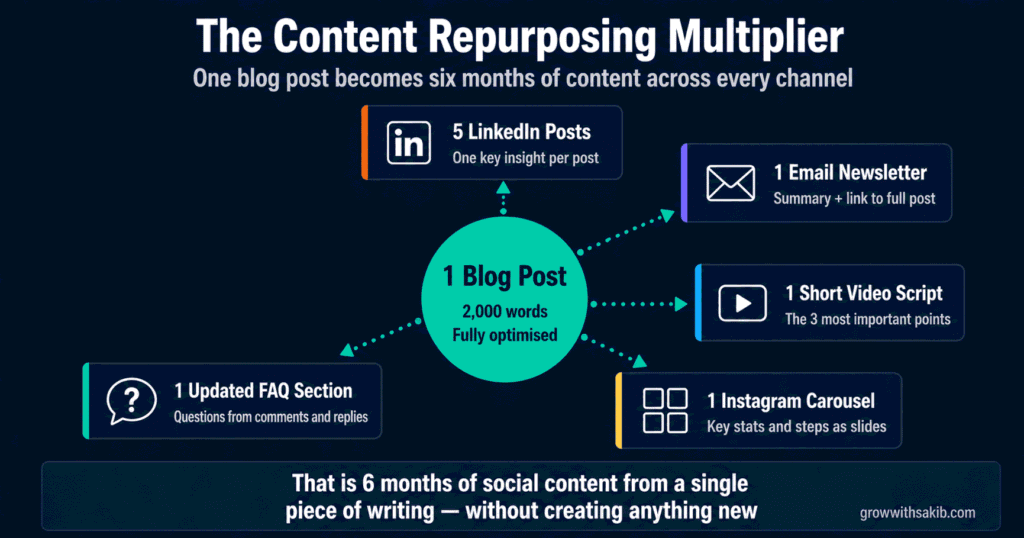
- Short-form video and content repurposing. One long-form blog post contains at least five social media posts, one email newsletter, and one short video script. Repurposing multiplies the reach of each idea without multiplying the work.
Step Five: Optimise Every Piece of Content for GEO
The 7 GEO signals that determine whether AI engines cite your content
- Direct answer in first 150–200 words. AI engines evaluate the opening of your page first. Answer the primary question directly and completely within the first 150–200 words. Do not build up to the answer — lead with it. According to Enrich Labs GEO Guide 2026, pages with direct-answer openings receive significantly more AI citations than pages with narrative introductions.
- Question-format H2 and H3 headers. Headers written as natural questions — ‘How do I create a content calendar?’ rather than ‘Content Calendar Creation’ — are pattern-matched by AI systems and far more likely to be selected for citation.
- Specific, verifiable data with named sources. According to Superlines AI Search Statistics 2026, content with statistics, citations, and quotations achieves 30–40% higher visibility in AI responses. Named sources are a citation magnet for both AI engines and traditional SEO.
- Structured FAQ section with schema markup. A dedicated FAQ section, marked up with FAQ schema, is one of the fastest routes to appearing in both Google’s Featured Snippets and AI Overviews. According to Marketing LTB GEO Statistics, FAQ schema pages receive disproportionately more AI citations across most content verticals.
- Clear entity signals — author and brand. AI engines need to identify the author and organisation behind content to evaluate trustworthiness. A clear author bio with credentials, a professional website, and consistent brand mentions across the web all contribute to entity recognition and citation selection.
- Internal topical linking. Connecting every post to related posts on your site builds a web of topical authority that AI engines use to gauge how comprehensively you cover a subject. A single excellent article is good. Ten interconnected articles covering all aspects of a topic signals genuine expertise.
- Regular content freshness. According to Superlines, pages updated within the past two months earn 28% more AI citations than older, unrefreshed content. Add a visible ‘Last Updated’ date and refresh your cornerstone posts every six months.
Step Six: Build E-E-A-T Into Every Piece of Content
| E-E-A-T Signal | What It Means | How to Implement It in Your Content |
|---|---|---|
| Experience | You have personally done what you are writing about | Share real client results, specific situations you have encountered, before-and-after data from your own work. Use first-person: ‘In my experience…’ or ‘A client I worked with recently…’ |
| Expertise | You have deep specialist knowledge in this area | Display credentials, years of experience, and specific technical understanding. Explain why things work — not just what to do |
| Authoritativeness | Others in your field recognise your knowledge | Get cited or linked to by other reputable sites. Publish original research. Write for industry publications. Be mentioned in AI-generated answers |
| Trustworthiness | Your content is accurate, honest, and transparent | Cite all statistics with named sources and links. Acknowledge limitations. Be transparent about who you are, how to contact you, and when content was last updated |
Step Seven: Build the Technical Foundation First
Core technical requirements for content strategy success
| Technical Factor | Why It Matters | How to Check |
|---|---|---|
| Core Web Vitals (LCP, INP, CLS) | Google uses page experience as a direct ranking signal. A slow page buries your content regardless of quality. | Google PageSpeed Insights — free tool, check monthly |
| Mobile optimisation | Over 60% of all searches happen on mobile devices (Google, 2024). Content that breaks on mobile loses rankings and readers. | Google Search Console — Mobile Usability report |
| XML Sitemap submitted to Google Search Console | Helps Google and AI crawlers discover and index new content. Without it, posts can take weeks to appear in search. | Google Search Console — Sitemaps section |
| Crawlable pages (check robots.txt and Cloudflare settings) | Common issue: Cloudflare and WordPress security plugins accidentally block AI crawlers like GPTBot. Content that cannot be crawled cannot be cited. | Check robots.txt file — ensure GPTBot is not disallowed |
| FAQ and Article schema markup | Structured data tells Google and AI engines exactly what your content is about. FAQ schema pages receive disproportionately more AI citations. | Rank Math or Yoast SEO plugin — Schema tab |
| HTTPS secure hosting | A non-HTTPS site is flagged as insecure and ranks lower. All content must be served over HTTPS. | Check browser address bar for padlock icon |
Step Eight: Map Content to the Full Buyer Journey
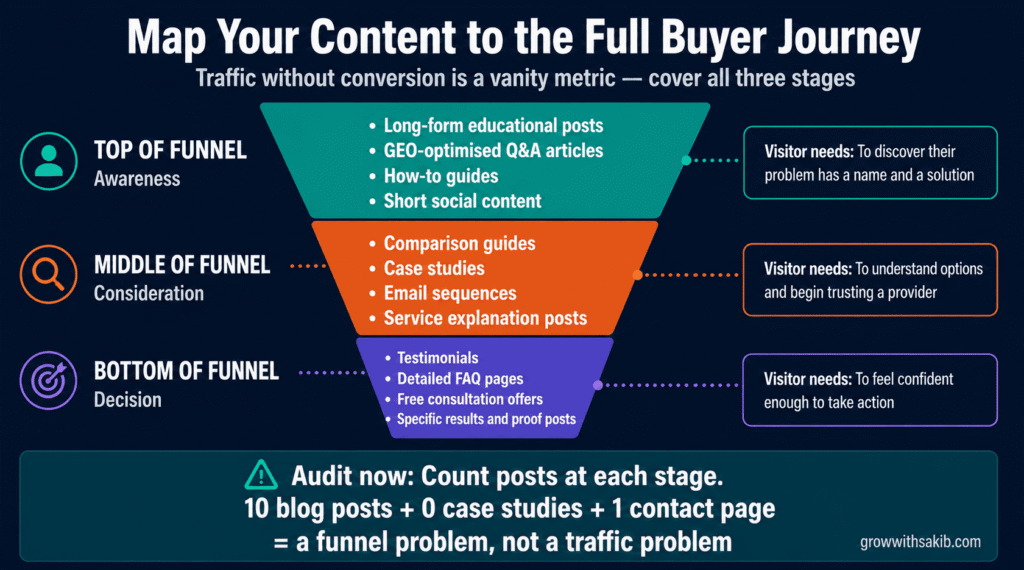
One of the most costly content strategy mistakes is concentrating all your content at the top of the funnel — broad educational posts that attract visitors but provide no mechanism for converting them into leads or customers. Traffic without conversion is just a vanity metric.
| Stage | What the Visitor Needs | Best Content Formats |
|---|---|---|
| Awareness (Top of Funnel) | To discover that their problem has a name and a solution | Long-form educational posts, GEO-optimised Q&A articles, short social content, how-to guides |
| Consideration (Middle of Funnel) | To understand their options and begin trusting a specific provider | Comparison guides, case studies, email sequences, detailed service explanation posts |
| Decision (Bottom of Funnel) | To feel confident enough to take action | Testimonials, detailed FAQ pages, free consultation offers, specific results and proof posts |
Audit your content right now: Count how many pieces you have at each funnel stage. If you have ten blog posts (top of funnel), no case studies (middle), and a single generic contact page (bottom), you have a funnel problem — not a traffic problem. Your next piece of content should be a case study or a detailed FAQ page, not another informational blog post.
Step Nine: Build a Realistic Content Calendar
Consistency beats intensity every time. Publishing four thoroughly optimised pieces of content per month for twelve consecutive months will outperform publishing twenty posts in January and then going silent. Search engines and AI systems both reward consistent, predictable publishing patterns.
| Week | Content Task | Goal |
|---|---|---|
| Week 1 | 1 long-form blog post (1,800+ words) — GEO-optimised, question-format headers, FAQ section, primary keyword, all statistics sourced | Organic traffic + AI citations |
| Week 2 | 3 social media posts repurposed from Week 1 blog + 1 email newsletter to existing subscribers | Audience nurture + awareness |
| Week 3 | 1 supporting FAQ post or ‘how to’ guide targeting a long-tail keyword from the same topic cluster | Topical authority + GEO depth |
| Week 4 | 1 case study or client result post — OR — refresh one existing post with updated data and new statistics | Conversion + AI freshness signal |
Step Ten: Measure What Actually Matters
Vanity metrics — likes, impressions, and raw page views — feel good but have no reliable relationship to business outcomes. Here are the metrics that actually indicate whether your content strategy is working.
SEO metrics — track monthly via Google Search Console and GA4
- Organic search clicks and impressions — how many people find your content through Google. Your primary SEO health indicator.
- Average keyword position — movement for your target keywords shows whether your SEO strategy is gaining traction over time.
- Click-through rate (CTR) — a high impression count with a low CTR means your title tag and meta description need improvement, even if your ranking is strong.
- Pages indexed — confirms Google has found and indexed new content. Posts not appearing within 2–4 weeks indicate a technical crawling issue.
GEO metrics — track monthly with manual checks
- AI citation frequency — search your target queries in ChatGPT, Perplexity, and Google AI Overview mode. Are you being cited? Which queries trigger your content?
- Brand mentions in AI answers — track whether your brand name or website URL appears in AI-generated answers over time. This builds brand authority even without a click.
- Referral traffic from AI platforms — track in GA4 under traffic sources. According to Semrush data, visitors arriving from AI-powered search convert at approximately 4.4x the rate of traditional organic visitors.
Business metrics — track monthly
- Lead conversion rate — what percentage of content visitors become leads? Aim for 1–3% for informational content, 5–10% for bottom-of-funnel pages. This is the true ROI metric.
- Email subscriber growth rate — measures whether your content is compelling enough for people to want more of it in their inbox.
- Content-attributed revenue — for businesses using a CRM, tracking which leads came from which content pieces reveals your highest-converting articles and informs future content investment.
The 9 Content Strategy Mistakes Small Businesses Make
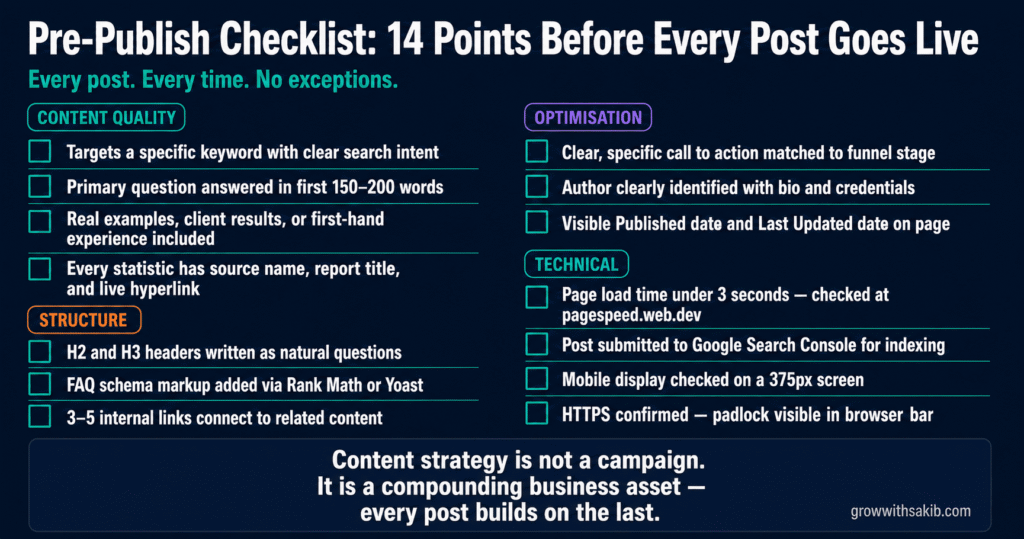
The Pre-Publish Checklist: 14 Points Before Every Post Goes Live
Content strategy is not a campaign or a one-time project. It is a compounding business asset — every post you publish builds on the last, every keyword ranking you earn feeds the next, every AI citation you receive builds brand authority that becomes increasingly difficult for competitors to replicate.
The businesses that dominate organic search in 2027 and 2028 are the ones building their content strategy right now. According to McKinsey, AI-powered search has already become the number one digital discovery channel for buying decisions in the United States (August 2025). Every month spent publishing content without a strategy — without proper keyword research, without GEO structure, without verified sources — is a month of compounding authority given to a competitor who started earlier.
Start with one post. Target one keyword. Answer one question better than anyone else has answered it. Source every statistic. Build from there. That is how every successful content strategy begins — and how it scales.
Frequently Asked Questions
How long does it take for a content strategy to show results?
Most small businesses see initial keyword ranking improvements within 6–12 weeks of consistent, well-optimised publishing. Meaningful organic traffic growth typically begins at 3–6 months. According to the Content Marketing Institute, significant lead generation from content usually requires 9–12 months of consistent execution. GEO citations can appear faster — sometimes within 4–8 weeks — when content is properly structured with direct answers and question-format headers.
How much content does a small business need to publish?
Quality consistently outperforms quantity in content strategy. According to HubSpot’s blogging research, one thoroughly researched, well-structured 2,000-word post per week outperforms four thin 500-word posts in both rankings and conversion rates. For most small businesses without a dedicated content team, one comprehensive post per week plus three repurposed social posts is a sustainable and effective publishing cadence.
Do I need a blog to have a content strategy?
A blog is the highest-ROI format for long-term organic traffic, but it is not the only option. A strong content strategy can be built around a thoroughly optimised FAQ page, detailed service pages with schema markup, a regularly updated Google Business Profile, and a consistent email newsletter. These four assets together can drive meaningful organic visibility for a local business — particularly when combined with Local SEO optimisation and schema markup.
What is the difference between content strategy and content marketing?
Content strategy is the plan — goals, audience research, keyword targets, format choices, publishing schedule, and measurement framework. Content marketing is the execution — the actual creation, publication, and distribution of content. Strategy must come before marketing. Creating content without a strategy is like building a house without architectural plans: the result may be technically constructed but will not function as intended.
How do I know which content topics to write about?
The best content topics come from three sources: the questions your customers ask most frequently (check emails, DMs, and sales calls), keyword research using free tools like Google Search Console and AnswerThePublic, and gaps in competitor content where you can provide a more complete or useful answer. Prioritise topics that sit at the intersection of high audience interest, reasonable keyword competition, and your genuine area of expertise.
Can a small business compete with large brands in content marketing?
Yes — and often more effectively. Large brands produce generic, brand-safe content for broad audiences. Small businesses can produce content that is more specific, more locally relevant, and more genuinely expert within a niche. According to Ahrefs, long-tail keywords — where small businesses have the greatest competitive advantage — account for 91.8% of all searches. Depth of coverage on a narrow subject beats breadth across many subjects for building topical authority.
How does content strategy connect to SEO in 2026?
Content strategy and SEO are inseparable in 2026. SEO provides the keyword intelligence that tells you what your audience is searching for. Content strategy translates that intelligence into a publishing plan. Every post in a content strategy should target a specific keyword — and every SEO campaign needs content to execute it. According to Google AI Overviews research, 88% of keywords that trigger AI Overviews are of informational intent — exactly the type of content a well-planned content strategy produces.
What tools do I need to start a content strategy?
To start, you need three free tools: Google Search Console (keyword data and indexing), Google Analytics 4 (audience behaviour and conversion tracking), and AnswerThePublic (question-based keyword discovery). For WordPress sites, Rank Math (free) handles on-page SEO and schema markup. As your strategy matures, paid tools like Ahrefs or Semrush add competitive keyword data — but they are not required to start.