Here is something I see constantly working with small business owners: they invest time and money in a website, maybe run a few paid ads, maybe post on Instagram — and then wonder why the phone is not ringing from Google searches. The website looks good. The service is genuinely excellent. But Google has no idea they exist.
The problem is almost never the business itself. It is a missing strategy called SEO — and more specifically, the kind of SEO that works for small businesses operating in competitive local markets.
SEO (Search Engine Optimisation) is the process of making your website clear, trustworthy, and useful enough that Google naturally recommends it to people already searching for your services. Unlike paid ads, where visibility stops the moment the budget runs out, SEO builds compounding, long-term traffic that grows over time without an ongoing spend.
Where to Start: The Right Order Matters
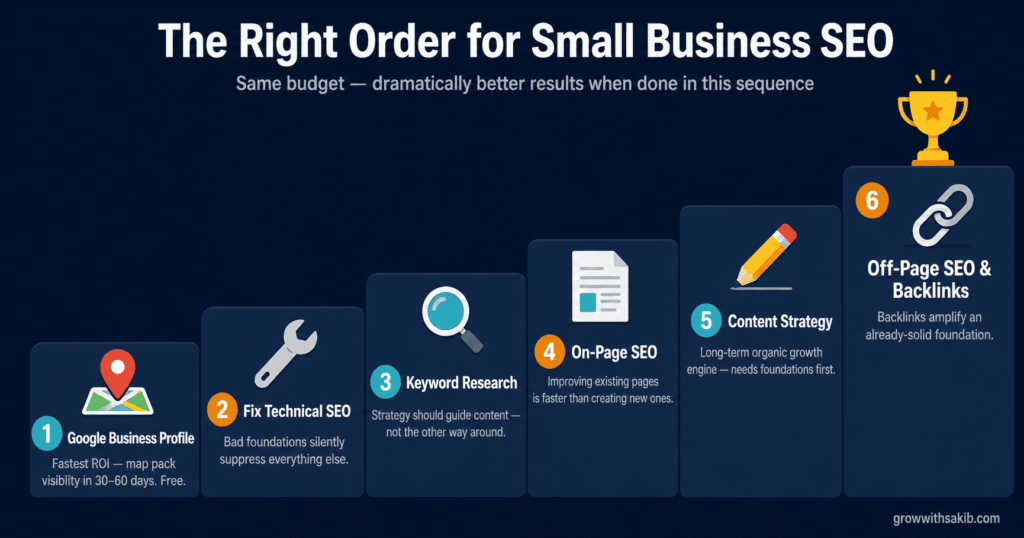
One of the most common mistakes small businesses make is attacking SEO in the wrong sequence — spending weeks on blog content before fixing basic technical issues, or building backlinks before the Google Business Profile is set up. The order you tackle SEO in directly affects how quickly you see results.
Based on real experience working with small businesses from scratch, this is the sequence that produces the fastest, most sustainable results:
| Priority | Step | Why this order |
|---|---|---|
| Step 1 (Start here) | Claim and fully optimise your Google Business Profile | Fastest ROI available — can produce map pack visibility within 30–60 days. Free to create. |
| Step 2 | Fix core technical SEO issues | Bad technical foundations silently suppress everything else you do. |
| Step 3 | Research and map your keywords | Keyword strategy should guide content — not the other way around. |
| Step 4 | Optimise existing pages (on-page SEO) | Improving existing pages is faster than creating new ones. |
| Step 5 | Build your content strategy | Long-term organic growth engine — needs the above foundations first. |
| Step 6 | Build authority (off-page SEO) | Backlinks amplify an already-solid foundation — weak without it. |
Keyword research is not about finding words with the highest search volume. It is about finding the specific phrases that real buyers in your market type into Google at the moment they are ready to make a decision — and then creating the most useful answer to those searches. The complete keyword research guide covers the full discovery process using only free tools.
After analysing keyword strategies across dozens of small business clients, I have noticed that the businesses ranking consistently well are not the ones targeting the most popular keywords. They are the ones targeting the most relevant keywords for their specific audience and location.
The Four Pillars of Modern Keyword Research
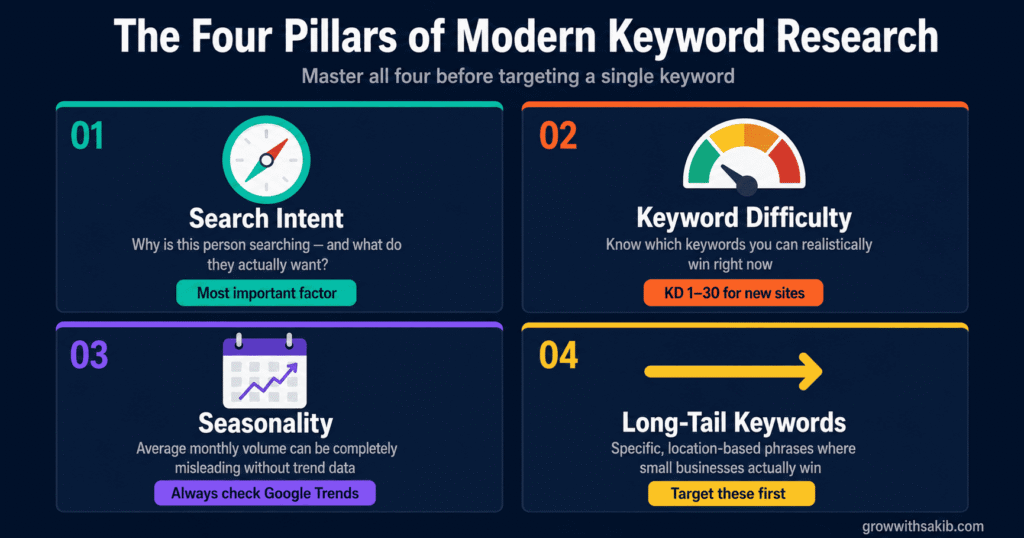
1. Search intent — the most important factor
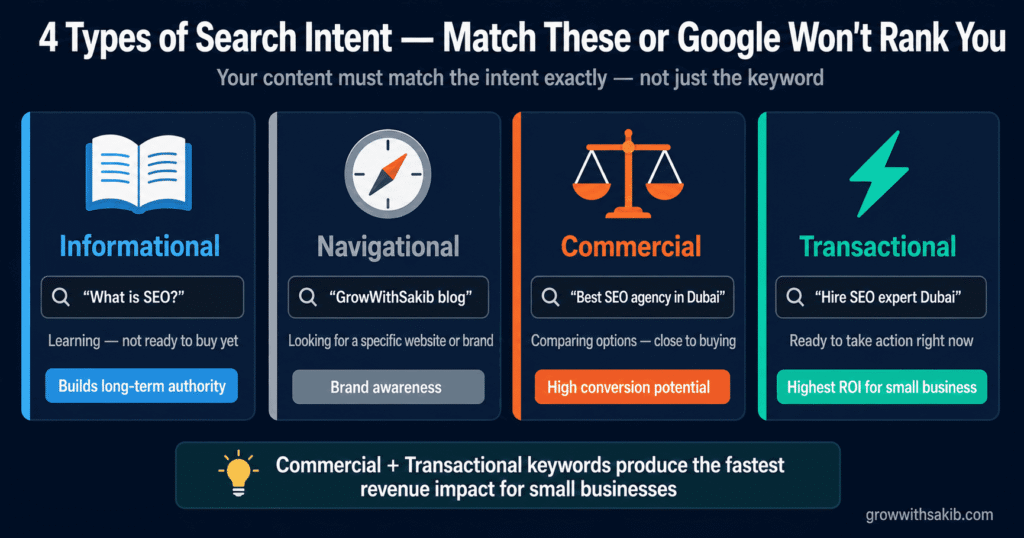
Before targeting any keyword, ask one question: why is this person searching? Search intent falls into four categories, and your content must match the intent exactly or Google will not rank it — see the search intent guide for SERP examples of each type and how to map content format to intent.
| Intent type | What the searcher wants |
|---|---|
| Informational — ‘What is SEO?’ | Learning and understanding — not ready to buy yet |
| Navigational — ‘GrowWithSakib blog’ | Looking for a specific website or brand |
| Commercial — ‘Best SEO agency in Dubai’ | Comparing options before deciding — close to buying |
| Transactional — ‘Hire SEO expert Dubai’ | Ready to take action right now — high conversion potential |
For most small businesses, commercial and transactional keywords produce the fastest revenue impact. Informational keywords build long-term authority and trust. A balanced strategy includes both.
2. Keyword difficulty — know where you can actually win
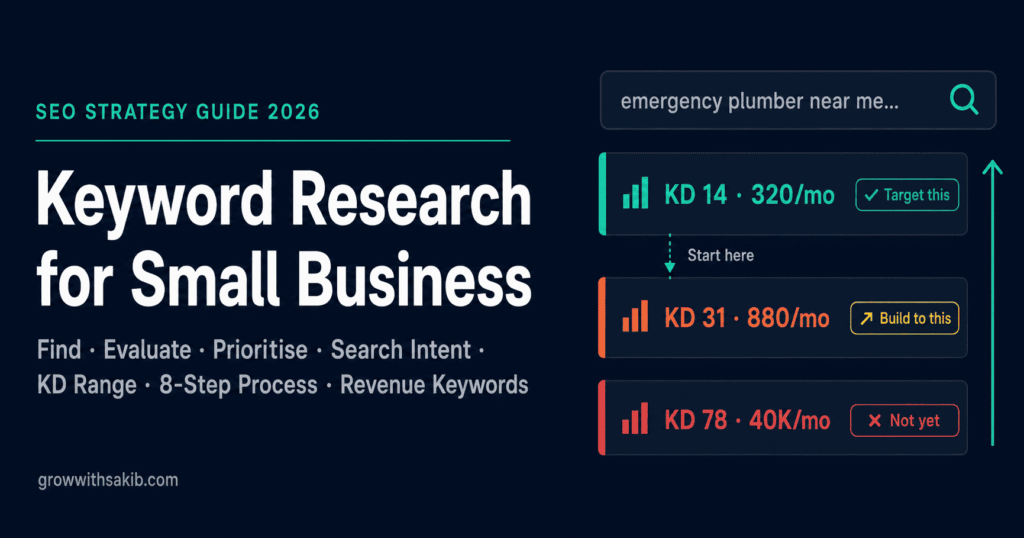
Every keyword has a Difficulty score (KD) that indicates how hard it is to rank for. Many small businesses make the mistake of targeting highly competitive keywords from day one — and then giving up when nothing happens after six months.
| KD Range | Level | Best for | What you need to rank |
|---|---|---|---|
| 1–30 | Easy | New websites / fresh domains | Solid content + basic on-page SEO |
| 31–70 | Medium | Established small businesses | Quality content + some authority + internal links |
| 71–100 | Hard | Only with strong domain authority | Expert execution + strong backlink profile required |
The practical rule: New websites should spend their first 6–12 months building authority through KD 1–30 keywords. Once you have domain authority from those wins, medium-difficulty keywords become achievable. Trying to skip this progression is the single most common reason small business SEO campaigns stall.
3. The Seasonality Trap — what tools do not show you
This is one of the most expensive mistakes I see small businesses make with keyword research, and almost no SEO guide covers it properly. Keyword tools show average monthly search volume. That average can be completely misleading.
4. Long-tail keywords — where small businesses actually win
Trying to rank for ‘SEO’ as a small business is like trying to find one specific person in a stadium holding 80,000 fans. It is not impossible — but it is the hardest possible way to start, and you will compete against global brands with millions in SEO budgets. The long-tail keywords guide makes the full mathematical case for why this strategy wins for small businesses. Instead, use specific, location-based, problem-specific phrases — this is especially critical for service-based businesses with nothing physical to photograph or compare.
| Broad keyword (avoid to start) | Long-tail alternative (target these) |
|---|---|
| SEO | SEO services for small restaurants in Dubai |
| Digital marketing | Affordable digital marketing for local businesses UAE |
| Website design | WordPress website design for freelancers in Dubai |
| Social media marketing | Instagram marketing for small salons in Dubai |
| Content writing | SEO content writing for real estate agencies Dubai |
Zero-volume keywords — a trap with a silver lining
Ranking for a zero-search-volume keyword is fast and easy. It is also completely worthless if nobody is searching for it. However, zero-volume keywords can have hidden value when they represent emerging trends not yet captured by keyword tools, or hyper-local phrases that tools undercount because their data panels are too small.
The rule: never build your entire strategy around zero-volume keywords. But do not ignore them either — a keyword with zero recorded volume can still bring you warm leads if the intent matches your service exactly.
SERP Features — the real goal in 2026
Ranking #5 on a SERP crowded with ads, map packs, and AI Overviews can generate almost no clicks. Before targeting a keyword, check the Google results page for that term and ask: what is actually clickable here?
- Featured Snippets: Answer a question directly in one clear paragraph — Google pulls these as position zero results above all organic rankings.
- Google AI Overviews: In 2026, Google uses Gemini to generate AI summaries for many searches. Your content needs to be factual, clearly structured, and directly answer the search query to appear in these summaries.
- Map Pack: Local businesses should prioritise appearing in the 3-pack of map results — which requires Google Business Profile optimisation, not website ranking.
- People Also Ask: These expandable questions are opportunities to capture additional visibility with short, precise answers.
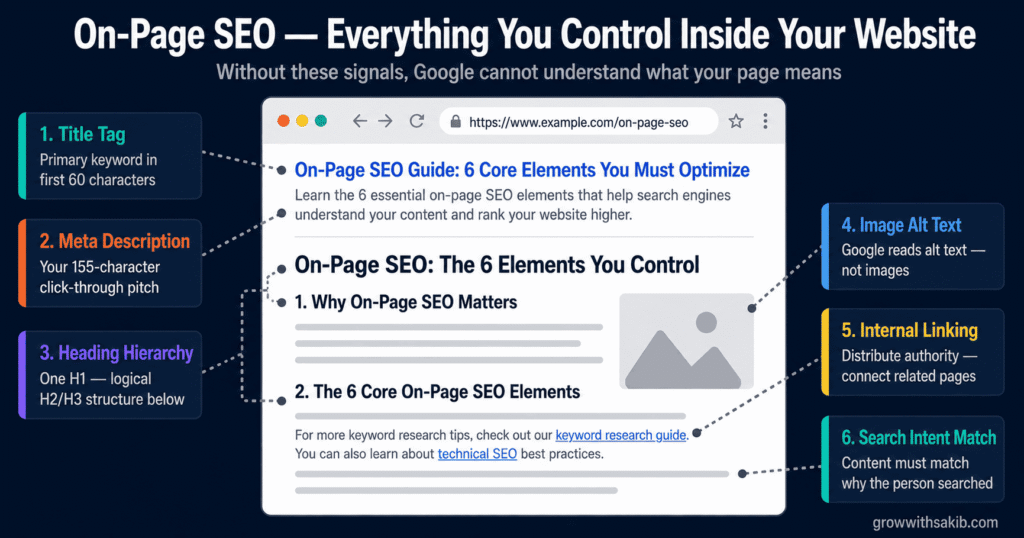
Google is software, not a human. No matter how well-written your content is, Google needs signals to understand what it means and who it serves. On-page SEO provides those signals — and without them, even genuinely excellent content can go completely undiscovered. The on-page SEO checklist turns every element below into a 12-point auditable list.
The Core On-Page SEO Elements
Title tag and meta description
Your title tag is the clickable headline in Google search results. It is the single most powerful on-page signal after your content itself — the guide to writing SEO title tags covers formulas, character limits, and CTR copywriting techniques. Your primary keyword should appear in the first 60 characters of your title tag. Your meta description (the grey text below the title) does not directly affect rankings, but it directly affects click-through rate — which indirectly does.
A well-written meta description tells the searcher exactly what they will get if they click, and why your page is better than the nine others on the same results page. Think of it as your 155-character sales pitch.
Headings (H1, H2, H3 hierarchy)
Your page should have exactly one H1 — the main topic of the page. Subheadings (H2, H3) should follow a logical hierarchy that mirrors how a reader would navigate the page. Headings are not just organisational tools — they are signals that help Google understand context and topic structure. Pages with clear heading hierarchies are also significantly more likely to be cited in AI Overviews.
Keyword placement — context over frequency
Modern Google does not count how many times a keyword appears on a page. It understands context. A page about ‘SEO for restaurants in Dubai’ that also naturally mentions ‘Google Business Profile,’ ‘local search visibility,’ ‘menu pages,’ and ‘customer reviews’ signals deep topical relevance — far more powerfully than a page that repeats ‘SEO for restaurants in Dubai’ fifteen times.
Use your primary keyword naturally in the title, first paragraph, one H2, and throughout where it fits genuinely. Then focus on related terms that establish context.
Image alt text
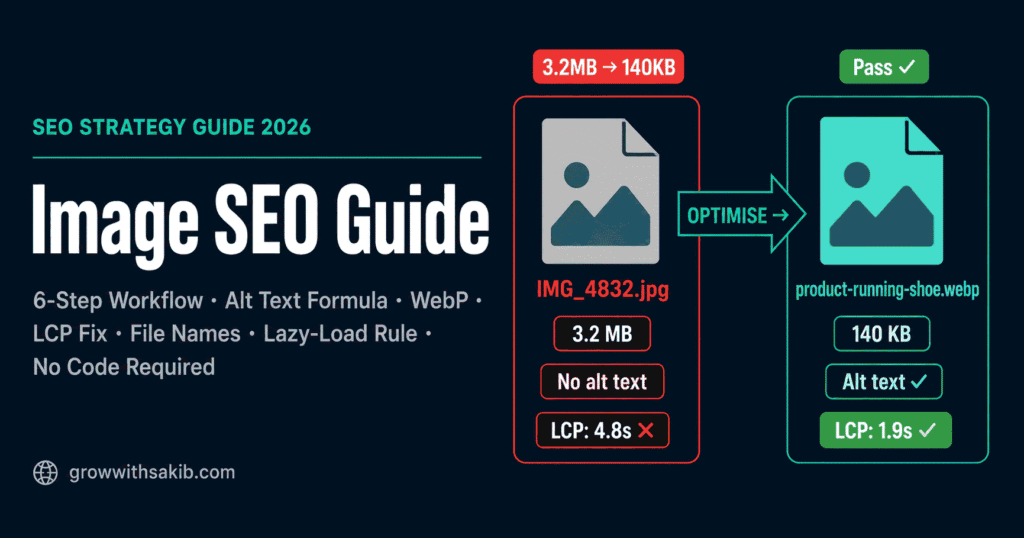
Google cannot see images — it reads the alt text you provide to understand what they contain. Every image on your site should have a descriptive alt text that explains what the image shows and, where relevant, includes your target keyword naturally. The image SEO guide covers alt text, file naming, compression, and WebP conversion. This is also critical for accessibility — screen readers use alt text to describe images to visually impaired users.
Internal linking
Internal links connect your pages to each other, distribute ranking authority across your site, and help Google understand how your content is organised. A case study from Backlinko documented a 250% traffic increase within one week of adding strategic internal links — without publishing any new content. Every new page you publish should link to at least two related pages already on your site — the internal linking strategy guide covers the full 4-layer system, anchor text rules, and how to find orphan pages.
Search intent alignment
The most technically perfect page on the internet will fail if it does not match the intent behind the search. If someone searches ‘how to do keyword research’ they want a guide — not a sales page for your keyword research services. Mismatched intent is one of the leading causes of high bounce rates, which signals to Google that your page is not delivering what searchers expected.
Technical SEO is the part of search optimisation that nobody sees — but everybody feels the results of. It is the difference between a website that Google can fully crawl, render, and trust, and one that Google repeatedly visits but partially understands.
The hard truth: I have reviewed dozens of small business websites where excellent content was sitting completely undiscovered — not because the content was weak, but because technical issues were preventing Google from properly reading it. Fix technical SEO first, and everything else you do becomes significantly more effective.
Core Technical SEO Checklist for Small Businesses
- Site speed and Core Web Vitals: Google uses Core Web Vitals as direct ranking signals. Target LCP (loading) under 2.5 seconds, INP (interactivity) under 200ms, and CLS (visual stability) under 0.1. For WordPress sites: switch to faster hosting, install a caching plugin (WP Rocket or LiteSpeed Cache), compress images using ShortPixel, and defer non-critical JavaScript. Most default WordPress setups score below 50 on mobile PageSpeed — moving above 70 produces measurable ranking improvement.
- Mobile-first indexing: Google indexes the mobile version of your site first. If your website does not work perfectly on a 375px mobile screen — with tappable buttons, readable text, and fast load times — your rankings reflect that. Over 80% of searches now happen on mobile devices.
- HTTPS (SSL Certificate): Google confirmed HTTPS as a ranking signal in 2014. In 2026 it is a baseline requirement. If your site still runs on HTTP, browsers display ‘Not Secure’ warnings — which drive visitors away before they even read a word.
- XML Sitemap: Submit your sitemap to Google Search Console. This gives Google a complete map of your site and helps ensure all important pages are indexed. For WordPress, Rank Math or Yoast generate this automatically.
- Robots.txt: This file tells search engines which pages to crawl and which to ignore. Accidentally blocking important pages — or your whole site — is one of the most common and damaging technical mistakes. Check yours at yourdomain.com/robots.txt.
- Broken links and 404 errors: Broken internal links waste crawl budget and frustrate users. Use Google Search Console (free) or Screaming Frog to find and fix them regularly — see the free SEO tools guide for the complete toolkit comparison.
- Canonical tags: If your site has multiple URLs showing the same content (HTTP and HTTPS, WWW and non-WWW, paginated versions), canonical tags tell Google which version is the primary one — preventing duplicate content penalties.
Off-page SEO is about how the rest of the internet talks about you. When reputable, relevant websites link to yours, Google interprets those links as votes of confidence — signals that your content is trustworthy and worth recommending. The domain authority guide explains how that authority is measured and built from zero.
The golden rule: one backlink from a genuine, relevant, authoritative source is worth more than 1,000 links from spammy directories. Google’s Penguin algorithm update specifically targets manipulative link patterns — and buying cheap bulk backlinks is one of the fastest ways to earn a Google penalty that removes your site from search results entirely.
How to Build Backlinks That Actually Help
- Guest posting: Write genuinely useful articles for respected publications in your industry. The link back to your site carries real authority — and the audience exposure is valuable even without the SEO benefit.
- Niche-relevant directory listings: Get listed in industry directories and local business listings that are genuinely relevant to your sector. For a Dubai-based business, UAE Chamber of Commerce listings and local business directories carry meaningful local authority.
- Broken link building: Find pages in your niche that link to dead URLs, and offer your content as a replacement. The site owner benefits by fixing a broken link — you benefit from the backlink.
- Digital PR and media mentions: Being quoted as an expert in industry publications, local news, or niche blogs earns the kind of editorial backlinks that carry the highest trust signals. Ahrefs research shows brand mentions correlate with AI citation probability at 0.664 — higher than backlinks alone at 0.218.
- Existing relationships: Suppliers, partners, professional associations, and satisfied clients are often willing to link to businesses they work with. Start with the relationships you already have.
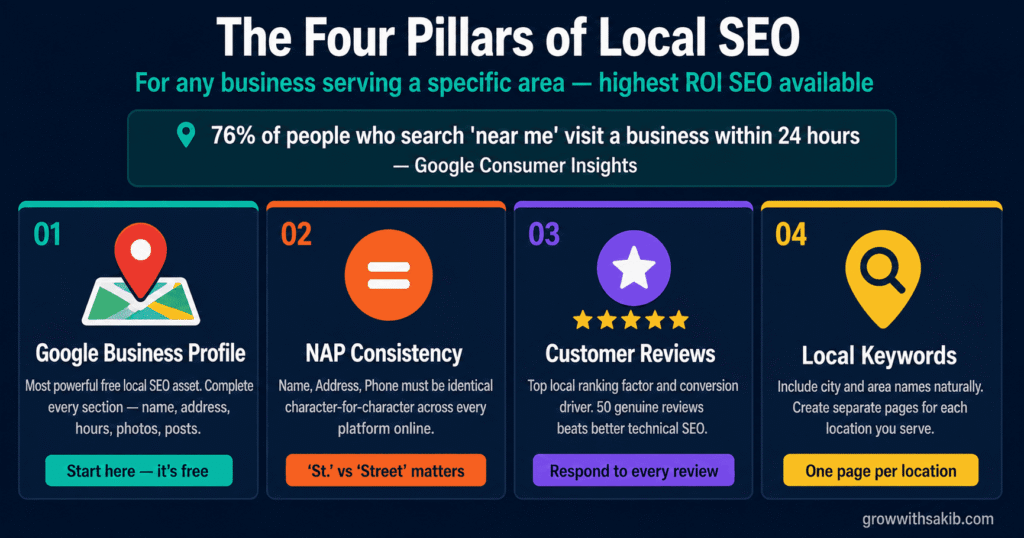
For any business serving a specific geographic area, local SEO is the single highest-return SEO investment available. Google reports that 76% of people who conduct a nearby search on their phone visit a business within 24 hours. That means local search traffic converts into real visits, real calls, and real revenue at a rate that national organic traffic rarely matches.
The Four Pillars of Local SEO
1. Google Business Profile (GBP) — start here
Your Google Business Profile is your most powerful local SEO asset — and it is completely free. A fully optimised GBP appears in Google Maps, the local Map Pack (the three business listings shown above organic results), and increasingly in Google AI Overviews for local queries. The GBP optimisation guide covers every profile section with a 30-day action plan.
Complete every section: business name, address, phone number, hours, website, category, services, photos, and posts. Businesses with complete profiles receive significantly more visibility than those with partial information. If you are in Dubai, make sure your address is pin-accurate on Google Maps — especially for areas like Business Bay, JLT, or DIFC where multiple businesses share building addresses.
2. NAP consistency — the detail that matters more than most people realise
NAP stands for Name, Address, Phone number. Your NAP must be identical — character for character — everywhere it appears online: your website, GBP, social profiles, directories, and review platforms. The NAP consistency guide covers the audit framework and the most important directories to check. Even small inconsistencies like ‘St.’ vs ‘Street’ or ‘+971’ vs ‘00971’ send conflicting signals to Google about whether these are the same business or different ones.
3. Customer reviews — the ranking factor and the conversion driver
Reviews are one of the top local ranking factors — and also one of the most powerful conversion drivers. A business with 50 genuine 4.8-star reviews will consistently outperform a competitor with 5 reviews, even if the competitor has better technical SEO.
Build a simple review process: after completing a job, send clients a direct link to your Google review page. Make it as easy as one click. Respond to every review — positive and negative. Google’s algorithm rewards active engagement.
4. Local keyword strategy
Every service page and blog post should include your city or area name where it fits naturally. ‘SEO expert in Dubai,’ ‘digital marketing services Business Bay,’ and ‘content strategy for UAE businesses’ all signal geographic relevance to Google.
For businesses serving multiple areas, create separate service pages for each location — not one generic page. A dedicated page for ‘SEO services in Abu Dhabi’ will always outrank a single page trying to capture all UAE cities at once. For an industry-specific example, see the local SEO for restaurants guide.
Content is how Google evaluates your expertise, understands your topics, and decides whether to recommend you to searchers. Without content, there is nothing for Google to rank. But in 2026, the volume of content you publish matters far less than the quality, depth, and strategic organisation of it.
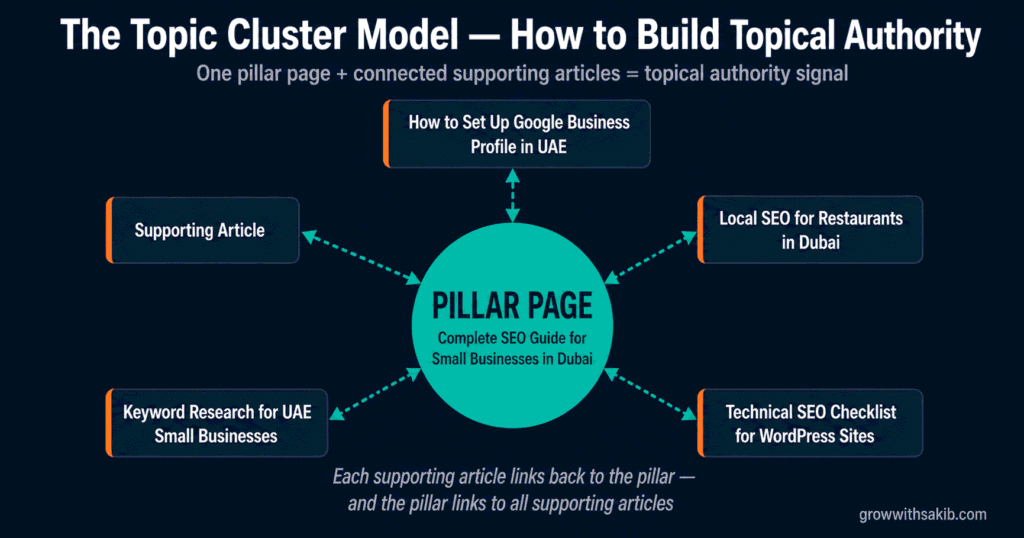
The Topic Cluster Model — how to build topical authority
Rather than publishing random blog posts around unrelated keywords, a topic cluster strategy organises your content into interconnected subject areas. You create one comprehensive ‘pillar’ page on a broad topic, then multiple supporting articles covering specific subtopics — all linking back to the pillar.
For a small SEO agency in Dubai, a topic cluster might look like this:
- Pillar page: ‘Complete SEO Guide for Small Businesses in Dubai’ (broad, comprehensive)
- Supporting article: ‘How to Set Up Google Business Profile in UAE’ (specific subtopic)
- Supporting article: ‘Local SEO for Restaurants in Dubai’ (industry-specific)
- Supporting article: ‘Technical SEO Checklist for WordPress Sites’ (technical subtopic)
- Supporting article: ‘Keyword Research for UAE Small Businesses’ (strategy subtopic)
This structure signals to Google that your site is an authoritative resource on a subject — not just a single page that mentions it once.
E-E-A-T — the quality framework Google actually uses
Google evaluates content through the lens of E-E-A-T: Experience, Expertise, Authoritativeness, and Trustworthiness. For small businesses, this means:
- Experience: Share real examples from your own work. Specific client situations, real outcomes, and genuine observations signal first-hand experience.
- Expertise: Write with depth and accuracy. Shallow, generic content scores low on expertise signals — even if it technically covers the right topic.
- Authoritativeness: Include an author bio, credentials, and links to your professional profiles. Content from named, credentialed humans ranks better than anonymous pages.
- Trustworthiness: Cite your sources. Link to authoritative external sites. Use HTTPS. Display contact information and a real business address.
Content refresh — often faster than creating new content
One of the most underused strategies in small business SEO is updating existing content. Backlinko documented a 70% organic traffic boost after refreshing an existing article with updated data, new examples, and improved structure — without publishing anything new. A quarterly content review — updating statistics, adding new sections, and improving internal links — compounds your existing investment rather than starting from scratch every time.
AI-assisted content — the 2026 reality
AI writing tools like ChatGPT and Claude can help small businesses produce content more efficiently. Google’s official stance in 2026 is that AI-generated content is acceptable as long as it is relevant, useful, and demonstrates genuine expertise.
The practical rule: use AI to accelerate, not replace. Let AI draft the structure and basic information — then add your real experience, specific client examples, local knowledge, and genuine opinions. That combination of efficiency and authentic insight is what produces content that both ranks and converts.
In 2026, SEO no longer means only Google rankings. ChatGPT, Perplexity, Bing Copilot, and Google AI Overviews are now answering millions of searches daily — without sending users to click a link. If your content is not structured for these AI systems to understand and cite, you are invisible in a rapidly growing share of search interactions.
GEO (Generative Engine Optimisation) is the practice of structuring your content so AI systems can extract, understand, and cite it accurately. The encouraging news for small businesses: the content principles that make GEO work are identical to what makes good SEO — clarity, structure, original expertise, and cited evidence.
Five practical steps to improve AI visibility
- Answer questions directly in the first sentence of each section — AI systems extract answers at the paragraph level
- Use a clear H1 → H2 → H3 heading hierarchy — AI systems use headings to understand topic structure
- Add statistics with named sources — the Princeton GEO research found that adding statistics increases AI citation probability by up to 41%
- Implement FAQ schema markup — helps Google surface your content in AI Overviews and featured snippets
- Build consistent brand mentions across your site, Google Business Profile, and external publications — brand entity strength is the strongest predictor of AI citation frequency
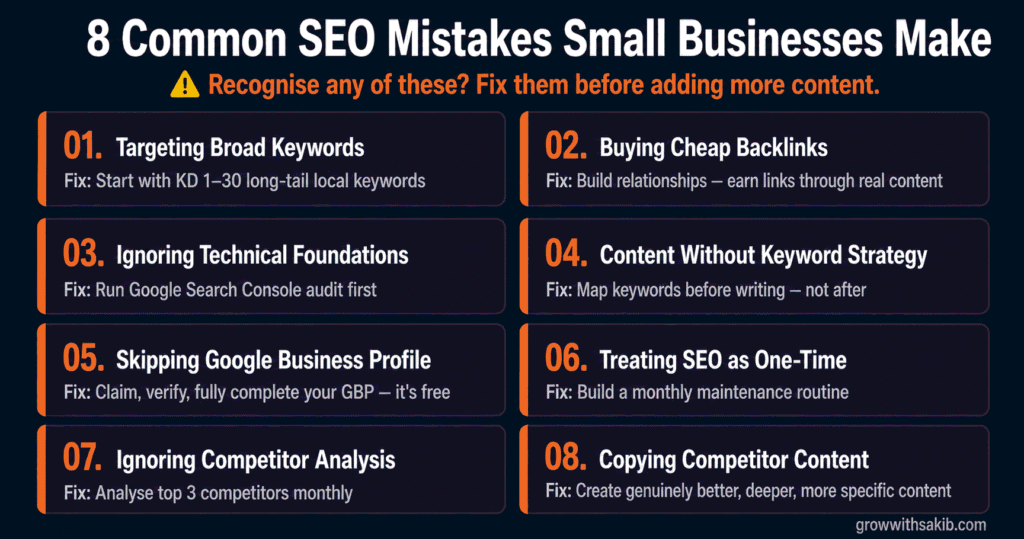
Common SEO Mistakes Small Businesses Make
These are the patterns that waste the most time and money in small business SEO — and the quick fix for each.
| # / Mistake | Why it hurts | Quick fix |
|---|---|---|
| 01. Targeting broad keywords from day one | Competing against global brands with huge budgets — and losing | Start with KD 1–30 long-tail keywords in your local market |
| 02. Buying cheap backlinks | Google penalty — site disappears from search results | Build relationships and earn links through genuine content |
| 03. Ignoring technical foundations | Strong content stays undiscovered because Google cannot read it | Run a Google Search Console keyword audit first — fix errors before adding content |
| 04. Publishing content without keyword strategy | Random blog posts that attract no targeted traffic | Map keywords to content before writing — not after |
| 05. Skipping Google Business Profile | Missing the fastest, highest-ROI local SEO channel available | Claim, verify, and fully complete your GBP today — it is free |
| 06. Treating SEO as a one-time project | Rankings drop when competitors update and you don’t | Build a monthly maintenance routine: update, monitor, improve |
| 07. Ignoring competitor analysis | No visibility into why competitors are outranking you | Analyse top 3 competitors monthly — content gaps, backlinks, keywords |
| 08. Copying competitor content | Google penalises duplicate content — you rank below the original | Create genuinely better, deeper, more specific content than competitors |
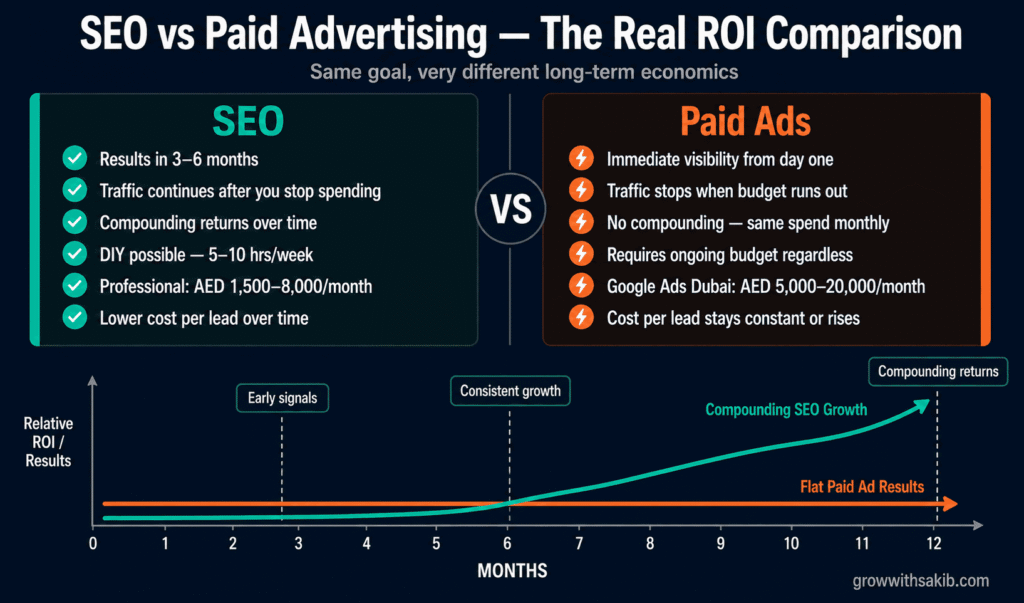
Is SEO Worth It for a Small Business? The Real Cost and ROI
This is the question every small business owner asks — and deserves a direct, honest answer. For the full side-by-side breakdown, see SEO vs paid ads.
| SEO investment | Paid advertising comparison |
|---|---|
| Results take 3–6 months to appear | Immediate visibility from day one |
| Traffic continues after you stop spending | Traffic stops the moment budget runs out |
| Compounding returns — each improvement builds on the last | No compounding — spend same amount every month for same results |
| DIY possible for basics (5–10 hours/week) | Requires ongoing budget regardless of involvement |
| Professional help: typically AED 1,500–8,000/month in UAE | Google Ads Dubai: AED 5,000–20,000/month for competitive keywords |
| Long-term: lower cost per lead over time | Long-term: cost per lead stays constant or increases |
For a small business with a limited budget, the realistic timeline is: 3 months to fix foundations and see early signals, 6 months to see consistent organic traffic growth, 12 months to see compounding returns that make the monthly investment feel like the best decision you made. The full timeline guide breaks down exactly what to expect at each stage.
The businesses that quit SEO at month 4 are the ones who never see the results that month 12 would have delivered. The guide to tracking SEO results shows which metrics actually prove progress before month 12 arrives.
SEO for small businesses is not about tricks, shortcuts, or gaming an algorithm. It is about building a website that Google trusts enough to recommend — and that real customers find genuinely useful when they arrive.
The businesses I have seen grow fastest through SEO at GrowWithSakib share one characteristic: they treat it as a long-term investment rather than a quick fix. They start with the right foundation (Google Business Profile and technical SEO), build keyword strategy before content, and update what they have before adding more.
The results compound. An SEO foundation built properly in 2026 will still be generating leads in 2028 and beyond — without the ongoing spend that paid advertising requires every single month.
Start with Step 1 from the priority sequence at the top of this guide. Fix one thing. Then the next. The businesses that win in search are not the ones who tried to do everything at once — they are the ones who did the right things in the right order, consistently.
Frequently Asked Questions
How long does SEO take to show results?
For a new website, the realistic timeline is 3–6 months for early ranking signals and 6–12 months for meaningful organic traffic. This depends on your competition, how consistently you publish quality content, and whether your technical foundations are clean. Established websites with existing authority typically see results faster.
Can buying backlinks work?
Buying cheap, spammy backlinks is one of the fastest ways to earn a Google penalty — which can remove your site from search results entirely. Google’s Penguin algorithm specifically identifies and penalises manipulative link patterns. The only sustainable link-building strategy is earning links through genuinely useful content and real relationships.
Do small businesses really need Local SEO?
Yes — especially in competitive local markets like Dubai. Local SEO is the fastest-acting, highest-ROI SEO channel available to local businesses. Google’s data shows 76% of people who search for a nearby service visit a business within 24 hours. Your Google Business Profile alone can drive significant lead flow before you rank for a single keyword organically.
What are keywords and how do I find them?
Keywords are the exact phrases people type into Google when looking for services like yours. Start with Google Search Console (free) — it shows what searches are already bringing people to your site. Then use Ahrefs, Semrush, or even Google’s free Keyword Planner to find related phrases your audience searches for. Focus on long-tail, location-specific keywords with KD scores under 30 when starting out.
Is content really that important?
Content is what Google ranks — so without it, there is nothing to optimise. But in 2026, quality matters far more than volume. One genuinely comprehensive, well-researched article that clearly answers a real question will outperform ten shallow posts that technically mention the right keywords. Publish less, but make each piece genuinely worth reading.
Should I do social media alongside SEO?
Social media does not directly improve Google rankings. However, it builds brand awareness, drives referral traffic, and creates the kind of brand mentions that influence AI citation probability. The two strategies complement each other — especially if you repurpose your SEO content for social distribution.
Why is mobile-friendliness important for SEO?
Google uses mobile-first indexing — meaning it primarily evaluates and ranks the mobile version of your website. With over 80% of searches happening on mobile devices, a site that performs poorly on a 375px screen will rank poorly regardless of how good it looks on desktop. Test your site on multiple devices and run PageSpeed Insights to identify mobile-specific issues.
What is a Free SEO Audit and what does it cover?
A free SEO audit from GrowWithSakib identifies technical issues preventing Google from properly crawling your site, analyses your on-page SEO setup, evaluates your keyword positioning, and explains clearly why your site is not ranking where it should be. It gives you a prioritised action plan — not just a list of problems.
Is Google Business Profile free?
Yes — completely free to create and maintain. Your Google Business Profile is the digital equivalent of a shopfront on Google Maps. For any local business, it is the single most important free tool available for local visibility. A fully optimised GBP can bring in leads within weeks of being set up correctly.
Can I do SEO myself?
You can handle the basics: claiming your Google Business Profile, writing keyword-informed content, fixing obvious technical issues, and building a review process. Expect to invest 5–10 hours per week for meaningful DIY SEO. More complex technical tasks — Core Web Vitals optimisation, schema markup, advanced link building — typically benefit from professional help. The cost of getting it wrong usually exceeds the cost of getting expert help from the start.