For a local business, this is the fastest, cheapest win in the whole link building guide – and the one most often done badly. It’s also the strategy where the standard advice is most misleading, so let’s start by correcting the two claims you’ll read everywhere else.
This is Strategy 1 in the link building guide for beginners on GrowWithSakib. For the deeper mechanics of NAP itself, see the NAP consistency guide on GrowWithSakib; this article is about building and auditing the citations.
The Two Myths You Need to Drop First
How Local Citations Actually Work
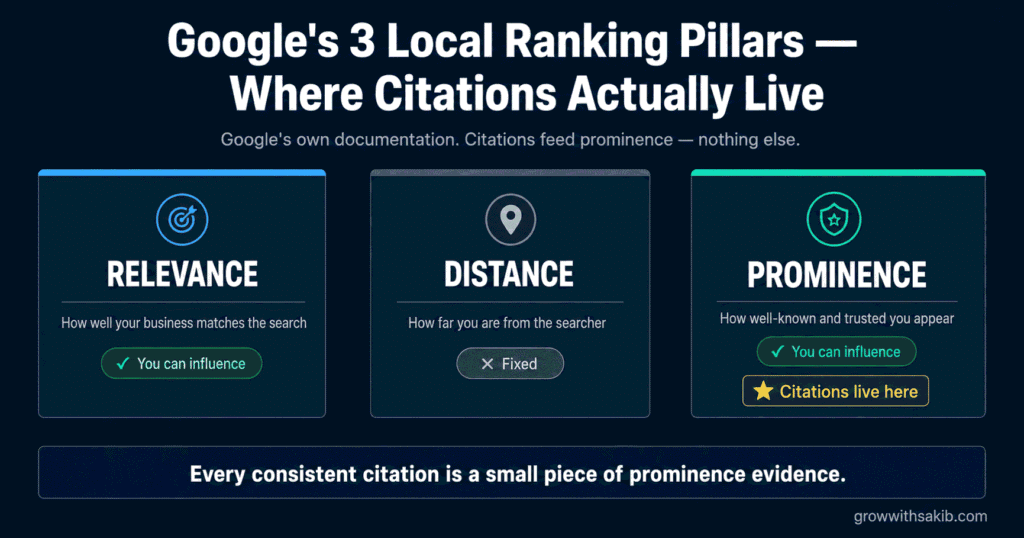
Google’s own documentation is unusually clear here. Google Business Profile Help states that local results are based primarily on three things:
| Pillar | What It Means | Can You Influence It? |
|---|---|---|
| Relevance | How well your business matches what someone searched for | Yes – categories, services, profile completeness |
| Distance | How far you are from the searcher or the searched-for area | No – you can’t move your shop |
| Prominence | How well-known and trusted your business appears to be | Yes – reviews, citations, links, mentions |
Citations live in prominence. Every consistent listing is a small piece of corroborating evidence that your business is real, established, and located exactly where you say it is. Google is effectively cross-referencing you against the web. When forty sources all agree on your name, address and phone number, confidence goes up. When they disagree, confidence goes down – and so does your prominence.
Why Accuracy Beats Volume (and Volume Can Hurt)
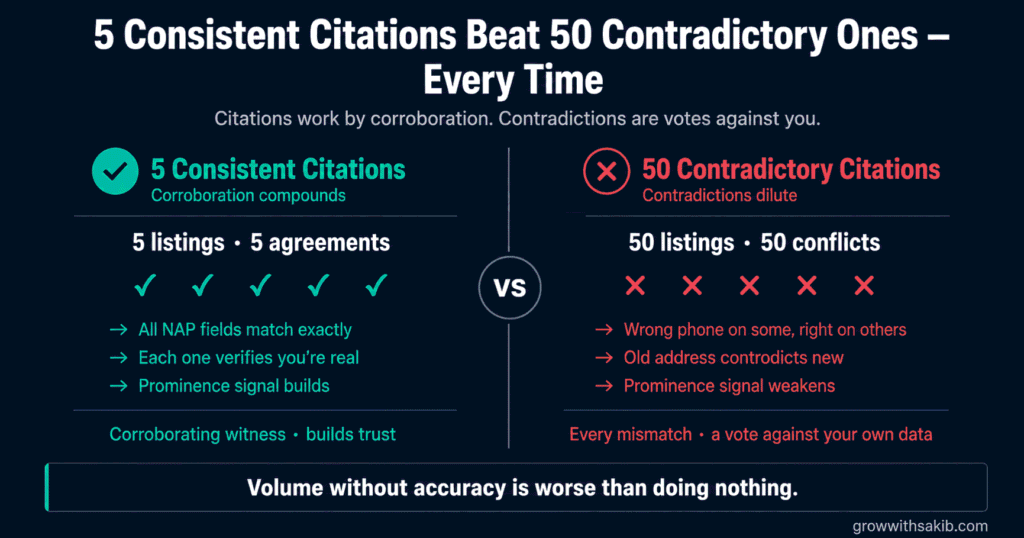
This is the practical consequence of the mechanism, and it flips the usual advice on its head. If citations work by corroboration, then a listing with the wrong phone number doesn’t just fail to help you – it actively contradicts your other listings and weakens the whole picture.
- Five consistent citations beat fifty contradictory ones – every inconsistency is a vote against your own data.
- Mass-submission services are a trap – blasting your details to 300 low-quality directories creates listings you can’t control, on sites nobody uses, with typos you’ll never find.
- Old data propagates – a single outdated record on a major data aggregator can seed dozens of wrong listings across smaller directories. Fixing the source matters more than fixing the symptoms.
- Duplicates actively dilute you – two listings for the same business split your signals and confuse Google about which is real. Find and remove them before building anything new.
Getting Your NAP Format Right
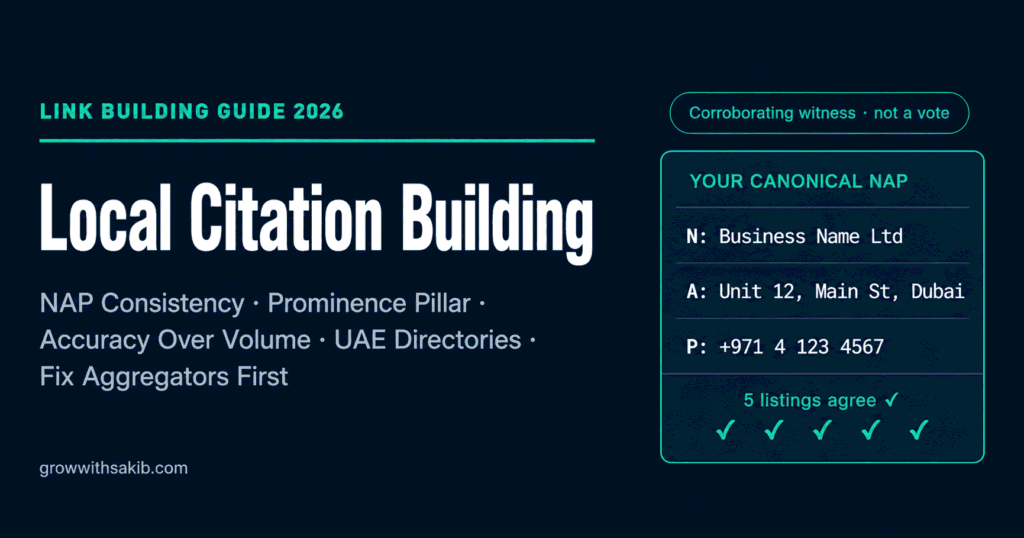
Before you touch a single directory, write your NAP down once and treat it as canonical. Every listing must match it exactly – character for character.
| YOUR CANONICAL NAP (decide once, use everywhere) Name: [Exactly as registered – no added keywords] Address: [Full format: unit, building, street, area, city] Phone: [One format: +971 4 XXX XXXX – always the same] Website: [https:// + www or not – pick one and stick to it] RULES: – Never add keywords to your business name (Google prohibits it) – ‘Street’ vs ‘St.’ – pick one, forever – Use a local number, not a call-tracking number, on listings – Suite/unit numbers: same format on every single listing |
The two most common self-inflicted wounds: adding keywords to the business name (“Sakib Plumbing – Best Plumber Dubai”) which violates Google’s guidelines and risks suspension, and using a call-tracking number on directories, which by definition makes your phone number inconsistent everywhere.
Which Citations Actually Matter
Work in tiers. Get Tier 1 perfect before you touch Tier 3.
Tier 1: The Core Platforms (do these first)
| Platform | Why It Matters |
|---|---|
| Google Business Profile | The single most important local asset. Feeds relevance and prominence directly |
| Bing Places | Powers Bing and, indirectly, some AI assistants that draw on Bing’s index |
| Apple Business Connect | Powers Apple Maps – significant for iPhone users searching nearby |
| Facebook Business Page | High-visibility NAP source that people and crawlers both check |
Tier 2: UAE and Gulf Directories
For a business operating in the UAE, these regional sources carry far more weight than a long tail of global directories:
| Directory | What It Is | Best For |
|---|---|---|
| Yellow Pages UAE | The established general UAE business directory | Every UAE business – a baseline citation |
| Dubai Chamber of Commerce | Official chamber directory – genuine institutional authority | Registered Dubai businesses (membership required) |
| Gulf Business Directory | Regional Gulf-wide business listings | Businesses serving the wider GCC market |
| Bayut | Major UAE property platform | Real estate, property services, and related trades |
| Dubizzle | The dominant UAE classifieds and listings platform | Local services, trades, and consumer-facing businesses |
Two notes. The Dubai Chamber listing is the standout here – a chamber of commerce is a genuinely authoritative local source, and the kind of local institution Google treats as meaningful corroboration. And industry-specific directories beat general ones: a listing on a respected trade body for your sector does more for prominence than ten generic directories.
Tier 3: Industry and Niche Sources
- Your trade or professional association – the most credible citation available to most businesses.
- Local business groups and BIDs – genuine local relevance, and often a real followed link.
- Supplier and partner sites – ‘stockists’ or ‘find a fitter’ pages you may already qualify for.
- Sponsorships – a local charity, school, or sports club listing you as a sponsor is a real local citation and often a real link.
Notice that Tier 3 blurs into genuine link building – these sources often do give a real followed link. That’s the bridge between this strategy and the rest of the beginner’s guide to backlinks on GrowWithSakib.
How to Audit Your Existing Citations
Most local businesses don’t have a citation-building problem – they have a citation cleanup problem. Do this before you build anything new.
- Write down your canonical NAP (above). This is your source of truth.
- Search for your business name in Google, then search your phone number in quotes, then your old phone number and old address if you’ve ever changed either. This surfaces listings you forgot existed.
- Log every listing you find in a spreadsheet: the site, the URL, the NAP exactly as shown, and whether it’s correct.
- Flag every mismatch – a different phone format, an old suite number, a missing unit number. Every one is a contradiction.
- Hunt for duplicates, especially on Google Business Profile. Two listings for one business is the single most damaging error here.
- Fix in order: duplicates first, then the biggest platforms, then data aggregators, then the long tail.
- Re-check in 60 days. Aggregator data propagates slowly, and some wrong listings regenerate.
Why Citations Matter More in the AI Era, Not Less
There was a period when SEOs argued citations were dying. The opposite has happened. BrightLocal’s research indicates that large language models draw on local citations, reviews and social profiles when answering local queries – which makes sense, because an AI answering “best plumber near me” needs exactly the corroborated, structured entity data that citations provide.
That fits the broader pattern in the generative engine optimisation guide on GrowWithSakib: AI systems reward brands that are consistently and verifiably described across the web. A business with contradictory NAP data isn’t just confusing Google – it’s confusing every AI that reads the web.
Common Local Citation Mistakes
| Mistake | Why It Hurts | Do This Instead |
|---|---|---|
| Treating GBP as a backlink | Misunderstands the mechanism entirely | Treat GBP as your core entity record |
| Chasing citation volume | Contradictions dilute prominence | Perfect the core listings first |
| Buying mass-submission packages | Creates listings you can’t edit or fix | Build the important ones by hand |
| Adding keywords to your business name | Violates Google’s guidelines; risks suspension | Use your registered name exactly |
| Using a call-tracking number | Makes your phone number inconsistent everywhere | One consistent local number on all listings |
| Ignoring duplicate listings | Splits your signals; the most damaging error | Find and remove duplicates first |
| Fixing symptoms, not sources | Bad data regenerates from aggregators | Correct the aggregator, then re-check in 60 days |
Frequently Asked Questions
1. What is a local citation in SEO?
A local citation is any online mention of your business’s Name, Address and Phone number (NAP) – on a directory, a chamber of commerce site, a review platform, or anywhere else on the web. Importantly, a citation doesn’t have to include a link: a plain-text mention of your NAP still counts. Citations help Google verify that your business is real, established, and located where you claim, which feeds the ‘prominence’ pillar of its local ranking system.
2. Are local citations backlinks?
Mostly not. A citation is a mention of your NAP, and BrightLocal notes it doesn’t require a backlink at all – many citations are plain text with no link. Among those that do link, most directory links are nofollow, so they generally won’t pass ranking credit the way an editorial link does. Citations work through a different mechanism: they corroborate your business details across the web, building prominence. A backlink is a vote; a citation is a corroborating witness.
3. Does Google Business Profile give you a backlink?
No. Your Google Business Profile is a listing – an entity record inside Google’s own index – not a page on a third-party site linking to you, and the website field doesn’t pass PageRank. This is a widespread myth. That said, GBP remains the single most important local ranking asset you own, because it tells Google directly who you are, what you do, and where you are – feeding both the relevance and prominence pillars of local ranking.
4. How does Google actually rank local businesses?
Google’s own documentation states that local results are based primarily on three factors: relevance (how well your business matches the search), distance (how far you are from the searcher or the area they specified), and prominence (how well-known and trusted your business appears to be). You can’t influence distance. You can strongly influence relevance through your Google Business Profile categories and services, and prominence through reviews, citations, links, and mentions.
5. How many citations do I need?
Fewer than you think – accuracy matters far more than volume. Five perfectly consistent listings on major, relevant platforms will outperform fifty contradictory ones. Because citations work by corroboration, a listing with the wrong phone number doesn’t merely fail to help: it actively contradicts your other listings and weakens the overall picture. Get Google, Bing, Apple and your key regional directories exactly right before you chase anything else.
6. Which directories should a UAE business use?
Start with the core global platforms – Google Business Profile, Bing Places, Apple Business Connect and Facebook. Then focus on regional sources that carry real weight in the market: Yellow Pages UAE as a baseline, the Dubai Chamber of Commerce directory (genuinely authoritative, membership required), Gulf Business Directory for wider GCC reach, and platform-specific listings like Bayut for property-related businesses and Dubizzle for local services. Industry-specific trade directories beat general ones.
7. How do I audit my local citations?
Write down your canonical NAP first, then search your business name, your phone number in quotes, and any old phone numbers or addresses you’ve ever used – old details surface listings you’d forgotten. Log every listing in a spreadsheet with the NAP exactly as shown, and flag every mismatch. Hunt for duplicate listings, especially on Google Business Profile, since duplicates are the most damaging error. Fix in order: duplicates, major platforms, data aggregators, then the long tail.
8. Do citations still matter with AI search?
They matter more, not less. BrightLocal’s research indicates that large language models draw on local citations, reviews and social profiles when answering local queries – which is logical, since an AI answering ‘best plumber near me’ needs exactly the kind of corroborated, structured business data that citations provide. A business with contradictory NAP data across the web isn’t just confusing Google; it’s confusing every AI system that reads the web.
Key Takeaways
- A local citation is any online mention of your business’s Name, Address and Phone number – and it doesn’t need to include a link at all.
- Citations are mostly NOT backlinks: many are plain text, and most directory links are nofollow, so they don’t pass link equity.
- Google Business Profile does not give you a backlink either – it’s an entity record, not a third-party page linking to you.
- They work through a different mechanism: Google ranks local results by relevance, distance and prominence – and citations feed prominence by verifying you’re real.
- A backlink is a vote; a citation is a corroborating witness. That’s why the rules differ.
- Accuracy beats volume: five consistent listings beat fifty contradictory ones, and mass-submission packages actively create contradictions.
- Most local businesses need cleanup, not building – audit first, kill duplicate listings, and fix the data aggregators, not just the symptoms.
- For UAE businesses: core platforms first, then Yellow Pages UAE, Dubai Chamber, Gulf Business Directory, Bayut and Dubizzle – plus your industry trade body.