Every other strategy in this guide asks someone for something. Broken link building asks a webmaster to swap a link. The skyscraper technique asks them to replace one. Guest posting asks an editor for space. Digital PR is structurally different: you don’t ask anyone for anything. You create something genuinely worth covering, and journalists link to you because it makes their story better.
That’s Strategy 6 in the link building guide for beginners on GrowWithSakib – the highest-impact strategy in the whole cluster, and the one most businesses wrongly believe they can’t afford. (For the broader, non-research view of press coverage, see the digital PR for small business guide on GrowWithSakib; this article is specifically about research-led execution.)
Why Digital PR Produces the Purest Editorial Link
The AI Search Dividend (The Case Most Guides Miss)
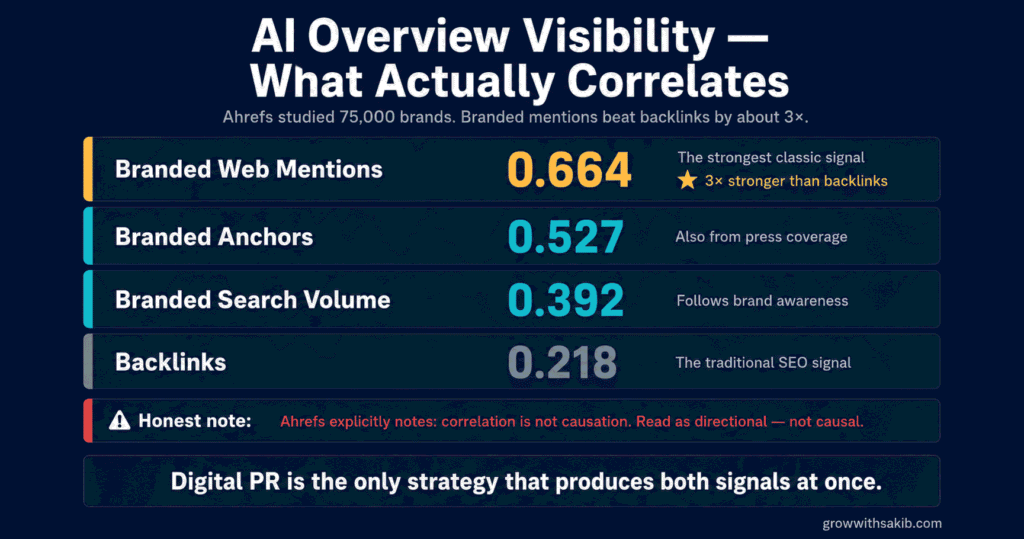
Here’s the argument that has changed digital PR’s priority entirely, and it comes with primary data. Ahrefs analysed 75,000 brands to see which signals predict whether a brand appears in Google’s AI Overviews:
| Signal | Correlation with AI Overview Visibility |
|---|---|
| Branded web mentions | 0.664 – the strongest of the classic signals |
| Branded anchors | 0.527 |
| Branded search volume | 0.392 |
| Backlinks | 0.218 |
Read that again. Branded web mentions correlate roughly three times more strongly with AI visibility than backlinks do. Ahrefs also found that brands in the top quartile for web mentions average around ten times more AI Overview mentions than the quartile below – and that brands in the bottom half of web mentions are, in their words, essentially invisible to AI systems. (Ahrefs are careful to note that correlation is not causation, and so are we.)
This matters enormously, because digital PR is the only strategy that produces both signals at once: an editorial link and a branded mention in a credible publication. If you’re also working on generative engine optimisation on GrowWithSakib, earning press coverage is now one of the highest-leverage things you can do.
Step 1: Find the Data Gap
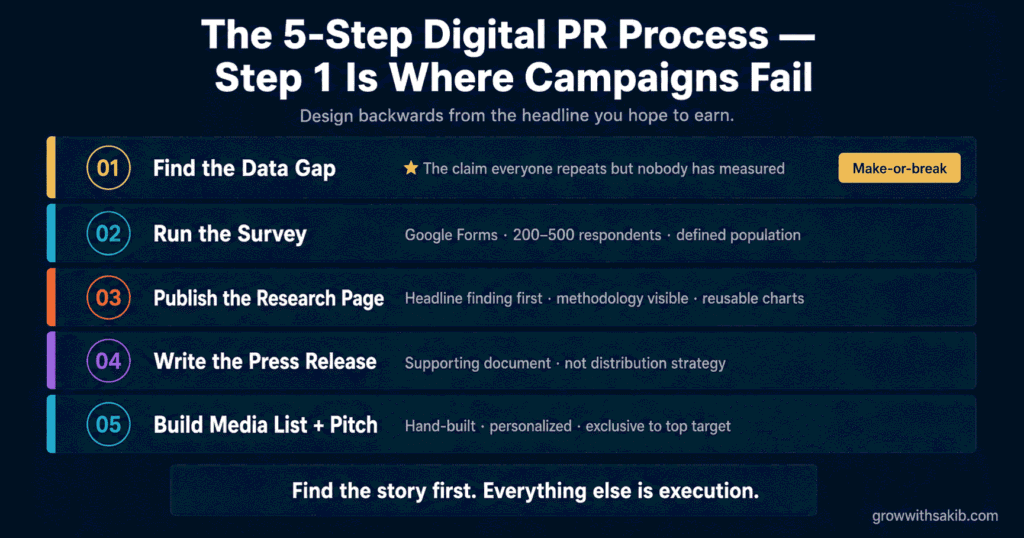
Most campaigns fail here, not at the writing. The mistake is starting with “what could we research?” The right question is: what does everyone in my industry claim, without ever proving?
- Listen for unproven assertions – every niche has confident claims nobody has measured. “Most small businesses don’t have a website.” Do they? Nobody knows. That’s a gap.
- Find the question journalists keep asking – search recent articles in your sector. If reporters keep citing a five-year-old statistic, they’re telling you exactly what data they wish existed.
- Look for the number that doesn’t exist – if you search for a statistic in your niche and find nothing, or find only ancient figures, you’ve found your campaign.
- Check who would care – a data gap only matters if a defined group of journalists would want the answer. If you can’t name three publications that would cover it, it isn’t a story.
The Four Types of Original Research
| Research Type | What It Is | Cost | Best For |
|---|---|---|---|
| Survey research | Ask 200-500 people in a defined group | Free-£800 | Most businesses – the entry point |
| Public data analysis | Re-analyse government or platform data | Free | No budget; strong analytical skill |
| Proprietary data | Aggregate your own platform or client data | Free | Businesses sitting on unique data |
| Original experiment | Run a test and publish what happened | Varies | Technical niches with testable claims |
Two honest notes. Proprietary data is the most powerful – literally nobody else can replicate it – but it must be anonymised and aggregated before publication. Never publish client-identifiable data, ever. And public data analysis is the true zero-budget route: government statistics offices publish enormous datasets that nobody has bothered to interrogate for a story.
Step 2: Run the Survey (Free Tools)
You do not need a research agency. Google Forms is free and entirely sufficient. If you need respondents beyond your own audience, a small paid panel is the only real cost – and it’s usually in the hundreds, not thousands.
Six Principles That Produce Citable Data
- Answer one specific question – not “what do owners think about marketing?” but “what percentage have never published a blog post?”
- Define the population precisely – “UK small business owners with fewer than 10 employees” is a research population. “People interested in marketing” is not.
- Aim for 200-500 respondents – below 200, journalists will question your sample. Above 500, you rarely buy meaningfully better credibility.
- Include at least one counterintuitive question – journalists don’t cite data that confirms what everyone assumes. Build in a question whose answer might genuinely surprise you.
- Ask about behaviour, not opinion – “have you done X in the last 12 months?” produces a fact. “Do you think X is important?” produces a shrug.
- Keep it to 10-15 questions – longer surveys produce tired, careless answers, and tired answers make bad data.
Step 3: Publish a Research Page Journalists Can Cite
Your research page is the asset every link points to. It has to make a journalist’s job easy – which means it needs things most blog posts don’t have:
- The headline finding, first – the single most surprising number, above the fold, stated plainly.
- Key findings as standalone statistics – three to five numbers a journalist can quote without reading the whole page.
- A visible methodology note – sample size, population, collection method, and dates. Without it, a serious journalist cannot cite you, and won’t.
- Charts they can reuse – clean, clearly labelled, with your brand on them. Reusable charts get republished, and republished charts get linked.
- A named, credentialled author – the E-E-A-T that makes the data trustworthy, as covered in the E-E-A-T content writing guide on GrowWithSakib.
- Raw data available on request – a line offering the underlying data signals confidence and separates you from marketing fluff.
Step 4: Write the Press Release
A press release is not a distribution strategy – wire services rarely produce meaningful links. It’s a supporting document you attach to a personal pitch, so a journalist has everything they need in one place.
| HEADLINE: The specific finding, not a description of the study. Good: “67% of small business owners have never published a blog post” Bad: “GrowWithSakib releases new small business research” SUB-HEADLINE: Your second most significant number. OPENING PARAGRAPH: Who, what, when, where – under 50 words. KEY FINDINGS: The 3-5 strongest stats, each quotable alone. EXPERT QUOTE: A named, credentialled person INTERPRETING the data – what it means, not restating the number. METHODOLOGY: Sample size, population, method, dates. CONTACT + LINK: A real human, and the URL of the research page. |
Step 5: Build the Media List and Pitch
Build the list by hand. It’s slow, and it’s the difference between coverage and silence.
- Identify 5-10 publications your customers actually read – trade titles, national outlets covering your sector, influential niche newsletters.
- For each, find the specific journalists who cover your topic – not the general editor. Read their recent work.
- Find their contact details (the publication’s site, their social profile, or a tool like Hunter.io).
- Record: name, publication, beat, a recent relevant article, email, and any prior contact.
- Start with 30-50 journalists. Grow it every campaign – the list is a compounding asset.
Then pitch individually. The pitch is not the press release – it’s a short email that makes one journalist want to open it. Lead with the finding, say why it matters to their readers specifically, and attach the release. The same craft as the guest post pitch on GrowWithSakib: specific, short, and obviously written for them.
Reactive Digital PR: Newsjacking
Original research is proactive and takes weeks. Newsjacking is the fast lane: when news breaks in your sector, journalists need expert comment within hours. Being useful inside that window earns links from major titles with no research at all.
- Set up alerts – Google Alerts on your key industry terms, plus monitoring of the journalists who cover your space.
- Move within the first two hours – the window is genuinely that short. Draft a comment that adds what the news report doesn’t have: what it means for a specific group, and why.
- Pitch fast and short – a subject line that signals an available expert quote, and two sentences of actual insight in the body.
- Build the relationships first – journalists respond to names they recognise. Register on expert platforms like HARO on GrowWithSakib, and be useful before you need anything.
Honest Expectations
- It’s slow – a research campaign takes weeks to design, run, and pitch. This is not a monthly tactic.
- Most pitches get no reply – that’s normal for outreach of any kind. A single national pickup can justify the entire campaign.
- Coverage does not guarantee a link – some publications mention brands without linking. Structure your assets to make citation the path of least resistance.
- The asset keeps paying – a research page keeps being cited for years, and each campaign builds the media list that makes the next one easier.
- Small niches are an advantage – a national brand can’t credibly research your local market. You can, and the trade press for that niche has nobody else to cite.
Common Digital PR Mistakes
| Mistake | Why It Hurts | Do This Instead |
|---|---|---|
| Researching before finding the story | Data nobody wanted to know | Find the data gap first; design backwards from the headline |
| Confirming what everyone assumes | Journalists don’t cite the obvious | Build in a genuinely counterintuitive question |
| Fewer than 200 respondents | Sample size becomes the story | Aim for 200-500 in a defined population |
| No methodology note | Serious journalists cannot cite you | Sample, population, method, and dates – visibly |
| Putting everything in the release | They write the story and link nothing | Lead with findings; point to the full data |
| Wire-service distribution | Syndicated copies, negligible link value | Hand-build a media list and pitch individually |
| Mass-emailing an identical pitch | Instantly recognisable; deleted | Personalise; offer an exclusive to your top target |
Frequently Asked Questions
1. What is digital PR link building?
Digital PR link building means earning editorial links and brand mentions by publishing something journalists genuinely want to cover – usually original research. Unlike other link building strategies, you don’t ask anyone for a link. You create data that improves a journalist’s story, and they cite you because it makes their article better. The links come from publications you could never reach through outreach, which is why it’s the highest-impact strategy available to a small business.
2. How do I find a data gap in my niche?
Listen for the confident claims everyone in your industry repeats but nobody has measured. Search recent articles in your sector: if journalists keep citing a five-year-old statistic, they’re telling you exactly what data they wish existed. If you search for a number in your niche and find nothing current, that’s your campaign. Then apply the test: write the headline you hope to earn. If it wouldn’t make a journalist stop scrolling, don’t run the research.
3. How many survey respondents do I need?
Aim for 200 to 500 within a clearly defined population. Below 200, journalists will question your sample size, and the credibility of the whole campaign becomes the story instead of your findings. Above 500, the extra cost rarely buys meaningfully greater credibility. Far more important than raw numbers is defining the population precisely: ‘UK small business owners with fewer than 10 employees’ is a research population; ‘people interested in marketing’ is not.
4. Can I do digital PR without a budget?
Yes. Google Forms is free and entirely sufficient for running the survey. If you can reach respondents through your own list or community, your cash cost is zero; a paid panel for external respondents typically costs hundreds, not thousands. Public data analysis is genuinely free – government statistics offices publish enormous datasets that nobody has interrogated for a story. Building a media list by hand costs time rather than money, and personalised email outreach costs nothing.
5. Do press releases still work for link building?
Not as a distribution strategy. Wire services produce syndicated copies with negligible link value, and journalists rarely pick stories from the wire. The press release still matters, but as a supporting document: a well-structured release attached to a personal pitch gives the journalist everything needed to write the story – headline finding, key statistics, an interpretive expert quote, and the methodology. The pitch earns the coverage; the release makes it easy to write.
6. Why did my campaign get coverage but no backlinks?
Usually because you gave journalists everything in the press release. If the release contains all the findings, they can write the whole story without ever needing to point readers elsewhere. The fix is structural: lead the release with your headline findings, but keep the full data set, the charts, and the methodology on your research page – and reference it explicitly. A visible methodology note is also what allows a serious journalist to cite you at all.
7. Is digital PR better than other link building strategies?
It produces the highest-value links, and there’s now data suggesting it matters even more than that. Ahrefs studied 75,000 brands and found branded web mentions correlate with AI Overview visibility at 0.664 versus 0.218 for backlinks – roughly three times stronger. Digital PR is the only strategy that produces both an editorial link and a branded mention at once. It’s also the slowest and most demanding, so most businesses should start with broken link building and add digital PR as they grow.
8. What is newsjacking?
Newsjacking is reactive digital PR: when news breaks in your sector, journalists need expert comment within hours, and providing it earns links from major publications with no research required. The window is roughly two hours. Set up alerts on your key industry terms, draft a comment that adds what the news report itself lacks – what the development means for a specific group – and pitch fast and short. It works far better if journalists already recognise your name.
Key Takeaways
- Digital PR is structurally different: you don’t ask for a link, you publish something worth covering – so the link is the purest editorial vote there is.
- Ahrefs studied 75,000 brands: branded web mentions correlate with AI Overview visibility at 0.664 versus 0.218 for backlinks – roughly 3x stronger (correlation, not causation).
- Digital PR is the only strategy that produces both signals at once: an editorial link AND a branded mention in a credible publication.
- Find the data gap before you design the research – the claim everyone in your industry repeats but nobody has ever measured.
- Write the headline you hope to earn before you build the survey. If it wouldn’t stop a journalist scrolling, don’t run it.
- Google Forms is free and sufficient. Aim for 200-500 respondents in a precisely defined population; ask about behaviour, not opinion.
- Publish a research page with the headline finding first, standalone statistics, reusable charts, and a visible methodology note – without it, serious journalists can’t cite you.
- A press release is a supporting document, not a distribution strategy: hand-build a media list, pitch individually, and offer your top target an exclusive.