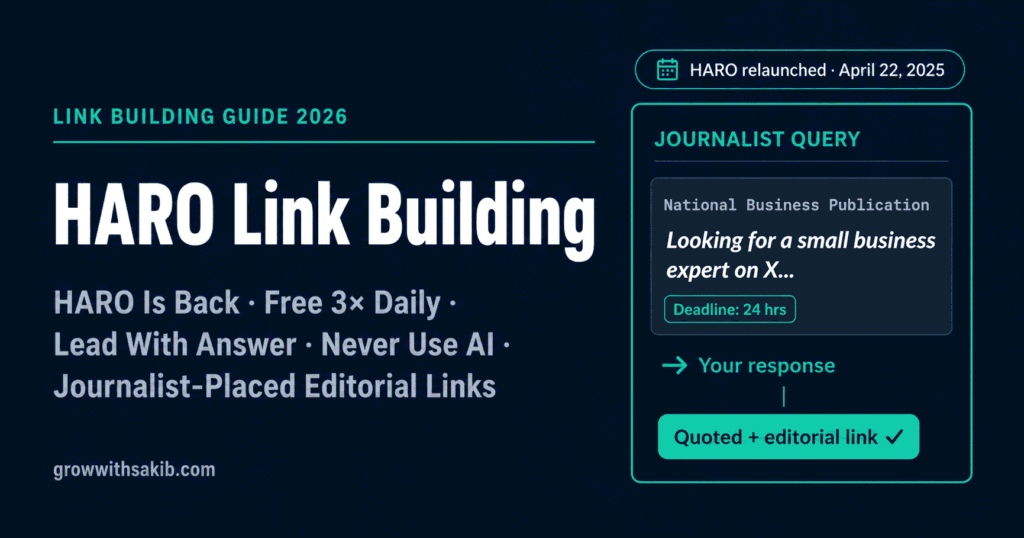
HARO link building has one thing almost no other strategy offers: the chance to earn a link from a national publication – a title whose domain you could never buy your way onto – simply by being genuinely useful to a journalist on deadline. But the platform itself has been through a chaotic few years, and the guides online haven’t kept up. Let’s fix that first, because if you follow most of them you’ll be pitching into a void.
This is Strategy 5 in the link building guide for beginners on GrowWithSakib – and the one where being current matters more than anywhere else.
What Happened to HARO – The Verified Timeline
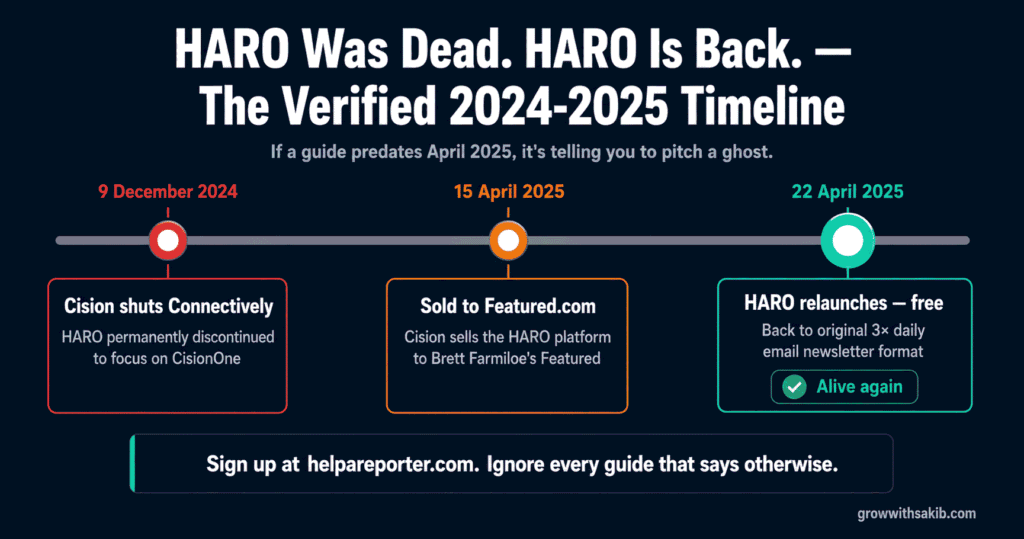
If you’ve searched for HARO recently, you’ve probably hit outdated guides and dead links. Here’s the documented sequence:
| When / What Happened |
|---|
| 2008: Peter Shankman founds Help a Reporter Out – it grows to roughly 800,000 sources and 55,000 journalists |
| 2010 / 2014: Acquired by Vocus; Vocus then merges with Cision, and HARO becomes a Cision brand |
| 2024: Cision retires the HARO name and migrates users to a new platform, Connectively |
| 9 December 2024: Cision permanently discontinues Connectively, to focus on its core CisionOne product |
| 15 April 2025: Cision sells the HARO platform to Featured.com (CEO Brett Farmiloe) |
| 22 April 2025: HARO relaunches – free, and back to its original three-times-a-day email format |
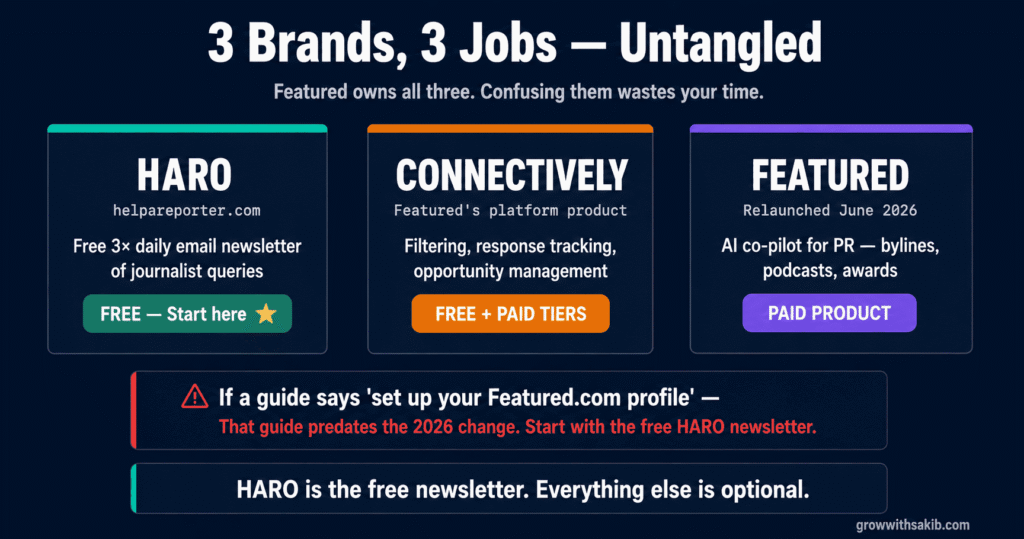
| May-June 2026: Featured revives the Connectively brand as its platform product, and relaunches Featured itself as an AI co-pilot for PR |
Why HARO Links Are Worth More Than Most
And the link is only part of the return. A published expert quote also builds author authority and E-E-A-T (your name, credentials and site cited in a real publication), sends referral traffic from people already interested in your topic, and strengthens your brand entity – the signals Google uses to understand who you are. That’s the same credibility work described in the E-E-A-T content writing guide on GrowWithSakib.
An Honest Word on the Link Itself
How to Choose Which Queries to Answer
The most common mistake is answering everything vaguely related to your field. Volume is not the strategy – fit is. Qualify each query:
| Answer It When… | Skip It When… |
|---|---|
| You can answer from genuine first-hand experience | It’s outside your real expertise – journalists verify |
| The question is specific and answerable | It’s vague (‘thoughts on marketing?’) – it’ll draw hundreds of generic replies |
| The publication is one you’d be proud to appear in | The outlet is unnamed, or a low-quality content site |
| There’s a realistic deadline (a few hours or more) | The deadline is imminent – you’ll be too late |
| You’ll be credited by name | The request is for an anonymous source – no name, no E-E-A-T, no link |
| The journalist wants insight | They’re fishing for product endorsements or testimonials |
How to Write a Response Journalists Actually Use
This is where the whole strategy is won or lost. A journalist on deadline is scanning dozens of responses for one quotable sentence. Give them that, fast.
- Lead with the answer, not your credentials – most responses open with “As a [title] with 15 years of experience…” and get deleted. Open with the insight itself.
- Be specific, never generic – “content marketing builds brand awareness” is exactly what the AI-generated pile says. A number, a mechanism, or a named example is what gets quoted.
- Include one concrete data point or example – journalists build credibility on specifics. Give them a real figure from your own work, or a real case.
- Keep it under about 250 words – they’re extracting a quote, not publishing your essay.
- Close with one line of credentials – name, title, company, and the link. One line, at the end, after you’ve already been useful.
| Subject: [Query topic] – [your one-line angle] [THE ANSWER – 2-3 sentences of specific, quotable insight. Lead with the actual point. No warm-up, no credentials.] [THE PROOF – one concrete example, number, or case from your own direct experience. This is what gets you quoted.] [OPTIONAL – one sentence of useful nuance or a caveat that shows genuine expertise rather than a talking point.] [Your name], [Title] at [Company] [Your website] | [Phone if you’re happy to be called] |
The 2026 Expert-Sourcing Landscape
Don’t rely on one source of queries. These are the platforms genuinely operating now:
| Platform | What It Is | Cost | Best For |
|---|---|---|---|
| HARO (helpareporter.com) | The relaunched original – 3x daily email digest | Free | Everyone – start here |
| Connectively | Featured’s platform product: filtering, tracking, workflow | Free + paid tiers | Managing volume seriously |
| Qwoted | Journalist request platform; strong journalist quality | Free + paid | Finance, tech, B2B |
| SourceBottle | Long-running request service | Free | Australia / New Zealand audiences |
| Help a B2B Writer | B2B-focused queries | Free | B2B and SaaS experts |
| #journorequest | Live hashtag on X and Bluesky | Free | Real-time, fast-moving requests |
| Muck Rack / ResponseSource | Media databases and request services | Paid | Agencies and PR teams |
A realistic weekly routine: scan the HARO digests (they arrive three times a day – a 10-minute scan is enough; you’re looking for the rare query you’re genuinely qualified for), check Qwoted once a day, and keep a saved search for #journorequest plus your niche. Answer one to three queries a day at most. This is a quality game.
Building the Relationship – The Real Multiplier
The platform is the introduction, not the relationship. When a journalist uses your quote, send a short, genuine thank-you. Follow their work. Be reliably useful when they come back. A journalist who trusts you will come to you directly – and a direct request from a reporter who already knows your name is worth more than a hundred cold responses in a digest.
Track everything in a simple sheet: the query, the publication, the date, your response, whether it was used, and the link you got. Without it you’re guessing about what works – the same discipline as any content calendar on GrowWithSakib.
Honest Expectations
- Most responses go nowhere – that’s normal. Journalists receive many replies and quote one or two. Be honest with yourself: nobody has published a reliable, independently-verified success rate, and any guide quoting a precise one should be treated with suspicion.
- Quality beats volume, decisively – a handful of genuinely expert responses will outperform dozens of generic ones, which mostly just train journalists to ignore you.
- It compounds slowly, then quickly – the first placement is the hardest. Each one makes the next easier, because prior media mentions are themselves a credibility signal.
- It is not a volume link-building channel – treat it as reputation-building that also produces excellent links, and you’ll use it correctly.
Common HARO Link Building Mistakes
| Mistake | Why It Hurts | Do This Instead |
|---|---|---|
| Following an outdated guide | You pitch a platform that no longer exists | Sign up at the relaunched HARO newsletter |
| Using AI to write responses | Detected and banned – it killed the old platform | Write from genuine first-hand experience |
| Answering every query | Wastes hours; journalists learn to ignore you | 1-3 per day, only where you’re truly qualified |
| Opening with your credentials | Deleted in seconds | Lead with the quotable insight |
| Generic, unquotable advice | There’s nothing for them to print | One specific number, mechanism, or example |
| Expecting a guaranteed dofollow | Publications set their own link policy | Judge by the publication, not the rel attribute |
| Answering anonymous-source requests | No name means no E-E-A-T and no link | Skip them – they’re not worth the time |
Frequently Asked Questions
1. Is HARO still active in 2026?
Yes. Cision shut HARO down (by then renamed Connectively) on 9 December 2024, but sold the platform to Featured.com in April 2025, which relaunched HARO on 22 April 2025 as a free, three-times-daily email of journalist queries. It remains active. Confusingly, Featured also revived the Connectively brand in 2026 as its platform product. If you’re a source wanting to earn media mentions, sign up for the free HARO newsletter at helpareporter.com.
2. What happened to HARO and Connectively?
HARO was founded in 2008 by Peter Shankman, acquired by Vocus in 2010, and became a Cision brand after the 2014 merger. In 2024 Cision retired the HARO name and migrated users to Connectively – then permanently discontinued Connectively on 9 December 2024. Cision sold HARO to Featured.com in April 2025, which relaunched it. In 2026 Featured also revived the Connectively name for its platform product, so both brands now exist under the same owner.
3. Is HARO free?
Yes. Under Featured.com, the HARO newsletter is free for both journalists and sources – no subscription and no pay-per-pitch. It’s funded through newsletter sponsorships rather than user fees, so every source gets the same access to the same queries. Featured’s separate platform product (now branded Connectively) offers paid tiers with extra features like filtering and response tracking, but you don’t need any of that to start earning placements.
4. Does HARO guarantee a dofollow backlink?
No, and any guide promising that is misleading you. Link policy is set by the publication, not by HARO. Some outlets give a followed link, some mark it nofollow, and some credit you by name with no link at all. That’s fine: a nofollow mention in a major national publication still delivers real referral traffic, genuine credibility, brand-entity signals, and often seeds followed links from smaller sites that pick up the story. Judge the placement by the publication.
5. How do I write a HARO response that gets published?
Lead with the answer, not your credentials – most responses open with ‘As a [title] with X years of experience’ and get deleted immediately. Give two or three sentences of specific, quotable insight, back it with one concrete number or example from your own direct experience, keep the whole thing under about 250 words, and close with a single line naming yourself, your company, and your site. A journalist on deadline is hunting for one printable sentence. Give them that.
6. Can I use AI to write HARO responses?
No – and this is a ban risk, not a style preference. AI-generated and spam responses degraded the original platform so badly that journalists abandoned it, which contributed directly to its shutdown. The relaunched HARO actively screens for this using AI text detection, image analysis, LinkedIn validation, and community reporting, and its owner has stated plainly that sources who aren’t genuinely helping reporters get banned. Your first-hand experience is the entire value you offer here.
7. What are the best HARO alternatives?
Use several sources rather than relying on one. Qwoted is strong for finance, tech, and B2B, and its journalist quality tends to be high. Help a B2B Writer focuses on B2B and SaaS queries. SourceBottle is useful for Australian and New Zealand audiences. The #journorequest hashtag on X and Bluesky surfaces real-time requests. Muck Rack and ResponseSource serve agencies and PR teams at a higher price point. HARO’s free newsletter remains the best starting point.
8. How is HARO link building different from digital PR?
HARO is reactive – you wait for journalists to ask a question, then answer it. Digital PR is proactive: you create something newsworthy, such as original research or a data study, and pitch it to journalists who haven’t asked for it. HARO is faster to start, needs no budget, and suits individual experts. Digital PR is slower and more expensive but can earn far more links from a single campaign. Most businesses should start with HARO and add digital PR as they grow.
Key Takeaways
- HARO is alive: Cision shut it down (as Connectively) on 9 December 2024, sold it to Featured.com, and it relaunched free on 22 April 2025.
- Most guides online are out of date – and almost all missed the 2026 change, where Featured revived Connectively as its platform product.
- Three brands, three jobs: HARO is the free newsletter, Connectively is the platform, and Featured is the AI PR co-pilot. Start with the free HARO newsletter.
- A HARO placement earns a journalist-placed editorial link – the kind Google actually counts – plus E-E-A-T, referral traffic, and brand-entity signals.
- You are not guaranteed a followed link; publications set their own policy. A nofollow mention in a national title is still hugely valuable.
- Answer only queries where you have genuine first-hand expertise, a real deadline, and a named credit – skip anonymous-source requests entirely.
- Lead with the quotable answer, not your credentials; add one concrete number or example; stay under ~250 words; close with one line of credentials.
- Never use AI to write responses – HARO screens for it with AI detection and LinkedIn validation, and the penalty is a ban.