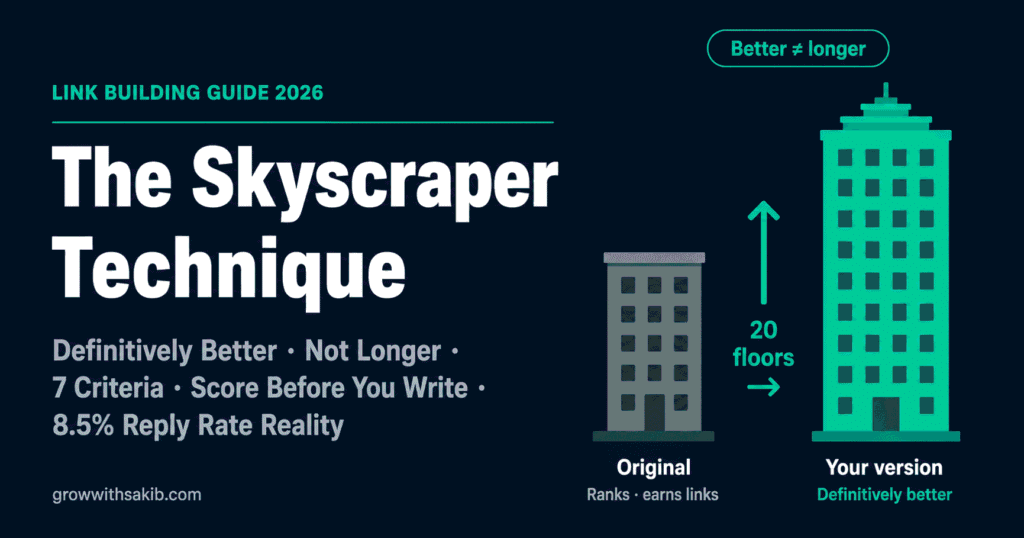
Most content is published and then hoped over: you write something, publish it, and pray somebody links to it. The skyscraper technique inverts that gamble. You start with proof – content that has already earned dozens of links – and build something better than the thing people are already linking to. The demand is established before you write a word.
This is the full method behind Strategy 4 in the link building guide for beginners on GrowWithSakib. It’s also the strategy most often executed badly – so we’ll be blunt about what works, what doesn’t, and what results you can actually expect.
Why the Skyscraper Link Is Worth Earning
What Is the Skyscraper Technique?
Brian Dean of Backlinko coined the name. The analogy: if you want the tallest building in the city, you don’t start from nothing – you find the current tallest and add twenty storeys. Applied to content, it’s three steps:
- Find link-worthy content – a page in your niche that has already attracted significant backlinks.
- Create something genuinely better – more current, more useful, more credible than the original.
- Reach out to everyone linking to the original and tell them your version exists.
His original case study is worth knowing precisely. He built on a post he published in April 2013 – a comprehensive list of Google ranking factors – then ran outreach. Backlinko reports that organic traffic to his entire site doubled in 14 days. The outreach itself: roughly 160 emails, 17 links – about an 11% conversion. Hold onto that number; we’ll come back to it, because it’s the most misquoted part of the whole strategy.
The Biggest Mistake: Thinking ‘Better’ Means ‘Longer’
The original guidance was widely read as: take the 25-item list and publish a 50-item list. Thousands of people did exactly that, and most got nothing. Here’s why that was always the wrong lesson.
The Seven Criteria for ‘Definitively Better’ Content
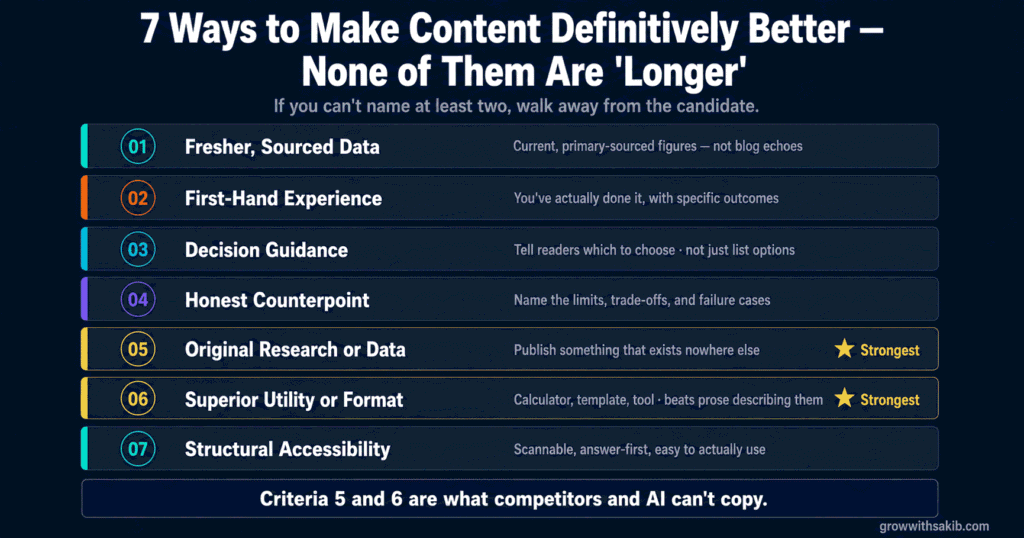
This is the heart of the strategy. Before you write anything, you must be able to name – specifically – which of these seven your version will deliver. If you can’t name at least two, walk away from the candidate.
| # / Criterion | What It Means in Practice |
|---|---|
| 01. Fresher, sourced data | The original cites stats from years ago. You cite current, primary-sourced figures |
| 02. First-hand experience | The original aggregates advice. You’ve actually done it, with specific outcomes |
| 03. Decision guidance | The original lists twenty options. You tell the reader which to choose, and when |
| 04. Honest counterpoint | The original is promotional. You name the limits, trade-offs, and failure cases |
| 05. Original research or data | You publish something that exists nowhere else – your own survey, test, or numbers |
| 06. Superior utility or format | A calculator, template, checklist, or tool beats prose that describes the same thing |
| 07. Structural accessibility | The original is dense. Yours is scannable, answer-first, and easy to actually use |
Note what is not on that list: word count, number of sections, number of images. Criteria 5 and 6 are the strongest – original data and genuine utility are the two things competitors and AI cannot copy, which is exactly why they earn links.
What Does NOT Count as Better
- More words without more insight – padding a comprehensive guide with 1,500 words of filler makes it worse, not better.
- Tangential sections – adding “the history of keyword research” to a keyword research guide adds length, not value.
- A new publication date – changing the date without revising the content is exactly the manipulation Google’s John Mueller has called out.
- A prettier version of the same thing – better design on identical substance is cosmetic. Nobody replaces a link for cosmetics.
How to Find Skyscraper Candidates
Method 1: Ahrefs Content Explorer
- Open Ahrefs Content Explorer and search your topic or keyword.
- Filter by referring domains – a minimum of around 30 confirms the content has genuinely earned links.
- Filter by published date – older pages are more likely to be beatable on freshness.
- Sort by referring domains, highest first. Those are your priority candidates.
- Open each one and read it properly. This step cannot be skipped – you’re deciding whether you can genuinely beat it.
Method 2: Competitor Backlink Analysis
- In Ahrefs Site Explorer, enter a top-ranking competitor’s domain.
- Go to Pages -> Best by Links to see their most-linked pages.
- Look for pages that are dated, narrower than the topic deserves, or thinner than they should be.
- Each one with a clear improvement opportunity is a candidate – and its backlink profile is your ready-made outreach list.
The Candidacy Scoring Framework
Not every heavily-linked page is a viable target. Score each candidate 1 (poor) to 3 (strong) on these five, before you commit any writing time:
| Criterion | Score 1 – Poor Candidate | Score 3 – Strong Candidate |
|---|---|---|
| Improvement potential | Already excellent and current | Clearly dated, thin, or promotional |
| Link profile quality | Links from spam and directories | Links from real, relevant publications |
| Topic relevance | Adjacent to your business | Core to what you actually sell |
| Your credibility | No real experience in this topic | Genuine first-hand expertise to bring |
| Maintenance risk | Actively maintained by a big team | Published once and left alone |
Add the five scores. 12-15: strong candidate, proceed. 8-11: marginal – only if you have a real edge. Below 8: walk away. The discipline here is the entire strategy – the skyscraper technique is a research problem, not a writing problem, and almost every failed campaign failed at this table, not at the keyboard.
Building E-E-A-T Into the Piece
This is the modern differentiator, and it’s what criteria 2 and 5 really mean in practice. Ahrefs found their own quality content sometimes failed to attract links because – in their words – content isn’t judged solely on quality, but also on who it comes from.
- Name the author, with credentials – visible at the top, not buried in a footer.
- Show first-hand experience – specific client outcomes, specific failures, specific numbers. AI cannot invent these, and neither can your competitors.
- Cite primary sources – the original study, the official documentation, not another blog’s summary of it.
- State your limits honestly – “this works for X, but not for Y” is a trust signal no promotional page will ever match.
This is the same craft covered in the E-E-A-T content writing guide on GrowWithSakib – and in a skyscraper campaign it does double duty, because it’s also the thing that makes an editor willing to swap their link.
The Outreach: Referencing Their Link Without Being Pushy
Build the prospect list from the original’s backlinks (Ahrefs -> Backlinks -> filter to live, followed links), find contacts via the site or a tool like Hunter.io, then – this is the part people skip – read the page their link sits on. Ninety seconds of reading is what turns a template into a message worth answering.
The email has exactly one job: make it easy for them to see your resource serves their reader better. Not to tell them their link is bad.
| Subject: Your [specific topic] piece Hi [Name], I was reading your piece on [their article] – the section on [specific point] is where you link out to [original resource]. I’ve just published something on the same topic that adds [the ONE specific improvement: e.g. 2026 data / a free calculator / results from our own tests]: [your URL] If it’s useful for that section, feel free to use it. If not, no problem at all – genuinely enjoyed the article. [Your name] |
Realistic Expectations (The Honest Numbers)
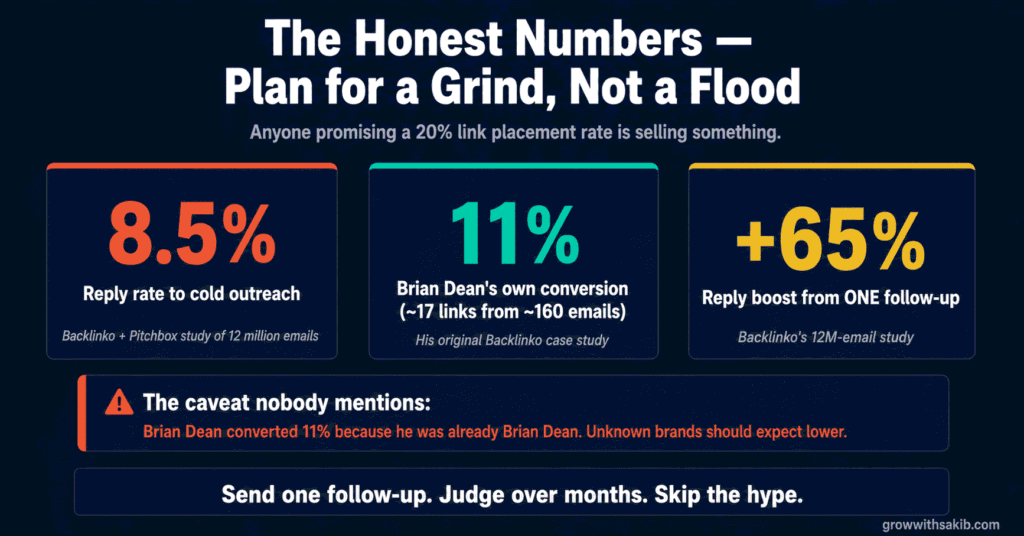
Most guides promise conversion rates that will leave you feeling like a failure. Here’s what the primary data actually says:
| Metric | The Real Number | Source |
|---|---|---|
| Reply rate to cold outreach | About 8.5% receive any reply at all | Backlinko + Pitchbox, 12 million emails |
| Brian Dean’s own conversion | ~17 links from ~160 emails (about 11%) | Backlinko’s original case study |
| Effect of one follow-up | Roughly 65% more replies | Backlinko’s 12M-email study |
| Personalised subject lines | Around a third more replies | Backlinko’s 12M-email study |
| Realistic beginner expectation | Lower than Brian’s – he was already famous | Ahrefs: content is judged by who it comes from |
Send one follow-up, about seven days later – the data says it’s worth roughly 65% more replies, and a second chase costs you goodwill. After that, move on. Track your outreach the same way you’d track any campaign: emails sent, replies, links placed, and the referring domains gained.
When to Use a Different Strategy
| The Situation | Why Skyscraper Struggles | Better Option |
|---|---|---|
| The original is actively maintained | A team updates it quarterly – you can’t out-fresh them | Broken link building |
| It’s an opinion or perspective piece | People linked to the take, not the information | Digital PR / original research |
| It’s a definitive single-author work | Authority is the person, not the page | Build your own authority first |
| You have no authority or experience yet | Editors judge who it comes from, not just what | Broken link building, guest posting |
For a site in its first year of link building, broken link building on GrowWithSakib is usually the more efficient starting point – it asks less of your authority, because you’re reporting a fault rather than asking someone to judge you better than an established name.
Common Skyscraper Technique Mistakes
| Mistake | Why It Hurts | Do This Instead |
|---|---|---|
| Confusing ‘better’ with ‘longer’ | Padding earns no links – length barely correlates | Name which of the seven criteria you’ll hit |
| Skipping candidate scoring | Weeks of work on an unwinnable target | Score before you write – 30 minutes saves 6 weeks |
| Expecting a 10-20% link rate | You quit at email 30, thinking you failed | Expect ~8.5% replies; plan for a grind |
| Generic outreach to a big list | Sub-1% replies; editors delete on sight | Read their page; name one specific improvement |
| Telling them their link is outdated | Makes them defensive | Reference the link neutrally; offer, don’t accuse |
| No follow-up (or four) | One follow-up lifts replies ~65%; four annoys | Exactly one, seven days later |
| Targeting maintained resources | Their team out-updates you forever | Target published-and-abandoned pages |
Frequently Asked Questions
1. What is the skyscraper technique?
The skyscraper technique is a link building strategy coined by Brian Dean of Backlinko. It has three steps: find content in your niche that has already earned lots of backlinks, create a definitively better version of it, then email every site linking to the original and suggest yours as the better resource. It works because you build on proven demand – those sites have already demonstrated they’ll link to this topic, so you’re not gambling on whether anyone cares.
2. Does the skyscraper technique still work?
Yes, but not the way it’s usually taught. The original formula was widely read as ‘make it longer’, and that no longer works – thousands of people tried it, and most got nothing. What still works is genuinely better content: fresher data, first-hand experience, original research, real utility. The outreach half also still works, because you’re contacting people who have already proven they link to the topic. Just expect a grind, not a flood.
3. What does ‘definitively better’ actually mean?
Not longer. Seven things make content genuinely better: fresher and properly sourced data, first-hand experience the original lacks, decision guidance rather than just a list of options, honest counterpoint where the original is promotional, original research or data that exists nowhere else, superior utility (a calculator, template, or tool), and structural accessibility. The strongest are original data and genuine utility, because they’re the two things competitors and AI cannot copy.
4. What response rate should I expect from skyscraper outreach?
Lower than most guides promise. Backlinko’s study with Pitchbox analysed 12 million outreach emails and found only about 8.5% receive any reply at all – and a reply isn’t a link. Brian Dean’s own famous case study converted roughly 17 links from 160 emails, around 11%, and he was already a recognised name. As an unknown brand, plan for less. Anyone promising a 20% link placement rate is selling something.
5. How do I find skyscraper candidates?
Use Ahrefs Content Explorer: search your topic, filter for a minimum of around 30 referring domains to confirm the content genuinely earns links, filter for older publication dates, then sort by referring domains. Alternatively, run a competitor’s domain through Site Explorer and open Pages > Best by Links to see their most-linked pages. Then score each candidate before writing anything – improvement potential, link quality, relevance, your credibility, and whether the original is actively maintained.
6. How many follow-ups should I send?
Exactly one, about seven days after the first email. Backlinko’s 12-million-email study found that a single additional follow-up produces roughly 65% more replies, so skipping it wastes much of your work. But a second and third chase produce diminishing returns and cost you goodwill with people who owe you nothing. Send one polite follow-up, then move on and put the time into the next campaign.
7. Can I use the skyscraper technique with a low-authority site?
You can, but be realistic. Ahrefs have noted that content isn’t judged solely on quality – it’s also judged by who it comes from, which is why a famous author’s outreach converts better than an unknown’s. If you’re starting out, your best lever is bringing something the original genuinely lacks: your own data, your own results, a genuinely useful tool. For a first-year site, broken link building is often the more efficient strategy.
8. Is the skyscraper technique a white hat strategy?
Yes. You’re creating genuinely better content and telling relevant people it exists – no payment, no manipulation, no self-placed links. Crucially, the link is placed by the site owner, on their own editorial judgement, which makes it a genuine editorial link of exactly the kind Google counts. That’s a meaningful advantage over tactics like guest posting, where Google’s John Mueller has said links you place yourself should be nofollowed.
Key Takeaways
- The skyscraper technique means finding content that already earns backlinks, building something definitively better, and telling everyone who linked to the original.
- It earns an editorial link – the site owner swaps the link themselves, on their own judgement – which is exactly the link type Google counts.
- ‘Better’ does not mean longer: Ahrefs found word count has near-zero correlation with citations, and over half of AI citations go to pages under 1,000 words.
- Use the seven criteria instead: fresher data, first-hand experience, decision guidance, honest counterpoint, original research, superior utility, and accessibility.
- Original research and genuine utility (a tool, calculator, or template) are the strongest – they’re what competitors and AI cannot copy.
- Score every candidate before you write. Skyscraper is a research problem, not a writing problem – failed campaigns fail at candidate selection.
- Be realistic: Backlinko’s study of 12 million emails found only ~8.5% get any reply, and Brian Dean’s own case study converted ~17 links from ~160 emails.
- Send exactly one follow-up (worth roughly 65% more replies), reference their existing link neutrally, and never accuse them of linking to something outdated.