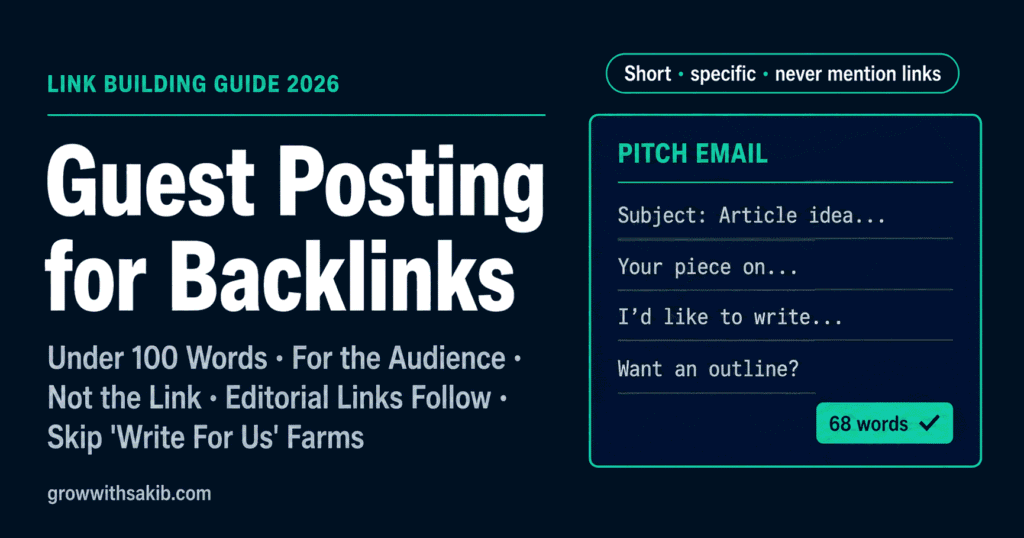
Guest posting works. But probably not for the reason you’ve been told – and if you chase it the way most guides teach, you’ll spend months earning links that Google quietly ignores. Let’s start with the part almost every guide leaves out, because it changes how you should approach everything that follows.
This is the full method behind Strategy 2 in the link building guide for beginners on GrowWithSakib – the operators, the qualification criteria, the pitch template, and the red flags.
What Google Actually Says About Guest Post Links
This is uncomfortable, and it’s the most valuable thing in this article. Google has been explicit about links in guest posts for over a decade:
The logic is simple once you see it. A backlink is supposed to be an editorial vote – someone chose to link to you. But in a guest post, you wrote the article and you placed the link. That’s a self-placed link, not a vote, which is why Google discounts it. It’s the same principle explained in the beginner’s guide to backlinks on GrowWithSakib: a referral you write yourself isn’t a referral.
So Is Guest Posting Still Worth Doing? Yes – For the Right Reasons
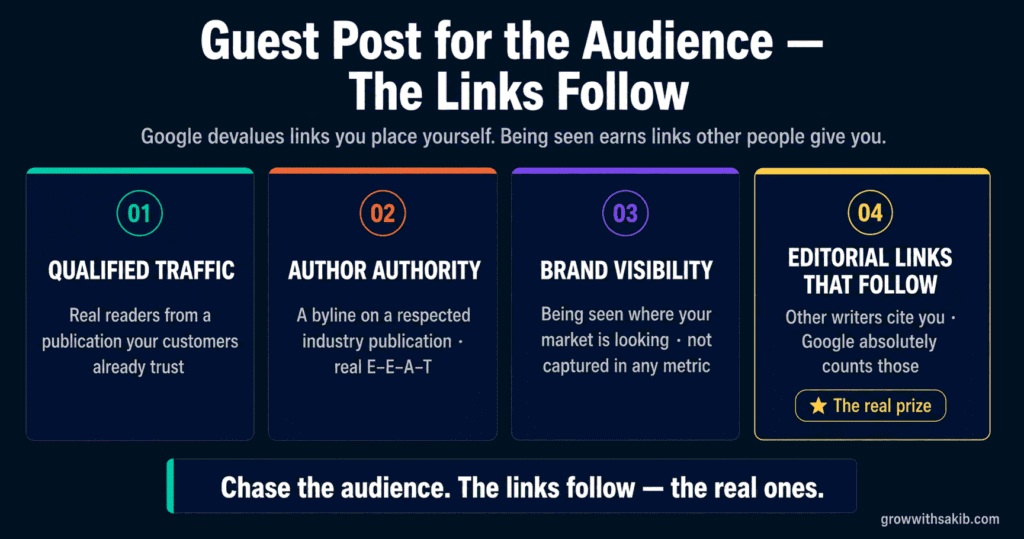
Notice what Mueller didn’t say. He didn’t say don’t guest post. He said it’s “fine to see it as a way of reaching a broader audience” – which is exactly where its value lies. Done properly, guest posting delivers four things that matter:
- Qualified referral traffic – real readers from a publication your customers already trust, arriving on your site ready to listen.
- Author authority and E-E-A-T – a byline on a respected industry publication is a credibility signal for humans and a real-world demonstration of expertise.
- Brand visibility – being seen where your market is looking, which no link metric captures.
- The editorial links that follow – this is the key. Other writers who read your piece may cite you in their articles, and those links are genuine editorial votes that Google absolutely does count.
Step 1: Find Guest Posting Targets
The standard advice is to run Google search operators to find “write for us” pages. These work – but understand what they find:
| Search Operator | What It Finds |
|---|---|
| [your niche] “write for us” | Sites openly soliciting contributors |
| [your niche] “guest post” OR “guest article” | Sites that publish guest content |
| [your niche] “contribute to” OR “become a contributor” | Publications with contributor programmes |
| [your niche] intitle:”write for us” | Dedicated submission pages |
| [your niche] inurl:guest-post-guidelines | Sites with formal editorial guidelines |
| [competitor name] “guest post by” | Where your competitors have been published |
Step 2: Qualify the Site Before You Pitch
Most beginners qualify sites by a Domain Authority number. That’s the wrong test – and remember, DA and DR are third-party tool scores, not Google metrics. Qualify like this instead:
| Check | How to Check It | What Good Looks Like |
|---|---|---|
| Does it have a real audience? | SimilarWeb or Ahrefs traffic estimate | Steady, genuine organic and direct traffic |
| Is it genuinely relevant? | Read it – would your customer read it? | Your buyers are in its readership |
| Are there real editors? | Named editorial team; consistent standards | Human editing, not auto-publishing |
| Is the content any good? | Read three recent posts | Original, well-edited, not spun filler |
| Do posts get engagement? | Comments, shares, citations elsewhere | Real readers, not an empty archive |
| Is the outbound link profile sane? | Ahrefs – who do they link out to? | Relevant sites, not casinos and loans |
The single best test is the simplest: would you be proud to have your name on this site? If the answer is no, no link metric can rescue it.
Red Flags: Sites and Deals to Walk Away From
| Red Flag | Why It’s a Problem |
|---|---|
| They charge a ‘publishing fee’ | That’s a paid link – Google’s spam policies apply |
| They promise a ‘dofollow link guaranteed’ | They’re selling links, not publishing content |
| They ask you to include exact-match anchor text | A clear manipulation pattern |
| The site publishes on wildly unrelated topics | A content farm, not a publication |
| No named editor and no editorial guidelines | Nobody is checking anything |
| Dozens of guest posts published per week | A link factory – Google knows the footprint |
| The site links out to gambling, loans, pharma | A bad neighbourhood; association is the risk |
| Traffic is near zero despite a high DA | The metric is inflated; the audience isn’t real |
| They accept your pitch instantly, unread | No editorial standard means no editorial value |
If a site hits two or more of these, walk away. A single link from a genuine publication beats fifty from farms – and the farms carry risk, since Google’s link spam policies treat paid and scaled article placements as link schemes.
Step 3: Write a Pitch Under 100 Words
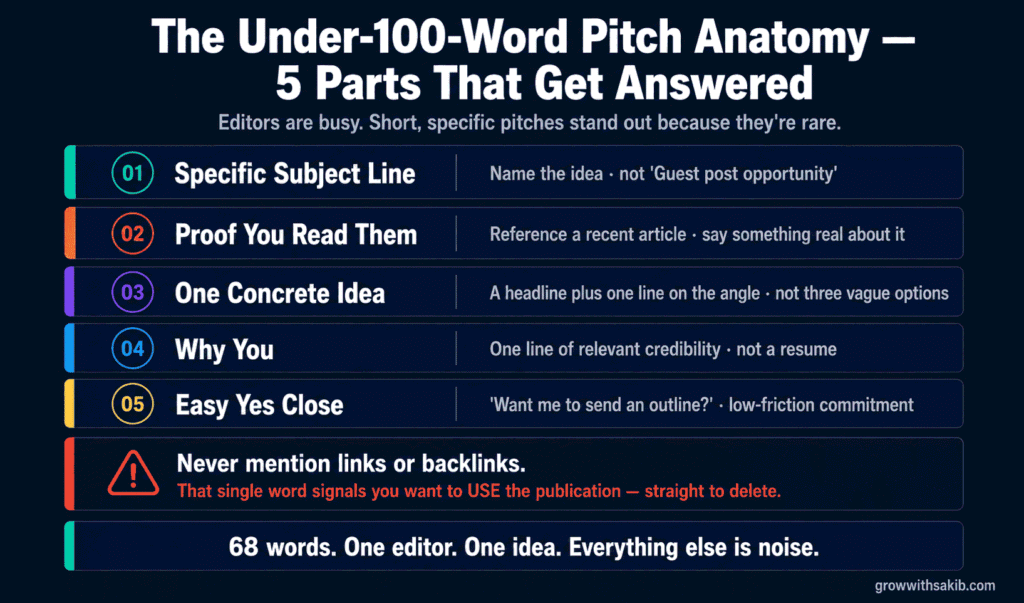
Editors are busy and their inboxes are full of generic requests. A short, specific, well-aimed pitch stands out precisely because it’s rare. Keep it under 100 words, and make it obvious you’ve actually read the publication.
The anatomy of a pitch that gets answered:
- A specific subject line – name the idea, not “Guest post opportunity.”
- Proof you read them – reference a specific recent article, and say something real about it.
- One concrete idea – a headline plus one line on the angle. Not three vague options.
- Why you – one line of relevant credibility, not a resume.
- An easy yes – a short, low-friction close.
The template (copy and adapt – never send it as-is):
| Subject: Article idea: [specific headline] Hi [Editor’s first name], Your piece on [specific recent article] made a point I keep seeing with my own clients – [one genuine, specific observation]. I’d like to write a follow-up for [Publication]: “[Proposed headline]” – [one line on the angle and what readers get from it]. I’m [one line: who you are and why you can write this]. Want me to send an outline? [Your name] [Your site] |
That’s roughly 70 words of body copy. Notice what it doesn’t contain: no flattery, no life story, no mention of backlinks, no attached 2,000-word article they didn’t ask for. Ask permission to send an outline – a tiny commitment is far easier to say yes to than a full draft.
Step 4: Write to the Publication’s Standard
Getting the yes is the beginning, not the finish. If you file thin, self-promotional copy, you’ll never be invited back – and you’ll have burned a relationship worth far more than one article.
- Match their format – read three of their pieces. Note the length, the tone, the heading style, whether they use data or stories. Then write like that.
- Give away your best material – the instinct is to hold back your real insight. Do the opposite. The piece that earns you traffic, invitations, and citations is the generous one.
- Bring something only you can – your data, your client examples, your contrarian take. Generic advice they can generate themselves in seconds is worthless to an editor.
- Don’t sell – one relevant, natural mention of your work is fine. A pitch dressed as an article gets cut or killed.
- File clean copy, on time – editors remember who made their job easy. That’s how one guest post becomes a standing column.
Step 5: Place Links Naturally and Honestly
Where links belong, and how to handle them without triggering anyone’s alarm:
| Placement | Guidance |
|---|---|
| In-content link to a genuinely useful resource | Best placement – it must earn its place for the reader |
| Author bio link to your homepage | Normal, expected, and uncontroversial |
| Exact-match commercial anchor text | Avoid – the clearest manipulation signal there is |
| Multiple links back to your own site | Avoid – one is a citation, three is an advert |
| Link to a sales or pricing page | Avoid – link to something that helps the reader |
Use natural, descriptive anchor text and link only where a reader genuinely benefits. And be relaxed about attribution: many respected publications nofollow contributor links as standard policy – Search Engine Land nofollows its own staff bylines. If a site nofollows your link, that is not a failure. You came for the audience, remember. The links that will actually move your rankings are the ones other people give you afterwards.
Honest Expectations
- Quality over quantity, always – three genuine placements a quarter beat thirty farm posts, which do nothing at best.
- Don’t pay for placement – a fee turns it into advertising. If you ever do, it must be marked rel=”sponsored” – which means no ranking benefit anyway.
- Expect nofollow, and be fine with it – judge the opportunity by the publication’s audience, as covered in the dofollow vs nofollow guide on GrowWithSakib.
- Measure the right things – referral traffic, enquiries, invitations to write again, and the editorial links that appear months later. Not the count of placements.
Common Guest Posting Mistakes
| Mistake | Why It Hurts | Do This Instead |
|---|---|---|
| Buying guest post packages | Paid links – a link scheme; links devalued | Earn placements on real publications |
| Targeting ‘write for us’ farms | The exact footprint Google devalues | Pitch real publications that never asked |
| Qualifying by DA/DR score | DA isn’t a Google metric; traffic may be fake | Check real audience and editorial standards |
| Mentioning links in your pitch | Signals you want to use, not contribute | Pitch the idea and the readers |
| Sending long, generic pitches | Deleted unread | Under 100 words, specific, clearly for them |
| Stuffing exact-match anchors | The clearest manipulation signal | Natural, descriptive anchors, used sparingly |
| Filing thin, self-promotional copy | Never invited back; relationship burned | Give away your best material |
Frequently Asked Questions
1. Does guest posting still work for SEO in 2026?
Yes, but not the way most guides claim. Google’s John Mueller has said links you place inside your own guest posts should be nofollowed and that Google devalues them algorithmically anyway – so guest posting purely to place links is largely wasted effort. What does work is guest posting to reach a real audience: it delivers qualified referral traffic, author authority, brand visibility, and – crucially – the genuine editorial links that other writers give you after reading your work.
2. Should guest post links be nofollow?
According to Google, yes. John Mueller stated that if you’re providing the content and the links, those links shouldn’t pass signals and should carry rel=”nofollow” or rel=”sponsored” – even when the link feels natural. The reasoning is that a backlink is meant to be an editorial vote, and a link you place in your own article is self-placed, not a vote. Many respected publications nofollow contributor links as standard – Search Engine Land nofollows even its own staff bylines.
3. How do I find guest posting opportunities?
Search operators are the starting point: [your niche] “write for us”, “guest post”, “contribute to”, intitle:”write for us”, and [competitor] “guest post by” to see where rivals have been published. But the best targets usually have no “write for us” page at all – a site openly soliciting strangers is often a content farm. Instead, list the publications your customers genuinely read, see where respected people in your industry have bylines, and pitch those even though they never asked.
4. How do I qualify a guest post site?
Don’t qualify by Domain Authority – it’s a third-party tool metric, not a Google ranking factor, and can be inflated. Check instead whether the site has a real audience (SimilarWeb or Ahrefs traffic estimates), whether it’s genuinely relevant to your customers, whether there are named editors and real editorial standards, whether recent posts are original and well-edited, and who the site links out to. The simplest test: would you be proud to have your name on it?
5. What should a guest post pitch email say?
Keep it under 100 words. Include a specific subject line naming your idea, proof you’ve actually read the publication (reference a recent article with a genuine observation), one concrete headline idea with a line on the angle, one line of relevant credibility, and a low-friction close like offering to send an outline. Never mention links or backlinks – that instantly signals you want to use the publication rather than contribute to it, and it’s the fastest route to deletion.
6. Is it safe to pay for a guest post?
Paying for placement turns the article into advertising, and Google’s spam policies treat paid links that pass ranking signals as a link scheme. If you do pay, the link must be marked rel=”sponsored” – which means it won’t pass ranking value anyway, so the SEO rationale disappears entirely. Guest post packages promising ‘DA 50+ sites, dofollow guaranteed’ are selling exactly the links Google devalues, and they put your name on low-quality content. Avoid them.
7. Where should I place my link in a guest post?
In two places at most: one in-content link to a genuinely useful resource on your site, where a reader actually benefits from clicking, and the standard author bio link to your homepage. Use natural, descriptive anchor text. Avoid exact-match commercial anchors (the clearest manipulation signal), multiple links back to your own site (one is a citation, three is an advert), and links to sales or pricing pages. Link to something that helps the reader, not something that sells.
8. How many guest posts should I write?
Far fewer than you think – quality decides everything here. Three genuine placements a quarter on publications your customers actually read will outperform thirty posts on content farms, which typically do nothing at all. Volume is also what makes a guest posting campaign look like a link scheme: publishing dozens of near-identical articles across unrelated sites is exactly the footprint Google’s algorithms were trained to detect. Aim for relationships with a handful of real publications instead.
Key Takeaways
- Google’s John Mueller has said links you place in your own guest posts should be nofollowed – and that Google devalues them algorithmically anyway.
- So don’t guest post to place links. Guest post to reach an audience: the traffic, authority, and editorial links that follow are the real return.
- The classic ‘write for us’ search operators find the worst targets – the best publications usually don’t advertise for contributors at all.
- Qualify sites by real audience, relevance, and editorial standards – never by a Domain Authority score, which isn’t a Google metric.
- Walk away from red flags: publishing fees, ‘dofollow guaranteed’, exact-match anchor requirements, unrelated topics, and no named editor.
- Keep your pitch under 100 words: a specific idea, proof you read the publication, one line of credibility, and an easy yes – never mention links.
- Write to the publication’s standard and give away your best material; that’s what earns repeat invitations and genuine citations.
- Place at most one natural in-content link plus an author bio link, use descriptive anchors, and be relaxed if the site nofollows them.