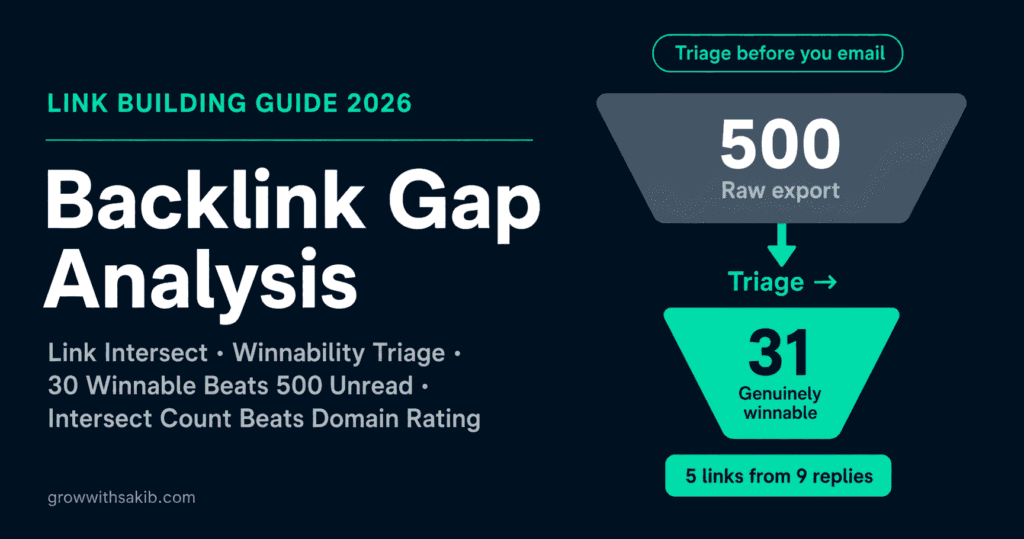
Most link prospecting is guesswork: you find sites that might link to you and hope. Gap analysis removes the hope. A site that already links to two of your competitors has publicly demonstrated it will link to a business exactly like yours, on exactly your topic. You’re no longer asking whether they link out – you know they do.
That makes it the highest-probability prospecting method there is. But it comes with a trap that almost every guide walks straight into, and we’ll deal with that first. This is the standalone strategy behind Step 4 of the backlink audit on GrowWithSakib – where gap analysis appears as a diagnostic step. Here it becomes a proactive campaign, and it’s part of the link building guide for beginners on GrowWithSakib.
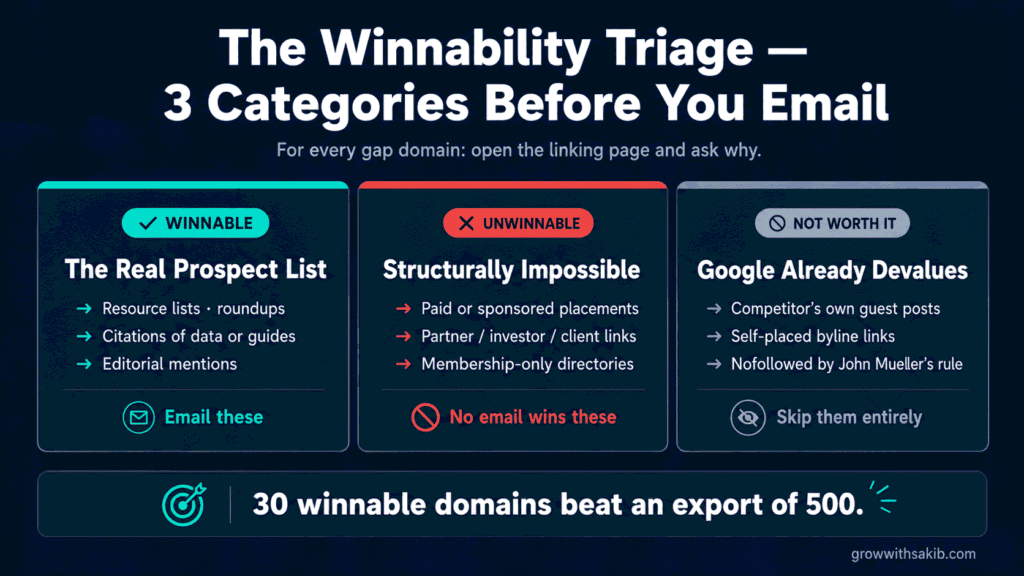
The Trap: A Link You Can See Is Not a Link You Can Win
Here’s what happens in a typical campaign. You run Link Intersect, export 500 domains, filter by Domain Rating, and email everyone. You get almost nothing back, and conclude that gap analysis doesn’t work.
It works. The list was just full of links that were never available to you. A domain linking to your competitor tells you they can link. It doesn’t tell you why they did – and the “why” is what determines whether you have any chance at all.
Step 1: Choose the Right Competitors
Get this wrong and everything downstream is wasted. The mistake is entering whoever outranks you – but a SERP rival is not always a business competitor. A large industry publication may outrank you for your keywords while pursuing an entirely different goal; its links come from being a publisher, and you’ll never replicate them.
- Pick businesses like yours – same model, same customers, comparable size. Their links are the ones you could plausibly earn.
- Use both domain-level and page-level competitors – the site that outranks you overall, and the specific pages that outrank your specific pages. Page-level rivals often reveal the most replicable links.
- Choose three or four – both Ahrefs and Semrush compare you against up to four competitors at once. More than that and the intersect signal gets noisy.
- Prefer competitors slightly ahead of you – a rival two steps ahead has links you can realistically get. A market leader’s links often came with a budget or a brand you don’t yet have.
Step 2: Run the Analysis
In Ahrefs: Link Intersect
- Open Link Intersect from the top navigation.
- Enter three or four competitor domains in the top fields, and YOUR domain in the ‘But doesn’t link to’ field.
- Run it. Ahrefs returns every referring domain linking to them but not to you.
- Sort by intersect count – how many of your competitors each domain links to.
- Click through to see the referring page and anchor text. This is the step that matters; it’s where you’ll do the triage.
In Semrush: Backlink Gap
Semrush’s Backlink Gap tool does the same job and lets you compare up to five domains at once (yours plus four rivals). Its filters are genuinely useful, and its own documentation defines them:
| Filter | What It Shows You | Use It For |
|---|---|---|
| Best | Domains linking to ALL your competitors but not you | Your highest-priority prospects – start here |
| Weak | Domains linking to you less than to competitors | Existing relationships worth deepening |
| Shared | Domains linking to everyone including you | Confirms you’re in the right neighbourhood |
| Strong | Domains linking only to you | Your moat – protect these |
| Unique | Domains linking to only one competitor | Often event-specific or partner links – usually unwinnable |
Step 3: Prioritise Properly (Not by Domain Rating)
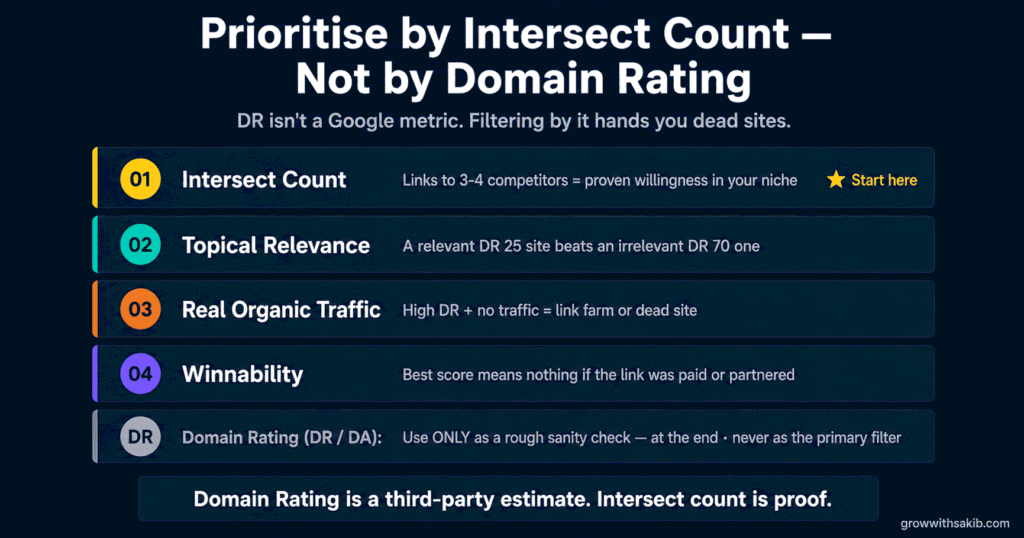
Every other guide says “filter by DR 30+.” Resist it. As the beginner’s guide to backlinks on GrowWithSakib explains, Domain Rating and Domain Authority are third-party tool metrics, not Google ranking factors. Filtering by them alone will hand you dead sites with inflated scores and discard genuinely valuable niche publications.
Prioritise on four things instead, in this order:
| Priority Factor | Why It Beats a DR Filter |
|---|---|
| 1. Intersect count | Links to 3-4 of your competitors = proven, repeated willingness to link in your niche |
| 2. Topical relevance | A relevant DR 25 trade site beats an irrelevant DR 70 general one, every time |
| 3. Real organic traffic | A high-DR site with no traffic is often a link farm or a dead site. Check it has actual readers |
| 4. Winnability | The best-scoring domain in the world is worthless if the link was paid for or came from a partnership |
Use DR as a rough sanity check at the end, not as your primary filter. The order above is what converts.
Step 4: Outreach That Makes the Link Make Sense
Gap outreach has one enormous advantage over cold outreach: you know, for a fact, that this site covers your topic and links out. Your email should use that knowledge visibly – it’s the difference between a stranger asking for a favour and a relevant source completing a picture.
| Subject: Your [specific topic] piece Hi [Name], I was reading your [specific article] – you link out to [Competitor] in the section on [specific point]. We work in the same space, and we’ve published [YOUR resource] which covers [the ONE thing yours adds: your own data / a free tool / the angle they didn’t cover]: [URL] If it’s useful for that piece, feel free to include it. If not, no problem at all. [Your name] |
Be realistic about the numbers. Backlinko’s study with Pitchbox of 12 million outreach emails found only about 8.5% receive any reply at all – and a reply is not a link. The same study found a single follow-up produces roughly 65% more replies, so send one, about a week later, and then stop.
How Often Should You Run It?
- Quarterly is enough – link profiles don’t change fast. A quarterly run catches new domains your competitors have picked up since last time.
- Re-run when a competitor surges – if a rival suddenly jumps in the rankings, a gap analysis often shows you exactly what they did.
- Run it before any campaign – it tells you which content earns links in your niche, which should shape what you build next.
- Track the winnable list, not the export – your prospect sheet should contain triaged, qualified domains only. That list is a compounding asset.
Common Backlink Gap Analysis Mistakes
| Mistake | Why It Hurts | Do This Instead |
|---|---|---|
| Emailing the raw export | Most ‘gaps’ are structurally unwinnable | Triage every domain: why did they link? |
| Filtering by DR alone | DR isn’t a Google metric; hides dead sites | Intersect count, relevance, real traffic, winnability |
| Chasing guest-post gaps | Self-placed links are devalued by Google | Skip them – they’re not worth winning |
| Picking SERP rivals as competitors | Publishers’ links can’t be replicated | Choose businesses like yours |
| Never opening the linking page | The context IS the qualification | Read the page; find what earned the link |
| Suggesting they replace a competitor | Makes editors defensive | Offer an addition, and name what you add |
| Expecting high conversion | ~8.5% of outreach emails get any reply | Send one follow-up, then move on |
Frequently Asked Questions
1. What is a backlink gap analysis?
A backlink gap analysis compares your backlink profile against your competitors’ to find referring domains that link to them but not to you. Those domains are your highest-probability prospects, because they’ve already publicly demonstrated they’ll link to a business like yours on your topic. You run it with Ahrefs’ Link Intersect or Semrush’s Backlink Gap tool by entering your domain alongside three or four competitors and filtering for the domains you’re missing.
2. How do I do a backlink gap analysis in Ahrefs?
Open Link Intersect from the top navigation, enter three or four competitor domains in the top fields, and put your own domain in the ‘But doesn’t link to’ field. Ahrefs returns every referring domain that links to them but not you. Sort by intersect count – the number of your competitors each domain links to – then click through to see the actual referring page and anchor text. That last step matters most: the context of the link is what tells you whether you can win it.
3. Which gap opportunities can I actually win?
Open the page containing each link and work out what earned it. Winnable: resource lists and roundups, citations of the competitor’s data or guides, genuine editorial mentions, supplier or stockist pages you’d also qualify for, and broken or outdated links you could replace. Unwinnable: paid placements, partner or investor relationships, press coverage of a specific event like a funding round, and directories requiring a membership you don’t have. Triage before you email.
4. Should I prioritise gap links by Domain Rating?
No. Domain Rating and Domain Authority are third-party tool metrics, not Google ranking factors, and filtering by them alone hands you dead sites with inflated scores while discarding valuable niche publications. Prioritise instead by intersect count (links to three or four competitors proves repeated willingness to link), topical relevance, real organic traffic, and winnability. Use DR only as a rough sanity check at the very end.
5. Are competitor guest post links worth chasing?
Generally no. If the gap link came from a guest post your competitor wrote themselves, it’s a self-placed link – and Google’s John Mueller has said links you place in your own guest posts should be nofollowed and are largely ignored algorithmically. Replicating a link that Google devalues is effort spent for nothing. Spend that time on genuine editorial gaps instead: resource pages, roundups, and citations, where the site owner places the link on their own judgement.
6. What is the difference between Ahrefs Link Intersect and Semrush Backlink Gap?
They do essentially the same job with different interfaces. Ahrefs’ Link Intersect shows domains linking to competitors but not you, with an intersect count showing how many competitors each links to. Semrush’s Backlink Gap compares up to five domains at once and adds useful filters: ‘Best’ shows domains linking to all your competitors but not you – the highest-priority prospects – while ‘Shared’ and ‘Strong’ show your existing overlap and your unique links. Either works; use whichever you already pay for.
7. How do I write outreach for a gap link?
Reference their existing coverage explicitly: ‘I was reading your piece on X – you link out to [Competitor] in the section on Y.’ That proves you read the page. Then name the one specific thing your resource adds that theirs doesn’t – your own data, a free tool, an angle they missed. Never suggest they remove the competitor’s link; you’re offering an addition, not a replacement. Give them an easy no, and send exactly one follow-up a week later.
8. How often should I run a backlink gap analysis?
Quarterly is enough for most businesses, since link profiles don’t change quickly. Also re-run it whenever a competitor suddenly surges in the rankings – a gap analysis often reveals exactly what they did – and before launching any link building campaign, because it shows which content actually earns links in your niche. Keep a running sheet of triaged, winnable domains rather than raw exports; that qualified list compounds in value over time.
Key Takeaways
- A backlink gap analysis finds domains that link to your competitors but not you – the highest-probability prospects in link building, because they’ve already proven they link in your niche.
- Run it with Ahrefs’ Link Intersect or Semrush’s Backlink Gap tool, comparing your domain against three or four competitors.
- The export is the easy part. The step that decides everything is winnability: WHY did they link, and can you replicate that reason?
- Unwinnable gaps include paid placements, partner and investor links, funding-round press, and membership directories – no email will win them.
- Skip guest-post gaps entirely: Google devalues self-placed links, so replicating one is effort spent for nothing.
- Don’t prioritise by Domain Rating – it’s a third-party metric, not a Google factor. Use intersect count, relevance, real traffic, and winnability.
- Semrush’s ‘Best’ filter (domains linking to ALL competitors but not you) is the single highest-value list you can generate.
- In outreach, reference their existing coverage, name the one thing you add, and never ask them to replace a competitor – you’re an addition, not a replacement.